
Carbs in Egg: Your 2026 Keto Guide

If you're keeping a close eye on your carbs, you can relax when it comes to eggs. The short answer is that they contain next to nothing.
A single large egg has just 0.6 grams of carbs, making it a true staple for anyone on a low-carb or ketogenic diet. You can add them to your daily meals without a second thought about your carb budget.
Your Quick Guide to Carbs in an Egg
When you’re tracking macros, you need numbers you can trust. Whether you’re logging meals in an app, planning your keto-friendly recipes, or just trying to be more mindful, it helps to know the exact breakdown.
The great news is that no matter how you prepare them, the carb count in eggs is consistently negligible.
A single large cooked egg contains only about 0.6 grams of total carbohydrates. And since it has zero fiber, the net carb count is exactly the same. This figure is backed by reliable nutrition databases, like the one you can find on CarbManager, so you can log it with confidence.
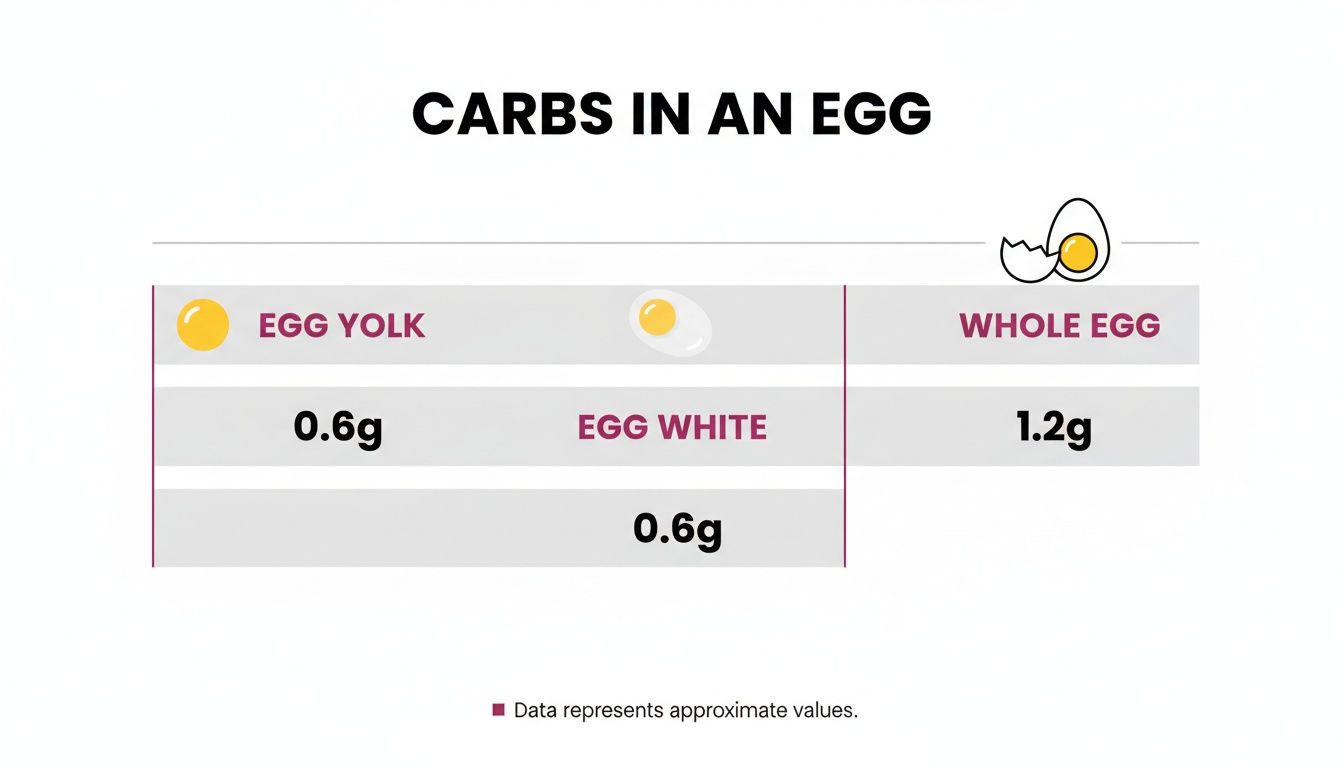
As you can see in the graphic, those trace carbs are split between the yolk and the white. To make logging even more precise, here’s a quick-reference table that breaks it down by egg size.
Carbohydrate Content of Eggs by Size and Part
Think of this table as your cheat sheet for meal tracking. It shows the approximate carbohydrate count for different egg sizes and their components, providing a quick nutritional reference.
| Egg Part/Size | Approximate Grams of Carbs |
|---|---|
| Small Egg (38g) | 0.4 g |
| Medium Egg (44g) | 0.5 g |
| Large Egg (50g) | 0.6 g |
| Extra-Large Egg (56g) | 0.6 g |
| Jumbo Egg (63g) | 0.7 g |
| Egg White (Large) | 0.2 g |
| Egg Yolk (Large) | 0.3 g |
As you can see, the differences from one size to the next are incredibly small.
Ultimately, whether you're making an egg-white omelet or enjoying a rich, whole-egg scramble, you're choosing a food that’s almost entirely protein and healthy fats—not carbs.
Why Eggs Are a Low Carb Powerhouse
The reason eggs have practically nonexistent carbs is fascinating, and it all comes down to their biological purpose. An egg isn't a snack for a hen; it's a self-contained incubator designed to build an entirely new life from scratch.
Think of it as nature's perfect construction kit.
Its main ingredients are high-quality protein and healthy fats. The protein acts as the literal building blocks for the developing chick—forming everything from its muscles to its feathers. The fat provides a rich, slow-burning fuel source to power that growth over the entire incubation period.
An egg's job is to build life, not to provide the quick-burning fuel that carbohydrates offer. This biological mission is precisely why it is packed with protein and fat, leaving almost no room for carbs.
This makes an egg's nutritional makeup a world away from plants, which often store their energy as carbohydrates like sugars and starches. An egg is playing a different game entirely—one focused on long-term construction and sustained energy, not short-term fuel.
That’s exactly why eggs are a cornerstone food for anyone looking to maintain stable energy and support muscle growth without the blood sugar roller coaster that carbs can cause. They are, by their very design, a protein-and-fat-delivery system. Their near-zero carb count isn't a coincidence—it's essential to their function.
Exploring the Complete Nutritional Value of an Egg
It’s easy to focus on the near-zero carbs in an egg, and for good reason—they're a fantastic choice for anyone watching their carb intake. But looking only at the carbs is like judging a book by its first page. The real story is that eggs are one of nature's most nutrient-dense foods, packed with high-quality protein and a surprising range of vitamins and minerals.
Think of an egg as a perfect package of complete protein. This means it delivers all nine essential amino acids your body can't make on its own. These are the critical building blocks for everything from repairing muscle to producing hormones. The yolk also provides healthy monounsaturated fats, the same kind you find in olive oil, which are great for your heart.
More Than Just Protein and Fat
The nutritional benefits don't stop there. Eggs are a true powerhouse of micronutrients, many of which can be tricky to get enough of from your daily diet. Just one egg gives you a solid dose of:
- Vitamin D: Often called the "sunshine vitamin," it's vital for strong bones and a healthy immune system.
- Choline: A game-changer for brain health, supporting memory and nerve function.
- Selenium: This powerful antioxidant acts like a bodyguard for your cells, protecting them from damage.
This potent mix of protein, healthy fats, and micronutrients is precisely why an egg keeps you feeling full and satisfied. It provides steady, reliable energy, helping you avoid the dreaded energy spikes and crashes that come with high-carb meals.
Here's a concept that really highlights why eggs are so special: the glycemic index (GI). This scale measures how quickly a food raises your blood sugar, and eggs have a GI of zero. That means they have virtually no impact on your blood sugar levels.
This zero-GI quality makes them an ideal food for maintaining stable energy and keeping hunger at bay. The data backs this up: 100 grams of egg contains just 1.1g of total carbs and has an insulin index of only 23, confirming its gentle effect on your system. At the same time, you're getting over 12g of protein and 28% of your daily selenium, a combination that promotes both fullness and overall health. You can dig even deeper into the numbers on Foodstruct.com.
How Cooking Methods Can Change Your Meal's Carb Count
I get this question all the time: does frying an egg magically add carbs? It's a great question, and the answer is a simple 'no'.
Cooking a plain egg—whether you boil it, poach it, scramble it, or fry it in a zero-carb oil like avocado oil—doesn't alter its carbohydrate content. The carbs in an egg are stable because heat alone can't create new carbohydrates.
So, where does the confusion come from? It’s not about how you cook the egg, but what you add to it. A plain egg is a fantastic, virtually carb-free starting point. The moment you introduce other ingredients, however, the nutritional math starts to change.
A simple fried egg has just 0.6 grams of carbs. But that's just the beginning of the story.
Where Hidden Carbs Come From
The extras are what you need to keep an eye on. Even small, seemingly harmless additions can pile up, which really matters if you're following a strict low-carb or keto lifestyle.
- Scrambled Eggs: That splash of milk for fluffiness adds carbs. A single tablespoon of whole milk brings in about 0.8 grams, but if you pour in half a cup, you've just added nearly 6 grams of carbs to your breakfast.
- Omelets: Fillings are the biggest variable here. Cheese is generally a safe bet, but tossing in onions, bell peppers, or especially starchy vegetables like potatoes can send the carb count way up.
- Breadings and Coatings: Making something like a Scotch egg? The breadcrumbs are almost pure carbohydrate, completely changing the final numbers.
- Sweet Preparations: When you're whipping up a meringue, the sugar you beat into the egg whites is all carbohydrate. This transforms the food's profile from low-carb to high-carb in an instant.
The egg itself won't derail your low-carb goals—it's one of the most reliable foods you can eat. The real responsibility lies with the company it keeps. Pay attention to what you're adding, and you can be sure your delicious egg meals stay perfectly aligned with your health goals.
If you're following a low-carb or keto lifestyle, you probably already know that eggs are a staple. But they're so much more than just a quick breakfast—they're one of the most reliable and versatile foods in your corner. Because the carbs in an egg are practically nonexistent, they offer a fantastic foundation for meals that keep you on track without making you feel like you're missing out.
What really makes them a powerhouse is their combination of high-quality protein and healthy fats. This duo is the secret to satiety, that feeling of being full and satisfied long after you've eaten. Honestly, this is the biggest win for most people. When you can keep cravings at bay, sticking to your goals becomes a whole lot easier.
Putting Eggs to Work in Your Diet
So, how do you make them a regular part of your routine? The beauty of eggs is that you don't need a complicated plan. They fit into any meal, helping you hit your macros without ever worrying about getting kicked out of ketosis.
Here are a few of the simple, go-to ways I use them:
- A Power Breakfast: Two eggs fried in butter alongside half an avocado. It’s packed with healthy fats and protein to fuel your morning.
- The Easiest Snack: I boil a dozen eggs at the start of the week. They become the perfect grab-and-go snack for those busy afternoons when you're tempted to reach for something less healthy.
- A Quick Lunch Upgrade: Tossing a couple of sliced hard-boiled eggs on a big salad adds the protein needed to turn it from a light side into a truly satisfying meal.
With people around the world eating 90 million tons of eggs every year, their impact is huge. Yet, with less than 1% of your daily value of carbs per serving, they're a tiny blip on the carb-counting radar. For someone on a 2,000-calorie diet, the carbs in a single egg make up less than 0.1% of their daily needs. This frees you up to focus on your overall eating patterns instead of obsessively counting every last gram.
Ready to see just how versatile they can be? Eggs are the perfect base for so many simple and delicious dishes. To get your creativity flowing, check out these 10 Easy Weeknight Meals Low Carb Busy Cooks Will Love.
Frequently Asked Questions About Carbs in Eggs
Now that we’ve covered the basics, let’s tackle some of the common questions that pop up when talking about the carbs in eggs.
Do Brown and White Eggs Have the Same Carb Count?
Yes, they absolutely do. The color of an egg's shell just tells you the breed of the hen that laid it—it has zero impact on the nutritional value inside.
Whether you prefer brown, white, or even blue eggs, they are all fantastic, virtually carb-free choices. This same principle applies to other curiosities, like whether the eggs we eat are fertilized, which also doesn't change the carb count.
How Many Eggs Can I Eat on a Keto Diet?
There’s no hard and fast rule here, since it really depends on your personal daily carb and calorie goals.
That said, because the carbs in an egg are so incredibly low, most people following a ketogenic lifestyle can comfortably enjoy 2-4 eggs a day without getting anywhere near their carb limit.
Are There Hidden Carbs in Eggs?
In a natural, whole egg? Nope. What you see on the nutrition label is what you get.
"Hidden" carbs only become a concern when you venture into processed egg products. Things like liquid egg substitutes, pre-made omelets, or fast-food egg patties can sometimes have starches or sugars added for texture or flavor. Your best bet is to always glance at the nutrition label on anything that isn't a simple, whole egg.
The yolk contains slightly more of the egg's total carbs, around 0.3 grams, while the white has about 0.2 grams. For all intents and purposes, both parts are so low in carbs that the difference is negligible.
Knowing the numbers is one thing, but truly understanding your eating habits is where the magic happens. A tool like Superbloom can help you move beyond simple carb counting to see the bigger picture. By tracking your meals, you can start to recognize patterns, build healthier routines, and foster a better relationship with food. Learn more at https://superbloomapp.com.