
Carbs in Soy Milk: A Complete Guide for 2026
You’re standing in the grocery aisle, coffee plan in one hand, shopping basket in the other, staring at soy milk cartons that all look healthy. One says unsweetened. Another says original. Another says vanilla. The front of the package feels reassuring, but the carb story can be very different.
That small choice often matters more than many realize. Not because you need to obsess over every gram, but because the carbs in soy milk can shape how steady you feel after breakfast, how hungry you are by midafternoon, and whether a “healthy” latte turns into a craving spiral later in the day.
Many people get stuck here. They want to eat in a more balanced way, but they’re tired of rigid food rules. They do not want another lecture about restriction. They want clarity. They want to know what helps them feel stable, what throws them off, and how to make grocery decisions that support real life.
That is where soy milk becomes a useful example. It is not just a milk substitute. It is a daily habit, often repeated in coffee, smoothies, cereal, and quick breakfasts. When a food shows up that often, understanding it can have an outsized effect on your routines.
Why The Carbs in Your Soy Milk Matter More Than You Think
A client once told me she “always bought the healthy soy milk,” but she could not understand why some mornings felt smooth and other mornings ended with a snack raid by noon. When we looked closer, the issue was not soy milk itself. It was the difference between versions.
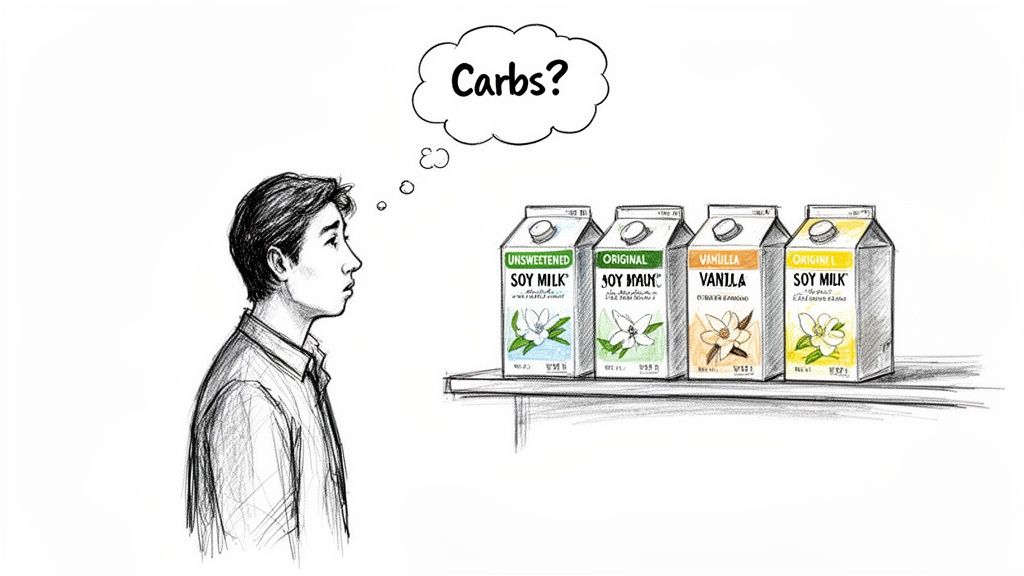
Small label differences can create very different days
“Unsweetened,” “original,” and flavored cartons can look like minor variations. In practice, they can lead to very different eating experiences.
If your morning drink includes a version with more added sugar, you may feel satisfied at first, then more snacky later. If you choose a lower-carb version with a steadier nutrition profile, your morning may feel less reactive. That does not mean one carton is morally good and another is bad. It means your body notices patterns, even when your brain files the choice under “just milk.”
Carbs are not the enemy. Confusion is
Many individuals do not need more food fear. They need a better lens.
A useful question is not, “How do I remove every carb?” It is, “What kind of carb load am I getting from this carton, and how does that affect my energy, appetite, and habits?”
A food choice becomes more powerful when you connect it to a lived result, like steadier mornings or fewer late-day cravings.
That mindset changes everything. Instead of chasing perfect eating, you start building awareness. And awareness is what makes habits sustainable.
Unpacking the Carbohydrates in Unsweetened Soy Milk
Unsweetened soy milk is the best starting point because it gives you a clean baseline. It shows what soy milk looks like before added sugar changes the picture.
Per Strongr Fastr’s soy milk nutrition entry, unsweetened soy milk provides approximately 4g of total carbohydrates per 1-cup (240mL) serving, with around 2g fiber, leaving about 2g net carbs.
What total carbs and net carbs mean
Total carbs include everything in the carbohydrate category. Net carbs subtract fiber, because fiber is not digested the same way as sugars and starches.
Here's a simple way to conceptualize it:
- Total carbs are the whole package
- Fiber is the part that slows things down
- Net carbs are the part more relevant to immediate blood sugar impact
That matters because fiber can make a food feel steadier.
Why unsweetened soy milk often feels more stable
Think of fiber like a speed bump. Without it, carbs move through faster. With it, digestion slows down.
In unsweetened soy milk, the carb content is relatively modest, and part of it comes with fiber. That combination is one reason many people find it easier to fit into a routine that supports calmer energy instead of sharp swings.
What this means in daily life
If you add unsweetened soy milk to coffee, a smoothie, or chia pudding, you are usually starting from a lower-carb foundation than you would with a sweetened carton. That does not automatically make the whole meal low carb, of course. A smoothie with fruit juice, sweetened yogurt, and flavored soy milk can still add up fast.
What unsweetened soy milk does give you is breathing room.
Here are a few practical ways to use that breathing room:
- Morning coffee: If you already enjoy a sweet breakfast, using unsweetened soy milk can keep the drink from becoming an extra sugar source.
- Smoothies: It helps you choose where the sweetness comes from. Maybe from fruit, not from both fruit and the liquid base.
- Savory cooking: In soups or sauces, unsweetened soy milk usually fits better because it does not bring surprise sweetness.
If you are trying to understand food patterns, start with the version that gives you the least noise. Unsweetened soy milk often does that.
One more helpful point. Low-carb does not mean flavorless. Many people adjust quickly once they stop expecting every milk alternative to taste sweet on its own.
Sweetened vs Unsweetened Soy Milk A Carb Comparison
The biggest shift in carbs in soy milk usually comes from added sugar, a factor that often trips up shoppers because “soy milk” sounds like one category when it is really several.
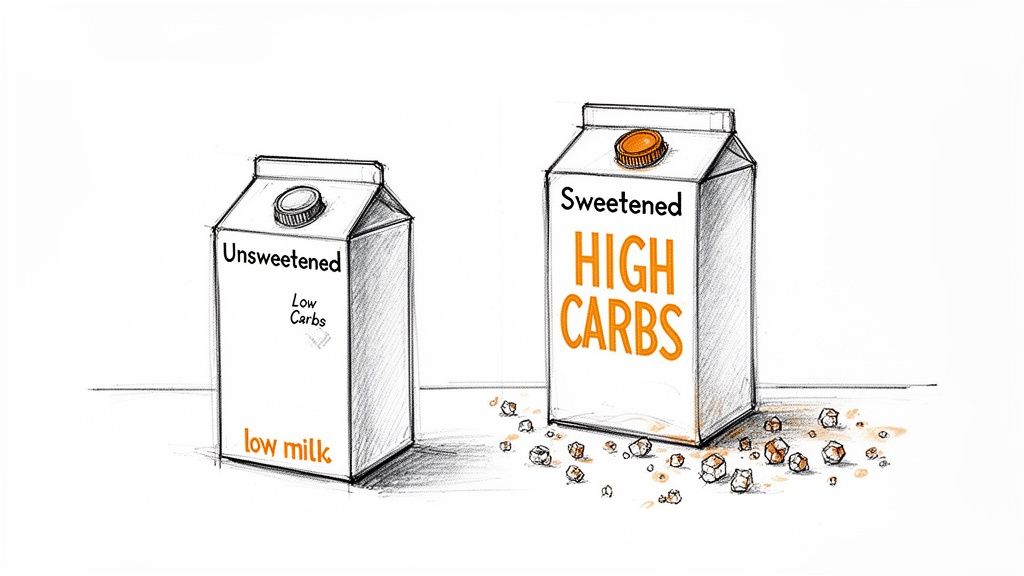
According to Carb Manager’s entry for sweetened soy milk, sweetened soy milk averages 13 to 15.3 grams of carbohydrates per cup, and 9.7 grams of sugars account for 87% of its carb load.
Why this difference matters in real life
That jump is not trivial. It can turn a low-carb add-on into a more significant source of sugar, especially if you use soy milk more than once a day.
A common example is the double dip:
You pour soy milk into coffee in the morning, add it to cereal later, and blend it into a smoothie after work. If the carton is sweetened, you may be stacking added sugar without realizing it.
For some people, that shows up as:
- a stronger desire for something sweet later
- more grazing between meals
- a harder time telling whether they are physically hungry or just reacting to an energy dip
The label words to watch
Front labels are often more about marketing than clarity. “Original” does not always mean low sugar. “Vanilla” often signals sweetness. “Unsweetened” is usually the clearest term if your goal is to keep carbs lower.
A quick label check can help:
- Find the serving size: Compare cartons using the same serving amount.
- Scan total carbohydrates: This gives you the broad picture.
- Look at sugars: This can reveal whether sweetness is coming from additions rather than the soy base.
- Check the ingredient list: If sugar or syrup appears early, the carton is likely sweeter than the branding suggests.
A short visual can make this easier to spot while shopping.
The behavior piece people miss
The point is not to fear sweetened soy milk. Some people enjoy it and feel fine with it. The better question is whether it supports the kind of day you want.
If a sweetened latte leaves you hunting for biscuits by midafternoon, that is useful information. If unsweetened soy milk in the same routine helps you feel more even, that is useful too.
Food awareness works best when you stop arguing with your own patterns and start observing them.
How Soy Milk Carbs Stack Up Against Other Milks
Soy milk makes more sense when you compare it with what it often replaces. The most useful comparison is not “Is soy milk good?” It is “Compared with my other usual options, what am I getting?”
Based on Foober’s comparison of soy milk carbs, unsweetened soy milk contains 1.6 grams of total carbohydrates per cup, while low-fat cow’s milk contains 12 grams per cup, which is over 86% fewer carbs.
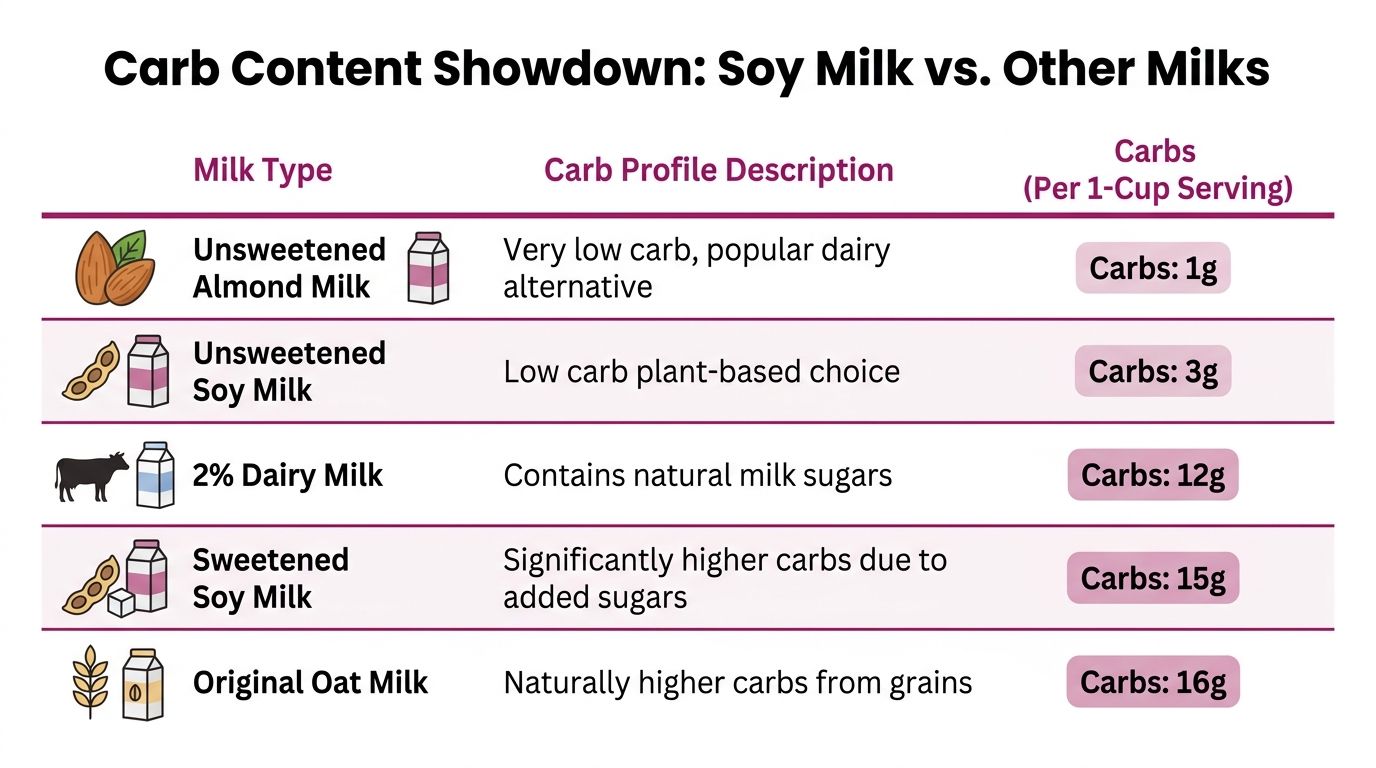
Milk comparison per cup 240ml
| Milk Type | Total Carbs (g) | Sugar (g) | Protein (g) |
|---|---|---|---|
| Unsweetened soy milk | 1.6 | Not specified | Not specified |
| Sweetened soy milk | 13 to 15.3 | 9.7 | 7.9 |
| 2% or low-fat cow's milk | 12 | Not specified | Not specified |
| Unsweetened almond milk | Not specified | Not specified | Not specified |
| Oat milk | Not specified | Not specified | Not specified |
How to read this table without overcomplicating it
The table has blanks because reliable numbers were not available here for every category. That is okay. You do not need a perfect spreadsheet to make a better choice.
A few practical takeaways stand out:
- If your priority is lower carbs: unsweetened soy milk is clearly different from sweetened soy milk and lower-fat cow’s milk.
- If your priority is avoiding hidden sweetness: the split between unsweetened and sweetened soy milk is more important than the fact that both are called soy milk.
- If your priority is balance: sweetened soy milk still offers protein, but the added carb load changes how it may fit into your day.
What this means for common goals
Someone making a post-workout smoothie may care about protein and be comfortable with a sweeter option. Someone trying to reduce reactive snacking may prefer the steadier profile of an unsweetened carton.
Neither choice lives in a vacuum. A milk choice works best when it matches the rest of the meal.
Do not judge soy milk by category alone. Judge the carton in your hand and the role it plays in your routine.
That habit is far more useful than memorizing a list of “good” and “bad” milks.
Practical Tips for Choosing the Right Soy Milk
Soy milk shopping gets easier when you stop trusting the front of the carton and start using a short personal filter.
Per Orasi’s soy milk nutrition overview, sweetened or original soy milk varieties can range from 4 to 15g of carbs per serving, which is exactly why shoppers often feel confused.
A simple store checklist
Take five extra seconds and check these in order:
- Start with the word unsweetened: If you want lower carbs in soy milk, this is usually the fastest shortcut.
- Look at total carbs per serving: Ignore vague front-of-pack claims and go straight to the panel.
- Check whether sugars are doing most of the work: A carton can sound wholesome and still be much sweeter than you expect.
- Keep the ingredient list short when possible: Fewer extras often make it easier to understand what you are drinking.
Match the soy milk to the job
The best carton depends on how you use it.
For coffee, many people do well with unsweetened soy milk because the drink may already have flavor from espresso or cinnamon. For smoothies, it helps to pick one sweetness source. If banana or berries are already in the blender, the base often does not need to be sweet too.
For breakfast bowls or overnight oats, pause and ask one question: “Is this milk adding balance or just more sweetness?” That one question can prevent the layered-carb effect that makes a meal feel much heavier than expected.
Avoid the consistency trap
One brand’s “original” can feel very different from another’s. If you are trying to understand your own habits, consistency helps.
Buy the same carton for a couple of weeks. Use it in the same situations. Notice what changes.
That gives you cleaner feedback than rotating between vanilla, original, barista blend, and sweetened cartons and then trying to decode your appetite from memory.
Using Superbloom to Understand Your Soy Milk Habits
Nutrition facts become useful when they connect to your day. Otherwise, they stay abstract.

According to Blue Circle Foundation’s page on unsweetened soy milk, low-carb unsweetened soy milk at 1.6 to 4g carbs per serving provides stable energy, and tracking it may help people understand how it interacts with stress eating because its low glycemic index may blunt carb cravings after stress.
Turn one habit into useful feedback
If soy milk is part of your routine, log it the same way you would log any repeating food. A coffee order, a breakfast smoothie, an afternoon protein shake. Repeated choices tell the clearest story.
Then look for patterns such as:
- Morning choice and afternoon appetite: Did a sweeter soy milk drink line up with more snacking later?
- Stress days: Did you reach for flavored or sweetened versions more often when you felt rushed or drained?
- Gut comfort: Did some cartons sit better than others?
Better questions lead to better habits
Instead of asking, “Is soy milk healthy?” ask more specific questions:
- Did this version keep me full?
- Did it make my breakfast feel balanced?
- Did it support a calmer day or a more reactive one?
Those questions move you out of diet mode and into pattern recognition. That is where sustainable change usually starts.
When you track one small recurring choice, like the soy milk in your coffee, you often uncover a much bigger pattern around stress, convenience, or cravings.
Frequently Asked Questions About Soy Milk and Carbs
Is unsweetened soy milk low carb
Usually, yes. The key detail is the word unsweetened. The verified nutrition data in this article shows that unsweetened soy milk can be much lower in carbs than sweetened versions.
Is soy milk okay for a lower-carb eating style
It can be, especially when you choose an unsweetened carton and pay attention to the rest of the meal. A latte made with unsweetened soy milk is different from a smoothie made with sweetened soy milk, fruit juice, and sweetened granola on the side.
Why do different websites list different carb numbers
Brand formulas vary. Serving sizes vary too. Some databases list one type of soy milk, while others list another. That is why the carton in your fridge matters more than a generic average.
Does flavored soy milk usually have more carbs
Often, yes. Vanilla and original styles are common places where added sugar shows up. The nutrition panel will tell you more than the front label.
Can soy milk affect cravings
For some people, yes. A lower-carb, unsweetened version may feel steadier, while a sweeter version may fit less well if you are sensitive to energy swings or stress-driven snacking. The most useful answer comes from watching your own pattern over time.
What if soy milk bothers my stomach
That can happen. Some people tolerate soy well. Others notice digestive discomfort with certain brands or formulations. If that sounds familiar, simplify. Try one carton consistently, notice how you feel, and adjust from there.
If you want help turning small food choices into clear personal insights, Superbloom can help. You can log meals, notice patterns around cravings and stress, and get guidance that supports steady habits without strict dieting or calorie counting.