
Your Guide to the Perfect Daily Food Journal Template
Let's be honest, the term "food journal" often brings to mind tedious calorie counting and a sense of restriction. But what if we thought about it differently? Instead of a rulebook, picture it as your personal health detective—a tool for figuring out the real story behind what you eat and how it makes you feel.
Your Food Journal is a Personal Health Detective
A well-kept food journal is less about logging every single bite and more about uncovering the "why" behind your eating habits. It’s your secret weapon for tuning into your body's unique signals and understanding the subtle connections between your food, your mood, and your energy levels throughout the day.
This isn't about judgment or chasing perfection. It's about getting curious.
Connecting the Dots You Didn't Know Existed
Ever hit that dreaded 3 PM slump and immediately craved something sweet? Or felt inexplicably bloated after a lunch you thought was perfectly healthy? These are the exact mysteries your food journal is designed to solve. Just by jotting down a few notes, you start building a personal dataset that can reveal some pretty powerful patterns.
You’ll start to see clear links you might have otherwise missed:
- Food & Mood: You might realize that certain meals leave you feeling irritable, while others give you a genuine mood boost.
- Energy & Focus: Pinpoint which foods fuel you for hours versus the ones that lead to a frustrating energy crash right when you need to be productive.
- Physical Symptoms: Finally, you can start identifying potential triggers for nagging issues like headaches, digestive discomfort, or even skin breakouts.
The real goal here isn't a "perfect" diet. It's about gathering personal insights that empower you to make small, meaningful changes that actually feel good for your body.
Turning Awareness Into Action
This is where the magic really happens. Moving from mindless eating to mindful awareness is the first step toward lasting change. Your journal acts like a mirror, reflecting your habits back to you without any of the criticism.
For instance, you might notice that you only reach for salty, crunchy snacks on days packed with stressful meetings. That single insight is incredibly valuable—way more so than any generic diet tip. It tells you the root cause is likely stress, not actual hunger.
When you shift your focus from restriction to awareness, you learn to identify your own emotional triggers and physical cues. This helps you build a more intuitive and trusting relationship with food, one that truly supports your unique goals—whether that's having more energy, improving your digestion, or simply feeling more in tune with your body.
How to Create a Food Journal That Actually Works for You
Forget the generic logbooks. Your health journey is unique, and your food journal should be too. A truly effective daily food journal template is one you build for yourself—one that captures what really matters for your specific goals. It's time to go beyond just listing what you ate and start digging into the context that tells the real story.
This means asking yourself the right questions. What was your hunger level before you ate? How did you feel an hour later? What emotions were driving your choices? This is where the real insights are found.
Start with a Solid Foundation
Before you get into the nitty-gritty, every good template needs a solid base. These are the core details that give you a complete snapshot of each meal or snack, providing the essential data you’ll need to spot patterns later on.
Make sure every entry includes these non-negotiables:
- Time of Day: Simply noting when you ate can reveal a lot about your daily rhythms and potential trouble spots.
- Meal/Snack: Be specific, but don't obsess. "Chicken salad sandwich on whole wheat" is far more useful than a full ingredient list.
- Portion Size: Keep it simple. Estimates like "small bowl," "two slices," or "a palm-sized portion" work perfectly.
- Location & Company: Where were you, and who was with you? We eat differently when we're at our desk versus having a relaxed dinner with friends.
This baseline information sets the stage for a much deeper understanding of how your food, environment, and feelings are all connected.
Add Layers for Deeper Insight
With the basics in place, you can start adding fields that get into your personal experience. This is where your template stops being a log and becomes a powerful tool for self-discovery. The idea is to capture the "before, during, and after" of each time you eat.
Try including prompts that make you pause and reflect:
- Pre-Meal Hunger & Cravings: On a scale of 1-10, how hungry were you, really? Were you craving something specific, like something sweet, salty, or crunchy?
- Emotional State: Check in with yourself before that first bite. Were you feeling stressed, bored, happy, or just plain tired?
- Post-Meal Energy & Satiety: How do you feel an hour after eating? Are you energized, sluggish, bloated, or perfectly satisfied?
By consistently tracking these qualitative details, you're no longer just logging food. You're documenting your body’s direct feedback, creating a personalized guide to what truly nourishes you.
This is all about seeing the bigger picture—how what you eat impacts everything else.
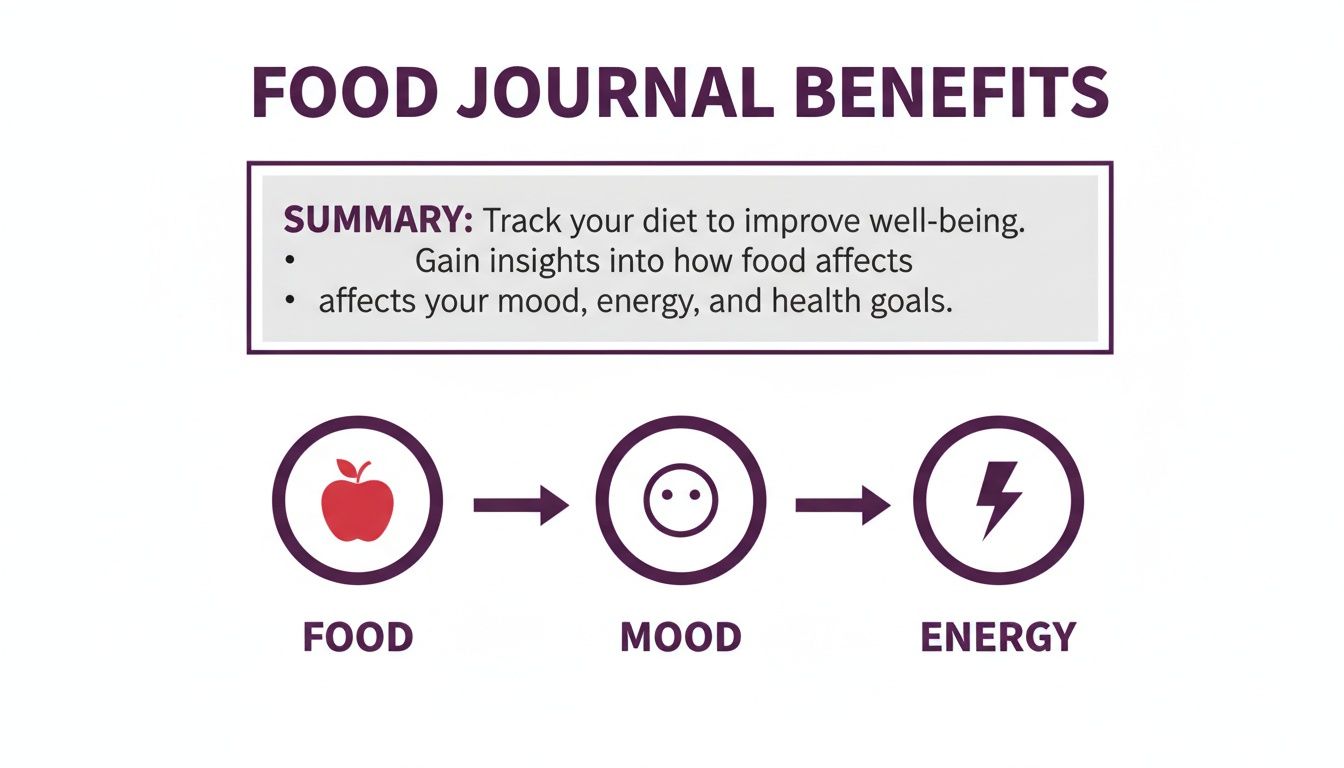
As the diagram shows, the food we eat creates a ripple effect, influencing our mood, energy, and ability to hit our long-term goals.
Tailor Your Template to Your Goals
The real magic happens when you align your daily food journal template with exactly what you want to achieve. Someone trying to improve their gut health will track very different things than someone working on mindful eating.
To help you create a more focused and effective tool, here’s a breakdown of which fields are most important for some common health objectives.
Essential Fields for Your Daily Food Journal Template
This table compares key tracking fields to include in your journal, depending on whether your goal is mindful eating, weight loss, or identifying food triggers.
By choosing fields that directly relate to your primary goal, you cut through the noise. This allows you to focus your attention where it can make the biggest impact, making your journaling practice not only more efficient but also far more powerful.
Example Food Journal Templates for Your Health Goals
It’s one thing to talk about what to track, but it’s another to see it laid out. To give you a practical starting point, I’ve put together three different journal templates. Each one is designed around a common health goal, showing how just a few small tweaks to what you track can completely shift your focus and the insights you gain.
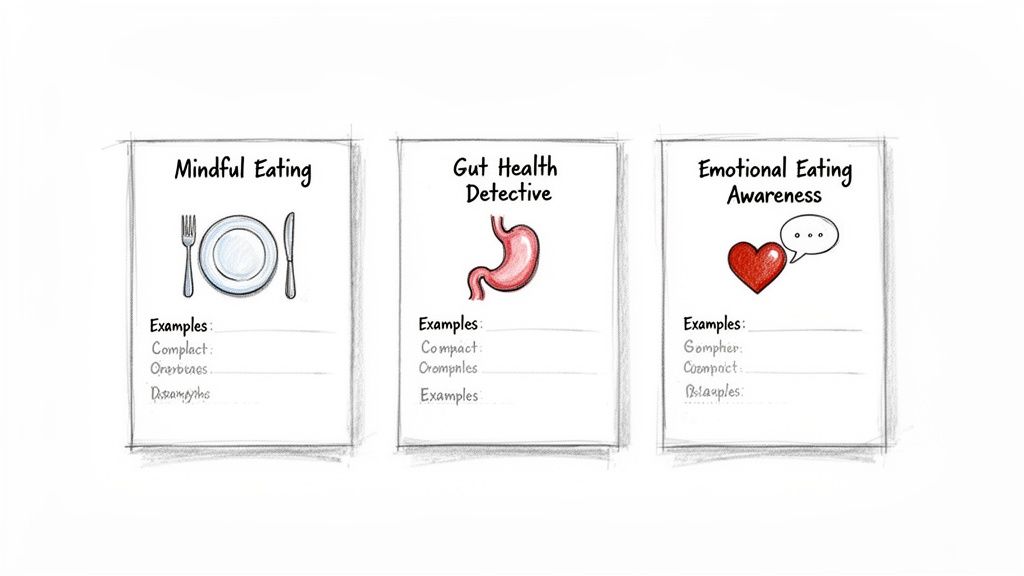
Think of these as a jumping-off point, not a strict set of rules. Feel free to borrow fields from each to build a hybrid journal that truly works for you.
Template 1: The Mindful Eating Companion
This template is all about slowing down and actually experiencing your food. It shifts the focus away from just what you eat to how you eat. The whole point is to get back in touch with your body's natural hunger and fullness signals, something many of us have lost touch with.
Key fields to include here are:
- Hunger Level (1-10): How hungry were you before you started?
- Eating Environment: Were you at your desk, on the couch, or at a table with no distractions?
- Pacing: Did you eat slowly, at a moderate pace, or did you rush through it?
- Sensory Notes: What did you notice about the taste, texture, or even the smell?
- Satiety Level (1-10): How full did you feel when you stopped?
Let’s look at Alex, who usually wolfs down lunch at their desk while firing off emails. After just a week with this template, they realized they barely tasted their food and often felt uncomfortably stuffed afterward. By simply paying attention to the sensory details and their pacing, Alex started taking a real lunch break, enjoying meals more, and finally recognizing their fullness cues before going too far.
Template 2: The Gut Health Detective
If you're navigating digestive issues like bloating, discomfort, or symptoms that seem to come out of nowhere, this template becomes your personal investigative tool. The goal is to connect the dots between specific foods, lifestyle factors, and how your gut responds.
Essential fields for your detective work:
- Meal & Ingredients: Get a little more specific than just "salad." Think: "Salad with chickpeas, feta, and vinaigrette."
- Symptoms: Note any bloating, gas, cramping, or other digestive weirdness.
- Time of Symptom Onset: How long after eating did issues pop up? Thirty minutes? Two hours?
- Stress Level (1--10): Never underestimate the impact of stress on your gut.
- Other Factors: Don't forget details like hydration, sleep quality, and physical activity.
Take Maria, who'd been dealing with random bloating for months. Using this template, she spotted a pattern: the bloating was worst on days she grabbed a specific protein bar for a quick lunch and had a high-stress afternoon. She tried swapping out the bar and immediately noticed an improvement. The culprit wasn't just the food, but the combination of that specific ingredient and her stress level.
Template 3: The Emotional Eating Awareness Journal
This journal is designed to help you understand the why behind your food choices, especially when you find yourself eating for reasons other than actual, physical hunger. It’s all about uncovering the triggers that lead to using food for comfort, distraction, or even procrastination.
Important prompts to explore include:
- My Mood Before Eating: Were you bored, anxious, sad, or maybe even celebrating?
- What Triggered the Urge to Eat: Was it an event, a thought, or just a feeling that washed over you?
- Was I Physically Hungry: A simple "yes" or "no" can be incredibly revealing.
- How I Felt Afterward: Did eating leave you feeling comforted, guilty, numb, or something else entirely?
By creating this space for reflection without judgment, you begin to untangle the complex web of food and feelings, empowering yourself to find alternative coping strategies.
Someone using this journal might notice a powerful craving for sugary snacks hits them like clockwork around 4 PM on workdays. A quick glance at the "Trigger" column reveals it’s not hunger—it’s the anxiety of a looming project deadline. That insight is gold. Now, they can address the root cause—stress—by taking a five-minute walk instead of hitting the vending machine.
As you begin building meal plans from these insights, you might also want to check out some plastic-free lunch containers to help keep your meals organized and support more sustainable habits.
How to Make Food Journaling an Effortless Daily Habit
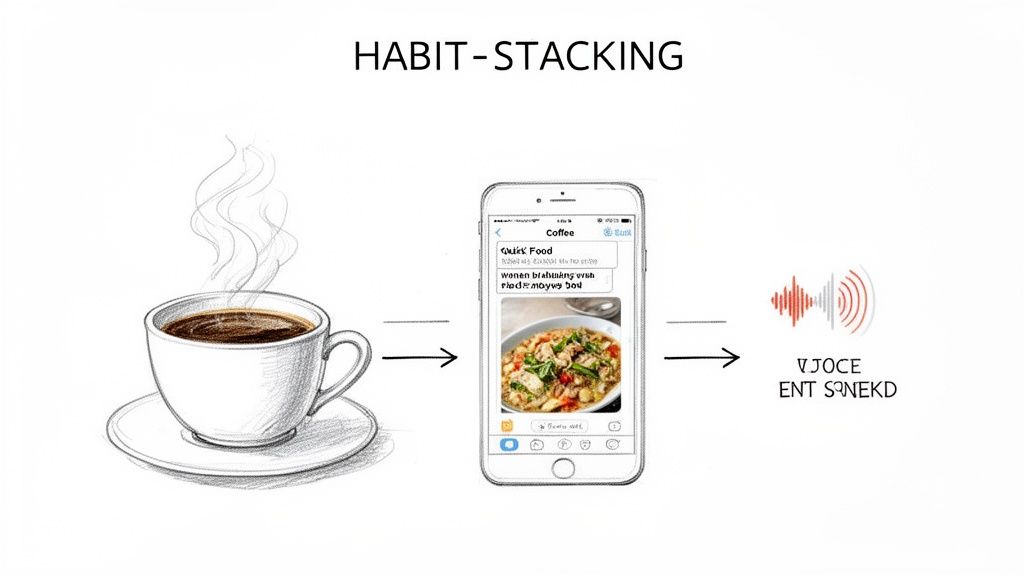
The best food journal in the world is the one you actually use. It’s that simple. Success doesn't come from finding a flawless template on day one, but from weaving the practice into your life until it feels as natural as brushing your teeth. A fantastic way to do this is with a technique called habit stacking.
The idea is to link your new habit (journaling) to something you already do automatically. Think about your unshakable daily routines. Maybe you always have a morning coffee or tea. Your new rule could be, "Right after I pour my coffee, I'll open my food journal." This piggybacking method removes the guesswork and mental load of figuring out when to log your food.
Keep It Simple and Lower the Bar
Don't let perfection become the enemy of consistency. If you're having a chaotic day, the temptation is to just skip your entry altogether. Don't do it. Simplify instead. A super-detailed log can feel like homework, and that’s a surefire way to burn out.
When time is tight, try one of these quick-and-dirty methods:
- Snap a Photo: A quick picture of your plate captures the meal instantly. You can always circle back and add details later when you have a quiet moment.
- Use Voice Notes: Just talk it out. Recording a quick voice memo while you're walking the dog or driving is often faster than typing and can capture your in-the-moment feelings more accurately.
- Focus on One Meal: Feeling completely overwhelmed? Just commit to logging lunch today. That’s it. Small wins build momentum for bigger habits.
To make logging even easier, you can lean on technology. For example, using voice typing app tools lets you dictate your entries without having to type a single word, which is a game-changer when you're busy.
Consistency Over Perfection
Look, you're going to miss a day. It happens. That’s not a failure; it's just life. The real goal is to gather data over the long haul, and a few gaps in the record won't ruin your progress. The all-or-nothing mindset is a trap, so just pick it right back up with your next meal.
Your journal is a tool for curiosity, not a test you can fail. Every single entry, no matter how small, adds another piece to your personal health puzzle.
This isn't just a personal quest; the scientific community is more focused on this than ever. Scientific interest in healthy eating has absolutely exploded, with research publications on the topic jumping nearly 25-fold between 2002 and 2021. We're talking about a leap from just 71 articles to 1,764 annually, which shows a massive global shift toward understanding how food impacts our well-being. By keeping a journal, you're essentially conducting your own personal research study.
Turning Your Journal Entries Into Actionable Insights
A journal filled with notes is just that—notes. The real value comes when you take a step back and see what it’s all telling you. By carving out a little time each week to review your entries, you can turn those simple observations into a powerful, personalized health strategy.
This isn't about getting bogged down in complicated analysis. It's really just about being curious. Set aside 15-20 minutes at the end of the week—maybe on a Sunday evening with a cup of tea—and just read through what you wrote down. Your only job is to look for recurring themes, no judgment allowed. This weekly check-in is your moment to see the bigger picture your daily entries have painted.
Asking the Right Questions
As you scan through your entries, ask yourself some specific questions to guide your detective work. This is how you start connecting the dots between your food choices and how you actually feel.
Get started with prompts like these:
- Energy Peaks & Slumps: When did I feel my best and most energetic this week? What did I eat beforehand? On the flip side, when did I feel sluggish or foggy, and what was on my plate?
- Emotional Triggers: Did I find myself eating when I was bored, stressed, or tired? What situations seemed to always lead to snacking when I wasn't actually hungry?
- Physical Symptoms: Can I see any link between certain foods and symptoms like bloating, headaches, or skin breakouts? Did my sleep quality seem to change after specific dinners?
The goal here is to spot your unique patterns. You might discover your afternoon sugar cravings only strike on days you skipped a protein-heavy lunch. That single insight is far more valuable than any generic diet rule because it's based on your own data.
From Patterns to Actionable Steps
Once you've identified a pattern, the next step is to create a small, manageable experiment for the week ahead. This is how you become an active participant in your own health journey, making smart tweaks based on your body's direct feedback.
This kind of proactive approach is more important than ever. The global cost of a healthy diet now averages $4.46 per person daily, which puts it out of reach for roughly 2.6 billion people worldwide. By understanding your personal eating patterns with a daily food journal, you can make more intentional and cost-effective choices. You can read more about the economic factors shaping dietary habits and see why this matters for everyone.
For example, if you noticed you slept poorly after late-night snacking, your action might be to simply try eating dinner an hour earlier next week. If your weekend eating habits left you feeling drained, maybe you could plan just one nourishing, home-cooked meal for Saturday. These aren't huge overhauls—they're small, targeted adjustments based on what your journal has already told you.
A Few Common Questions About Food Journaling
Getting started with a food journal, even with the perfect template in hand, can bring up a few questions. It’s completely normal. Let's walk through some of the most common things people ask, so you can feel confident from your very first entry.
Do I Really Have to Track Calories?
Nope, you absolutely don't. In fact, for many people, the whole point is to get away from fixating on numbers and start paying attention to what really matters. The templates we've been looking at are built to help you tune into your body's signals, not just count calories.
Instead of getting bogged down in math, you'll be tracking much more insightful details, like:
- How you physically felt before and after eating.
- Where your hunger and fullness levels landed on a scale of 1-10.
- What was going on around you when you chose to eat.
This shift helps you build a much healthier relationship with food by focusing on the why and how behind your choices, which is way more powerful than just tracking the what.
What Happens if I Forget to Fill It Out?
You will. And that’s okay. We all miss a day here and there, especially when building a new habit. The goal is consistency, not perfection.
If you miss an entry or even a whole day, don't sweat it. Just pick right back up with your next meal. Think of your journal as a tool for curiosity and self-discovery, not a test you can fail.
Every single entry you log is one more piece of your personal health puzzle. The most important thing is to avoid that all-or-nothing thinking and just give yourself some grace.
It's also interesting to see how our personal habits connect to bigger trends. Did you know global dietary energy consumption shot up by 32 percent between 1961 and 2018? Keeping your own journal helps you understand your piece of that puzzle. If you're curious, you can explore more on global food energy trends and see how things have changed over time.
How Long Should I Do This For?
Honestly, it really depends on what you're trying to achieve. Some people get the clarity they need in just a few weeks—enough time to spot a pattern and make a change. Others might keep a journal for a few months to work through something specific, like figuring out which foods trigger their migraines or digestive issues.
There's no one-size-fits-all answer here. A solid plan is to commit to 30 days. That's usually the sweet spot for a new habit to start feeling natural, and it gives you plenty of data to work with to uncover some really valuable insights.
Ready to see what your journal entries can reveal? Superbloom uses AI to connect the dots in your food log, giving you personalized guidance to build healthier habits that stick. Take the guesswork out of the equation and start your journey at https://superbloomapp.com.