
Elimination Diet for Gut Health: A Simple Step-by-Step Guide to Find Triggers
If you're constantly dealing with bloating, gas, or unpredictable stomach pain, an elimination diet can feel like a revelation. It’s a methodical, short-term eating plan designed to help you figure out exactly which foods are causing you trouble. Think of it as a reset button for your gut.
The process is straightforward: you’ll temporarily remove common trigger foods—like gluten, dairy, or soy—and then add them back one by one. This lets you pinpoint your personal food sensitivities and finally build an eating plan that makes you feel good.
Your Starting Point for Gut Health Relief
When you're stuck in a cycle of digestive distress, it’s easy to feel lost. An elimination diet is one of the most effective tools for getting to the bottom of it all. It’s a personal investigation that helps you connect the dots between what you’re eating and how your body is reacting.
This guide is your roadmap. The goal here isn't about long-term restriction; it's about a short-term investigation to give you lasting control over your digestive health.
Why This Approach Works So Well
An elimination diet works because it clears away all the noise. Instead of guessing which food might be the problem, you start with a clean slate by removing all the usual suspects. This gives your gut a much-needed break and allows your symptoms to calm down, creating a clear baseline to work from.
Then, as you start reintroducing foods, any reaction—no matter how small—becomes incredibly obvious. What was once just confusing guesswork turns into concrete evidence about your body's unique needs.
And this isn't just anecdotal—the data backs it up. A 2023 study on digital elimination diets found that up to 78% of people saw their symptoms improve significantly. Even more impressive, 67.6% found their symptoms were completely resolved. It's a powerful strategy, especially for managing common conditions like IBS, which affects an estimated 11.2% of people worldwide. You can dive into the full findings from this digital diet study for a closer look.
An elimination diet is less of a diet and more of an experiment. You are both the scientist and the subject, gathering data to understand your body’s unique language.
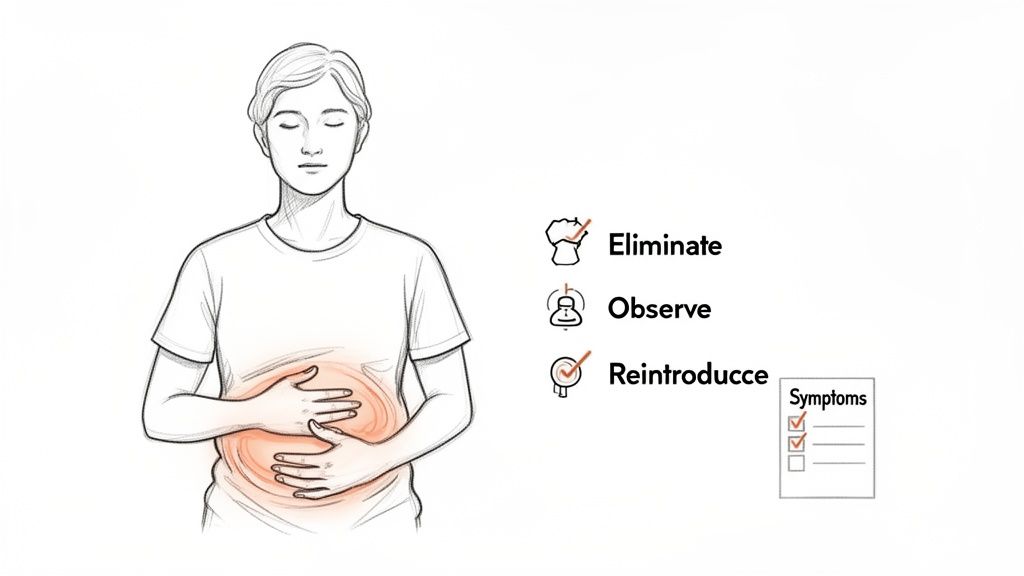
To better understand the journey ahead, it helps to see the process broken down into its core components.
Key Phases of an Elimination Diet at a Glance
This table outlines the three distinct phases of the process. Each stage has a specific purpose and timeframe, making the entire journey feel much more manageable.
Following these phases turns a potentially overwhelming task into a clear, step-by-step experiment.
What to Expect from This Guide
We'll break down this entire process into simple, actionable steps. You'll get practical advice on everything from meal planning and label reading to tracking your body's feedback. We’ve got you covered for every stage, including:
- Meal Prep Strategies: Simple tips and recipes to make eating well easy and enjoyable.
- Symptom Journaling: Clear guidance on what to track (and how) to get the most accurate insights.
- Reintroduction Protocol: A safe, step-by-step method for reintroducing and testing foods.
With this roadmap, you’ll be ready to turn dietary confusion into clarity and build a personalized eating plan that supports your gut for the long haul.
Here’s the human-written version:
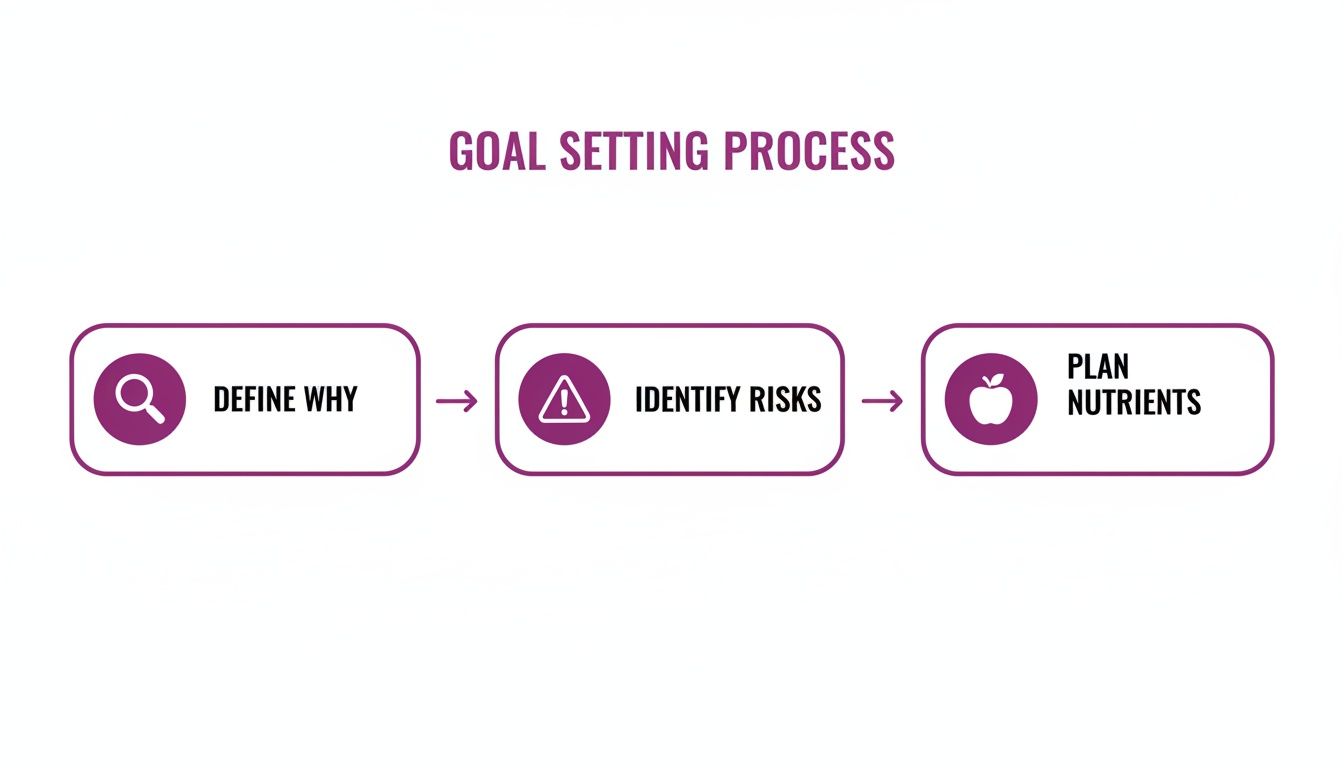
Getting Started: Set Your Goals and Understand the Risks
Before you even think about clearing out your pantry, let’s get on the same page. An elimination diet isn't a casual detox you try for a week. It’s a powerful diagnostic tool, and you need to treat it with respect. The whole point is to figure out exactly which foods are causing your specific symptoms—whether that’s bloating, brain fog, fatigue, or something else entirely.
Think of this as a short-term mission to gather intel on your body. This isn’t a forever diet. You're playing detective, learning to listen to your body's signals and finally connect the dots between what you eat and how you feel.
First, Pinpoint Your “Why”
Your motivation is what will get you through the tough days. So, what are you really hoping to achieve? Get specific. "Better gut health" is too vague to be useful.
Instead, define what success looks like for you. Try goals like these:
- "I want to wake up in the morning and not feel immediately bloated."
- "My goal is to make it through the workday without that 3 PM brain fog."
- "I need to figure out what's triggering my eczema flare-ups."
These tangible goals give you a clear finish line. They turn a fuzzy wellness goal into something real and measurable, which makes all the difference when you're tempted to give up.
Your goal isn't just to find what's wrong, but to build a foundation for what feels right. This mindset shifts the focus from restriction to empowerment, making the entire journey a more positive and insightful experience.
A Word on the Risks (And How to Avoid Them)
Now for the serious talk. While incredibly effective, pulling entire food groups from your diet comes with some real risks if you're not careful. The biggest one? Nutritional deficiencies. This is a clinical process, and approaching it like a long-term diet without a solid plan can do more harm than good.
For example, if you cut out dairy without a backup plan, you could be missing out on crucial calcium and Vitamin D for bone health. Or, if you ditch all grains, you might suddenly lack the B vitamins and fiber your body needs for energy and regular digestion.
The trick is to swap, not just subtract. For every food group you take out, you absolutely must bring in a nutrient-dense replacement.
Creating a Nutrient-Smart Plan
To sidestep those nutritional gaps, you need to plan your swaps from day one. This isn't optional; it's essential for doing this safely.
This kind of deliberate planning is non-negotiable. The risks are well-documented. For instance, research on nutritional planning during elimination diets has shown that while these diets work for identifying triggers, they have to be carefully managed. One study found that people who successfully hit their energy and protein targets saw big improvements, which really drives home how critical balanced nutrition is.
This is where a tool like the Superbloom app can be a game-changer. It helps you keep an eye on your food intake and gives you feedback on things like your protein and fiber consumption. Think of it as a safety net, making sure you’re staying nourished while you do this important investigative work.
The 3 to 6 Week Elimination Phase Action Plan
Alright, this is where the real detective work kicks off. For the next 3 to 6 weeks, you're going to create a "clean slate" for your gut. Think of it as giving your system a much-needed rest from potential irritants so you can finally hear what your body has been trying to tell you. It takes commitment, but the clarity you’ll gain is absolutely worth it.
The main goal here is to completely remove a specific list of common inflammatory foods. This gives any underlying inflammation a chance to calm down and allows your symptoms to fade, establishing a clear baseline. Once you’re feeling consistently better, you’ll have the perfect foundation to begin reintroducing foods one by one.
What to Eliminate and What to Swap In
Success during this phase isn't just about what you cut out—it's equally about what you add in. This isn't about deprivation. The focus should be on swapping those potential triggers with delicious, nutrient-dense alternatives that will actively nourish your gut.
This table offers a practical guide to the most common foods people temporarily remove and some great-tasting, gut-friendly replacements to try instead.
Common Foods to Eliminate and Nutrient-Rich Swaps
Making these strategic swaps ensures you’re still eating a rich and varied diet. This helps prevent the nutritional gaps that can sometimes pop up when you're eating more restrictively.
Navigating the Grocery Store and Your Kitchen
It’s time to become a food label detective—this is a non-negotiable skill for the elimination phase. Hidden ingredients are lurking everywhere. Keep an eye out for vague terms like "hydrolyzed vegetable protein" (which can hide soy or wheat) or "natural flavors," as these can contain all sorts of triggers.
My best advice? Stick to the perimeter of the grocery store. It’s where you’ll find the whole, unprocessed foods like fresh produce, quality meats, and fish.
To make this whole process feel less overwhelming, learning how to meal prep can be a total game-changer. Spending just a few hours on a Sunday to wash and chop veggies, cook up a big batch of quinoa, and grill some chicken can save you from making impulsive, off-plan food choices during a hectic week.
Remember, this phase is temporary. The strictness is designed to deliver clear results, not to become your new permanent lifestyle. Every compliant meal is a step toward understanding your body better.
Journaling Your Food and Symptoms
Your food and symptom journal is, without a doubt, the single most important tool in this entire process. Without it, you’re just guessing. Meticulous tracking is what transforms this diet from a simple eating plan into a powerful personal experiment.
For your journal to be effective, it needs to capture more than just what you ate. Every day, make sure to log:
- Food & Drink: Write down everything you consume, including rough portion sizes and what time you ate. Specificity is key!
- Symptoms: Note any digestive issues (bloating, gas, pain), but also pay attention to your energy levels, mood, skin changes, headaches, and sleep quality.
- Symptom Severity: Use a simple 1-10 scale to rate the intensity of any symptoms you feel. This helps you spot subtle changes.
- Other Factors: Don't forget to include details about your stress levels, exercise, and any medications or supplements you're taking.
This detailed log is what will help you (and your doctor, if you're working with one) start connecting the dots. Using a tool like the Superbloom app can make this incredibly easy. It lets you quickly log meals and symptoms and even helps identify patterns you might have missed on your own.
It's fascinating to know that an elimination diet can create rapid shifts in your gut microbiome, sometimes in as little as 24–48 hours. While this can bring fast relief, it’s also why the elimination phase must be temporary. Prolonged restriction can reduce numbers of beneficial bacteria, which are crucial for a healthy gut. By the end of this 3 to 6 week period, you should have a clean baseline—a state where your initial symptoms have significantly improved or even disappeared. This is the green light that tells you you're ready for the next crucial stage: reintroduction.
Getting to Know Your Triggers: The Reintroduction Phase
So, you’ve put in the work. After a few weeks of sticking to your plan, things have hopefully quieted down, and you’re feeling a whole lot better. This is where the real detective work begins—the part of the elimination diet for gut health that delivers the biggest "aha!" moments.
Don't be tempted to rush this part. I've seen it happen time and time again: people feel great, get excited, and throw caution to the wind, undoing all their hard work. The patience you show now will arm you with the knowledge you need to manage your health for years to come. We're going to reintroduce foods one by one, very carefully, so we can see exactly what your body has to say about them.
One Food, Three Days: The Only Rule That Matters
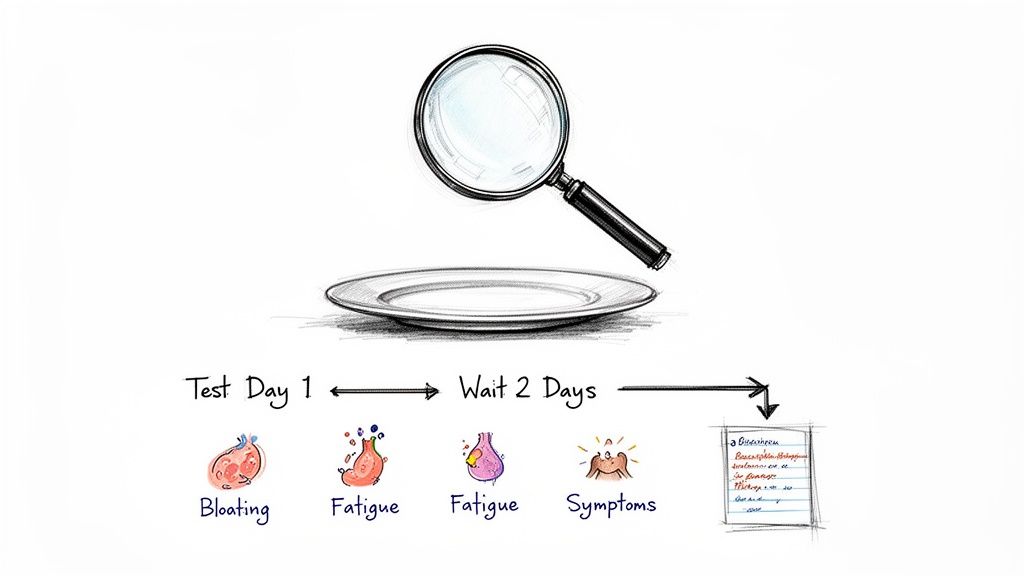
This is the most critical principle of reintroduction, and it’s non-negotiable: test only one new food group every three days. Why so long? Because while some reactions hit you like a ton of bricks within minutes, others are sneaky. They can take a full day or two to show up.
Giving yourself this three-day buffer is the only way to get clear answers. If you test dairy on Monday and then try some gluten on Tuesday, you'll have no clue what caused the headache or bloating that shows up on Wednesday. It just muddies the water.
Think of the reintroduction phase as a conversation with your body. By going slowly and listening closely, you learn its unique language without any confusion.
Here’s the plan: you’ll challenge a single food group for just one day. Eat a normal-sized serving of that food two or maybe three times throughout the day. Then, stop. For the next two full days, you’ll go back to your safe elimination diet, paying close attention and logging everything.
What Reintroduction Looks Like in Real Life
Let's walk through an example. Say you're ready to see how you handle dairy.
- Day 1 (Test Day): Assuming you're feeling good and are symptom-free, you'll introduce dairy. Maybe you add a half-cup of plain, full-fat Greek yogurt to your breakfast and have another half-cup with your lunch. Critically, you eat nothing else new that day.
- Day 2 (Observation Day): You go right back to your baseline elimination diet—no dairy. Your job today is to watch and wait. Track everything in your journal, even if it’s just to write "felt great today!" Note any bloating, skin changes, mood shifts, or headaches.
- Day 3 (Observation Day): Same as yesterday. Stick to your safe foods and keep an eye out for any delayed reactions. By the end of today, you should have a pretty clear verdict on dairy.
If you sailed through all three days with no symptoms, fantastic! It’s very likely dairy is not a problem for you. You can add it back to your regular diet and get ready to test the next food group on your list.
But what if you did have a reaction? Now you know. Dairy is a trigger. You'll need to remove it again and wait until you're completely back to your symptom-free baseline before starting a new three-day cycle with a different food.
Listening to Your Body’s Language
Reactions aren't always a five-alarm fire in your gut. Your body often communicates in whispers, and learning to hear them is a skill you'll develop over time. It's so important to look beyond the obvious stomachache.
Be on the lookout for a wide range of signals:
- Digestive Issues: The usual suspects like bloating, gas, cramps, diarrhea, or constipation.
- Neurological Symptoms: A sudden headache or migraine is a huge red flag. So is that sluggish, foggy-headed feeling.
- Mood and Energy Shifts: Did you suddenly feel irritable, anxious, or hit an afternoon slump that felt deeper than usual? Pay attention to that.
- Skin Reactions: Acne breakouts, an eczema flare-up, hives, or general itchiness can often be a delayed reaction to a food.
- Other Physical Symptoms: Things you might not connect to food, like joint pain, a stuffy nose, or puffiness around your eyes, can also be clues.
This is where a tool like the Superbloom app becomes your best friend. Instead of trying to remember everything, you can snap a picture of your meal and tap to log symptoms with a timestamp. Over time, the app's pattern-recognition features can connect the dots between a subtle symptom, like a dip in your mood, and a food you never would have suspected.
If a food does cause a reaction, remember that it might not be a life sentence. For some, the problem is quantity—they can handle a little bit of a trigger food now and then. For others, they may need to avoid it completely for a few more months before trying again. The data you're gathering now is what gives you the power to make those personal, informed choices for your own health.
Using Digital Tools for Better Tracking and Support
Let's be honest: an elimination diet generates a ton of personal data. You're tracking meals, symptoms, moods, energy levels—the works. Trying to manage all of that with a pen and a cluttered notebook can get overwhelming, fast. I’ve seen many people get discouraged and give up simply because the record-keeping felt like a second job.
This is where a good digital tool can be a game-changer. It’s not just about tidying up your notes; it’s about making the entire process smarter, more insightful, and frankly, a lot less chaotic. Think of it as your personal health detective, right in your pocket.
Streamline Your Daily Logging
The foundation of any successful elimination diet is consistent, detailed tracking. A well-designed app transforms this from a tedious chore into a quick daily check-in. Instead of trying to remember and write down every single ingredient from lunch, you can just snap a photo. This visual food diary is not only faster but often more accurate.
With just a few taps, you can also log all those other crucial pieces of the puzzle that are easy to forget:
- Symptom tracking: Quickly note that afternoon headache or the specific timing of your bloating.
- Emotional states: Log feelings of stress or anxiety. You might be surprised how often they're connected to what—or when—you eat.
- Energy levels: Rate your energy on a simple scale throughout the day. Was it that breakfast that led to your 3 PM slump?
Getting this data logged consistently is the first, most important step toward finding real answers.
The true advantage of using a digital tool isn't just about being organized. It’s about turning all that raw data into a clear story, helping you connect the dots between what you eat and how you feel in a way that’s nearly impossible to do on your own.
Uncover Patterns with Intelligent Insights
This is where a tool like the Superbloom app really proves its worth. A paper journal just holds information; an AI-powered app actively works for you, searching for hidden connections in the background. It’s like having a data analyst tirelessly looking for correlations you might have completely missed.
This is how you move from just collecting data to actually understanding it. The app might highlight something you never would have noticed—for example, that your mid-afternoon brain fog isn't random, but consistently appears 4-5 hours after you eat a specific "safe" food. Or maybe it's not one food, but a combination of them, that triggers your discomfort.
These aren't just abstract reports. The app gives you personalized feedback and gentle nudges. It might point out that you're consistently low on fiber on certain days and then suggest compliant, fiber-rich foods you can add. This turns the rigid diet into a dynamic, responsive learning process that’s all about your unique body.
Stay Motivated with Visual Progress
Sticking with an elimination diet for gut health is a marathon, not a sprint. The restrictive phase can feel long and challenging, and it's easy to lose motivation. This is where seeing your progress visually can provide a huge psychological boost.
A good app makes your hard work tangible with features like:
- Progress Charts: Seeing a graph where your symptom scores are steadily dropping is incredibly reinforcing. It proves your efforts are paying off.
- Weekly Summaries: Get a simple, high-level look at your week—your wins, your patterns, and where you can focus next.
- Consistency Trackers: Celebrating small milestones, like sticking to the plan for 7 days straight, builds momentum and makes you feel capable.
This kind of positive feedback is essential for navigating the ups and downs. When you can see with your own eyes that your bloating is less frequent or your energy is more stable, it’s much easier to stay the course. It makes the entire journey feel less like a struggle and more like an empowering path to better health.
Building Your Sustainable Gut-Friendly Lifestyle
So, you’ve made it through the reintroduction phase. It's tempting to see this as the finish line, but what you’ve really done is build the foundation for a whole new way of living and eating. The goal isn’t to stay on a restrictive elimination diet for gut health forever; it's to create a vibrant, varied diet filled with foods you genuinely enjoy and tolerate.
This is your new normal, designed by you, for you.
Turning Your Findings Into a Lifestyle
Think of the information you gathered as your personal dietary roadmap. It shows you exactly how to handle the foods that once caused you trouble. For some triggers, you might find that complete avoidance is the only path forward. For others, it might be about moderation.
Maybe you discovered that a weekly sourdough pizza is a recipe for disaster, but a single slice once a month is perfectly fine. You now have the power—and the personal data—to make those calls with confidence, not fear.
Nurturing Your Gut for the Long Haul
With the inflammation dialed down, now is the perfect time to focus on actively supporting your gut microbiome. Think of it as tending to a garden; you want to fertilize the good stuff and plant more of it.
- Feed the good guys with prebiotics: Start weaving in foods rich in prebiotic fiber, which acts like fertilizer for your beneficial gut bacteria. Great options include asparagus, garlic, onions, and even slightly green bananas.
- Add more good guys with probiotics: Fermented foods introduce beneficial bacteria directly into your system. Try adding things like sauerkraut, kimchi, or a high-quality kefir (if you know you handle dairy well).
A huge part of maintaining your progress is having a solid grasp on the relationship between probiotics and gut health. Understanding this connection is crucial for building a truly resilient gut ecosystem long after the initial diet is over.
The ultimate goal is food freedom, not food fear. Use your knowledge to build a diet that is as broad and enjoyable as possible, knowing you have the tools to navigate any bumps in the road.
Finally, never forget the powerful link between your mind and your gut. Stress is a massive trigger for many people—sometimes even more potent than a problematic food. Continuing to use a tool like Superbloom can help you keep an eye on these connections, so you can spot patterns and prevent a slow slide back into the habits that caused your symptoms in the first place.
Frequently Asked Questions
Whenever I guide people through an elimination diet, the same questions always come up. It's completely normal to feel a bit uncertain, so let's get those common concerns out of the way right now.
How Long Should I Stay in the Elimination Phase?
The sweet spot for the elimination phase is typically 3 to 4 weeks. From my experience, this is just enough time for the inflammation in your gut to really calm down, giving you a clean slate before you start reintroducing foods.
You don't want to stay in this phase for too long, as it can open the door to nutritional gaps. If you hit the 4-week mark and your symptoms haven't improved, it’s a clear signal to pause and talk to a healthcare professional.
What if I Accidentally Eat a Restricted Food?
First, take a breath. It happens to everyone. One accidental bite of a trigger food doesn't ruin everything.
The most important thing is to get right back on track with your next meal. One mistake doesn't derail your progress.
Just make a note of what you ate and any symptoms that followed in your journal. If this happens during the reintroduction phase, however, you need to be a bit more careful. You'll have to wait until any new symptoms completely disappear before you try testing the next food group. This is the only way to keep your results clean and trustworthy.
Can I Really Do This Without a Doctor?
You can certainly use this guide to get started on your own, but I always recommend looping in a professional. Doing an elimination diet is most effective—and safest—when you have a doctor, dietitian, or registered nutritionist in your corner.
They can offer critical support that you just can't get on your own. For example, they can help you:
- Rule out underlying medical issues that could be masquerading as food sensitivities.
- Confirm this diet is the right approach for your unique health history.
- Create a solid plan for food swaps to make sure you’re not missing out on key nutrients.
Think of them as your safety net, ensuring you're using this powerful tool the right way.
Ready to stop guessing and start seeing real patterns? A tool like Superbloom can be a game-changer here. It simplifies the process of logging your meals, symptoms, and even your moods. The app's AI then helps you connect the dots between what you eat and how you feel—insights that are tough to catch on your own. If you’re tired of the messy notebook, I’d recommend downloading the Superbloom app to get started.