
Emotional Hunger vs Physical Hunger A Guide to Mindful Eating

It really boils down to this: physical hunger is your body’s biological request for fuel. It builds up gradually. Emotional hunger, on the other hand, is a sudden, urgent response to feelings, and it usually demands a very specific comfort food.
Learning to tell which one you’re feeling is the first real step toward building a healthier, more mindful relationship with food.
Decoding Your Body’s Two Hunger Signals
Have you ever found yourself standing in front of an open pantry, grabbing a snack, but you can’t remember your stomach even growling? If so, you're definitely not alone. It’s a classic moment that perfectly illustrates the difference between your body’s two main hunger signals.
Figuring out the difference between emotional and physical hunger isn’t about putting foods off-limits. It’s about listening closely and understanding what your body and mind are truly asking for.
Think of physical hunger as your body's internal fuel gauge. It’s a purely physiological need for energy that comes on slowly. When you’re truly hungry, a lot of different foods sound good, and once you eat, you feel a pleasant sense of fullness and satisfaction.
Emotional hunger is a whole different beast. It’s usually sparked by an external trigger—feelings like stress, boredom, or sadness. It hits you like a tidal wave, feels incredibly urgent, and brings on intense cravings for specific high-sugar or high-fat foods.
“The goal isn’t to eliminate emotional eating completely—it’s human and sometimes a source of comfort. But building awareness allows you to make choices instead of reacting out of habit.”
Key Differentiators at a Glance
Ever wondered why that craving for chips hits you out of nowhere, while real hunger is more of a slow burn? Research gives us some clues. Physical hunger can be satisfied by a range of foods that leave you feeling full for a while. Emotional hunger often fixates on specific items, like carbs, which can kick off a cycle of eating more and feeling guilty later. You can learn more about how to distinguish physical and emotional hunger on Solution Health.
Here’s a quick comparison to help you read your body’s signals when a craving strikes.
At a Glance: How Emotional Hunger Compares to Physical Hunger
This table breaks down the core differences, helping you interpret your body’s cues in the moment.
Seeing the signals side-by-side makes it easier to pause and ask, "What am I really feeling right now?" That small moment of reflection can make all the difference.
How to Decode Your Body's Hunger Cues
Going beyond the textbook definitions, learning to tell the difference between emotional and physical hunger in the moment is all about tuning into the subtle signals your body and mind are sending. Think of yourself as a detective investigating your own internal cues.
Physical hunger is a conversation that starts in your stomach. It’s a slow burn—a gradual build-up of sensations like a slight emptiness, a gentle gurgle, or a noticeable dip in your energy. This feeling is patient; it gives you time to plan and prepare a satisfying meal.
On the other hand, emotional hunger often feels like a demand that originates "above the neck." It’s a sudden, urgent craving for a very specific taste or texture, usually sparked by an emotion rather than a genuine need for fuel.
This decision tree is a great way to visualize the different paths physical hunger and emotional hunger take.
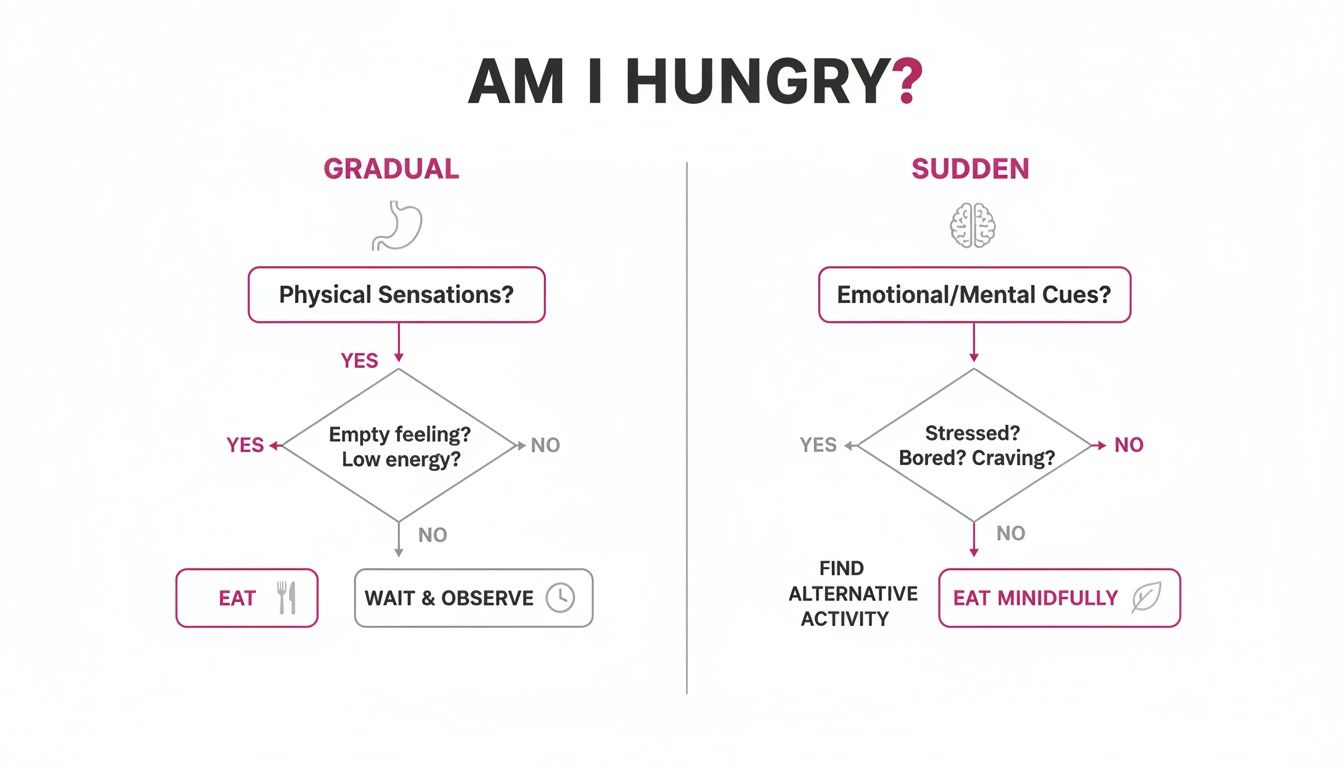
The flowchart makes it clear: a gradual onset usually points to a physical need, while a sudden, specific craving is a classic sign of an emotional response. This visual can be a powerful tool for making a quick check-in with yourself.
Situational Hunger Cues: Real-World Scenarios
Let's ground these ideas in everyday life. Sometimes, seeing how these feelings show up in different situations is the best way to learn how to spot them in yourself.
These examples show how the context of our day can easily trigger one type of hunger over the other. The key is recognizing the pattern.
Physical hunger asks for nourishment. Emotional hunger seeks comfort. One is a biological need, the other is an emotional want—and telling the difference is the first step toward eating with intention.
It's also important to remember that external factors can make these signals much harder to read. For instance, food insecurity often blurs the line between emotional and physical hunger. Nearly one-third of people worldwide deal with this, and research shows how the stress of not having reliable access to food can amplify emotional eating patterns. A study on food insecurity during the COVID-19 pandemic revealed that about 33% of participants faced this issue, which correlated with higher rates of emotional eating. You can read the full research on food insecurity and eating habits to better understand this complex relationship.
Connecting Cues to Your Daily Life
Applying this knowledge in your own life really just comes down to taking a mindful pause. Before you reach for that snack, ask yourself a few simple questions. This quick self-check can help you decode whether your body is asking for fuel or if your emotions are driving the bus.
- Where do I feel this? Is it a deep, physical sensation in your stomach, or is it a craving centered in your mouth and thoughts?
- How fast did it come on? Did it build slowly over the last hour, or did it hit you like a ton of bricks right after something happened?
- What do I want to eat? Does a balanced meal sound good, or are you laser-focused on one specific "comfort" food?
Answering these questions honestly creates just enough space to make a more conscious choice. This practice isn’t about restriction; it’s about giving your body and mind what they truly need in that moment.
Understanding Your Emotional Eating Triggers
To really tell the difference between emotional and physical hunger, you have to look past the craving itself and ask a simple, powerful question: "Why am I really eating right now?" Emotional hunger almost never has to do with an empty stomach. It's usually a quick-fix response to an emotional need that food seems to soothe, at least for a moment.
These needs often show up as predictable emotional triggers. Stress is probably the most common one. When you're stressed out, your body pumps out cortisol, a hormone that can crank up your appetite and make you crave all the things—salty, sugary, fatty foods. Eating them gives you a hit of relief, but it never lasts.

The Brain Chemistry of Comfort Foods
There’s a real scientific reason that pint of ice cream feels like a hug after a terrible day. Foods that are high in sugar, fat, and salt—what experts call "highly palatable"—light up the brain’s reward centers by releasing dopamine.
That little chemical rush creates a potent, if short-lived, feeling of pleasure. Your brain is smart, and it quickly learns the pattern: feel bad + eat this = feel better. This forges a strong neurochemical loop that reinforces the habit, making you automatically reach for those same foods the next time a difficult emotion surfaces.
This dopamine-driven cycle is exactly what makes emotional eating so tough to overcome. It’s not about willpower. It's your brain’s reward system doing its job, seeking out pleasure to quiet down negative feelings.
Unpacking Your Common Triggers
While stress gets a lot of the blame, plenty of other feelings can send you straight to the pantry. Figuring out your own personal triggers is the critical first step in breaking the cycle.
- Boredom or Procrastination: Eating can be an easy way to fill empty time or put off a task you’re dreading. It provides a simple distraction and makes you feel like you're doing something.
- Loneliness or Sadness: Food can feel like a friend, offering comfort when you’re feeling down or isolated. It’s a common way people try to fill an emotional void.
- Anxiety or Uncertainty: When you're worried, the mindless, repetitive motion of eating can be genuinely calming. It gives you a temporary break from whatever thoughts are racing through your mind.
- Celebration or Reward: Emotional eating isn’t always about negative feelings. Many of us learn to use food to reward a big accomplishment, creating a habit of celebrating with treats instead of other joyful activities.
This isn't a niche problem; it's incredibly common. Research reveals that emotional eating impacts a staggering 44.9% of overweight and obese adults around the world. It drives a cycle of craving and guilt that just doesn't exist with true physical hunger. The fact that this pattern is so widespread shows why learning to spot the difference is so crucial. You can discover more insights from this global meta-analysis to see just how big the impact is.
The Long-Term Consequences of Emotional Eating
When food becomes your primary tool for managing emotions, the long-term effects can be damaging. It often leads to a complicated and strained relationship with food, where you start labeling things as "good" or "bad." This mindset can fuel a frustrating cycle of restricting yourself, only to overindulge later.
Over time, it can also throw your nutrition out of balance if comfort foods consistently push more nourishing options off your plate. But most importantly, it stops you from getting to the root of what you're actually feeling. By understanding what triggers your emotional eating, you can finally start finding healthier, more sustainable ways to cope—and break the cycle for good.
Actionable Strategies for Mindful Eating
Knowing the difference between emotional and physical hunger is one thing, but actually acting on that knowledge in the heat of the moment is another beast entirely. The goal isn't to fight your cravings but to understand them. These strategies are designed to help you create a bit of space between the urge to eat and your reaction, shifting you from autopilot to conscious choice.
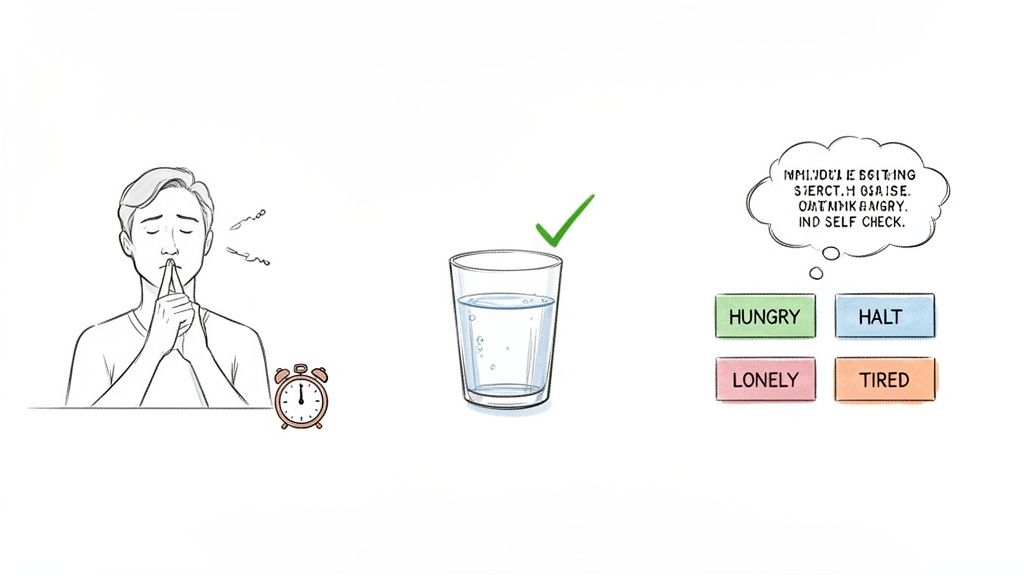
Think of this as a process of investigation, not restriction. By simply pausing to check in, you can give your body what it’s genuinely asking for—whether that's food, water, or simply a moment of comfort.
The Mindful Pause Technique
The most powerful tool you have is often the simplest: the Mindful Pause. The next time a craving hits out of nowhere, just stop. Don't do anything for one to two minutes. Take a few deep, slow breaths and ask yourself, "What am I really feeling right now?" This simple question is surprisingly effective at breaking the spell of automatic emotional eating.
That brief pause is just enough to interrupt the brain's demand for instant gratification. It gives the more logical part of your brain a chance to get involved, helping you make a choice you feel good about instead of just reacting to an impulse.
Use the Water Test First
It’s incredibly common to mistake thirst for hunger. In fact, the signals for both come from the same area of the brain, so it's an easy mix-up. Before you grab a snack, try the Water Test. Drink a full glass of water and then just wait 10-15 minutes.
More often than not, you might find the "hunger" completely vanishes. Your body was just thirsty. If you still feel that empty, rumbling sensation in your stomach after the wait, then you can feel much more certain that it's true physical hunger.
By dealing with potential dehydration first, you effectively rule out one of the most frequent false hunger alarms. It helps clarify whether your body is calling for hydration or actual fuel.
Check In with the HALT Acronym
When you feel that sudden, urgent need to eat—especially if it’s nowhere near a mealtime—run through the HALT acronym. It’s a quick mental checklist to diagnose what might really be going on emotionally. Ask yourself if you are feeling:
- Hungry? (Is it genuine, stomach-rumbling hunger?)
- Angry? (Are you secretly fuming about something?)
- Lonely? (Do you feel disconnected or in need of a friend?)
- Tired? (Are you running on fumes, mentally or physically?)
Being honest with yourself here can be a game-changer. If the answer is "Tired," a 15-minute rest might serve you better than a bag of chips. If you’re feeling lonely, maybe what you really need is to call a friend, not raid the pantry. HALT helps you find a solution that fits the real problem, building a more intentional and self-aware relationship with your body's cues.
How to Build Sustainable Habits for Lasting Change
Figuring out the difference between emotional and physical hunger is a huge first step. But the real magic happens when you turn that knowledge into consistent, everyday actions. Building habits that stick isn't about rigid rules or restriction; it’s about creating a personal system that makes mindful choices feel second nature.
This journey starts by playing detective and looking for your unique patterns. The feelings, situations, and even times of day that trigger emotional eating are rarely random. When you start tracking your meals alongside your moods, you can begin to connect the dots. You might notice that a stressful afternoon at work almost always leads to a desperate craving for something sugary.
Turning Awareness into Action
The trick is to build a new feedback loop that reinforces better choices. Instead of just acknowledging an emotional craving and giving in, the goal is to introduce a healthier, more helpful response. With enough practice, you’re actually teaching your brain a new, more constructive way to handle that specific trigger.
This is where a tool like Superbloom can be a game-changer. Its daily check-ins and prompts encourage you to log not just what you ate, but the why behind it. Over time, the app's personalized feedback offers specific suggestions right when you need them. For instance, if you log a craving for salty chips every time you feel exhausted, Superbloom might suggest a high-protein snack to tackle the root cause—an energy slump. It helps turn a reactive moment into a proactive one.
Building new habits requires a supportive structure. By combining self-awareness with personalized guidance, you create a system that reinforces positive behaviors until they become second nature.
This approach is all about fostering a healthier, more balanced relationship with food, not about enforcing a strict diet. It’s about feeling more in control and less at the mercy of your emotional triggers.
Making Progress Motivating
Real, lasting change is fueled by seeing your efforts pay off. Nothing keeps you going quite like seeing tangible proof that your hard work is making a difference. Visualizing your progress—like realizing you made it through a tough week without once turning to comfort food—is incredibly powerful.
Think about how your environment can set you up for success, too. As you work on building these new habits, having the right tools in your kitchen can make healthy eating feel less like a chore. Finding equipment that you enjoy using, like the best non-toxic air fryer for healthy living, can make preparing nutritious meals faster and more appealing.
Ultimately, building habits that last boils down to three core elements:
- Consistent Reflection: Regularly check in with your moods and eating patterns to pinpoint your personal triggers.
- Guided Action: Use personalized feedback to introduce healthier alternatives when emotional hunger shows up.
- Progress Visualization: Track your wins—big and small—to stay motivated and reinforce the positive changes you're making.
When you create this kind of supportive ecosystem for yourself, the journey becomes less about sheer willpower and more about skill-building. It breaks down the overwhelming challenge of "changing your habits" into a series of small, manageable steps that lead to real, lasting change.
Your Questions About Hunger Cues, Answered
As you start paying closer attention to your body’s signals, you're bound to run into some confusing moments. It’s a learning process, and questions will pop up. Let’s walk through some of the most common ones.
Can I Be Physically and Emotionally Hungry at the Same Time?
Yes, absolutely. In fact, this is incredibly common and one of the trickiest situations to navigate.
Imagine this: It’s 6 PM, and your stomach is rumbling—that’s classic physical hunger. But you just got off a draining video call, and suddenly you’re not just hungry, you’re craving a huge, greasy pizza. That specific, urgent craving is emotional hunger piggybacking on a real physical need.
When this happens, try tackling the physical need first. Eat a balanced meal or a healthy snack that will give your body the fuel it actually needs. Once that’s taken care of, you can check in with yourself again. More often than not, once your body is nourished, it’s much easier to address the underlying emotion with something other than food, like calling a friend or just taking a few deep breaths.
Think of it as a two-step process: nourish, then nurture. By feeding your body first, you can separate the mixed signals and give your emotions the specific attention they need.
How Long Will It Take to Learn the Difference?
Honestly, there’s no magic number here. Learning to read your body’s cues is a skill, and like any skill, it takes practice. For some people, things might start to click within a few weeks. For others, especially if emotional eating has been a go-to coping mechanism for years, it might take several months.
The key isn't speed; it's consistency. Focus on progress, not perfection.
- Try daily check-ins: Before you eat, just pause and ask, "What am I actually feeling right now?"
- Look for patterns: A simple journal (or an app) can help you connect the dots between your moods and your food choices.
- Be kind to yourself: Some days will be easier than others. That’s okay. Learning is a messy, non-linear process.
These small, consistent efforts build the self-awareness you need to strengthen that mind-body connection over time.
What if I Know It’s Emotional Hunger, but I Eat Anyway?
First things first: let go of the guilt. The fact that you can identify your hunger as emotional is a massive step forward. It means you’re already building the awareness that’s necessary for change. That’s a win!
When you catch yourself in that moment, see if you can introduce a tiny pause. Maybe you take a five-minute walk around the block, put on your favorite song, or drink a big glass of water. Sometimes, that small interruption is all you need.
If you still choose to eat, that's okay too. The goal is to do it mindfully. Eat slowly, without distraction. Pay attention to the taste and texture. Notice how it makes you feel—physically and emotionally—without judging yourself. Over time, you’ll naturally start building a bigger toolkit of non-food coping skills to choose from.
Do I Have to Stop Eating My Favorite Comfort Foods?
Not at all! This isn't about restriction; it's about intention. A healthy relationship with food absolutely includes enjoying the things you love without feeling guilty. The only thing that changes is the why.
The goal is to move away from using comfort food as an automatic reaction to a tough emotion and toward choosing it because you genuinely want to savor the experience. It's the difference between mindlessly eating a pint of ice cream to numb stress and deciding, "I really want to enjoy a bowl of my favorite ice cream tonight."
This simple shift in mindset empowers you to truly enjoy those foods, breaking the negative cycle of craving, guilt, and regret. You can have that brownie just because you love brownies, not because you need it to fix something else.
Ready to turn this awareness into a lasting habit? Superbloom helps you understand your eating patterns with daily check-ins and personalized feedback, so you can build a healthier relationship with food without all the rules. Learn more about starting your journey toward mindful eating today.