
A Guide to Food Intolerance Testing at Home in 2026

When you’re struggling with bloating, fatigue, or mysterious digestive symptoms, the promise of a quick answer is incredibly appealing. That’s the allure of at-home food intolerance tests. But can you really trust the results you get from a simple finger-prick kit?
Let's cut to the chase: while these tests promise clarity, their scientific foundation is shaky at best. Most of them aren't showing you a problem; they're simply showing you what you've eaten.
Should You Trust At-Home Food Intolerance Tests?

The market for food intolerance testing at home has exploded for a reason. When you feel "off" after eating and can't pinpoint why, a test that claims to identify the exact culprits feels like a lifeline. But before you buy one, it's critical to understand what they're actually measuring.
The vast majority of these kits are IgG (Immunoglobulin G) tests. They work by analyzing a small blood sample for the presence of IgG antibodies, which are proteins your immune system produces in response to all sorts of things, including the foods you eat.
A Food Log, Not a Fault Finder
Here’s the best way to think about IgG antibodies: they’re like your body's food journal. Their presence simply indicates exposure to a food, not a problematic reaction to it.
In fact, higher levels of IgG are often found for foods you eat all the time. Your immune system is just doing its job, noting what’s passing through.
This is the fundamental flaw in using these tests for diagnosis. The presence of IgG is widely considered a normal, healthy immune response. It’s a sign of memory and tolerance, not intolerance.
Because of this, major medical and allergy organizations consistently advise against using IgG tests to diagnose food sensitivities. They often generate a long list of "problem" foods—like eggs, wheat, or almonds—that are perfectly healthy and cause no actual symptoms. Following these results can lead people down a rabbit hole of unnecessary food restrictions, potential nutrient deficiencies, and a whole lot more anxiety around eating.
Despite the weak evidence, the demand for easy answers is huge. The at-home food sensitivity test market was valued at USD 261.8 million in 2025 and is on track to more than double by 2035. Blood-based kits, primarily IgG tests, drive this growth, making up over 63% of the revenue, as detailed in recent market analyses.
This leaves many people wondering what to do. The first step is to get familiar with the different types of tests being sold and what the science says about each one.
Common Types of At-Home Food Intolerance Tests
To help you sort through the options, here’s a quick comparison of the most common at-home tests, what they claim to measure, and where they stand scientifically.
As you can see, the methods are quite different, but they share one thing in common: a lack of solid scientific backing for what they claim to do.
While the idea of a simple test is tempting, the evidence just isn't there to support most at-home kits. In the next section, we’ll dive into what actually works: a proven, step-by-step method for uncovering your food triggers that you can do on your own.
So, you’ve sent your blood sample off to an at-home food sensitivity company. What exactly are they looking for? The vast majority of these kits test your blood for something called IgG (Immunoglobulin G) antibodies.
To make sense of this, let’s imagine your immune system is the head of security at an exclusive club. Its main job is to spot genuine trouble and toss it out. But it also has to know who the regulars are—the familiar faces that pose no threat.
IgG antibodies are basically the security guard giving a friendly nod to the regulars. When you eat a food, your body might produce IgG antibodies simply as a way of saying, "I've seen this before, we're cool." It's a sign of exposure and memory, not a signal that the food is causing trouble. This distinction is everything.
Allergy, Intolerance, or Just Memory?
It’s incredibly easy to mix these terms up, but they describe completely different things happening in your body. Getting clear on the difference is the key to understanding why IgG tests often lead people astray.
Food Allergy: This is an immediate, and sometimes dangerous, immune response involving a totally different antibody called IgE (Immunoglobulin E). In our club analogy, this is security tackling a known threat at the door. An IgE response is what causes classic allergy symptoms like hives, swelling, or difficulty breathing, and it happens fast.
Food Intolerance: This isn't an immune problem at all; it's a digestive one. It happens when your body struggles to break down a certain food component, like with lactose intolerance. The symptoms—gas, bloating, or diarrhea—are definitely unpleasant but aren’t life-threatening and usually show up hours later.
IgG Response: This is what the at-home kits measure. It’s a delayed immune reaction, but here's the crucial part: leading medical organizations agree it signifies tolerance and exposure, not a "sensitivity" that causes symptoms. A high IgG level for almonds most likely just means you eat almonds, not that they're the source of your bloating.
It’s this fundamental misinterpretation that has led major allergy and immunology organizations worldwide to strongly advise against using IgG testing to diagnose any kind of food-related issue.
Following IgG test results can lead to an unnecessarily restrictive diet. By cutting out dozens of "red-flagged" foods—which are often healthy staples—you risk nutritional deficiencies and can develop a really stressful relationship with food.
Why The Market Is Booming Anyway
Despite the shaky science, the desire for a quick fix is powerful. The global market for this kind of testing hit USD 1.18 billion in 2024 and is projected to skyrocket to USD 2.34 billion by 2033. This growth is all about consumer demand for convenient, at-home answers.
But while the convenience is tempting, the results often create more confusion than they solve. Imagine getting a report flagging you as "sensitive" to broccoli, spinach, and chicken—foods you eat all the time as part of a healthy diet. What are you supposed to do with that? The test gives you zero context for whether those foods are actually behind your symptoms.
When you look at the rigorous standards of professional nutrition laboratory settings, the gap becomes clear. In those environments, every test is intensely validated for accuracy and clinical meaning—a hurdle that most direct-to-consumer IgG tests simply can't clear.
Ultimately, these kits can’t tell the difference between your body’s normal memory of a food and a reaction that’s actually causing you harm. The results are far more likely to be a simple reflection of what you eat most often, not a diagnostic map of your sensitivities. Instead of giving you answers, they often send you down the wrong path, creating a frustrating cycle of food fear and unresolved symptoms.
Your Guide to the Elimination Diet Gold Standard
So if at-home test kits often create more confusion than clarity, what’s the next step? For decades, dietitians and gastroenterologists have relied on one proven method: the elimination diet. This approach is the true gold standard because it turns you into a detective for your own body, using a careful, systematic process to find your unique food triggers based on real-world evidence.
An IgG test is like trying to identify someone in a blurry, out-of-focus photo of a crowd—it’s nearly impossible to spot the real troublemaker. An elimination diet, on the other hand, is like patiently interviewing each person one-by-one until you find the culprit. It takes time and patience, but the results are clear, personal, and trustworthy.
This isn’t about random guesswork. It's a structured investigation that unfolds in phases. By isolating foods and paying close attention to your body’s reactions, you can finally connect the dots between what you eat and how you feel with a certainty no mail-in kit can provide.
Phase 1: The Baseline and Symptom Tracking
Before you start changing anything, you need a clear snapshot of your current normal. This first phase is all about observation. For one to two weeks, you'll simply eat as you usually do while keeping a detailed food and symptom journal.
This journal becomes your foundational evidence. You're looking to capture:
- What You Ate and Drank: Get specific. Jot down ingredients, rough portion sizes, and even brands if you can.
- When You Ate: Timing is a huge clue, especially since intolerance symptoms can be delayed.
- Any Symptoms You Experienced: Track everything from bloating, gas, and headaches to brain fog, skin issues, or mood shifts. Note when they happened and how severe they felt.
This initial log often reveals surprising patterns before you even eliminate a single food. You might notice that your worst bloating consistently appears on days you eat a certain breakfast, giving you a powerful first clue for your investigation.
Phase 2: The Elimination Period
This is the heart of the process. Guided by your symptom log and common trigger foods, you’ll temporarily remove a group of suspects from your diet. This phase usually lasts for 2–4 weeks—long enough for your body to "reset" and for any underlying inflammation and symptoms to calm down.
While working with a dietitian to create a personalized plan is always the best option, a standard elimination diet often starts by removing the most common offenders:
- Gluten (from wheat, barley, and rye)
- Dairy (milk, cheese, yogurt)
- Soy
- Corn
- Eggs
- Processed sugars and artificial sweeteners
The key here is total avoidance. Hidden ingredients are everywhere, so you’ll need to become a savvy label reader. If your symptoms get dramatically better or disappear completely during this time, it’s a strong sign you're on the right track and that one or more of those foods were part of the problem.
Phase 3: The Systematic Reintroduction
Once you’re feeling better, it's time to bring the eliminated foods back—but one by one. This is the most crucial phase for getting crystal-clear answers. You’ll reintroduce one food group at a time, slowly and methodically.
The image below shows why this methodical reintroduction is so much more reliable than an at-home test.
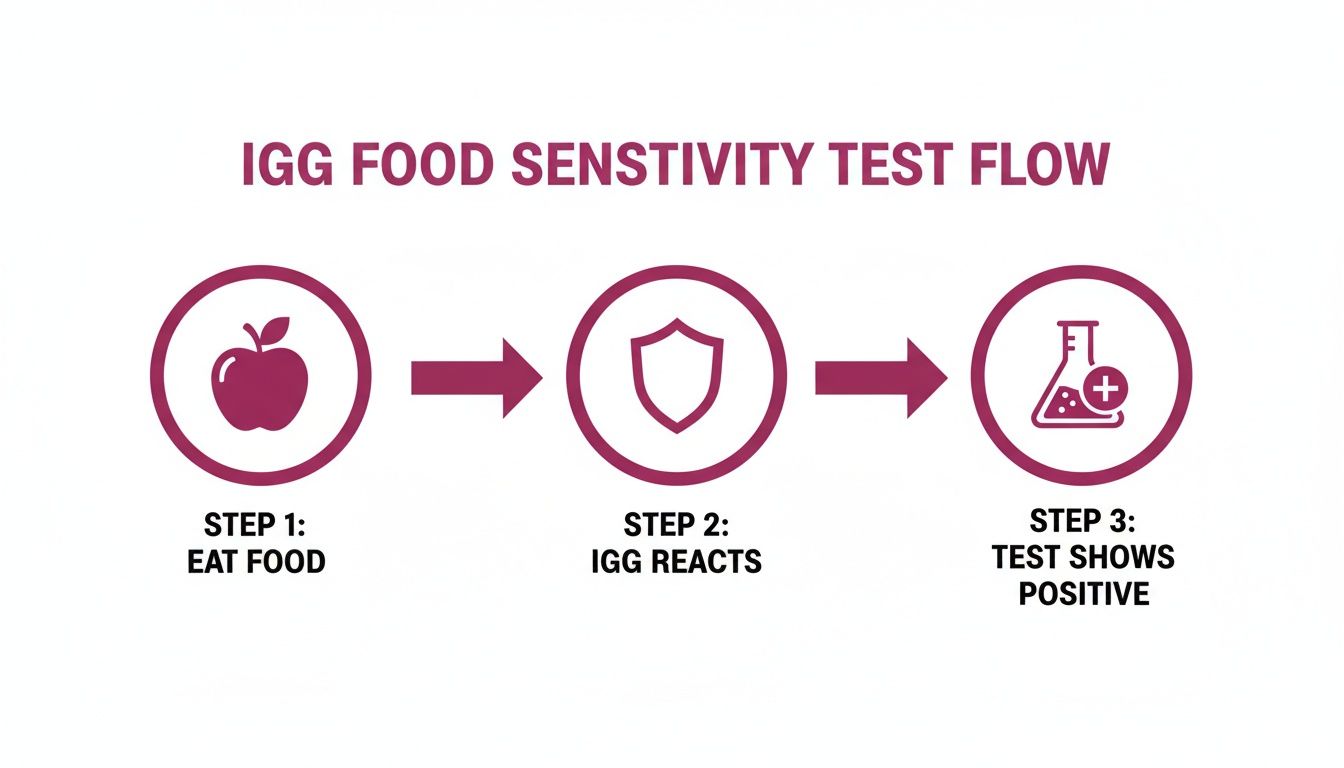
As you can see, simply eating a food can trigger a normal IgG response, which an at-home test might flag as a "positive" result even when it’s meaningless. This is exactly why the reintroduction phase, where you test foods against your actual symptoms, is the only way to get answers you can trust.
Here’s how to do it right:
- Choose One Food to Test: Start with a single food, like milk.
- Introduce a Small Amount: On day one, have a small serving of that food and pay close attention to how you feel.
- Increase If Tolerated: If you feel fine, eat a normal-sized portion on day two.
- Wait and Observe: Now, wait for three full days without introducing any other new foods. Stick to your otherwise elimination-friendly diet and meticulously track any symptoms that pop up.
That three-day waiting period is non-negotiable. Symptoms from a food intolerance can be delayed by up to 72 hours. If you reintroduce foods too quickly, you'll muddy the waters and won't know which food caused a reaction.
If your symptoms come back, you’ve found a likely trigger. Stop eating that food and wait for the symptoms to go away before you test the next one. If you have no reaction after three days, you can consider that food "safe" and move on. By repeating this process for every food you eliminated, you build your own personalized roadmap in your food intolerance testing at home journey.
How to Use Symptom Tracking to Find Your Triggers
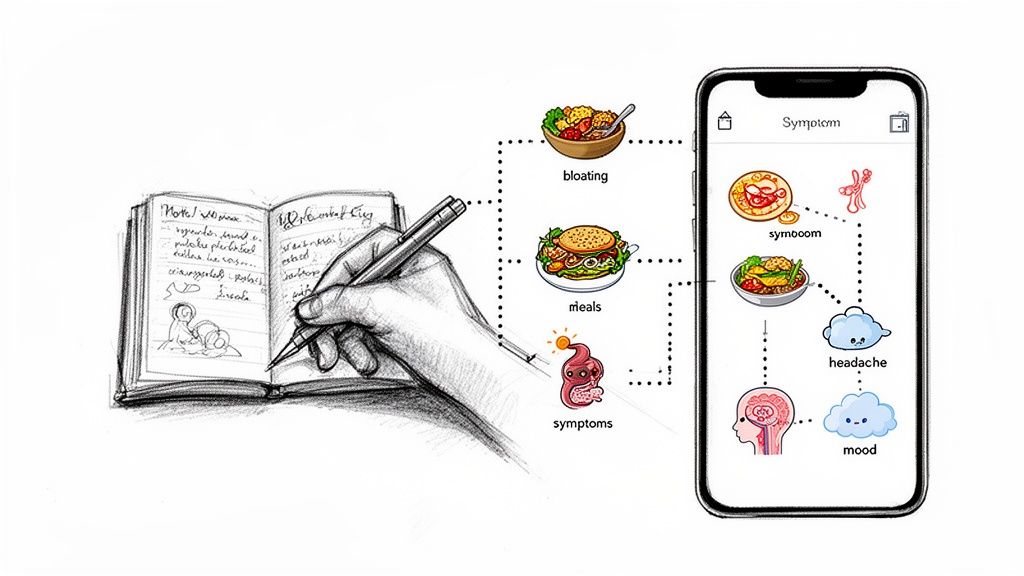
If an elimination diet is the road map for figuring out your food sensitivities, then consistent symptom tracking is the engine that gets you to your destination. Think of yourself as a detective on a case. Every meal, snack, and symptom you experience is a clue, and your job is to log them with enough detail to reveal the patterns hidden in your daily life.
This is what separates a successful investigation from a frustrating guessing game. It’s the only way you’ll finally connect the dots between that afternoon latte and the headache that pops up three hours later, or figure out why that "healthy" salad consistently leaves you feeling bloated and tired.
Setting Up Your Food and Symptom Journal
Honestly, the best tool for this is whichever one you’ll actually stick with. Some people love a simple notebook and pen; others prefer a dedicated app. The method doesn't matter as much as the consistency. Your goal is simply to create a reliable record of what goes into your body and how your body reacts.
A good log takes all the confusing data points from your day and turns them into something you can actually use. It’s a far more precise approach than any commercial kit because it’s built on your direct, real-world experience—not a questionable lab measurement.
To get started, just make sure every entry includes a few key details.
What to Record for Clearer Insights
For every meal and snack, you need to capture more than just the food itself. When it comes to pinpointing triggers, context is everything.
- The "What": Be specific. Instead of just writing "salad," list every single ingredient: "spinach, grilled chicken, cherry tomatoes, cucumber, balsamic vinaigrette."
- The "How Much": Estimate your portion sizes. Was it a few spoonfuls of yogurt or the whole bowl? This detail helps you spot dose-dependent sensitivities, where a small amount is fine but a larger one causes trouble.
- The "When": Log the exact time you ate. Because intolerance symptoms can show up hours or even days later, precise timing is absolutely crucial for connecting cause and effect.
Next, you’ll pair this food data with your symptoms. Again, be specific. Note the symptom itself (e.g., bloating, brain fog, fatigue, skin rash), what time it appeared, and its severity on a simple scale, like 1 to 5.
This level of detail is a game-changer. Once you start logging both your meals and how you feel, you can begin to spot correlations you'd otherwise miss, like how certain foods almost always show up before moments of low energy or digestive upset.
This shift toward personalized, data-driven self-investigation is gaining serious traction. In the US alone, where 26 million adults dealt with food allergies in 2020, people are looking for faster, more personalized answers. The convenience and real-world precision of at-home tracking are a big reason why this approach is resonating, especially for busy people who need clear guidance. You can explore more about this growing market and see how consumer health habits are changing.
By diligently tracking what you eat and how you feel, you are creating your own personalized dataset. This is the most reliable form of food intolerance testing at home because it’s based on your unique body and real-world reactions.
Ultimately, this methodical process helps you move beyond the confusing, often inaccurate results of a commercial test kit. Instead of a generic list of "red flag" foods, you get a clear, evidence-based understanding of which specific foods are truly affecting you. That knowledge is the key to building a sustainable diet that lets you feel your best.
When to Skip Self-Diagnosis and See a Doctor
Symptom tracking and elimination diets are fantastic tools for figuring out what’s going on with your body, but they have their limits. The whole process of food intolerance testing at home is really designed for those nagging, non-urgent digestive issues like bloating, gas, or general discomfort.
Sometimes, though, certain symptoms are more than just a nuisance—they’re red flags. It’s like the difference between a leaky faucet you can probably troubleshoot yourself and a burst pipe that needs a plumber, immediately. Some health symptoms are that burst pipe. They signal that something more serious might be happening, and trying to self-diagnose could dangerously delay the medical care you really need.
Serious Symptoms That Need a Doctor's Attention
If any of the following symptoms pop up, it’s time to pause your self-investigation and book an appointment with a healthcare professional. These aren't your typical signs of a food intolerance. They could point to a true food allergy or another underlying condition that needs a proper diagnosis.
- Sudden or Severe Reactions: Think hives, a rash, swelling of the lips, tongue, or throat, or trouble breathing right after eating. These are the classic signs of a true food allergy, an IgE-mediated immune response that can be life-threatening and requires immediate medical attention.
- Unexplained Weight Loss: Losing weight without even trying might sound nice in theory, but it can be a sign your body isn't absorbing nutrients correctly. This happens with serious conditions like Celiac disease or Inflammatory Bowel Disease (IBD).
- Persistent or Severe Pain: Mild abdominal discomfort can come with the territory of intolerances. Sharp, persistent, or truly severe abdominal pain does not.
- Blood in Your Stool: This is always a reason to see a doctor. It can be a symptom of IBD (like Crohn's disease or ulcerative colitis) or other serious gastrointestinal problems.
- Chronic Fatigue or Dizziness: We're not talking about just being tired. This is extreme exhaustion that sleep doesn't fix, and it can signal deeper issues like anemia or significant nutrient malabsorption.
These are all signs that go far beyond what an elimination diet can—or should—be used to address.
Distinguishing Intolerance from a Medical Condition
Understanding the line between a food intolerance and a medical condition is absolutely critical. A food intolerance is usually a digestive problem that causes discomfort. But something like Celiac disease is an entirely different beast—it's an autoimmune disorder where eating gluten triggers your immune system to attack your own small intestine.
Trying to diagnose a condition like Celiac disease on your own is incredibly risky. A proper diagnosis depends on specific medical tests, and you must continue eating gluten before being tested for the results to be accurate.
Likewise, IBD involves chronic inflammation in your digestive tract that requires ongoing medical management. Attempting to manage these conditions by yourself can lead to severe, long-term complications.
Which Doctor Should You See?
Navigating the healthcare system can feel overwhelming, but knowing who to call is the first step toward getting the right help.
- Your Primary Care Physician (PCP): This is always the best place to start. Your PCP knows your overall health history, can run initial tests, and can refer you to the right specialist if needed.
- An Allergist: If your symptoms scream "food allergy" (hives, swelling, immediate reactions), an allergist is the expert for you. They perform specific procedures like skin-prick tests to give you a definitive answer.
- A Gastroenterologist: For persistent gut issues like severe pain, chronic diarrhea or constipation, or blood in your stool, a gastroenterologist is the specialist to see. They are the experts in diagnosing and treating conditions of the entire digestive system, from IBD to Celiac disease.
Building a Sustainable Diet After Finding Your Triggers
So, you’ve pinpointed the foods that have been causing you trouble. That’s a massive accomplishment and the hardest part of the investigation is officially over. But it can also feel a little overwhelming. Now what?
The goal was never to shrink your world of food; it was to understand your body better. This isn't about restriction. It's about taking what you’ve learned and building a new way of eating that makes you feel incredible. You haven't lost foods so much as you've gained powerful information. Now you can finally craft a diet that truly works for you, not against you.
Finding Delicious and Nutritious Swaps
Once you have your list of foods to avoid, the fun part begins: discovering all the delicious things you can eat instead. Finding great substitutes is what makes this journey feel sustainable and exciting, rather than like a chore.
A little creativity in the kitchen goes a long way. Here are some of the most common swaps people make:
- If Dairy is a Trigger: The world of plant-based milks is huge! Oat milk makes for a creamy latte, almond milk is a classic for smoothies, and full-fat canned coconut milk adds unbelievable richness to curries and soups.
- If Wheat is a Trigger: Forget the sad, crumbly gluten-free products of the past. Today you can find incredible pastas made from corn, rice, lentils, or even chickpeas that have a fantastic texture and bite.
- If Eggs are a Trigger: When you're baking, a "flax egg" (just mix one tablespoon of ground flaxseed with three tablespoons of water and let it sit for a few minutes) is a game-changer. Mashed banana or applesauce also works beautifully to add moisture and act as a binder.
The best mindset shift is to focus on what you get to add to your plate. As you build out your new diet, you might also look into how certain gut health supplements can help support your digestive system through the transition.
Become a Savvy Label Reader
Problem ingredients have a knack for hiding where you least expect them. You might find dairy listed as "whey" or "casein", and gluten often lurks in soy sauce, salad dressings, and even soups. Getting comfortable with quickly scanning an ingredient label is an essential skill for feeling confident in your new routine.
Think of reading labels as your superpower. It puts you in complete control, allowing you to walk through a grocery store or look at a menu and know exactly what you're getting. No more accidental exposures or surprise symptoms.
At first, it might feel tedious, but you'll be surprised how quickly it becomes second nature. You'll start to recognize sneaky ingredients instantly and make informed choices without even thinking about it. This is what real food freedom looks like—knowing your body, knowing your food, and feeling fantastic.
Frequently Asked Questions
It’s natural to have more questions as you figure this all out. Let's tackle some of the most common ones we hear about at-home food intolerance testing.
Can At-Home Food Intolerance Tests Detect Celiac Disease?
Absolutely not. The IgG tests you can buy online are not designed for, and cannot diagnose, Celiac Disease.
Celiac is a serious autoimmune disease, which is entirely different from a food intolerance. Diagnosing it properly involves specific medical blood tests (like the tTG-IgA test) ordered by a doctor, and it's usually confirmed with an intestinal biopsy by a gastroenterologist.
Relying on an at-home IgG kit for a condition like Celiac is dangerous. It can prevent you from getting the essential medical diagnosis and care you need, leading to long-term health complications.
Should I Stop Eating A Food If An IgG Test Says I Am Sensitive?
My strong advice is no, not based on that test result alone. Seeing a high IgG level for a food like eggs or almonds doesn't prove it's causing your symptoms. More often than not, it just means you eat that food regularly and your immune system is familiar with it.
Cutting out whole food groups based on these tests can create a lot of unnecessary stress around eating and might even lead to nutritional gaps in your diet. A better approach is to see the result as a single clue—a starting point for a more structured investigation, like a proper elimination diet.
How Long Does It Take For Food Intolerance Symptoms To Show Up?
This is where things get tricky. Unlike a true food allergy where a reaction happens almost instantly, food intolerance symptoms are famously delayed. They can creep up on you anywhere from a few hours to as long as 72 hours after eating the offending food.
This big delay is exactly why it’s so hard to connect the dots on your own. It’s also why keeping a consistent, detailed log of your food and symptoms is the most powerful tool you have. It’s the only reliable way to spot a pattern between what you ate on Monday and how you felt on Wednesday.
Feeling like you're playing detective with your own body? Superbloom can make it simpler. Our AI-powered nutrition coach helps you easily track meals and symptoms, then finds personalized insights to guide you toward healthier habits—without the guesswork. Take the first step toward food freedom today at https://superbloomapp.com.