
Mastering Habit Formation Psychology for Real Change
The real secret to building better habits has little to do with 'trying harder' or having more discipline. The psychology of habit formation shows us that willpower is a resource that runs out, but our brain's love for automation is practically endless. This is exactly why trying to force change through sheer will so often leads to burnout and giving up.
Why Willpower Is Not Enough for Lasting Change
Let's be real for a moment. Relying on willpower alone to create new habits is a surefire way to get frustrated. Most of us have tried to "white-knuckle" our way to better eating or a consistent workout routine, only to watch our motivation evaporate after a few weeks. The issue isn't that you don't want it enough; it's that this approach goes against the very design of our brains.
Think of your brain as a super-efficient, energy-saving computer. Its main job is to conserve mental energy for new, complex problems. To do this, it automates as many daily actions as it can. This is the heart of habit formation psychology.
Your Brain's Autopilot System
When you repeat a behavior enough times in the same situation, your brain shifts it from the conscious, high-effort part of your mind to the automatic, subconscious part. This is a brilliant trick to free up your decision-making power. It's the reason you can drive a familiar route without remembering every turn or brush your teeth while your mind is a million miles away.
These automatic routines aren't just minor quirks—they pretty much run our lives. And recent research shows just how powerful this autopilot system really is.
A study in Psychology & Health revealed that about 66.34% of our daily behaviors are triggered by habit. Think about that: nearly two-thirds of what you do each day happens automatically, without you consciously deciding to do it. On top of that, once a habit starts, 87.6% of them are carried out automatically.
This data points to a crucial truth: you aren't fighting a constant battle of willpower. You're navigating a world of pre-programmed scripts that run in the background. Trying to override these scripts with brute force is like trying to stop a complex computer program with a single keystroke—it’s exhausting and rarely works for long.
Shifting from Brute Force to Smart Systems
Once you grasp this core principle of habit psychology, everything changes. The goal is no longer to have more willpower, but to work with your brain's natural desire to automate. Instead of fighting old patterns head-on, you can strategically design new ones to take their place.
This means making the behaviors you want easier and more obvious, while making the ones you don't want more difficult. It's about building systems that support your goals, especially for those times when motivation inevitably fades. Often, the real problem isn't a lack of desire, but a reliance on a strategy that's doomed from the start. For real, long-term success, you have to build healthy habits that actually stick.
When it comes to nutrition, this means setting up your environment so that healthy choices are the path of least resistance. This is the foundation for tools like Superbloom, which are designed to put these psychological principles into action. By helping you identify your triggers and build new, rewarding routines, you can create a system for success that works on its own. The struggle for self-control becomes a more graceful process of self-design, making healthy choices feel less like a chore and more like second nature.
How Your Brain Builds Habits on Autopilot
Have you ever found yourself mindlessly reaching for a snack when you weren't even hungry? Or maybe you've opened a social media app without consciously deciding to do so. These aren't random impulses. They're the result of a powerful, efficient process wired into our brains called the habit loop.
Understanding this simple, three-part cycle is the key to unlocking real, sustainable change. It's the psychological blueprint that governs so much of what we do each day, and learning to work with it is far more effective than fighting against it.
The Three Pillars of Every Habit
At its core, the habit loop is an energy-saving feature. Your brain is constantly looking for ways to work more efficiently, and when it finds a sequence—a trigger, an action, and a satisfying outcome—it automates it. This process frees up your conscious mind to deal with new challenges instead of getting bogged down in routine decisions.
This is the whole point of building good habits: moving from effortful, willpower-draining actions to effortless, automatic systems.
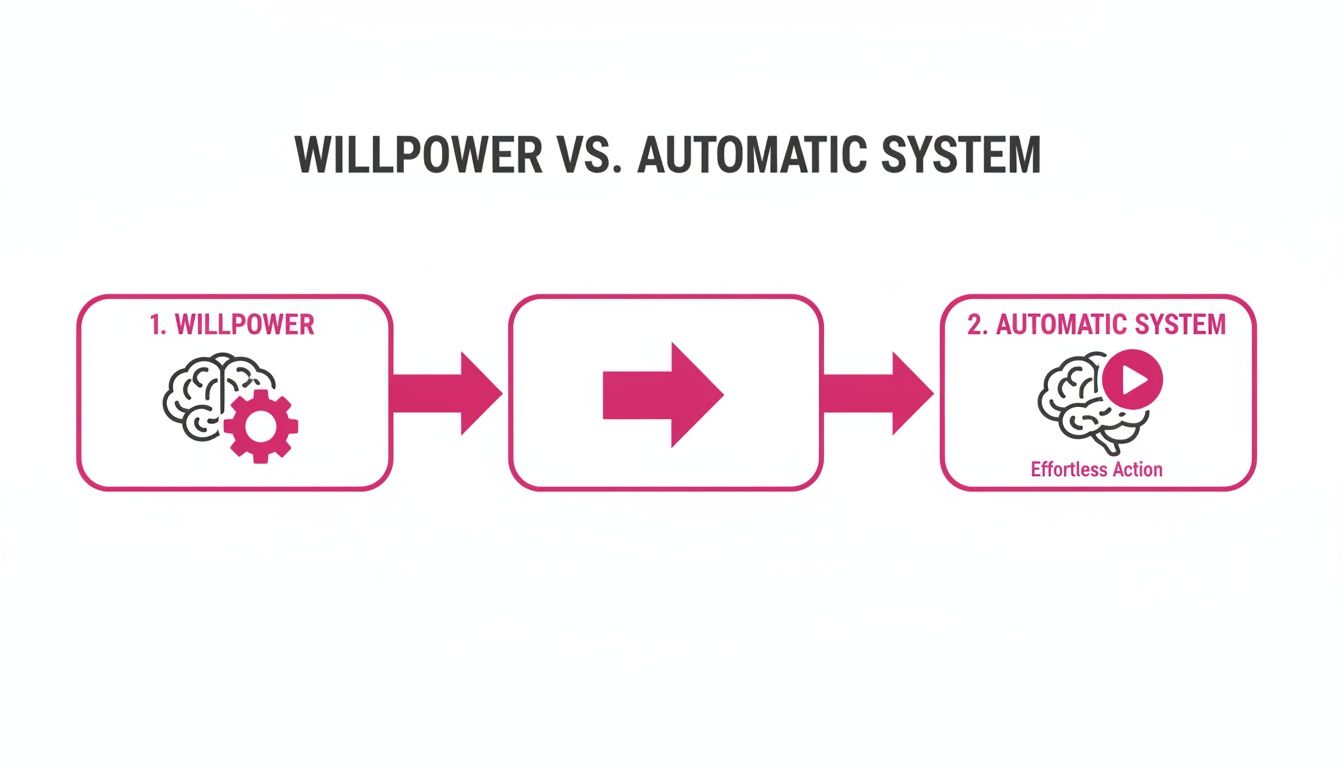
As the diagram shows, we want to shift from relying on the "Willpower" brain, which gets tired, to the "Autopilot" brain, which runs smoothly in the background.
So, what are the components of this powerful loop?
The Cue: This is the trigger that tells your brain to switch into automatic mode and run a specific habit. Cues can be a time of day (like the 3:00 PM slump), a place (the kitchen), an emotion (stress or boredom), or the action you just finished.
The Routine: This is the action itself—the physical, mental, or emotional behavior that follows the cue. When that 3:00 PM slump hits, your routine might be to walk over to the vending machine or grab a coffee.
The Reward: This is the payoff. It’s what tells your brain, "Hey, this loop is worth remembering!" The reward provides a feeling of satisfaction, solidifying the link between the cue and the routine. In our example, the sugar rush or caffeine kick delivers a quick burst of energy, which feels great in the moment.
Over time, this Cue-Routine-Reward cycle becomes so deeply ingrained that the cue itself starts to trigger a craving for the reward. Your brain anticipates the payoff before you even act, which is what makes habits so compelling and hard to break.
To change a habit, you can’t just remove one piece; you need to thoughtfully redesign the entire loop. The table below shows how you can swap an unhealthy routine for a healthier one while keeping the cue and satisfying the underlying need for a reward.
Re-Engineering the Habit Loop for Healthier Eating
By consciously choosing a new routine, you give your brain a better way to get the reward it’s looking for.
Forging New Paths in Your Brain
Think of a habit as a path through a dense forest. The first time you make the journey, it’s tough. You have to push through branches and pay close attention to where you're going. But each time you walk that same path, it gets clearer and wider. Eventually, it becomes a well-worn trail you can follow without a second thought.
The psychology of habit formation shows that every time you repeat an action, you physically strengthen the neural pathways in your brain. You're not just "doing a thing"—you're carving a groove that makes the behavior more automatic next time.
This is precisely why telling yourself to "just stop" a bad habit rarely works. You're trying to block a superhighway in your brain without offering a new exit ramp. The far better strategy, as outlined in the work of Charles Duhigg, is to keep the old cue and deliver the old reward, but insert a new routine.
For example, if your 3:00 PM slump (cue) sends you searching for a cookie, what you might really be craving is a quick break and a mood lift (the reward). Instead of the cookie (old routine), try listening to your favorite high-energy song for a few minutes (new routine). You still get the rewarding mental shift, but you've started carving a new, healthier path.
This is exactly how tools like Superbloom help you make progress. By prompting you to journal and track your meals and moods, the app helps you become a detective of your own behavior. You start to see the hidden cues and rewards that drive your choices, which is the essential first step to intentionally re-engineering your habit loops for good.
How Long It Really Takes to Build a Habit
You’ve probably heard it before: “It takes 21 days to form a habit.” It’s a catchy, optimistic idea that has stuck around for decades. The problem? It's largely a myth, and clinging to it can set you up for disappointment. When that initial burst of motivation wears off around week three, it's easy to feel like a failure.
So, let's talk about what the science actually says. A landmark study dug into this very question and found a much more realistic timeline. On average, it takes about 66 days for a new behavior to start feeling automatic. If you’re curious, you can dig into the full details of this habit formation research to see how they reached that number.
But here’s the most important part: "average" is just that—an average. The study uncovered a huge range, from as short as 18 days for simple actions to a whopping 254 days for more demanding lifestyle changes.
Why the Timeline Varies So Much
That massive difference in timing makes a lot of sense when you stop to think about it. The amount of effort a new habit requires—both mentally and physically—plays a huge role in how quickly it becomes second nature.
For example, compare these two goals:
- Simple Habit: Drinking a glass of water when you first wake up.
- Complex Habit: Cooking a healthy, home-cooked dinner every weekday.
The first goal is a single, straightforward action that takes less than a minute. The second involves a whole chain of behaviors: planning meals, buying groceries, prepping ingredients, cooking, and then cleaning up. It's no wonder the more complex a routine is, the longer your brain needs to cement the entire sequence.
Key Takeaway: Think of building a habit as a journey, not a sprint. The "21-day rule" is a recipe for frustration. A more powerful mindset is to embrace a longer timeline—expect it to take two, three, or even more months for a habit to truly stick.
This shift in perspective is a cornerstone of habit formation psychology. Knowing this keeps you in the game. When you stumble on day 30, you won't throw in the towel thinking you’ve failed. You’ll recognize it for what it is: a completely normal part of the process.
From Learning a Skill to Living a Habit
A great way to think about this is to compare habit-building to learning a new skill, like playing the guitar or speaking a new language.
In the beginning, everything is new and exciting. You learn a few basic chords or some common phrases, and that quick progress feels incredibly rewarding. This initial phase is fueled by novelty and high motivation.
But then, inevitably, you hit a plateau. Progress seems to slow to a crawl, and practice starts feeling like a chore. This is the make-or-break moment where so many people give up. It’s that tricky gap between your starting enthusiasm and the point where the skill finally clicks.
If you keep showing up and push through this phase, something amazing happens. One day, you just play the song without staring at the chords, or you find yourself ordering coffee in another language without mentally translating every word. The action has shifted from conscious, clunky effort to subconscious fluency.
Building healthy eating habits follows this exact same arc. This is where tools like Superbloom can make all the difference, helping you bridge that difficult middle phase. By journaling your experience and tracking your actions, the app gives you concrete proof that you're still making progress, even on days when it doesn't feel like it. It helps you stay consistent long enough for that new, healthy behavior to simply become your new normal.
Actionable Strategies for Building Better Habits
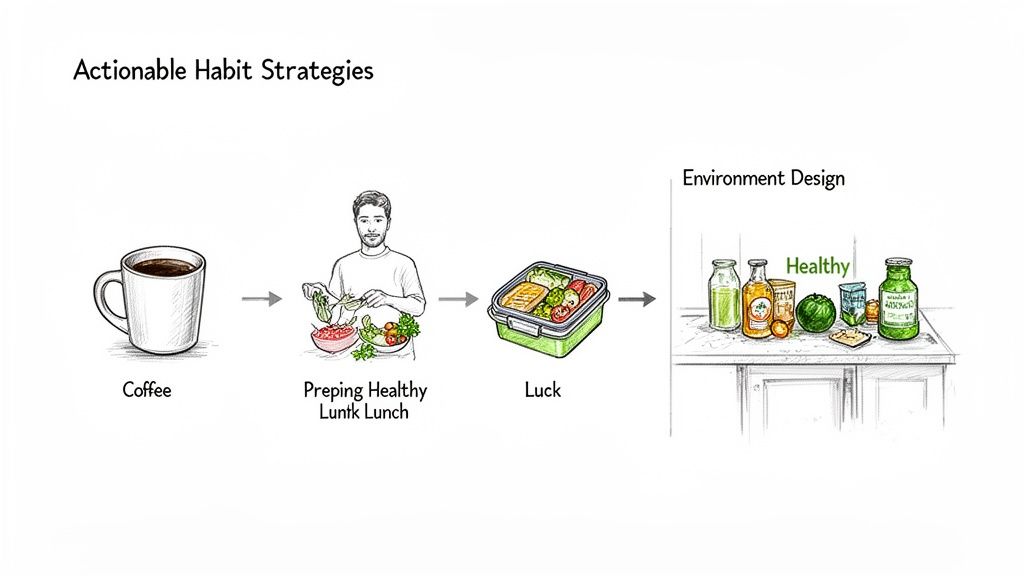
Knowing the science behind your habits is one thing. Putting that knowledge into practice is another. So, let’s move from theory to action with a few proven, psychology-backed strategies you can start using today. These techniques are all about working with your brain’s natural tendency to automate, not fighting against it.
A fan-favorite method is called Habit Stacking. The concept is brilliantly simple: you piggyback a new habit you want to build onto an existing one that’s already second nature. Your current habits act as powerful, pre-programmed cues in your brain, and you can essentially hijack that automatic trigger to launch a new behavior.
The formula looks like this: "After I do [Current Habit], I will do [New Habit]."
- Example 1: "After I brush my teeth in the morning, I will drink a full glass of water."
- Example 2: "After I pour my first cup of coffee, I will take out my vitamins."
- Example 3: "After I finish my work lunch, I will immediately pack a healthy snack for the afternoon."
By anchoring the new action to something you already do without thinking, you remove the need for constant reminders or a burst of motivation. The old habit becomes the cue for the new one, making the whole process feel much more natural. For more practical advice, you can find great tips on picking up productive habits that last.
Design Your Environment for Success
Another cornerstone of habit psychology is Environment Design. This is all about making your desired behaviors the easiest, most obvious choice while making the actions you want to avoid more difficult. Think of yourself as the architect of your own choices.
Instead of relying on sheer willpower to resist temptation, you can simply remove the temptation or make it harder to get to. At the same time, you make the healthy choice so convenient it becomes the path of least resistance.
The most disciplined people are often not those with the strongest willpower, but those who are best at structuring their lives so they don't have to use it. They make good habits inevitable and bad habits nearly impossible.
This means proactively shaping your physical and digital spaces to support your goals.
- To Eat Healthier: Don’t just decide to eat more fruit. Put a bowl of fresh apples and bananas right on your kitchen counter where you'll see it a dozen times a day. Meanwhile, hide the cookies on a high shelf where they’re out of sight and out of mind.
- To Drink More Water: Always keep a filled water bottle on your desk. That constant visual cue will prompt you to sip throughout the day without even thinking about it.
- To Prep More Meals: The night before, lay out the cutting board, knife, and containers you’ll need for your morning meal prep. By cutting down the number of steps it takes to get started, you lower the mental barrier to actually doing it.
When you curate your environment, you offload the hard work of decision-making. Your surroundings start to do the heavy lifting for you, gently guiding your automatic behaviors in the right direction.
Create Plans for When Things Go Wrong
Even with the best-laid plans, life gets in the way. Stress, a surprise deadline, or a change in routine can easily knock a new habit off track. This is where Implementation Intentions come in. It’s a powerful strategy where you create a specific "if-then" plan to handle potential obstacles before they happen.
The format is simple: "If [Obstacle X] happens, then I will [Healthy Response Y]."
This isn't about hoping you'll make the right choice under pressure. It's about pre-deciding your response so you can act on autopilot when the moment strikes.
Sample "If-Then" Plans for Nutrition:
- Plan 1: "If I get a craving for a sugary snack in the afternoon, then I will drink a cup of herbal tea and wait 15 minutes."
- Plan 2: "If I am too tired to cook dinner after work, then I will eat the healthy, pre-made frozen meal I have in the freezer."
- Plan 3: "If I go out to a restaurant with friends, then I will order a side salad as my appetizer before even looking at the main courses."
These simple plans are like pre-loaded responses, protecting you from making impulsive decisions that work against your long-term goals. They are a critical tool for building resilience as you form new habits.
This is where digital tools like Superbloom can really shine. The app's customizable prompts can remind you of your habit stacks, and its journaling feature is perfect for identifying those "if-then" scenarios that pop up in your life. By tracking your progress, Superbloom gives you the visual feedback that reinforces your new, healthier systems, making lasting change feel truly within your grasp.
How Identity Shapes Your Habits for Life

While tactics like habit stacking and environment design are incredibly effective, the real secret to making change stick for good lies a little deeper. The habits that last a lifetime aren't just things you do; they’re reflections of who you are. This is where we move beyond simple behaviors and into the core of habit formation psychology: building identity-based habits.
There's a subtle but profound difference between saying, "I'm trying to eat healthier," and truly believing, "I am a healthy person." The first one implies a struggle—an effort you're making against your "normal" self. The second one grounds your choices in who you are, making them feel authentic and almost effortless.
Instead of focusing on what you want to achieve (an outcome), you start by focusing on who you want to become (an identity). The right behaviors then naturally fall into place as a simple expression of that identity.
Every Action Is a Vote for Your Identity
Think of your identity not as something fixed, but as something you build with every choice you make. Each decision is like casting a vote for the type of person you want to be.
When you choose a salad over fries, that's a vote for "I'm a healthy eater." When you take a walk after dinner instead of sinking into the couch, that's a vote for "I'm an active person." When you take a moment to log your meal to understand its impact, that's a vote for "I'm someone who is mindful about my body."
Of course, one vote doesn't decide an election, and one healthy choice won't transform you overnight. But as those votes accumulate, so does the evidence. The more you prove this new identity to yourself, the more you internalize it. This is how you build real, lasting confidence—one small, consistent action at a time.
The goal is not to eat one healthy meal; the goal is to become a healthy eater. The goal is not to go for a run; the goal is to become a runner. Once you adopt that identity, you are no longer trying to convince yourself to act—you are simply acting in alignment with who you are.
Building Your New Identity
So how do you actually start building this new identity, especially when it feels like you're just pretending? The trick is to start with small, undeniable wins that make it easy to cast those first few votes.
- Focus on the Entry Point: Forget committing to an hour-long workout. Just put on your gym clothes. That's a small, easy vote for "I am someone who exercises."
- Acknowledge the Action: Don't stress about a "perfect" diet. Just focus on adding one more vegetable to your dinner plate. That's a tangible vote for "I am someone who eats nutritious food."
- Track the Proof: Don't just do the thing—make a note of it. Recording your wins creates a visual history of your new identity taking shape, which is absolutely critical for making it stick.
This is where tools like journals and progress trackers become so important. They’re not just for logging data; they are your personal book of evidence, proving who you're becoming.
How Superbloom Reinforces Your New Identity
This powerful psychological shift is exactly what Superbloom is built to support. The app is designed to help you look beyond just tracking numbers and start reflecting on the person you are becoming.
- Journaling as Proof: When you use Superbloom’s journal to note you chose water over soda, you're not just logging a drink. You’re creating a written record that proves you are a person who makes mindful choices for your health.
- Feedback for Reinforcement: The personalized feedback you get after logging a meal is more than just information—it's immediate validation. It confirms your choice was a good one, strengthening the mental connection to your new "healthy eater" identity.
- Progress Visuals as Evidence: Seeing your consistency charted over days and weeks gives you undeniable proof of your transformation. It shows you, in black and white, that you are repeatedly casting votes for the person you want to be.
By turning small actions into a visible story of success, Superbloom helps you earn your new identity. Before you know it, healthy choices stop feeling like a chore and simply become the most natural thing in the world—because that’s just who you are now.
Common Questions About Habit Formation
Even with a solid grasp of habit science, the real world always throws a few curveballs. The path to building better habits is rarely a straight line, so let's tackle some of the most common questions and sticking points.
Knowing how to handle these challenges is just as important as knowing which strategies to use. Think of this as your field guide for navigating the messy, human side of habit change.
What Should I Do If I Miss a Day?
First off, don't panic. Missing one day doesn't mean you've failed or have to start over from square one. It’s a common myth that a perfect, unbroken chain is the only way to succeed, but the research tells a very different story. A single slip-up has almost no measurable impact on your long-term progress.
The most important thing is what you do next. The golden rule is simple: never miss twice.
The real danger isn't the one missed day. It's the "what-the-heck" effect that can follow, where you let one little slip-up snowball into a missed week or even a month. Instead of aiming for perfection, shift your focus to how quickly you can recover. Acknowledge what happened, get curious about what threw you off, and get right back to your routine at the very next opportunity. Consistency over time is always more powerful than a short-lived, perfect streak.
How Can I Break a Bad Habit Like Emotional Eating?
Breaking a bad habit is one of the toughest challenges out there, mostly because you can't just erase a behavior. Your brain has a well-worn neural pathway for that habit, and simply trying to stop it leaves a void. The most effective strategy is to replace the bad habit with a better one.
To do this, you have to become a detective of your own behavior. Start by dissecting its habit loop:
- Identify the Cue: What’s the trigger that kicks off the urge? With emotional eating, it's often an emotion like stress, boredom, or loneliness—not actual physical hunger.
- Understand the Routine: What’s the action you take? In this case, it’s reaching for comfort food.
- Pinpoint the Real Reward: What craving is the routine really satisfying? It probably isn't nutrition. It's more likely a feeling of comfort, a distraction from a tough emotion, or a moment of relief.
The secret to changing a habit is to keep the same cue and deliver the same reward, but to insert a new, healthier routine. By satisfying the underlying craving in a different way, you teach your brain a better solution.
For example, let's say your cue is "feeling stressed after a long meeting," and the reward you're chasing is "a mental break and a sense of calm." You can start experimenting with new routines. Instead of grabbing chips, you could try listening to one specific song, stepping outside for five minutes of fresh air, or just writing down what's stressing you out. Once you find a new routine that successfully delivers that feeling of calm, you'll start to overwrite the old, unhelpful one.
Why Do I Lose Motivation After a Strong Start?
This is probably the most frustrating—and most common—experience when building new habits. You kick things off with a huge burst of excitement, but a few weeks in, that initial fire dies down. Suddenly, sticking with the routine feels like a total grind. This is completely normal.
Initial motivation is an emotion. And like all emotions, it's fleeting. It’s a fantastic starter, but it makes for a terrible long-term fuel source. Habits, on the other hand, are automatic behaviors that are designed to run without needing motivation.
That tough period you're feeling is what experts sometimes call the "valley of despair"—it's the gap between your fading motivation and the point where the behavior finally becomes automatic. The key to getting through it is to stop relying on how you feel and start relying on your system.
- Reduce Friction: Make your new habit ridiculously easy to do. If you want to go for a morning run, lay out your clothes, shoes, and headphones the night before. Remove every single barrier standing between you and the action.
- Make the Reward Immediate: The long-term benefit of "being healthier" is too abstract to power you through the dip. You need to find a way to reward yourself immediately after doing the habit. This could be as simple as tracking your success in an app like Superbloom and feeling that little jolt of satisfaction from seeing your progress streak grow. That small, instant win tells your brain the effort was worth it, which helps reinforce the entire loop.
Ready to turn this knowledge into action and build habits that truly last? Superbloom uses the power of habit formation psychology to provide personalized guidance that helps you understand your patterns and make healthier choices feel effortless. Start your journey to lasting change today.