
Habit Stacking Examples: Quick, Practical Routines for Every Day
Have you ever tried to start a new healthy eating habit, only to have it fall apart after a few days? You are not alone. The problem often is not a lack of willpower, but a flawed strategy. Instead of starting from scratch, the most effective method is to attach a new, desired behavior to an existing one, a technique called habit stacking.
This article moves beyond theory to provide concrete, practical habit stacking examples focused on improving your relationship with food. We will break down eight specific stacks you can implement immediately to build awareness, interrupt unhelpful patterns, and create sustainable change without restrictive dieting. To truly build habits that actually stick, consider incorporating a consistent daily practice, like the advice found in this comprehensive guide to daily practice.
You will learn not just what to do, but the why behind each stack, with tactical insights to make these habits feel effortless and automatic. We will analyze specific combinations like a Meal + Reflection Stack and a Trigger + Alternative Response Stack. The goal is to give you a clear, replicable system for integrating mindful eating into your life, one small step at a time.
1. Meal + Reflection Stack
The Meal + Reflection Stack is a powerful method for breaking the cycle of mindless eating. It works by inserting a moment of awareness directly after you finish a meal or snack. Instead of moving on to the next task, you anchor the new habit of reflection to your existing habit of eating.
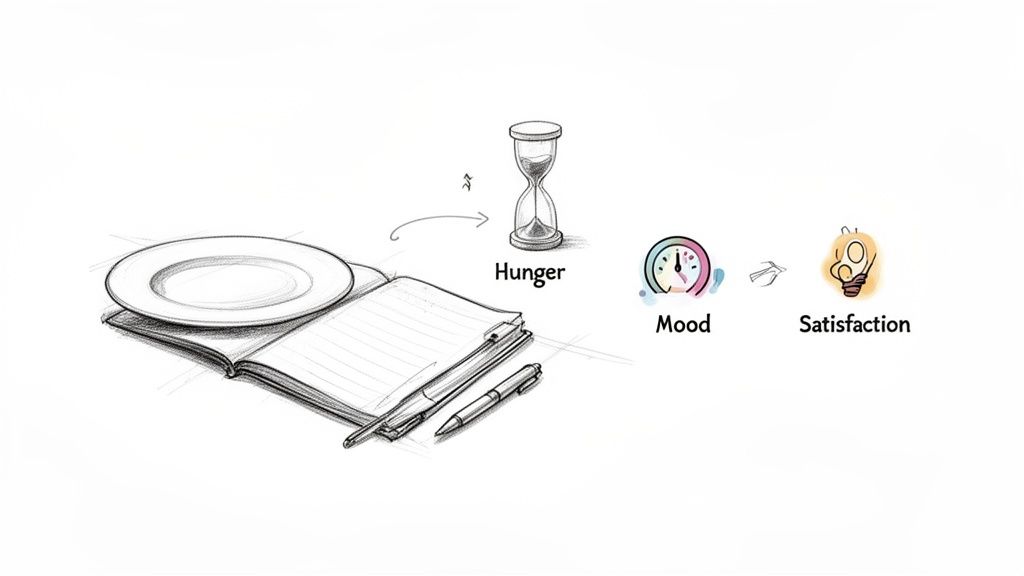
The process is simple: immediately after eating, you log what you consumed and spend 2-3 minutes answering a few guided questions. This practice directly addresses the root causes of unconscious eating habits by connecting your food choices to your physical and emotional state.
Strategic Breakdown
This is one of the most effective habit stacking examples for building nutritional awareness without the pressure of calorie counting. The core strategy is to create a feedback loop between action (eating) and insight (reflection).
- Existing Habit: Finishing a meal (e.g., lunch at your desk, dinner at home, an evening snack).
- New Habit: Opening a journal or app (like Superbloom) to answer simple reflection questions.
Key Insight: The goal isn't to judge the meal as "good" or "bad." The purpose is to build a dataset of your body's unique responses to food, stress, and environment. Over time, this reveals patterns that calorie counts alone can never show.
Actionable Tips for Implementation
To make this habit stick, reduce friction and start small.
- Set an Immediate Reminder: Use a phone alarm or calendar notification that triggers the moment you typically finish eating.
- Start with One Meal: Don't try to reflect after every single thing you eat. Choose one meal, like lunch, to focus on for the first week.
- How hungry was I before this meal (1-10)?
- How satisfied do I feel now (1-10)?
- What emotions am I feeling right now (e.g., stressed, bored, calm)?
- Focus on Weekly Patterns: Review your reflections at the end of the week. Look for connections between high-stress days and food choices, or certain foods and afternoon energy slumps.
- Existing Habit: Your first morning activity (e.g., pouring a cup of coffee, opening your curtains, brushing your teeth).
- New Habit: Setting one specific eating intention for the day and logging it in a journal or an app like Superbloom.
- Be Highly Specific: Your intention should be a clear, physical action. For example, "I will pause and notice my feeling before reaching for an afternoon snack."
- Focus on One Intention Daily: Trying to manage multiple goals at once leads to decision fatigue. Choose one focal point per day to build momentum.
- Review and Refine: Before setting today’s intention, take 30 seconds to review yesterday's. Did you succeed? Why or why not? Use that insight to inform your new goal.
- Use Your Data: If you're tracking your habits, review your weekly patterns. If you notice you often feel bloated after dinner, a good intention might be "I will eat my last meal two hours before bed."
- Existing Habit: Responding to a trigger (e.g., feeling afternoon work stress, end-of-day boredom, or fatigue).
- New Habit: Immediately engaging in a pre-planned alternative behavior (e.g., making herbal tea, listening to a podcast, doing a few stretches).
- Log Your Triggers: For one week, jot down when and why you eat or snack, especially when you're not hungry. Note the time, place, and your emotional state to find the real patterns.
- Design a Better Response: Brainstorm alternatives that address the need. For stress, try deep breathing or a walk. For boredom, have a compelling podcast or book ready.
- Make the Alternative Accessible: Keep herbal tea bags on your desk. Have your walking shoes by the door. Pre-load a five-minute guided meditation on your phone. Reduce friction for the new habit.
- Start with One Trigger: Focus on rewriting a single, high-impact trigger-response pair, like the "3pm slump," before adding others. Master one before you expand.
- Existing Habit: Sitting down to eat a meal or snack.
- New Habit: Taking a photo of your plate before you begin eating and reviewing the AI feedback.
- Take Clear Photos: For the best AI analysis, take photos from directly above your plate. Include your hand or a standard object for scale to help the app gauge portion sizes.
- Focus on Patterns, Not Perfection: Don't feel pressured to act on every single suggestion. Instead, review feedback at the end of the week to identify recurring themes, like consistently low fiber intake at breakfast.
- Use Feedback for Future Planning: If the app frequently suggests adding protein to your lunch, use that insight to plan your next grocery trip. The goal is to build your own intuition for balanced meals.
- Gradually Adjust Portions: Based on the feedback, make small changes to your portions over a one to two-week period and observe how you feel. For example, slightly increase your vegetable portion and see how it affects your afternoon energy levels.
- Existing Habit: The impulse to eat (e.g., reaching for a snack, opening the fridge after dinner).
- New Habit: Pausing for 2-3 minutes to ask yourself a few key questions before you eat.
- Use a Trigger: Set a simple timer on your phone for two minutes the moment you feel the urge to have a non-mealtime snack.
- Start with Discretionary Eating: First, apply this pause only to unplanned snacks or desserts. Once it feels natural, you can expand it to meals.
- Am I physically hungry? (e.g., stomach pangs, low energy)
- What emotion am I feeling right now? (e.g., anxious, bored, lonely)
- What am I truly craving? (e.g., comfort, distraction, hydration)
- Track Your Discoveries: Note how often the pause changed your decision. Observing that you chose rest over a snack 5 out of 7 times this week reinforces the habit's value.
- Existing Habit: The clock hitting a predetermined mealtime (e.g., 12:00 PM for lunch).
- New Habit: Pausing to check in with an app like Superbloom to note hunger levels before eating and satisfaction levels after.
- Choose Realistic Times: Select eating windows that fit your existing work and personal schedule. A shift worker might have two different schedules they alternate between. The goal is consistency within your reality.
- Plan Meals Loosely: To reduce stress at mealtimes, have a rough idea of what you'll eat. This prevents you from defaulting to less-nourishing convenience foods.
- Prioritize Satisfaction: If you feel hungry outside your windows at first, ensure your meals contain enough protein, fiber, and healthy fats to keep you full. Your body will adapt.
- Use Check-Ins to Adjust: At each mealtime, use your check-in to assess how the last eating window felt. Were you starving an hour before lunch? Maybe your breakfast needs more protein. The data guides your adjustments.
- Existing Habit: Finishing a workout (e.g., leaving the gym, ending a run, completing a yoga session).
- New Habit: Completing a detailed check-in on hunger, cravings, and energy levels at set intervals after exercise.
- Log Your Workout: Before checking in, note the exercise type and duration. This provides crucial context for your hunger signals.
- Use Timed Check-ins: Assess your hunger and cravings at multiple points post-exercise, such as 30 minutes, 2 hours, and 4 hours after. This reveals how your appetite evolves.
- Fuel First, Then Assess: Consume a planned post-workout snack with protein and carbs before your first check-in. This helps you distinguish true hunger from a simple need for recovery fuel.
- Identify Hunger vs. Habit: When a craving strikes, ask yourself: Is this genuine physical hunger, or is it a psychological response like "I worked hard, so I deserve this"? This kind of structured self-query is also a core part of building consistent habits with systems like Intermittent Fasting, where timing and awareness are key.
- Existing Habit: Feeling a strong emotion (e.g., stress, loneliness, frustration).
- New Habit: Pausing to identify the emotion and choosing a supportive action before eating.
- Build Your Emotional Vocabulary: For one week, simply notice and name your emotions without changing your eating habits. Just write down, "Feeling overwhelmed," or "Feeling bored."
- Create a Coping Menu: List non-food coping strategies that work for you. For stress, this might be a 5-minute walk. For loneliness, it could be texting a friend.
- Choose Nourishment, Not Restriction: If you do decide to eat while emotional, focus on what would feel genuinely nourishing. Avoid the shame spiral, which often leads to more unhelpful eating patterns.
- Review Weekly Patterns: Look at your notes at the end of the week. Do you notice that you mostly eat out of boredom on weekday afternoons? Identifying your biggest triggers is the first step to addressing them. For more structured support, consider tools that offer coaching on emotional eating.
- Choose Just One: Don't overwhelm yourself. Select the single habit stack that resonates most with your current challenges, whether it's mindless snacking at your desk or late-night stress eating.
- Define Your "After": Be specific. Instead of a vague goal, clearly define the existing habit you will anchor your new action to. For example, "After I close my laptop for the day, I will immediately drink a glass of water and stretch for two minutes."
- Track Your Consistency: For the first week, focus only on performing the action, not on the outcome. Mark a calendar or use a simple note to track how many days you successfully completed your stack. This builds momentum and self-efficacy.
- Iterate and Adapt: If a stack isn't working, don't abandon the concept. Analyze why it's failing. Is the anchor habit not consistent enough? Is the new habit too difficult? Tweak the formula until it fits. Perhaps your Pre-Eating Pause + Decision Stack needs to happen when you open the fridge, not when the plate is already in front of you.
2. Morning Intention + Eating Stack
The Morning Intention + Eating Stack creates a direct link between your daily nutritional goals and your actions. This method anchors the new habit of setting a mindful eating intention to your existing morning routine, such as making coffee or brushing your teeth. It primes your brain to be more aware of your food choices throughout the day.
This approach works by starting your day with a single, clear intention about your eating behavior. For instance, a busy professional might set an intention to "eat lunch seated at a table, not at my desk." This simple act of pre-commitment makes you more likely to follow through when the moment arrives.
Strategic Breakdown
This is one of the most proactive habit stacking examples because it sets the stage for success before hunger or stress can dictate your choices. The strategy is to move from a reactive eating pattern to an intentional one, guided by a goal you set when you are calm and clear-headed.
Key Insight: The focus is on specific behaviors, not ambiguous outcomes. An intention like "I will eat healthier" is too vague. Instead, "I will add a vegetable to my lunch" is a concrete, measurable action that you can easily track and achieve.
Actionable Tips for Implementation
To make this habit effective, keep your intentions simple and your feedback loop tight.
3. Trigger + Alternative Response Stack
The Trigger + Alternative Response Stack is a proactive strategy to dismantle unwanted eating habits before they even start. It works by identifying the specific trigger that prompts an automatic behavior (like stress eating) and consciously replacing the action with a planned, more beneficial one. Instead of mindlessly reaching for a snack, you interrupt the habit loop with a chosen alternative.
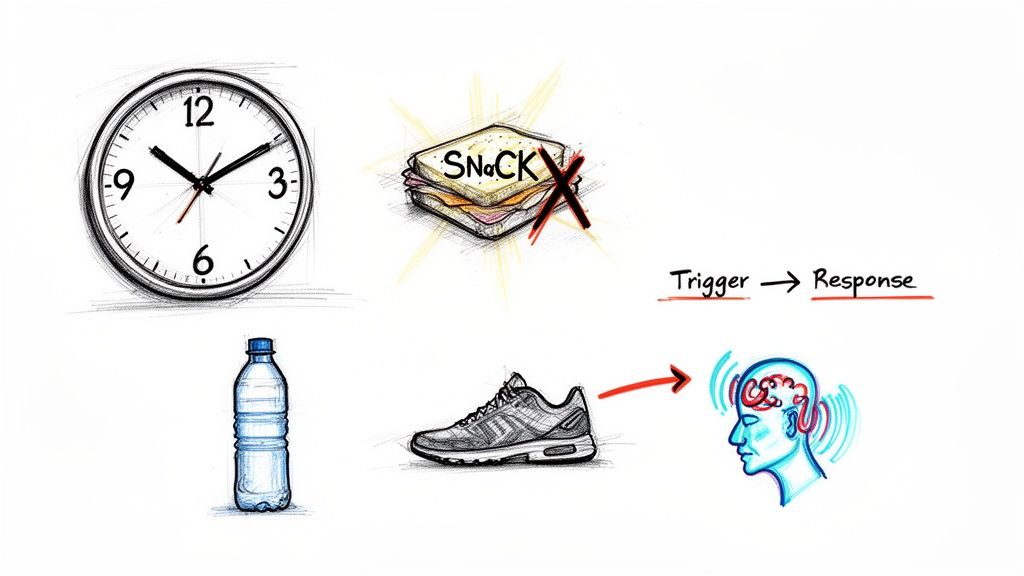
For instance, when you feel the 3pm energy slump, you might automatically grab a cookie. With this stack, you recognize the dip as your cue and instead drink a glass of water and take a five-minute walk. This method directly targets the link between your trigger and your response.
Strategic Breakdown
This is one of the most effective habit stacking examples for breaking cycles of emotional or boredom-driven eating. The core strategy is to insert a new, conscious choice between the cue and the routine, effectively rewriting your brain's automatic script.
Key Insight: The goal isn't just to stop a behavior; it's to address the underlying need the old habit was trying to meet. If you eat out of boredom, your alternative should provide stimulation. If you eat due to stress, it should promote relaxation.
Actionable Tips for Implementation
Success with this stack depends on accurate trigger identification and making the new response as easy as possible.
4. Meal Photo + Instant Feedback Stack
The Meal Photo + Instant Feedback Stack modernizes meal tracking by turning your phone's camera into a personal nutrition coach. This method connects the simple action of taking a photo of your food with receiving immediate, AI-driven suggestions. It closes the gap between eating and understanding, providing a quick feedback loop to improve nutritional awareness without calorie counting.
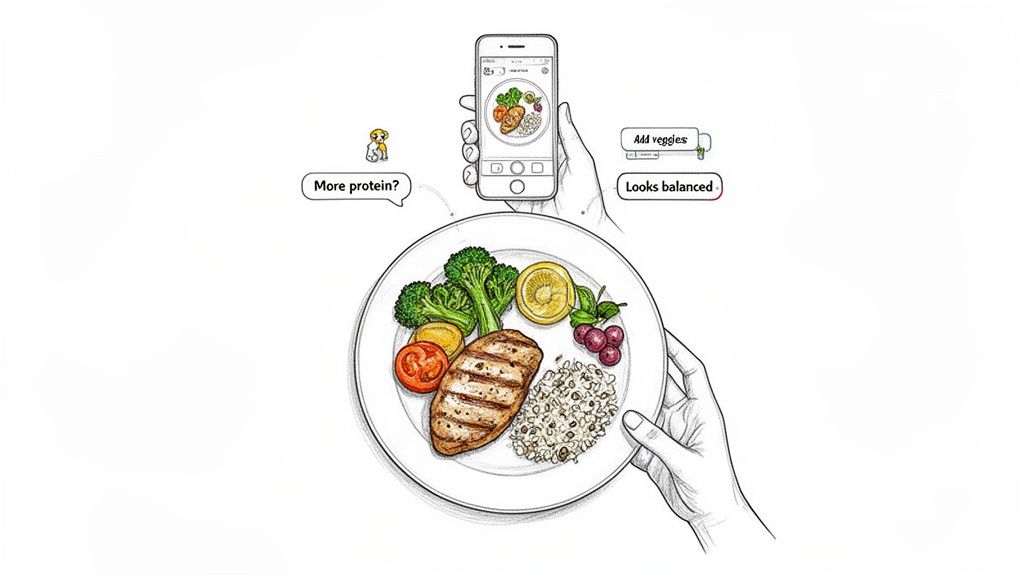
The process is fast and intuitive. Just before eating, you snap a photo of your meal. An AI-powered app like Superbloom analyzes it and offers objective observations, such as "Consider adding a source of protein" or "Great job including fiber!" This creates a supportive, non-judgmental environment to build lasting intuition.
Strategic Breakdown
This is one of the most practical habit stacking examples for people who want actionable guidance in real time. The strategy bypasses manual logging and delivers personalized insights at the moment of decision-making.
Key Insight: This stack isn't about achieving a "perfect" plate every time. Its power comes from creating a consistent data stream that reveals nutritional patterns, helping you see where small adjustments-like adding more vegetables at lunch-can have a big impact on your energy and satisfaction.
Actionable Tips for Implementation
To make this habit effective, aim for consistency and a focus on long-term patterns.
5. Pre-Eating Pause + Decision Stack
The Pre-Eating Pause + Decision Stack is a powerful technique for regaining control over impulsive eating. It introduces a brief, intentional interruption right before you eat, creating a crucial space between a craving and your response. This simple pause allows you to check in with your body's actual needs.
This method works by giving your prefrontal cortex, the rational part of your brain, a chance to catch up with the automatic impulses driven by habit or emotion. For example, a stress eater might pause before grabbing a bag of chips, realize they are actually just tired, and choose to rest instead. Similarly, someone reaching for an afternoon snack might discover they are simply thirsty and opt for a glass of water.
Strategic Breakdown
This is one of the most effective habit stacking examples for short-circuiting emotional and habitual eating patterns. The core strategy is to create a "choice point" where you can consciously decide your next action instead of reacting on autopilot.
Key Insight: This pause isn't about restriction; it's about information gathering. The goal is to identify the true driver of your desire to eat. Is it physical hunger, boredom, stress, or just habit? The answer empowers you to meet your real need.
Actionable Tips for Implementation
To make this pause a consistent habit, focus on making it automatic and non-judgmental.
6. Time-Based Eating Window + Check-In Stack
This stack creates a predictable eating rhythm to reduce decision fatigue and retrain your body's natural appetite signals. It works by establishing consistent meal times and pairing each one with a quick check-in about your hunger and satisfaction. This approach moves you from grazing or chaotic eating to a structured, mindful pattern.
The process is straightforward: you commit to eating at specific times (e.g., 7 am, 12 pm, 6 pm) and use those moments as a trigger for a brief reflection. For a busy professional, this eliminates the constant "what should I eat now?" mental load. For someone trying to stop grazing, it rebuilds the body's ability to recognize true hunger cues.
Strategic Breakdown
This is one of the most effective habit stacking examples for anyone whose eating schedule feels erratic or out of control. The strategy here is to use time as an anchor, creating predictability that calms the nervous system and simplifies food choices.
Key Insight: This stack isn't about rigid restriction; it's about creating structure. By setting specific eating windows, you give your digestive system a break and allow genuine hunger signals to emerge, rather than eating based on boredom, stress, or opportunity.
Actionable Tips for Implementation
To succeed with this habit, align the structure with your lifestyle and start with a plan.
7. Movement + Eating Awareness Stack
The Movement + Eating Awareness Stack connects physical activity with your subsequent food choices. This method helps you distinguish between genuine post-exercise hunger and psychological eating triggers like boredom or the feeling that you "earned" a treat. It works by creating a conscious check-in point after exercise to observe how movement influences your appetite and cravings.
Instead of automatically reaching for a recovery shake or a big meal, you anchor a new habit of awareness to your existing habit of finishing a workout. This practice builds a deeper understanding of your body's specific nutritional needs based on the type, duration, and intensity of your activity.
Strategic Breakdown
This is one of the most powerful habit stacking examples for optimizing fitness and nutrition together. The core strategy is to use exercise as a cue to observe your body's signals, turning your post-workout window into a period of learning.
Key Insight: Not all exercise creates the same hunger response. A high-intensity weight training session might demand more fuel than a restorative yoga class. This stack helps you move from generic "post-workout" nutrition to a personalized strategy based on your own data.
Actionable Tips for Implementation
To make this habit effective, gather context and look for patterns over time.
8. Stress/Mood Awareness + Food Choice Stack
The Stress/Mood Awareness + Food Choice Stack is a technique for managing emotional eating by linking your feelings directly to your food decisions. It works by creating a deliberate pause when you feel a strong emotion, allowing you to acknowledge the feeling first and then choose a response, which might be food or another coping strategy.
This method directly confronts the common habit of using food as an automatic reaction to stress, boredom, or sadness. Instead of unconsciously reaching for a snack, you build a new habit of emotional check-ins, giving you control over your actions. For example, an anxious professional might notice their stress, opt for herbal tea and a few minutes of breathing, and then decide if they are still truly hungry.
Strategic Breakdown
This is one of the most powerful habit stacking examples for anyone who feels their eating is driven by their emotions rather than physical hunger. The core strategy is to intercept the emotion-to-eating pipeline and insert a moment of conscious choice.
Key Insight: The goal is not to stop emotional eating entirely but to make it a conscious choice rather than a mindless reaction. This builds a toolkit of responses beyond food, reducing food's role as the primary solution for emotional discomfort.
Actionable Tips for Implementation
To make this stack effective, start by building awareness before trying to change your actions.
Comparison of 8 Habit Stacks
From Stacking Habits to Lasting Change
Throughout this article, we've explored a variety of practical habit stacking examples designed to weave healthier eating choices into the fabric of your daily life. The core principle is simple: attach a new, desired behavior to an established, automatic routine. This method removes the friction and decision fatigue that so often derail our best intentions.
From the Meal + Reflection Stack that builds mindful awareness to the Trigger + Alternative Response Stack that helps you regain control over emotional eating, each example provides a replicable framework. The power isn't in adopting all eight at once, but in understanding the strategic thinking behind them. You are essentially creating a personalized system that works with your life, not against it. The goal isn't immediate, flawless execution, but consistent, incremental progress.
Turning Knowledge into Action
The most important takeaway is that habit stacking is a skill that improves with practice. The initial clumsiness of pausing before a meal or logging a food photo eventually becomes a smooth, automatic sequence. This is where lasting change is forged.
Here are your actionable next steps:
Mastering these concepts allows you to move from being a passive participant in your health to an active architect of your well-being. You begin to see your routines not as fixed, but as a series of connection points where new, positive behaviors can be integrated. This shift in perspective is the foundation for creating sustainable, long-term health without resorting to restrictive diets or feeling deprived. You are building a system of support, one small, stacked habit at a time.
Ready to accelerate your progress and gain deeper insights from your new habits? Superbloom is designed to help you connect the dots between your actions and their outcomes, making it the perfect companion for implementing these habit stacking examples. The platform provides the structure to track your stacks and the intelligent feedback needed to understand your body's unique patterns. Start your journey with Superbloom today and turn small, consistent actions into lasting well-being.