
How to Break Bad Eating Habits A Science-Backed Guide

If you've ever found yourself polishing off a bag of chips while watching a movie or reaching for a candy bar every single afternoon, you know how automatic it can feel. This isn't a sign of weak willpower. It's actually a sign that your brain is working exactly as it's designed to—by creating mental shortcuts to save energy.
This powerful shortcut is called the habit loop, a simple neurological pattern that drives most of our daily behaviors, especially when it comes to eating. It’s made up of three parts: a cue, a routine, and a reward.
The Real Reason Your Eating Habits Feel Stuck
Trying to just "stop" a bad eating habit cold turkey is like trying to dam a river with a few sandbags. It's an exhausting, uphill battle against your brain's most basic programming, and it almost always ends in frustration. This is the core reason so many diets fail long-term.
Your brain is incredibly efficient. When you do something that leads to a feeling of pleasure or satisfaction (the reward), your brain logs it. Repeat that action enough times, and it automates the whole process.
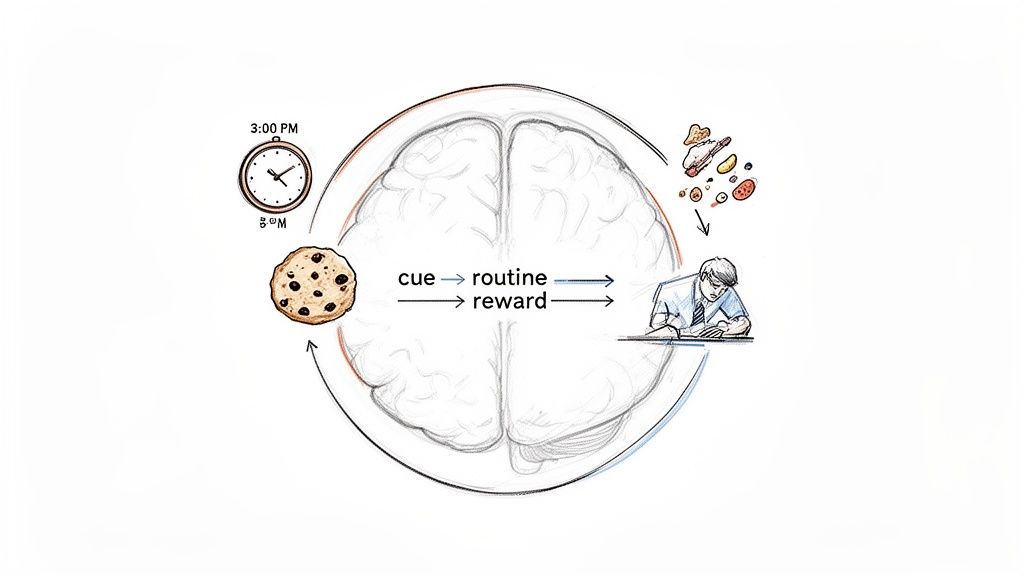
This is why you don’t consciously decide to raid the pantry when you're stressed; you just find yourself doing it. Your brain has already connected the dots.
The Science of Automatic Behavior
Let's break down the three parts of this loop so you can see them in action.
The Cue: This is the trigger that tells your brain to go into automatic mode. It could be a time of day (that 3 PM slump), an emotion (feeling overwhelmed after a tough meeting), a specific place (your kitchen counter), or even the people you're around.
The Routine: This is the behavior itself—the eating habit you want to change. It might be grabbing a soda, ordering greasy takeout, or mindlessly snacking while you scroll through your phone.
The Reward: This is the satisfying feeling that reinforces the habit, telling your brain, "Hey, let's do that again!" The reward isn't always obvious. It could be a quick sugar rush, a moment of comfort, or simply a welcome distraction from boredom.
Because this loop becomes so ingrained, just trying to eliminate the routine feels nearly impossible. Your brain still gets the cue, and it screams for the reward it’s been conditioned to expect. This explains the classic cycle of restrictive dieting followed by a relapse.
In fact, while over half of American adults tried a diet last year, some studies show relapse rates for these plans can soar as high as 80%. This has sparked a much-needed shift toward more sustainable, habit-based approaches. It also reflects the goals of the 45% of consumers who say their main priority is simply to feel better and more energized. You can dive deeper into these evolving nutrition trends to see the bigger picture.
The key isn't to fight your brain but to work with it. By understanding your unique cue-routine-reward loops, you can begin to consciously redesign them, paving the way for lasting change without the struggle of constant self-denial.
Uncovering Your Hidden Eating Triggers
Lasting change begins with awareness, not brute force or restriction. If you really want to understand how to break bad eating habits, you have to become a detective of your own life. This means digging in to find the specific cues—the who, what, when, and where—that launch you into those eating patterns you want to change.
Many of us just slap a generic label on it, like "stress eating." But that's too broad to be helpful. Real progress comes from pinpointing the exact moment, place, or feeling that kicks off the whole cycle.
Think of it this way: if your car kept stalling, you wouldn't just say it's "broken." You’d pop the hood to find the real problem—a dead battery, a loose wire. We need to do the same with our habits.
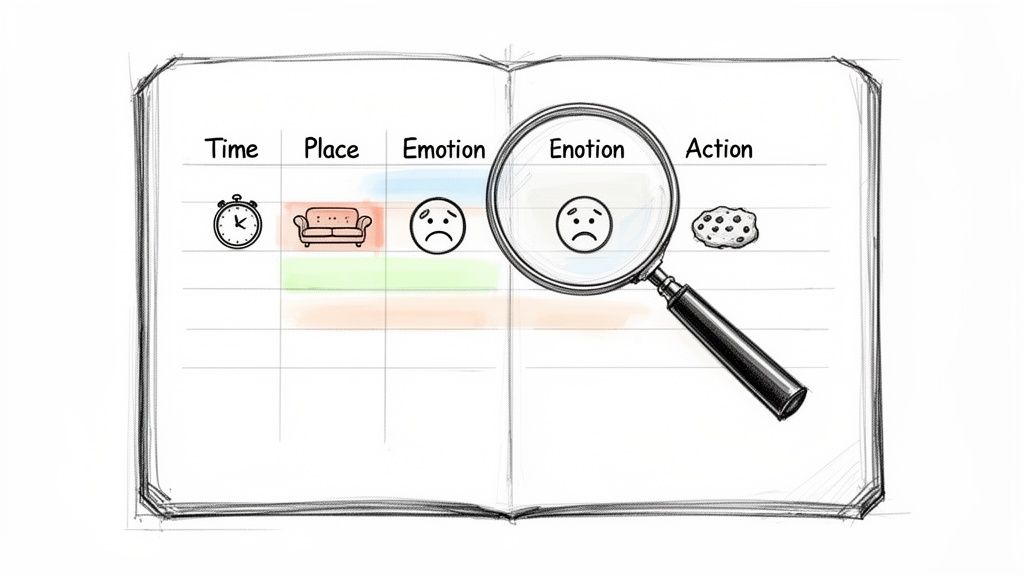
This whole process is about gathering data, not judging yourself. You're simply collecting clues in the moment or right after an eating episode you’d like to understand better.
Start by Asking the Right Questions
Your first mission is to connect the dots between the trigger and the action. Instead of just noting what you ate, you need to capture the full context surrounding it. For the next week, anytime you catch yourself in an unwanted eating habit, just pause. Ask yourself a few simple questions and jot down the answers in a notebook or a tracking app like Superbloom.
- Where was I? (On the couch, in my car, standing in front of the pantry)
- What time was it? (3:15 PM, 10:00 PM right after the kids went to bed)
- What was I feeling right before? (Bored, anxious about a deadline, lonely, frustrated)
- Who was I with? (Alone, with my partner, with coworkers)
- What just happened? (Finished a tense meeting, scrolled through social media, just walked in the door from work)
This is investigative work. It turns vague feelings into concrete data points, shining a light on patterns that have likely been running on autopilot for years.
By simply observing your actions without judgment, you interrupt the automatic nature of the habit. This small pause is often the first and most powerful step toward regaining control and making a conscious choice.
To help you get started, this table breaks down the most common types of triggers. See which ones resonate with you as you begin your investigation.
Decoding Your Common Eating Triggers
Use these categories as a guide. They'll help you organize the clues you collect and see the bigger picture more clearly.
From Observation to Insight
After just a few days of this tracking, the fog will start to lift. You’ll begin to see clear patterns emerge from the data.
You might discover that your "stress eating" is actually "procrastination eating" that only flares up when you're facing a complex task. Or maybe that late-night snacking isn't about hunger at all, but a way to decompress in the sudden quiet after a chaotic day with the family.
Let's look at a real-world scenario. Sarah kept finding herself reaching for cookies around 3 PM. After tracking for a week, she realized it had almost nothing to do with hunger.
- Time: Always between 3:00 and 3:30 PM.
- Place: At her desk, during the afternoon lull.
- Emotion: Overwhelming boredom and a slump in mental energy.
- Preceding Action: Finishing her main tasks with two hours still left in the workday.
The cookie wasn't solving a hunger problem; it was providing a momentary escape from boredom and a quick jolt of sugar to power through the end of the day. That one insight changes everything. Suddenly, the problem isn't a lack of willpower—it's a need for a better strategy to manage the afternoon slump.
This is the kind of clarity you're aiming for. It transforms a vague, frustrating goal like "stop eating junk food" into a specific, solvable problem.
Designing Smarter Swaps That Actually Stick
Once you’ve pinpointed the triggers driving your habits, you have the power to consciously rewire your responses. The real secret isn't about fighting the craving—it's about satisfying the underlying need with a better routine. This is where "smarter swaps" come in. You're replacing the old behavior without sacrificing the reward your brain has come to expect.
A successful swap is never about deprivation. It’s about finding a new, healthier action that delivers the same emotional or physical payoff. Trying to replace a comforting afternoon cookie with something totally unsatisfying like celery sticks is a recipe for disaster because it completely ignores why you wanted the cookie in the first place.
For this to work, the new habit has to be genuinely appealing, easy to do in the moment, and satisfying enough to outshine the old one.
Engineer a Better Routine
Let's go back to Sarah's 3 PM cookie habit. We figured out her trigger was boredom and a mental slump, and the reward was a quick distraction plus a sugar-fueled energy boost. Simply taking away the cookie won't work. She needs a swap that addresses both of those needs.
Here are a few potential swaps she could experiment with:
- For a mental break: She could step away from her desk for a brisk five-minute walk outside. This changes her environment, gets her blood flowing, and delivers a powerful mental reset.
- For an energy boost: She could try a cup of green tea or a small, protein-packed snack like a handful of almonds. This gives her a much more sustained lift without the inevitable sugar crash.
- For a distraction: She could pop in her earbuds and listen to one song from her favorite high-energy playlist or a five-minute clip from an engaging podcast.
By testing these different options, Sarah can find a replacement routine that effectively gives her the reward she was really after. The goal is to make the new habit so good that the old one just loses its shine.
A smart swap works because it honors the underlying need. You’re not just stopping an old habit; you're starting a better one that fulfills the same purpose, making the transition feel less like a sacrifice and more like a genuine upgrade.
The Power of Protein and Fiber
When your swaps involve food, two nutrients are your absolute best friends: protein and fiber. These are the keys to satiety—that feeling of fullness and satisfaction that shuts down cravings. Unlike the simple carbs and sugars that cause a rapid spike and crash, protein and fiber deliver a slow, steady release of energy.
This is especially crucial for breaking habits tied to hunger or energy slumps. It's no surprise that 71% of Americans are actively trying to eat more protein. People are catching on to how high-protein foods lead to better habit control and sustained energy throughout the day.
Incorporating foods like legumes, nuts, and seeds can keep you feeling fuller for longer, which naturally helps curb the mindless snacking that often derails progress. Choosing a swap that’s high in these nutrients is a strategic move. It physically changes your body's response, making it so much easier for your new habit to stick.
Real-World Scenarios and Swap Ideas
Let's look at how this plays out in other common situations.
Scenario 1: The Busy Professional's Late-Night Binge
- Trigger: Finally collapsing on the couch after a long, stressful day.
- Underlying Reward: Decompression, comfort, and a way to "turn off" the brain.
- Old Routine: Mindlessly eating a large bag of chips or a pint of ice cream while scrolling.
Smarter Swap Ideas:
- A Calming Ritual: Brew a cup of chamomile tea and sip it slowly without any screens. The warmth and the ritual itself can be incredibly soothing.
- A Sensory Shift: Apply a scented hand lotion or use an essential oil diffuser. Engaging a different sense, like smell, can provide a powerful mental break.
- A Satisfying Snack: If actual hunger is part of the equation, go for a small bowl of Greek yogurt with berries. It's creamy, satisfying, and packed with protein.
Scenario 2: The Emotional Eater's Comfort Craving
- Trigger: Feeling lonely or sad on a quiet evening at home.
- Underlying Reward: A feeling of comfort, companionship, or a temporary numbing of difficult emotions.
- Old Routine: Ordering a large, greasy pizza for one.
Smarter Swap Ideas:
- Active Connection: Call or text a friend or family member. Genuine social connection often provides the comfort you're truly looking for.
- Creative Outlet: Spend 15 minutes journaling, sketching, or getting lost in an immersive audiobook to process the emotion in a healthier way.
- A Better Food Choice: To make your healthier choices stick, check out this ultimate guide to healthy snacks for weight loss that actually satisfy. Having a planned, nourishing, yet still comforting option, like a warm bowl of oatmeal, can make all the difference.
The key is to have these swaps planned before the trigger ever hits. When you prepare your environment and your mind ahead of time, you make the better choice the easier choice.
A Practical Four-Week Plan to Build Momentum
Alright, you've done the hard work of understanding your triggers and routines. Now it's time to put that knowledge into practice. Let's walk through a structured, week-by-week plan to turn theory into real-world change.
Think of this not as a diet, but as a roadmap. We're going to build awareness, test out new habits, and create momentum that actually lasts. The key here is gradual progress, not overnight perfection. Each week has a single, clear goal that builds on the last, making the whole process feel manageable and, dare I say, empowering.
Week 1: The Observer Phase
This week, your only job is to be a detective. Don't try to change a single thing yet. The entire focus is on observation and logging your habits to get an honest baseline of what's really going on.
Your main task is to track your eating patterns just like we discussed earlier. Grab a notebook or use an app like Superbloom to log what you eat, when and where you eat it, and how you were feeling right beforehand. This isn't about judgment; it's about collecting data. You can't change what you don't acknowledge.
By the end of the week, you should have a much clearer picture of one or two specific habit loops you want to tackle first.
Week 2: The Experiment Phase
With a week of solid data in your back pocket, it's time to get your hands dirty. Your goal this week is to pick one key habit and design a "swap" to test out. I can't stress this enough: just pick one. Trying to fix everything at once is a surefire way to get overwhelmed and give up.
Let's say you discovered that every night while watching TV, you mindlessly demolish a bag of chips. The reward you're really after isn't the chips themselves, but the satisfying crunch and having something to do with your hands.
So, your experiment could be swapping the chips for something else.
- A bowl of crunchy, lightly salted edamame.
- A handful of pistachios you have to shell (this keeps your hands busy!).
- Sipping on a hot, flavorful herbal tea.
This week is all about trial and error. If one swap doesn't hit the spot, that's not a failure—it's just more data. Try a different option the next night until you land on something that truly satisfies that underlying craving.
This simple flow is the core engine of habit change.
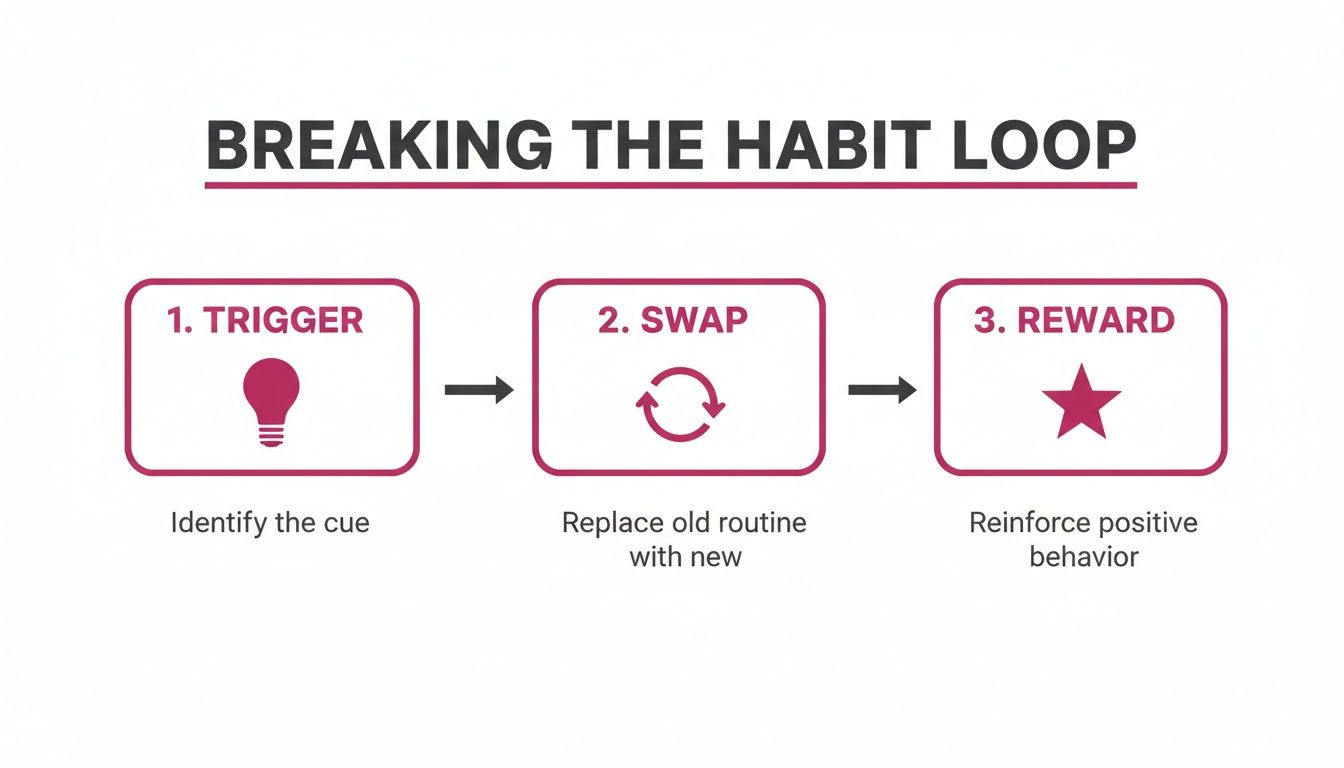
By consciously choosing a new routine (the swap) that delivers the same reward, you start to rewire your brain's automatic responses.
Week 3: The Consistency Phase
You've found a swap that works. Great! This week is all about building consistency. Your mission is to practice your new routine every single time the trigger pops up. This is where the magic happens, and that new neural pathway in your brain starts to get stronger.
Be prepared for obstacles, because they will show up. You'll have a stressful day that makes your old habit incredibly tempting, or you might just forget your new plan entirely. That's perfectly normal.
When you slip up, just ask yourself what happened and what you can do differently next time. Maybe you need to prep your swap ahead of time so it's the easier option. To make sure healthy choices are always within reach, it's worth looking into effective strategies for meal prepping for the week.
The goal is not perfection; it's consistency. Every time you successfully execute your swap, you cast a vote for the person you want to become. One successful day builds on the next, creating powerful forward motion.
Remember, building a new habit is all about repetition. Be patient with yourself, and if you fall off, just focus on getting back on track as quickly as you can.
Week 4: The Reflection and Expansion Phase
In the final week, it's time to review your progress and plan your next move. Seriously, take a moment to look back at the last three weeks. Did your swap work? How do you feel?
Celebrating this small win is incredibly important. Acknowledge the effort you put in! You’ve successfully interrupted an automatic behavior and replaced it with a conscious, healthier choice. That is a huge accomplishment.
From here, you decide what's next.
- Want to keep strengthening this new habit? Great. Keep practicing until it feels completely automatic.
- Ready to tackle another one? Awesome. Go back to your data from Week 1, pick a new target, and start this four-week process all over again.
This cyclical approach breaks a monumental task into manageable, four-week sprints. It’s a sustainable system for change that builds real confidence and prevents you from feeling overwhelmed.
Navigating Setbacks and Building True Resilience
Let's get one thing straight right away: when you set out to change your eating habits, you will have setbacks. It’s just part of the process. The path to real, lasting change is never a straight line. It's messy. There will be days when stress gets the best of you, an old cue pops up out of nowhere, and you find yourself falling back into a pattern you’ve been working so hard to break.
This isn't failure. It's just data.
Honestly, the most resilient people aren't the ones who never slip up. They’re the ones who learn how to get back on track quickly, without beating themselves up. Shifting your mindset from seeing a setback as a "failure" to seeing it as a "learning opportunity" is the single most important thing you can do. It’s the difference between giving up and building a flexible, lifelong approach to eating well.
So, when a slip-up happens, your first instinct shouldn't be self-criticism. It should be curiosity.
The Never Miss Twice Rule
One of the most effective strategies I’ve seen for building this kind of resilience is the "Never Miss Twice" rule. The idea is wonderfully simple: you might miss a day with your new habit, but you do whatever it takes to avoid missing two days in a row.
A single slip is just an outlier. Two in a row, though? That’s the start of a new, unwanted habit. This rule stops a small detour from turning into a complete U-turn. It turns a moment of weakness into a powerful trigger for getting right back to it.
- Did you eat a whole pizza on Friday night? It happens. On Saturday morning, you go right back to your planned healthy breakfast.
- Skipped your afternoon walk and grabbed a donut instead? No big deal. The next day, that walk becomes a non-negotiable priority.
This approach builds incredible momentum because it prizes recovery over perfection. You’re actively training your brain to see that getting back on track is the new default.
Turn Setbacks into Strategy Sessions
After a slip-up, once you're back on your planned path, take a few minutes for a non-judgmental debrief. This is another perfect moment to use a tool like the Superbloom app to log exactly what happened. Ask yourself the same kinds of questions you did when you first started mapping out your triggers.
- What was the specific cue that sent me down the old path?
- Was I just unprepared for that particular situation?
- Did my planned "swap" not really deliver the reward I needed in that moment?
Maybe you realized your healthy snack wasn't easily accessible when a craving ambushed you, or a last-minute happy hour invitation threw your whole evening off. This information is gold. It shines a light on the weak spots in your plan so you can make them stronger for next time.
A setback doesn't mean your plan is broken. It just means your plan needs an upgrade based on the new, real-world data you just collected. Each slip-up is a chance to build a more bulletproof system.
Handling Tricky Social Situations
Let's face it: holidays, vacations, and parties are notorious for derailing new habits. You can’t just avoid these situations forever, so the key is to have a flexible game plan. You want to navigate them without feeling deprived or watching all your progress evaporate.
Practical Strategies for Social Events:
- Plan Ahead: If you know you're going to a party, check out the menu online or have a small, protein-rich snack before you leave. Showing up starving is a recipe for disaster.
- Focus on the First and Last: Make your very first choice a healthy one (like a salad or some veggies) and make your last drink of the night a glass of water. These small bookends can make a huge difference.
- Contribute a Healthy Dish: Bringing a nutritious option that you genuinely love ensures there's at least one thing you can fill up on without a second thought.
- Shift Your Focus: Remember why you're there—it’s about connecting with people, not just the food. Concentrate on having great conversations and enjoying the company.
At the end of the day, building resilience is all about embracing imperfection. It’s about cultivating self-compassion, learning from your experiences, and understanding that every single day is a fresh start to make a choice that aligns with your goals. The path isn't paved with perfection; it's paved with thousands of these small, consistent recoveries.
Got Questions About Changing Your Eating Habits? We’ve Got Answers.
Let's be real—even the best plan runs into roadblocks. Changing your relationship with food is a journey, and it’s completely normal to have questions pop up along the way. Think of this as a quick-reference guide for those moments, filled with practical advice for the most common hurdles I see people face.
How Do I Handle Social Pressure from Friends and Family?
Ah, the classic social minefield. You're trying to stick to your goals, and suddenly everyone around you becomes a food critic or a concerned relative pushing seconds. The best defense is a good offense: have a simple, confident response ready to go. You don't owe anyone a dissertation on your eating habits.
A friendly, "No thanks, I'm good for now!" works wonders. If someone keeps pushing, a polite but firm, "I'm paying more attention to how food makes me feel, so I'm going to pass," usually ends the conversation. Remember, these are your choices about your body.
You can also start suggesting social activities that aren't centered entirely on food. Think a walk in the park, a new fitness class, or checking out a local museum.
What’s the Best Way to Deal with Intense Sugar Cravings?
Those sudden, all-consuming cravings for sugar can feel impossible to ignore. They’re often a signal that your body is trying to tell you something, but it's rarely, "I need a candy bar, stat!" Is it a need for energy? Comfort? A break from boredom?
Before you give in, get curious. First, down a big glass of water. Thirst often masquerades as hunger or a craving. If it's still there after a few minutes, try a "smarter swap" that gets to the root of the issue without sending your blood sugar on a rollercoaster.
My favorite trick? Pair a small amount of what you're craving with a protein or healthy fat. A few dark chocolate chips with a handful of almonds, for example, can crush a sweet tooth while giving you steady energy. You get the taste you want without the dreaded spike and crash.
Is It Really Possible to Break Habits I’ve Had for Decades?
Absolutely. It’s easy to feel like habits you’ve had for 20 or 30 years are set in stone, but they aren’t. Your brain has an incredible ability to adapt and rewire itself—a concept called neuroplasticity. This means you can always forge new pathways and routines, no matter how old you are or how long you've been doing something.
The key is patience and starting small. Don't try to change everything at once. Focus on one tiny, specific habit you want to shift. Your goal isn't a total life makeover overnight; it's simply to prove to yourself that change is possible.
Every single time you choose the new behavior over the old one, you're literally weakening the old neural connection and strengthening the new one. It gets easier and more automatic with every repetition.
What Should I Do When My Motivation Starts to Fade?
Motivation is fickle. It's a feeling, and like all feelings, it comes and goes. If you rely on it to get you through this journey, you’ll be stuck on an emotional rollercoaster. The secret to long-term success is building systems and routines that carry you through, even on the days you're just not feeling it.
This is where a little prep work makes all the difference.
- Make healthy choices easy: Keep fruit on the counter, not in a drawer.
- Make your plan obvious: Set phone reminders to drink water or prep your lunch.
- Make it enjoyable: Find healthy foods and activities you genuinely look forward to.
And when you feel that motivation waning, reconnect with your "why." Why did you start this in the first place? To have more energy for your kids? To feel better in your own skin? To manage a health condition? Tapping into that deeper purpose is the real fuel that will keep you going when the initial excitement wears off.
Ready to turn this awareness into real, lasting action with some personalized support? Superbloom is an AI-powered nutrition coach designed to help you understand your unique eating patterns and build healthier habits that stick—without any restrictive dieting. Get the guidance you need, one small step at a time. Discover how Superbloom works.