
How to Build Healthy Habits That Actually Stick
If you've ever tried to build a healthy habit, you know it’s less about willpower and more about having a smart system. The whole process really boils down to three simple actions: start with a ridiculously small step, connect it to something you already do every day, and then actually celebrate that small win to lock it in. This approach, which is backed by a ton of psychology, makes change feel manageable instead of like a massive, uphill battle.
Why Most Healthy Habits Fail (and How to Make Yours Stick)
Sound familiar? It’s January 1st, you’re fired up with motivation, and you vow to eat perfectly clean and hit the gym every single day. But by the time February rolls around, you’re right back where you started. This is the classic pitfall of habit change: the all-or-nothing trap.
We go for a complete life overhaul overnight, which requires an enormous amount of willpower. The problem is, willpower is a finite resource. It runs out, especially when work gets crazy, the kids get sick, or you’re just plain stressed.
The issue isn't you or your desire to be healthier; it’s the flawed strategy. Lasting, meaningful change doesn't happen in a short, intense sprint. It’s built through tiny, consistent actions that gradually rewire your brain’s automatic settings. This is about shifting your mindset from, "What's wrong with me?" to, "What's a better system I can build?"
The Science Behind Your Habits: The Habit Loop
Every single habit you have—good or bad—is driven by a simple, three-part neurological process called the habit loop. Once you see it, you can't unsee it.
- Cue: This is the trigger that kicks off the behavior. It could be a time of day (that 3 PM energy dip), a feeling (stress or boredom), or even a place (walking into the kitchen).
- Routine: This is the action you take. It might be reaching for a cookie or, alternatively, putting on your running shoes.
- Reward: This is the payoff. Your brain gets a little hit of pleasure that says, "Hey, let's do that again!" It could be the comfort of a sugar rush or the endorphin high from a great workout.
Bad habits are so sticky because they deliver an immediate and easy reward. Our brains are hardwired for that kind of instant gratification. The secret to building better habits isn't fighting this powerful loop—it's hijacking it for your own good.
To truly succeed, you have to stop relying on motivation and willpower. Instead, you need to create a system where doing the right thing is the easiest thing.
To make sure your new healthy habits actually last, the focus has to be on building a sustainable lifestyle. By consciously picking a new, healthier routine to link to your existing cues, you can start to write over those old, unhelpful patterns.
Instead of trying to change everything at once, you just make tiny, strategic tweaks. For example, when that 3 PM slump (your cue) arrives, your new plan is to take a quick, five-minute walk outside (your new routine) to get a natural boost of energy (your new reward). This is how you create a clear path forward, one small win at a time.
Start Small: Define Your Cues and Master the Micro-Habit
We’ve all been there. You make a big, bold declaration—"I'm going to completely overhaul my diet!"—only to find yourself back at square one a week later, feeling defeated. That all-or-nothing approach is practically designed for burnout.
The real path to lasting change isn’t about massive, heroic efforts. It’s about actions so small they feel almost too easy. This is the magic of micro-habits: tiny, specific behaviors that you can execute even on your worst days, bypassing the need for motivation and making consistency feel natural.
Instead of a vague, overwhelming goal like "eat healthier," a micro-habit drills down to one concrete action. It’s about finding a solid foundation to build upon. In fact, many people who struggle with new habits often overlook the basics, like establishing healthy sleep habits, which can impact everything else.
The first move is to piggyback your new habit onto an existing part of your daily routine. This existing behavior is your cue, the trigger that tells your brain it's time to act. You’re simply adding a tiny step to a pathway that's already on autopilot.
This flowchart shows exactly why ditching that "all-or-nothing" mindset is the first critical step toward building a habit loop that actually works.
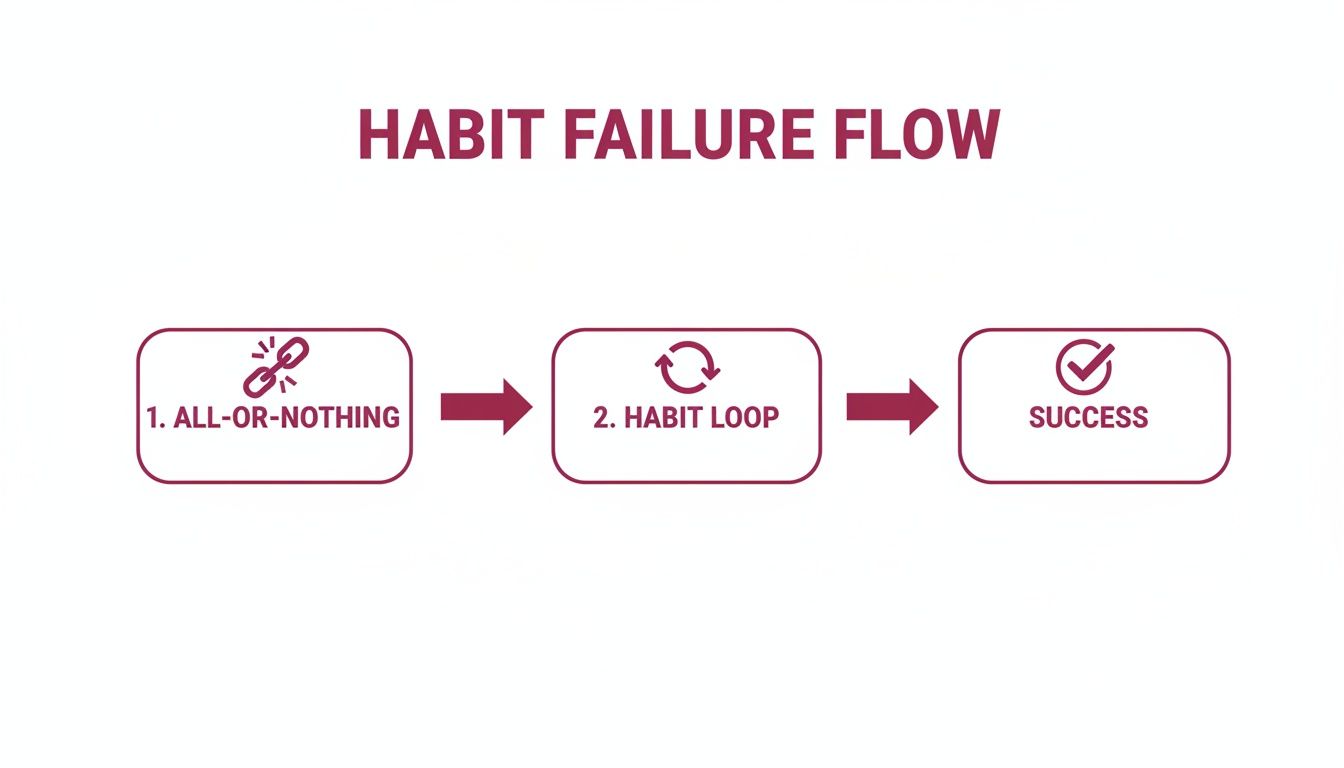
As you can see, real success comes from engaging with the process, not from demanding perfection right out of the gate.
Find Your Everyday Cues
Your day is already packed with reliable cues. The trick is to spot them. We're looking for those autopilot moments that happen every day, without fail.
Think about your non-negotiable daily actions:
- Turning off your morning alarm
- Brushing your teeth
- Making that first cup of coffee or tea
- Sitting down at your desk to start work
- Taking your lunch break
- Walking in the door after work
- Getting into bed
Any one of these can be the launchpad for a new habit. Let's say you want to drink more water. The cue could be, "After I turn off my alarm." The micro-habit is just, "I will drink one glass of water." It’s a simple action that takes maybe a minute and requires zero mental debate.
The goal isn’t to transform your life overnight. It’s to prove to yourself that you can show up, even in a small way. This consistency is what builds the momentum for bigger changes down the road.
From Vague Goals to Actionable Micro-Habits
This is where the rubber meets the road. Vague goals like "get fit" are impossible to measure and incredibly easy to quit. A micro-habit, on the other hand, is a clear, binary task attached to a cue. You either did it or you didn't.
Here’s how you can reframe those common but fuzzy goals into something you can actually do.
From Vague Goals to Actionable Micro-Habits
This table contrasts common but ineffective health goals with their specific, cue-based micro-habit alternatives, showing readers how to reframe their intentions for success.
Notice how specific those actions are. This isn't about perfection; it's about making the first step so small that you can't say no.
Once you’ve done your micro-habit, give yourself a little credit. A simple mental "Done!" or a physical checkmark is a reward that reinforces the new neural pathway you're building.
And don't underestimate the power of tracking these tiny wins. A simple "X" on a calendar or a quick note in your phone creates a visual chain of success. Seeing that streak grow is a huge motivator. It shifts your focus from some far-off goal to the immediate satisfaction of showing up for yourself today.
Level Up Your Habits With Stacking
So, you’ve been practicing your micro-habit and it's starting to feel almost automatic. That’s a huge win. Now, where do you go from here? It’s time to build on that momentum with a technique I’ve seen work wonders for countless people: habit stacking.
The concept, made famous by author James Clear, is brilliantly simple. You just find a habit you already do without thinking and attach a new, tiny habit right after it. It’s a chain reaction for positive change.
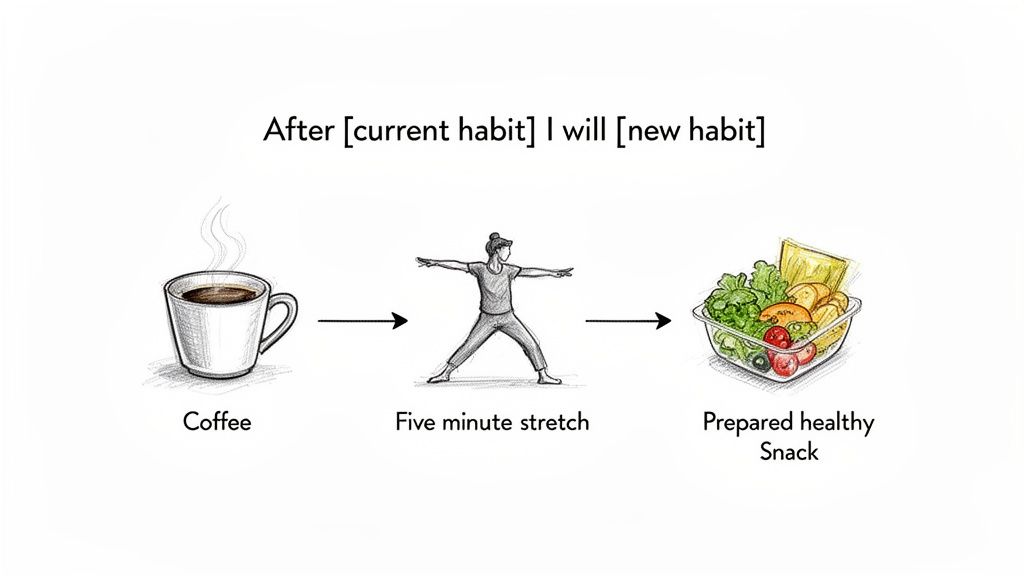
The script you follow is easy: After [My Current Habit], I will [My New Habit].
This little formula takes all the decision-making out of the equation. You no longer have to wonder when or where you’ll do your new habit. It’s already anchored to something you do every single day on autopilot.
How to Build Your Own Habit Stack
Take a look at your daily routine. It's already full of existing habits that can serve as the perfect foundation. Brushing your teeth, turning off your alarm, making coffee—each one is an opportunity to snap a new healthy action into place.
Your morning coffee is a classic example. It’s a non-negotiable part of your day. What if you used that time to your advantage? While the coffee is brewing, you have a few minutes of built-in downtime.
Let's see how that looks in practice:
- After I press "start" on the coffee maker, I will pull out a healthy snack and put it in my work bag for later.
- After I pour my coffee, I will do five minutes of simple stretches in the kitchen.
- After I finish my coffee, I will take my daily vitamins with the last sip of water.
See how they flow together? You're not trying to find an extra hour in your morning. You're just slotting in a two-minute action that pushes you closer to your goals without causing any disruption.
Don't Forget the Reward
Building the stack is the first step, but making it stick requires one more crucial piece: closing the loop with a reward. This is the part almost everyone forgets. We do the thing, but we don't take a second to celebrate the win, and we miss the chance to tell our brain, "Hey, that was a good thing. Do it again."
A reward doesn't have to be some grand prize. It’s just an immediate bit of positive feedback. This is basic brain science; positive reinforcement is what turns a conscious action into an unconscious, automatic behavior.
You can think of rewards in two ways:
- Intrinsic Rewards: This is the good feeling you get from the activity itself. Think about the little jolt of energy after a quick walk or the sense of calm after a minute of deep breathing. That’s the reward.
- Extrinsic Rewards: These are things you give yourself. Maybe you listen to a great podcast while you work out, or you savor a cup of your favorite herbal tea right after you finish your meal prep. Even a mental high-five counts.
The secret is that the reward must be immediate. Your brain needs to connect the action with the good feeling right away. A far-off goal like "losing 10 pounds" is too abstract to reinforce the five-minute walk you just took.
Making Your Small Wins Count
For the reward to really work its magic, you have to be intentional about it. Don't just check it off your list and rush to the next thing. Pause for a moment. Acknowledge what you did and savor the feeling.
Here are a few quick prompts you can use to really lock in the behavior:
- Acknowledge It: Say it out loud or in your head: "Done. I prepped my healthy snack." This gives you a clear sense of completion.
- Feel It: Ask yourself, "How does that feel?" Notice the sense of organization, the relief of having one less thing to worry about, or the quiet pride in taking care of your future self.
- Own It: Connect the action to your identity. "This is who I am now. I'm a person who plans ahead." This reinforces the new version of yourself you’re building.
When you link a new habit to an old one and immediately follow it with a genuine, positive feeling, you're giving your brain a clear roadmap. This isn't about bribing yourself; it's about providing the positive feedback your brain needs to put good habits on autopilot. Soon enough, the habit itself becomes its own reward.
Of course. Here is the rewritten section, designed to sound natural and human-written, as if from an experienced expert.
Navigate Setbacks and Cravings with Mindfulness
Let's be real for a moment. Even with the perfect plan, the path to building new habits is never a straight line. There will be days when you're tired, stressed, or just completely over it. Old cravings will bubble up, and sometimes, you'll give in. This isn't just a possibility—it's a guarantee.
Here's the most important thing I want you to burn into your brain: a setback is not a failure. It’s just data. Think of it as a learning opportunity that puts a spotlight on your triggers, your emotional needs, and the exact situations where your new habits are still a little wobbly. The goal was never perfection; it's about getting back on track, but this time with a little more wisdom than before.
When you start to see it this way, everything changes. Instead of letting one slip-up derail your entire week, you can approach it with curiosity instead of judgment. And that, right there, is where mindfulness becomes your secret weapon.
Pause, Acknowledge, and Get Curious
When a powerful craving hits—maybe it’s for that sugary donut after a stressful meeting or the magnetic pull of the couch when it's time for your workout—don't try to fight it with brute force. Willpower is a finite resource, and you'll eventually lose that battle.
Instead, try this simple mental routine.
Pause. Before you do anything, just take one deep breath. It’s a tiny action, but it creates a crucial gap between the trigger and your automatic reaction. In that gap, you find your power.
Acknowledge. Simply notice the craving for what it is: a thought or a physical sensation. You can even name it, without any judgment. "Ah, there's the urge for something sweet." Or, "I'm feeling a really strong pull to just stay put."
Get Curious. Now, ask yourself a simple question to figure out what's really going on. This shifts you from a place of internal conflict to one of genuine understanding.
A craving is rarely about the food itself. It’s usually a signal that your body or mind is asking for something else—maybe it's comfort, a distraction, or just a break from stress.
By digging into the "why" behind the urge, you start solving the real problem, not just patching over the symptom. This kind of self-awareness is the bedrock of habits that actually last.
The Power of Curious Self-Talk
When you investigate a craving, you're really just having a little chat with yourself. The trick is to make sure that inner voice is a supportive coach, not a harsh critic. So instead of scolding yourself ("Ugh, I can't believe I want this again!"), try asking some gentle, open-ended questions.
Here are a few scripts I use with my clients to help them decode their cravings:
- "Am I actually hungry, or am I feeling something else?" So often, we mistake boredom, stress, or even dehydration for hunger. Do a quick body scan. Is your stomach actually rumbling?
- "What was I doing or thinking right before this craving popped up?" This is how you start to connect the dots and identify your triggers. Maybe you just wrapped up a tough project or had a tense phone call.
- "What am I hoping this food will do for me right now?" Are you looking for a quick hit of energy? A feeling of comfort? A five-minute escape? Naming what you're really after is the first step toward finding a healthier way to get it.
This process isn't about denying yourself pleasure. It’s about figuring out what you truly need in that moment. Once you know that, you can find a much better way to meet the need.
Satisfy Cravings with Smart Swaps
Once you understand the real reason for your craving, a whole world of healthier alternatives opens up. We're looking for a "smart swap" that delivers a similar reward without throwing you off course. It’s about satisfying the core need, not just the surface-level want.
Here are a few common craving scenarios and some smart swaps that actually work:
When you respond to the real need, you’re doing more than just avoiding an unhealthy choice—you’re actively taking care of yourself. You’re building a brand-new habit loop where the reward is genuine and sustainable. This mindful approach turns setbacks from moments of defeat into your most powerful lessons.
Bring in an AI Coach to Guide Your Progress
Building healthy habits is a deeply personal journey. What works for one person can completely fall flat for another, which is why generic advice often fails. This is where having a bit of smart technology on your side can make all the difference, giving you guidance that actually fits your life.
Think of an AI-powered nutrition coach like Superbloom as a private, non-judgmental sounding board. It’s a space where you can be totally honest about your food choices without worrying about being shamed for having an "off" day. That kind of psychological safety is huge when you're trying to figure out what works for you.
Turn Vague Goals into Clear Actions
One of the biggest roadblocks I see is people trying to translate abstract goals like "eat more protein" into what they actually put on their plate for lunch. It's tough. This is where something like meal photo logging really shines. Instead of meticulously counting every macro, you just snap a quick picture of your food.
For instance, you might log a photo of your salad and get an instant tip like, “Great job on getting your veggies in! Adding a source of lean protein, like grilled chicken or a handful of chickpeas, could really help boost your energy levels this afternoon.” That immediate, practical feedback turns a simple meal into a small lesson. It feels less like a chore and more like a helpful experiment.
Here’s an example of how the AI coach gives you specific, encouraging feedback on a meal, transforming a photo into a learning opportunity.
The insight is valuable because it’s constructive, not critical. It focuses on what you can add to make your meal better, which is a much more positive and sustainable approach.
Uncover Your Hidden Habit Patterns
The real magic of an AI coach is its ability to spot the patterns you’d never notice on your own. Over time, it starts connecting the dots between what you eat, how you feel, and what’s going on in your day.
You might begin to see clear trends emerge:
- You consistently crave something sweet around 3 PM on days packed with meetings.
- You’re more likely to skip breakfast on the days you work from home.
- Your digestion feels much better on days when your lunch includes fermented foods like kimchi or yogurt.
Once those connections are clear, the coach can offer truly personalized strategies. If it notices a pattern of post-meeting sugar cravings, it might gently ask, "I'm seeing you often reach for sugar after a stressful meeting. What if we tried a five-minute walk or a quick breathing exercise to tackle that stress head-on?"
This is how you shift from being reactive to your cravings to being proactive about your needs. The focus moves away from pure willpower and toward building a better strategy—and that’s the secret to habits that actually stick.
An AI coach doesn’t just give you a to-do list; it helps you understand the why behind your actions. This self-awareness is the bedrock of lasting change. With a supportive partner in your pocket, you can learn to navigate setbacks with curiosity, celebrate the small victories, and build a genuinely healthier relationship with food.
If you want these new habits to actually stick, you can't just set them and forget them. Real, sustainable change requires a little bit of course-correction along the way.
This is where the single most important routine comes into play: the weekly check-in. Think of it as your time to become the architect of your own health system. It’s not about judging your performance, but about getting smart about what works.
Just 15 minutes once a week is all you need. I usually do this on a Sunday evening. This short block of time is what separates people who successfully build new habits from those who fall off the wagon after a few weeks.
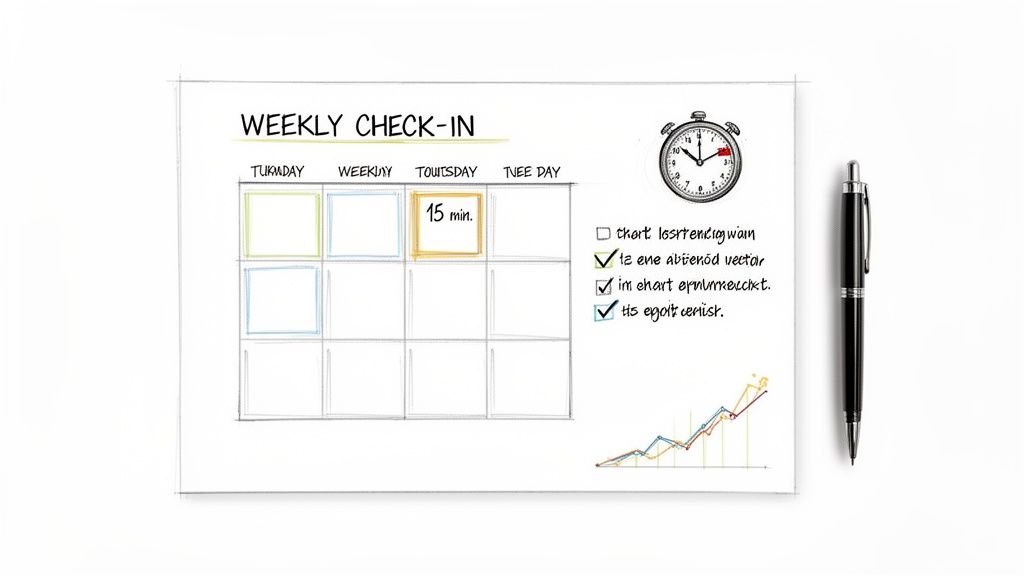
Your 15-Minute Game Plan for a Weekly Review
Grab a journal or open a note on your phone. The goal here is curiosity, not criticism. By asking a few simple questions, you start to see the patterns and can make intelligent adjustments for the week ahead.
Here are the questions I run through with my clients:
- Which new habit felt the easiest this week, and why? Seriously, celebrate what went right. Maybe stacking that five-minute walk right after your morning coffee felt totally seamless. Why? Because the timing was perfect. That's a huge win.
- What was my biggest trigger for an old habit? Get specific. Was it the wave of stress that hit after that 2 PM team meeting? Was it the sheer boredom you felt on a quiet Tuesday afternoon? Naming the trigger takes away its power.
- What's one small tweak I can make for next week? Based on what you just uncovered, decide on one tiny adjustment. If post-meeting stress sent you to the vending machine, maybe next week you’ll try a two-minute breathing exercise as soon as the call ends.
This check-in process is where real, lasting change takes root. It’s the difference between blindly following a plan and intelligently designing a lifestyle that actually fits you.
This is also a great time to pull up data from your Superbloom coach. Seeing your progress in black and white can be incredibly motivating. The app might show that you successfully added a source of protein to 80% of your lunches—a powerful dose of encouragement!
At the same time, that data can point to areas that need a little more focus, without any judgment. It might reveal a clear pattern of you reaching for sugary snacks around 3 PM on workdays. Now you have a specific, concrete target to work on for next week, turning guesswork into a smart, evolving strategy.
A Few Common Questions About Building Healthy Habits
When you start changing your habits, a lot of questions pop up. That's completely normal. Getting good answers can be the difference between moving forward and just spinning your wheels. Let’s tackle some of the big ones I hear all the time.
How Long Does It Really Take to Form a Habit?
You've probably heard the "21-day" rule. It's a nice, simple idea, but unfortunately, it's mostly a myth. The reality is a lot more personal and takes a bit more patience.
A well-known study from University College London found that it takes, on average, 66 days for a new habit to feel automatic. But "average" is the key word here. The actual time for participants in that study ranged from 18 all the way up to 254 days.
The takeaway? Don't get hung up on a magic number. A simple habit like drinking a glass of water after you wake up might lock in quickly, while a more complex one like a complete dietary overhaul will naturally take longer. Focus on consistency over speed. Just show up today.
What Should I Do If I Miss a Day?
First, don't panic. A single missed day isn’t a failure—it's just a data point. The most common trap people fall into is the "all-or-nothing" mindset. They have one slip-up, decide they've ruined everything, and give up entirely.
The most important habit you can build is getting back on track quickly. One missed workout or one off-plan meal doesn't erase all your previous effort. Just focus on making your very next choice a good one.
The goal is simple: never miss twice. If you skipped your morning walk, see if you can squeeze it in later. If the day gets away from you, just recommit to getting it done tomorrow. That’s how you build resilience.
How Can I Stay Motivated When I Don't See Results?
This is a huge one. Motivation is a feeling, and feelings are fickle. That’s exactly why we build systems and habits—so we don't have to rely on being "in the mood" to do the right thing. When you're not seeing big results like the number on the scale dropping, you have to find your reward elsewhere.
Here’s how you can shift your focus:
- Celebrate the Process, Not Just the Outcome: Instead of waiting for a milestone, give yourself credit for simply doing the thing. Acknowledge the immediate win: "I did my 5-minute stretch today. That's a success."
- Connect It to Your Identity: Every time you complete your habit, you're casting a vote for the person you want to become. Tell yourself, "I'm the kind of person who takes care of my body, even when I don't feel like it." This reinforces the behavior on a much deeper level.
- Track Your Actions: A simple checkmark in a notebook or an app can be incredibly powerful. Seeing a visual chain of your successes builds its own momentum and makes you want to keep it going, regardless of what the scale says today.
By focusing on the action itself, you create a positive feedback loop that makes your new habits stick for the long haul.
Ready to stop guessing and start building a system that works for you? Superbloom is the AI nutrition coach that provides the personalized feedback and support you need to build healthy habits that last. Start your journey toward a healthier you by visiting Superbloomapp.com.