
Unlock a New You: How to Change Your Relationship with Food

If you feel like you’re stuck in a battle with food, you’re not alone. So many of us are trapped in a frustrating cycle of restriction, guilt, and emotional eating. It can feel like an endless loop. But what if the problem isn’t your willpower? What if the real key is simply paying better attention?
Healing your relationship with food isn't about finding a new diet or a stricter set of rules. It’s about a fundamental shift in perspective—moving away from a place of restriction and toward mindful awareness and emotional intelligence. This is where you learn to treat your eating patterns as data, not as moral failings, and use that insight to build small, sustainable habits.
This guide will walk you through a new approach built on three core ideas:
- Mindful Awareness: Becoming a curious, non-judgmental observer of your own habits.
- Emotional Intelligence: Finally understanding the why behind your cravings and choices.
- Consistent Action: Taking small, intentional steps that add up to real change over time.
It’s time to trade the reactive, all-or-nothing approach for one that’s intentional and, most importantly, kind to yourself.
Your New Relationship with Food Starts Now
So much of our anxiety around food comes from a place of scarcity. We have our mental lists of "good" and "bad" foods, we obsess over calories, and we feel crushing guilt when we "mess up." This mindset automatically positions food as the enemy, turning something meant for nourishment and pleasure into a constant source of stress.
The alternative is to cultivate a mindset of abundance. Instead of focusing on what you need to cut out, what if you focused on what you could add? Think more nutrients, more flavor, more variety, and more genuine enjoyment. When you actually savor your meals, your body can even absorb more of their nutritional benefits.
A healthy relationship with food is built on self-compassion, not self-control. It’s about listening to your body, honoring your needs, and letting go of the all-or-nothing thinking that keeps you stuck.
This shift feels more urgent than ever. Since 2020, the world has seen a 20% increase in people facing acute food insecurity, making food a major source of global stress. Here in the US, food-at-home prices are projected to climb by another 2.3% in 2026, adding a financial strain that complicates our nutritional choices even further. You can read more about these trends in the World Bank’s recent food security update.
The journey toward a better relationship with food follows a clear path: it begins with Awareness, builds into Intelligence, and leads to sustainable Action.
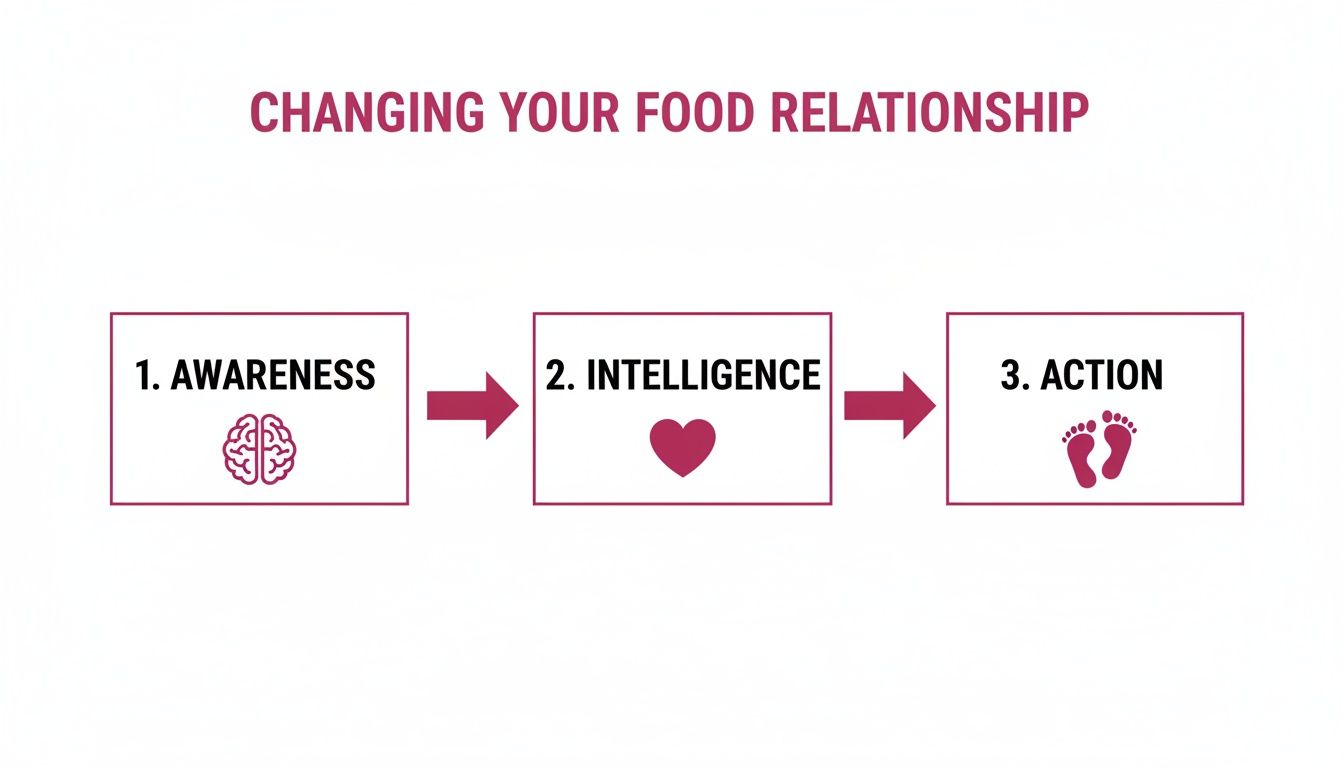
As you can see, lasting change starts by understanding what's going on inside before you try to change your external behaviors.
Shifting Your Food Mindset From Reactive to Intentional
So what does this shift actually look like in day-to-day life? This table breaks down the old, reactive way of thinking about food versus the new, intentional approach we're aiming for. It helps to have a clear picture of where you are and where you're headed.
| Aspect | The Old Way (Reactive & Restrictive) | The New Way (Intentional & Mindful) |
|---|---|---|
| Mindset | "I shouldn't eat that." (Guilt & Restriction) | "How does this food make my body feel?" (Curiosity) |
| Triggers | Reacting to stress or boredom with food. | Pausing to identify the underlying need. |
| Eating | Mindless eating while distracted (TV, phone). | Savoring meals and paying attention to hunger cues. |
| Progress | Measured by the number on the scale. | Measured by energy levels, mood, and less food guilt. |
| Setbacks | One "bad" meal ruins the whole week. | Viewing a slip-up as a learning opportunity. |
Seeing it laid out like this makes the transformation feel more concrete and achievable. It’s not about becoming a perfect eater overnight; it’s about making small, deliberate shifts in your thinking and habits, one meal at a time.
Uncovering Your Hidden Food Patterns
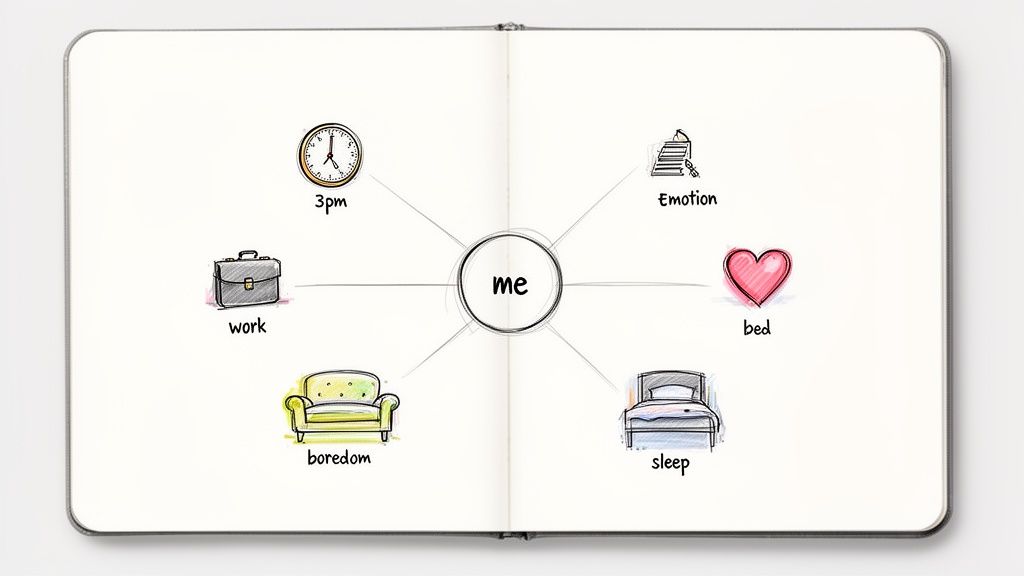
Before you can rewrite your relationship with food, you first have to read the current script. This means getting honest about what’s really going on, and it often goes much deeper than just "I'm an emotional eater." It’s time to become a detective of your own habits.
The key here is to see your eating patterns not as random, but as a series of reactions. They’re driven by specific triggers—the who, what, where, when, and especially the why behind your choices. This is where real self-awareness begins, and it’s the only foundation for change that actually lasts.
From Vague Feelings to Concrete Data
It's one thing to have a hunch you eat when you're stressed. It's something else entirely to know for a fact that you raid the pantry for chips every Tuesday around 4 PM, right after that draining weekly team meeting. The first is a feeling; the second is actionable data.
To get this kind of clarity, you just need to start paying attention. Don't try to change a single thing yet—your only job is to be a curious observer. For the next few days, whenever you find yourself reaching for food (especially when you don’t feel true stomach-growling hunger), take a mental note of the situation.
Ask yourself:
- Who were you with? (Alone, with my partner, kids, or coworkers?)
- What were you doing right before? (Scrolling Instagram, finishing a report, watching Netflix?)
- Where were you? (At my desk, in the car, on the couch?)
- When was it? (That 3 PM slump, late at night?)
- Why did you eat? (Was it boredom, anxiety, exhaustion, celebration, or actual hunger?)
This simple practice pulls you out of autopilot and into the driver’s seat. It's a non-judgmental way to gather the intel you need and a crucial first step in learning how to change your relationship with food for good.
Mapping Your Personal Trigger Landscape
As you start observing, you’ll begin to notice themes. Most of our triggers fall into a few common buckets. See if any of these real-world scenarios sound familiar.
Situational Triggers
These are all about your environment and daily routines.
- The 3 PM Office Slump: Your energy tanks, you see a coworker grab a cookie, and suddenly your brain screams for sugar.
- The Post-Dinner "Reward": The kitchen is clean, the kids are in bed, and you've finally plopped onto the couch. The TV is on, and an automatic craving for a bowl of ice cream kicks in.
Emotional Triggers
These are directly tied to your feelings—the good, the bad, and the boring.
- Boredom Snacking: You hit a lull between tasks and find yourself wandering to the kitchen without even thinking about it.
- Anxiety Eating: A stressful email lands in your inbox, and the crunch of a salty snack feels like the only thing that can release the tension.
Physiological Triggers
Sometimes, your body sends confusing signals.
- Poor Sleep: After a restless night, you’re exhausted. Your body craves a quick hit of energy, sending you straight for high-sugar, high-fat foods.
- Thirst in Disguise: Mild dehydration often feels a lot like hunger, tricking your brain into thinking you need food when all you really need is a glass of water.
Understanding your patterns isn't about blaming yourself. It's about gathering the intel you need to create a new game plan—one that serves your true needs instead of just reacting to old cues.
It’s also important to acknowledge that outside pressures can make things harder. For example, with food price forecasts for 2026 predicting a 2.7% rise in overall food costs and a 4.6% jump for dining out, the financial stress alone can be a powerful trigger. In fact, some behavioral studies suggest up to 70% of weight struggles are tied to psychological factors, not just physical ones. You can read more about these food price projections and their impact.
This is where a modern tool can be a huge help. An app like Superbloom uses personalized check-ins to help you connect these dots, analyzing your daily log to reveal patterns you might not see on your own. It gives you the power to build that trigger map without the pressure of a restrictive diet. Honestly, getting this map laid out is your first major win on this journey.
Learning to Practice Mindful Eating
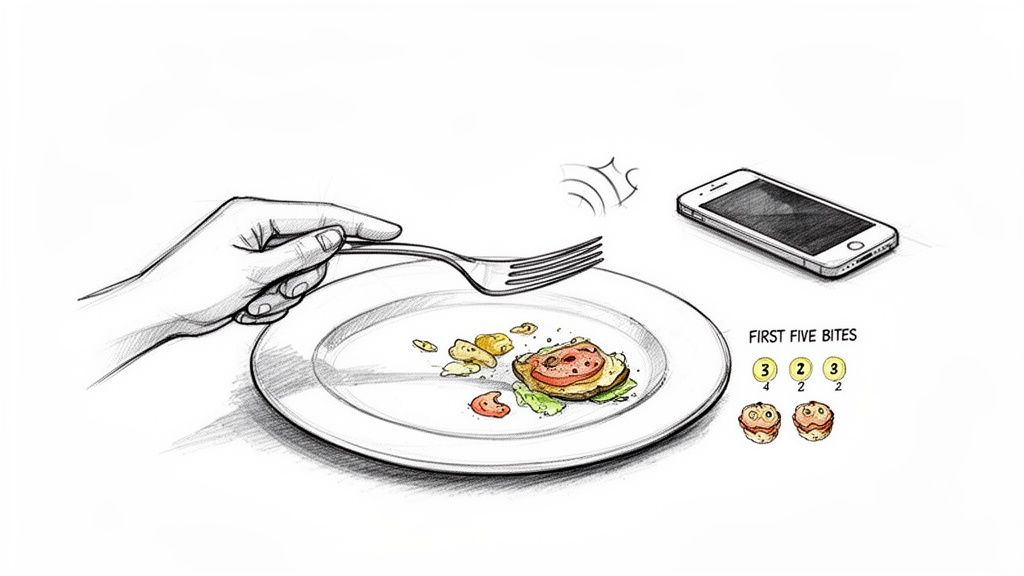
Once you've started to spot your personal food triggers, the next step is to get back in touch with your body's natural signals. Mindful eating isn't some complex ritual; it's simply the practice of paying full attention to your meal, without judgment. It’s the perfect countermove to the distracted, autopilot eating most of us do while scrolling our phones or watching TV.
The whole point is to bridge the gap between your brain and your stomach. When you do that, you finally start to hear the subtle cues your body has been sending you all along. This practice is the foundation for truly learning how to change your relationship with food.
Start with a Simple Five-Bite Exercise
You don't need to change everything overnight. You can start practicing mindful eating with just the first few bites of your next meal.
Give this a try: for the first five bites, and only those five, commit to being completely present.
- Look: Really see the colors, shapes, and textures on your plate.
- Smell: Take a moment to breathe in the aromas before you even pick up your fork.
- Taste: Chew slowly. Can you pick out different flavors as they unfold?
- Feel: Notice the temperature and texture of the food in your mouth.
- Listen: Try putting your utensils down between each of those first five bites.
This tiny change of pace can pull you out of your head and into the actual sensory experience of eating, which sets a much more intentional tone for the rest of your meal.
Do a Quick Mid-Meal Check-In
We've all been there—halfway through dinner, you just keep eating because there's still food on the plate. This is the perfect time for a quick, private check-in. Just pause for 30 seconds and ask yourself one simple question: "On a scale of 1 to 10, how full am I right now?"
- 1–3: You're definitely still hungry. Keep enjoying your meal.
- 4–6: You’re feeling satisfied, but not stuffed. This is often the sweet spot.
- 7–8: You're full. This might be a good time to stop, even if the plate isn't empty.
- 9–10: You're stuffed or even uncomfortably full.
This pause gives you a real opportunity to listen to your body’s fullness cues before you accidentally ignore them. It’s not about judging yourself; it’s just about gathering information.
If you find this helpful, you might want to strengthen your overall awareness "muscles." Exploring mindful meditation for emotional and physical well-being can build a stronger foundation for mindfulness that extends far beyond your mealtimes.
Mindful eating isn't about restriction. It's about giving yourself permission to fully experience your food, which often leads to feeling more satisfied with less.
Shift Your Focus from Restriction to Nourishment
A huge mental shift happens when you stop obsessing over what you can't eat and start thinking about what you can add to your plate. Framing it this way turns healthy eating into an act of self-care instead of a punishment.
Take the "fiber-maxxing" trend, for example. We're seeing a massive 9,500 percent surge in page views for articles about fiber, which shows where people's heads are at. While most of us get plenty of protein, a shocking 5 percent of Americans actually meet their daily fiber needs. Intentionally adding fiber-rich foods like berries, beans, and whole grains is a positive action that helps you feel fuller longer and supports great gut health. You can read more about this and other upcoming 2026 food trends on the horizon.
So, instead of banning potato chips, maybe ask yourself: "Could I add a side of guacamole or black bean dip to get more nutrients and fiber?" This small question reframes the whole experience from one of deprivation to one of abundance.
Navigating Cravings and Emotional Setbacks
Let's be real: changing your relationship with food isn't a smooth, uphill climb. It's full of twists, turns, and the occasional pothole. There will be days when a massive craving hits out of nowhere or an old emotional eating pattern decides to show up uninvited. This isn't a failure—it's just part of the process.
The real goal isn't to pretend these moments won't happen. It’s about building a solid toolkit of coping strategies so you feel ready and in control when they do. When you have a plan, these moments stop being discouraging roadblocks and become incredibly valuable learning opportunities.
The PAUSE Technique for Managing Urges
When a strong craving takes over, our gut reaction is usually one of two things: fight it tooth and nail or immediately give in. There's a much better way. The PAUSE technique is a simple, mindful framework that wedges a little space between an urge and your reaction, putting you back in control.
Here’s how it works:
- Pause: Before you reach for anything, just stop. For one full minute. Take a deep breath. You don't have to make a decision yet.
- Acknowledge: Without any judgment, name what’s happening. Try saying, "Okay, I'm feeling stressed and I'm really craving chips."
- Understand: Get a little curious. Ask yourself what you truly need right now. Is it really the chips, or is it a break from work? Comfort? A distraction?
- Shift: If you realize the urge isn't about physical hunger, try a non-food coping strategy from your toolkit first.
- Eat Mindfully: If you've waited a bit and still genuinely want the food, give yourself permission. Then, sit down and enjoy it slowly, without an ounce of guilt.
This simple act of pausing shatters that automatic, knee-jerk connection between a trigger and your response. It puts you firmly back in the driver's seat.
Build a Menu of Non-Food Coping Mechanisms
Navigating emotional eating becomes so much easier when you have other ways to give yourself what you need. That "Shift" step in the PAUSE technique is a breeze when you have a pre-made menu of options that you know actually work for you. Think of it as your personalized self-care toolkit.
Your list doesn't have to be complicated or time-consuming. In fact, the best coping tools are quick, accessible, and designed for the specific feeling you're trying to manage.
Try These Ideas:
- For Stress or Anxiety: Step outside for a 5-minute walk, blast a favorite song, or do a few gentle stretches at your desk.
- For Boredom: Organize that one messy drawer, call a friend for a quick chat, or spend ten minutes on a puzzle. I keep a "distraction list" on my phone for these moments.
- For Fatigue: Set a timer for a 10-minute power nap, drink a big glass of ice-cold water, or just close your eyes for a few minutes away from your screen.
Having these strategies written down means you don't have to come up with a brilliant solution in the heat of the moment. You just have to check your list.
A setback is not a failure; it’s feedback. It’s your body giving you a clue about what you needed in that moment. Listen to it with curiosity, not criticism.
Overcoming the What-the-Hell Effect
We’ve all been there. It’s that voice in your head that says, "Well, I've already eaten one cookie, so I might as well finish the whole bag." Researchers call this the "what-the-hell effect," and it’s one of the biggest traps you can fall into.
This all-or-nothing thinking can turn a minor slip-up into a major spiral. It’s a leftover habit from the old-school diet mentality, where you were either perfectly "on" your plan or completely "off" it. The truth is, one snack or one meal doesn't define your progress.
When you feel yourself going down that path, here’s how to stop it in its tracks:
- Notice the thought, don't fight it. See that "what-the-hell" voice for what it is: an old, unhelpful thinking pattern. Just observing it takes away its power.
- Give yourself some grace. Talk to yourself like you would a friend. Changing deep-rooted habits is tough work, and you're not supposed to be perfect.
- Focus on your very next choice. Don't get stuck ruminating on what just happened. Your next meal is a brand-new chance to make a choice that feels good.
This shift in perspective is fundamental to learning how to change your relationship with food for good. Every setback is just a data point, giving you a chance to learn more about your triggers and make your coping plan even stronger for next time.
Making New Habits Stick for Good
Knowing why you eat the way you do is the first step. But the real, lasting change happens when you turn those insights into consistent, everyday actions. This is where we build habits that feel second nature, not like a chore.
Forget the idea of a massive, life-altering overhaul. The secret to success lies in consistency, not intensity. A small, positive change you repeat daily is infinitely more powerful than a huge, perfect effort you can only muster once. This is how to change your relationship with food in a way that feels manageable and actually rewarding.
The Magic of Habit Stacking
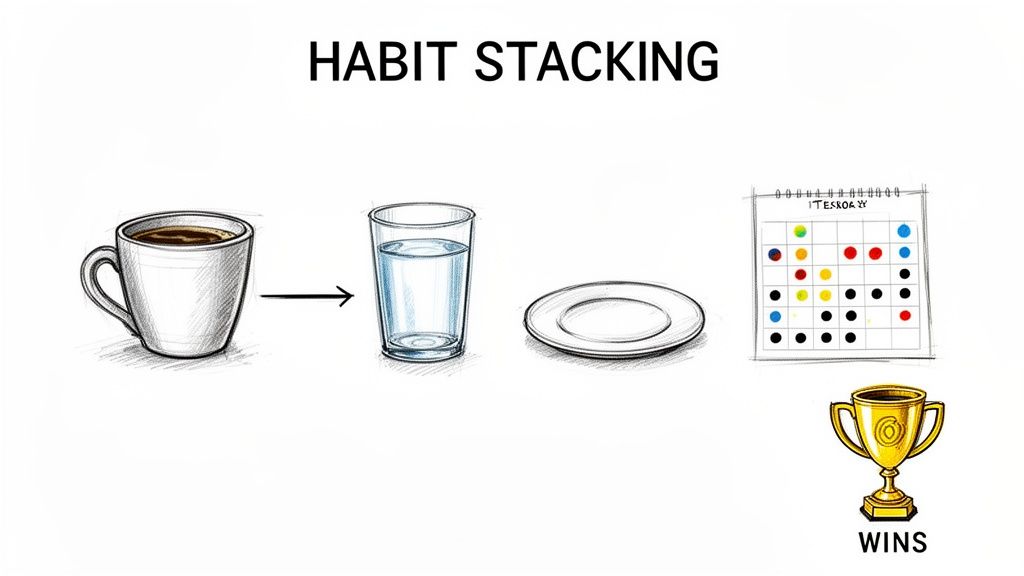
One of the most effective strategies I’ve seen is anchoring a new habit to one you already have on autopilot. It’s a technique called habit stacking. Your brain is wired for efficiency, so linking a new behavior to an old one creates a powerful shortcut that makes it easier to remember.
You’re not trying to pull a new habit out of thin air; you’re simply tacking it onto your existing routine.
Here’s what this looks like in the real world:
- Morning Stack: "After I pour my morning coffee, I will drink one full glass of water."
- Lunchtime Stack: "Before I take my first bite of lunch, I will take three deep, calming breaths."
- Evening Stack: "When I finish washing the dinner dishes, I will lay out my healthy snacks for tomorrow."
The key here is specificity. A vague goal like "drink more water" is almost guaranteed to be forgotten. But a concrete plan like, "When I put my work bag by the door, I will fill my water bottle for the next day," gives your brain a clear trigger and a clear action.
Your daily routines are a powerful foundation for change. By linking new, intentional food habits to the things you already do automatically, you put your progress on autopilot.
To make these new habits feel even more worthwhile, it helps to understand the "why" behind your food choices. For instance, understanding Prebiotics and Probiotics can empower you to choose foods that genuinely support your body, making the new habit feel less like a rule and more like an act of self-care.
Your Blueprint for a Mindful Week
Okay, let's put this all together into a simple weekly guide. Think of this not as a rigid plan, but as a flexible structure to help you weave in mindful moments, plan ahead, and have coping strategies ready to go.
Sample Weekly Framework
| Day | Morning Focus | Midday Action | Evening Wind-Down |
|---|---|---|---|
| Monday | Drink water right after coffee. | Mid-meal check-in during lunch. | Journal one food win from the day. |
| Tuesday | Add berries to your breakfast. | Take a 5-minute walk before your afternoon snack. | Eat dinner without your phone. |
| Wednesday | Prep veggies for tomorrow's lunch. | Practice the "First Five Bites" exercise. | Sip herbal tea instead of late-night snacking. |
Use this as a jumping-off point. The best plan is one that fits your unique schedule, triggers, and goals. The aim isn't perfection; it's to create a supportive structure that makes the better choice the easier choice.
Measuring Progress That Isn't Just a Number
It's so easy to get fixated on the number on the scale. But real progress in your relationship with food is measured in how you feel—your energy, your freedom, your peace of mind.
Learning to spot and celebrate these non-scale victories (NSVs) is crucial for staying motivated. They are the tangible proof that your hard work is paying off where it counts.
Non-Scale Victories to Look For:
- You stopped eating when you felt satisfied, not stuffed.
- You navigated a stressful day without turning to food for comfort.
- You enjoyed a "forbidden" food without a side of guilt.
- You noticed your energy is more stable throughout the day.
- You tried a new healthy recipe and actually loved it.
- You went an entire day without a single negative thought about your body.
- You feel less bloated and your digestion has improved.
Keeping track of these wins is incredibly powerful. You can use a simple journal or an app like Superbloom to log these moments. Seeing this kind of progress over time gives you concrete evidence of how far you've come, reinforcing your new habits and showing you that you really are changing your relationship with food from the inside out.
Got Questions About Your Relationship With Food? We've Got Answers.
When you start down the path of healing your relationship with food, it’s completely normal for questions to pop up. You might be wondering about the timeline, what this means for your favorite pizza night, or how to handle a family dinner. Getting some clarity on these common hurdles can give you the confidence you need to move forward.
This whole process is about finding what works for you—it's built on flexibility and self-compassion, not a set of rigid rules. So, let's dive into some of the most common questions I hear.
How Long Does This Actually Take?
There's no finish line here. Honestly, if you're looking for a universal timeline, you won't find one. We're talking about changing habits and thought patterns that have been with you for years, maybe even decades. That’s a gradual process. So instead of fixating on a deadline, shift your focus to being consistent and celebrating the small wins along the way.
Some people feel a real shift in their mindset after just a few weeks of practicing mindful eating. For others, it might take a few months before their automatic response to stress isn't reaching for the pantry. The speed of your progress is far less important than the direction you're heading.
This isn't a race. It's a lifelong practice of getting to know yourself better. Be patient, stay curious, and trust that every small step is building a stronger, healthier foundation.
The goal isn't to be "fixed" by a certain date. It’s about building a supportive, kind relationship with food that truly lasts. The real change in learning how to change your relationship with food happens in those small, daily moments of choosing awareness.
Do I Have to Give Up My Favorite Foods?
Absolutely not. In fact, a healthy relationship with food includes your favorite things. Forbidding certain foods is a classic move from the restrictive diet playbook we're trying to leave behind. As soon as you label a food "bad" or "off-limits," it suddenly has this immense psychological power over you, which is what leads to those intense cravings and the guilt that follows.
The real game-changer is moving from restriction to intention. Instead of telling yourself you can't have a cookie, you give yourself full permission to enjoy one—mindfully.
Here's how you can start weaving treats back in without the guilt:
- Plan for it. Don't wait for a late-night craving to strike. Intentionally decide, "I'm going to have a scoop of ice cream after dinner tonight." This puts you in the driver's seat.
- Savor it. Put it on a real plate (or in a bowl!), sit down, and get rid of distractions. Pay attention to the taste, the texture, and how you feel. Enjoy every single bite.
- Move on. When it’s gone, it’s gone. Just move on with your day. There’s no need to "make up" for it with a hard workout or by skimping on your next meal.
This approach takes away the power of those "forbidden" foods and gives it back to you. It's how you learn that all foods can fit.
What if My Partner or Family Eats Differently?
This is a big one. Navigating social and family dynamics can feel like one of the toughest challenges. It's easy to feel a little isolated when the people you live with aren't on the same page. But your journey doesn't have to happen in a bubble. It all comes down to a little communication and some gentle boundaries.
You don't need to get everyone around you to change. Just focus on what you can control.
A Few Practical Ideas for Shared Meals:
- Lead by example. Just focus on your own plate. When others see you enjoying a variety of foods without all the stress and drama, it often sparks genuine curiosity.
- Contribute to the meal. Offer to bring a dish you know you'll enjoy to family gatherings—like a big, colorful salad or a side of roasted vegetables. That way, you know there will be something you'll feel great about eating.
- Share your "why." You can explain what you're doing in a simple, non-judgmental way. Something like, "I'm really focusing on eating in a way that gives me more energy, so I'm trying to add more veggies to my meals."
- Separate the food from the event. Remind yourself that getting together is about connecting with people you care about. The food is part of it, but it's not the only part. Focus on the conversations.
Your journey is your own, but it can absolutely coexist with the habits of the people you love. You're just finding a balance that honors your needs without starting a conflict.
Ready to put these ideas into practice? The Superbloom app is designed to help you understand your unique patterns and build habits that stick, all without restrictive dieting. You can get personalized guidance and track your progress in a way that feels genuinely supportive. Start your journey with Superbloom today.