
How to Develop Healthy Eating Habits That Actually Last
Most advice about healthy eating fails for a simple reason. It starts with rules.
Cut sugar. Meal prep every Sunday. Never snack late. Stop eating emotionally. Be more disciplined.
That sounds clean on paper. It falls apart in a real week filled with work stress, family logistics, low energy, cravings, skipped lunches, social meals, and the random moment when you eat chips over the sink because dinner still is not figured out.
If you want to learn how to develop healthy eating habits that last, stop treating eating as a morality test. Treat it as a behavior pattern.
Behavior patterns can be observed. They can be adjusted. They can be reinforced. That is a far more useful frame than trying to become a “perfect eater.”
Why Willpower Is Not the Answer to Better Eating
Willpower matters, but it is a terrible primary plan.
If your strategy depends on making the right decision every time you are stressed, tired, rushed, distracted, or tempted, the strategy is weak. You are asking your most depleted brain state to do your best decision-making.
That is why people can know a lot about nutrition and still struggle. The issue is often not knowledge. The issue is behavior under pressure.
The CDC’s guidance on improving eating habits points to a gap many people feel but cannot name. Eating is often driven by stress, boredom, and visual cues, not just hunger, and mainstream advice often skips the reflection needed to understand why we eat in the first place, especially for busy people and those dealing with stress-related eating (CDC guidance on improving eating habits).
What willpower gets wrong
Willpower-based advice assumes the problem is temptation. In practice, the problem is usually setup.
A few common examples:
- The afternoon crash: You did not “lack discipline.” You had coffee, no real breakfast, a rushed lunch, and a hard meeting at 3 PM.
- The late-night snack spiral: You were not weak. You were underfed all day and finally alone with easy food.
- The takeout habit: You do not need a lecture on vegetables. You need an easier default at 6:30 PM.
When people blame themselves, they miss the mechanics. And when they miss the mechanics, they repeat the same loop.
A better lens
Behavioral psychology gives us a more workable question: what is the cue, what is the routine, and what reward is your brain seeking?
Sometimes food solves a real problem. It gives comfort, stimulation, relief, distraction, or convenience. If you ignore that and focus only on “good” and “bad” foods, you stay stuck.
Key shift: Stop asking, “Why can’t I be more disciplined?” Start asking, “What keeps happening right before this choice?”
Modern tools can also help. An AI coach does not replace judgment or medical care, but it can reduce friction. Instead of expecting you to remember every pattern on your own, it can help you notice them in real time and turn vague guilt into specific feedback.
Healthy eating gets easier when your system does more work than your willpower.
First Understand Your Current Eating Patterns
Before changing anything, get accurate about what is already happening.
Not in a punishing way. Not with a “clean eating reset.” Think of this as field research.
The most useful habit framework here is Reflect, Replace, Reinforce. In the Reflect stage, you track intake and emotions to uncover patterns. That matters because over 80% of U.S. adults have diets low in fruits, vegetables, and dairy, and only 2.7% meet all benchmarks for a healthy diet according to the source provided on the framework (Reflect, Replace, Reinforce overview).
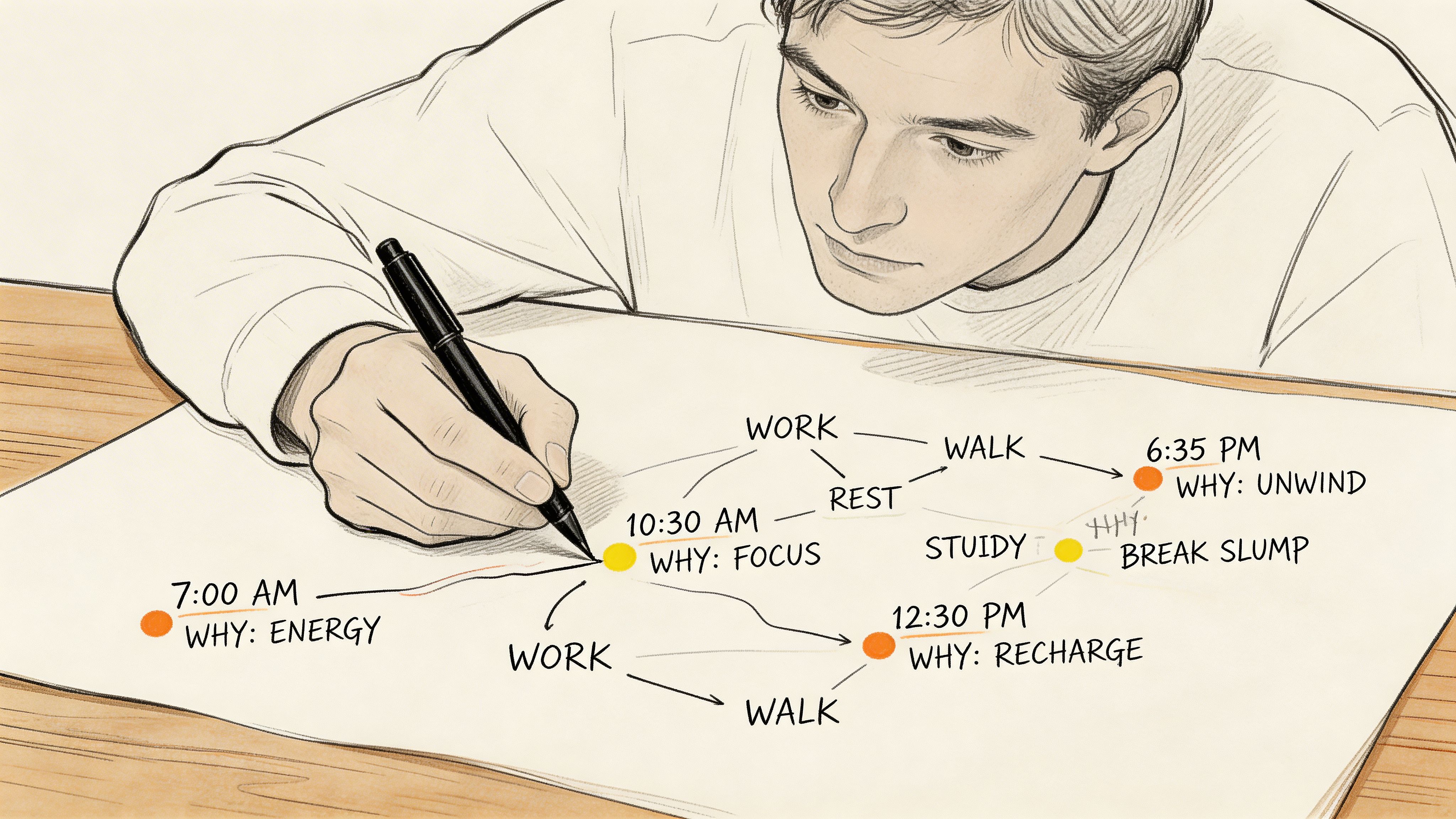
Track context, not just food
A food log is only helpful if it reveals behavior.
Writing “granola bar” tells you very little. Writing “granola bar at desk, after poor lunch, tired, between calls” tells you a lot.
For a few days, capture details like these:
- What you ate
- When you ate
- Where you were
- Who you were with
- How hungry you felt before eating
- What emotion was present
- What happened right before
You do not need perfect accuracy. You need enough detail to spot repeat situations.
The questions that uncover patterns
Many people discover their habits by accident. It works faster if you ask sharper questions.
Try prompts like these after each meal or snack:
- Was I physically hungry, emotionally activated, or just responding to the environment?
- Did I choose this, or was it the easiest thing available?
- What did I need in that moment?
- How did I feel one hour later?
- Would this same pattern happen if my day were less stressful?
The goal is not to catch yourself doing something wrong. The goal is to identify where your eating becomes automatic.
What real patterns often look like
Once people track for even a short stretch, certain themes show up.
| Pattern | What it often means | Better question |
|---|---|---|
| Skipping breakfast and overeating later | Under-fueling early | What makes the first meal easier? |
| Constant snacking at work | Stress or convenience eating | What cue starts it? |
| Healthy weekdays, chaotic weekends | Missing structure | What routine disappears on weekends? |
| Late-night cravings | Fatigue, restriction, or decompression | What are you trying to recover from? |
That is why reflection matters. It turns “I have no self-control” into “I keep getting home overhungry with nothing ready.”
Those are very different problems.
Keep the tone neutral
The best reflection is boringly honest.
Do not write “bad lunch” or “cheated.” Write what happened. If lunch was fast food because you had no break, that is useful information. If you ate sweets after a conflict, that is useful information too.
Judgment hides patterns. Neutral observation exposes them.
Practical tip: Track just three to seven days if longer tracking makes you obsessive or irritated. Short bursts can still show the main loops.
Use tools that reduce friction
A paper notebook works. Notes app works. A meal photo works.
If logging feels tedious, you will stop. That is why lower-friction tools are valuable. A system that lets you snap a meal photo, tag your mood, and record a quick note usually produces better self-awareness than a perfect tracker you avoid.
Superbloom fits well here because it combines meal logging, daily check-ins, and emotional pattern tracking without requiring strict calorie counting. That makes the reflection phase more realistic for people who want insight, not another rigid diet tool.
Reflection is not passive. It is the diagnostic step that tells you which habit to change first.
Building Your Action Plan with Small Wins
After reflection, many people make the same mistake. They try to fix everything at once.
That feels productive for about three days.
The better move is smaller and less exciting. Choose one or two shifts that lower friction and repeat well. Small changes are not a compromise. They are how durable habits get built.
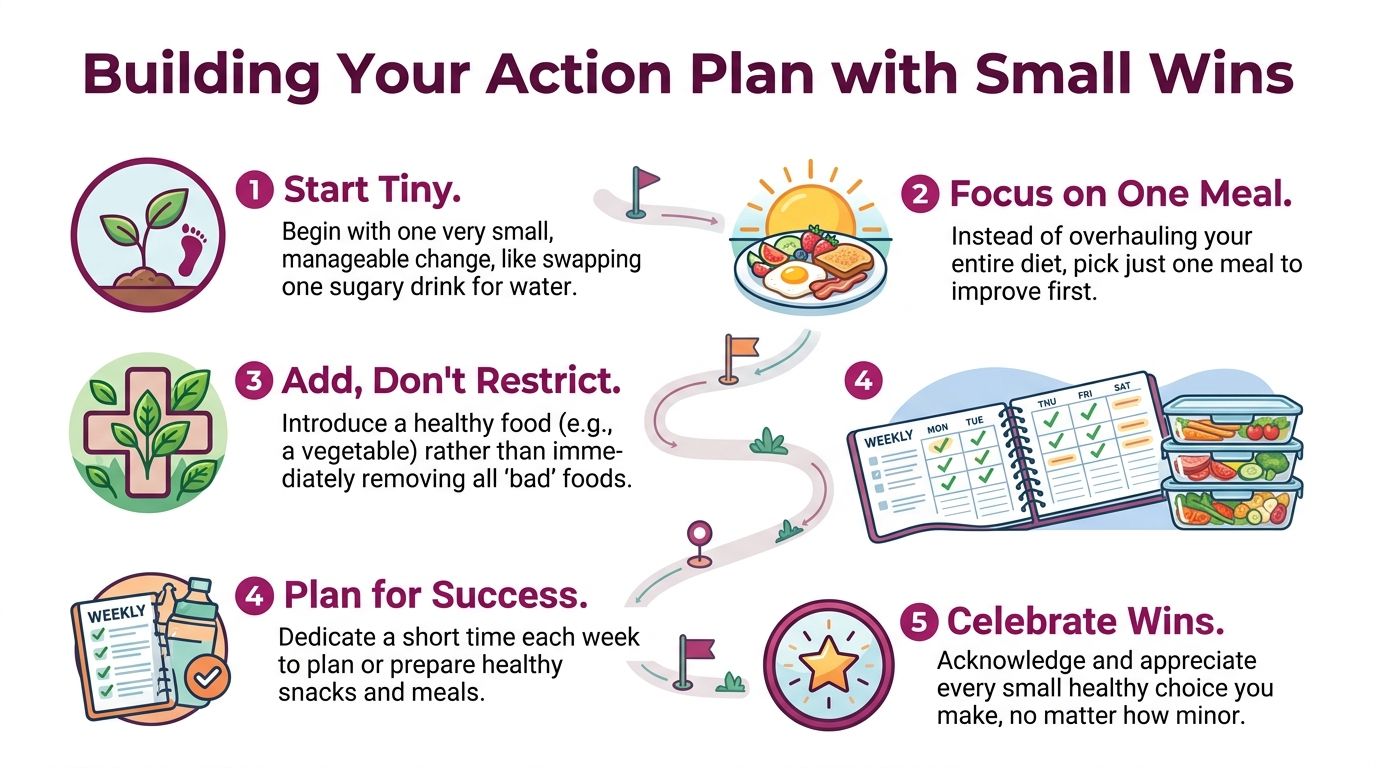
Why small wins beat a full overhaul
Healthy eating improves when your new behavior fits your life.
That means the right habit is often unimpressive:
- adding fruit to a breakfast you already eat
- keeping a ready lunch option in the freezer
- buying one bagged salad every week
- putting protein into the meal that usually leaves you hungry an hour later
These are not dramatic. They are effective.
Home cooking is one good example of a practical lever. 29% of people who cook at home daily rate their diets as extremely or very healthy, compared with 12% of those who cook less frequently, while 90% of Americans say rising healthy food costs make it harder to maintain healthy habits (Kansas State summary on food habits and cost barriers). That tells us two things at once. Cooking helps, and cost is a real barrier. So the solution cannot be “just cook more” in the abstract. It has to be easier, cheaper, and repeatable.
Start with replacements, not restrictions
A replacement habit works better than a vague rule because it tells you exactly what to do.
Try patterns like these:
- If breakfast is inconsistent, keep one reliable option that requires no thought.
- If afternoons unravel, build a lunch with more staying power instead of promising yourself not to snack.
- If dinner is chaotic, create a short list of fallback meals using ingredients you buy.
- If takeout is your pressure valve, keep one easier at-home option that competes with it on speed.
People often do better when they add before they subtract.
Examples:
- Add a vegetable to the meal you already make.
- Add a glass of water when you start your workday.
- Add protein or fiber to the snack that currently does not hold you.
- Add one grocery staple that saves you on your hardest day.
Habit stacking for busy lives
One reason healthy habits fail is that they float. They are not attached to anything.
Habit stacking solves that by linking the new action to an existing cue.
For example:
- After I start the coffee maker, I put out breakfast.
- When I pack my laptop, I pack a snack.
- When I plate dinner, I add produce first.
- After I clear lunch dishes, I check tomorrow’s first meal.
This removes the need to “remember to be healthy.” The cue does the remembering.
Make meal planning less ambitious
Many adults do not need gourmet meal prep. They need fewer moments of food panic.
If you want a simple structure, this practical meal planning guide is useful because it focuses on reducing decision fatigue rather than chasing perfect menus.
A workable weekly plan often includes only three things:
- A few repeat breakfasts
- Two or three lunches you can rotate
- A short fallback dinner list
That is enough to change your week.
Cheap, fast, and good enough
A lot of healthy eating advice assumes free time, stable energy, and a generous grocery budget. Real habit change has to respect constraints.
A “good enough” shopping list might include:
- Convenience produce: pre-washed greens, frozen vegetables, fruit that keeps well
- Easy proteins: eggs, yogurt, canned fish, tofu, beans, rotisserie chicken
- Fast starches: oats, rice, potatoes, whole-grain bread
- Emergency meals: soup, frozen meals you are comfortable using, pasta with simple add-ins
- Default snacks: nuts, fruit, yogurt, crackers with something more substantial. Many people get unstuck here. They stop trying to shop like an aspirational version of themselves and start shopping for their real Tuesday.
Key takeaway: A healthy habit is not one you can do on your best day. It is one you still do on a rushed, annoying, low-energy day.
A short decision filter
When you consider a new habit, ask:
| Question | If the answer is no |
|---|---|
| Is it easy enough to repeat this week? | Make it smaller |
| Does it solve a real problem I found during reflection? | Pick a different habit |
| Can I do it without extra motivation? | Attach it to a cue |
| Is it affordable and realistic? | Simplify the plan |
That is how to develop healthy eating habits in a way that survives ordinary life. Start small, aim for repeatability, and build from there.
Mastering Your Emotional and Environmental Triggers
Most eating struggles are not random. They are patterned responses to cues.
You feel pressure after a meeting and want something crunchy. You watch television and automatically look for snacks. You walk into the office kitchen, see pastries, and eat one before deciding whether you even wanted it.
Those moments matter because food is often doing more than feeding you. It may be helping you regulate attention, emotion, or energy.
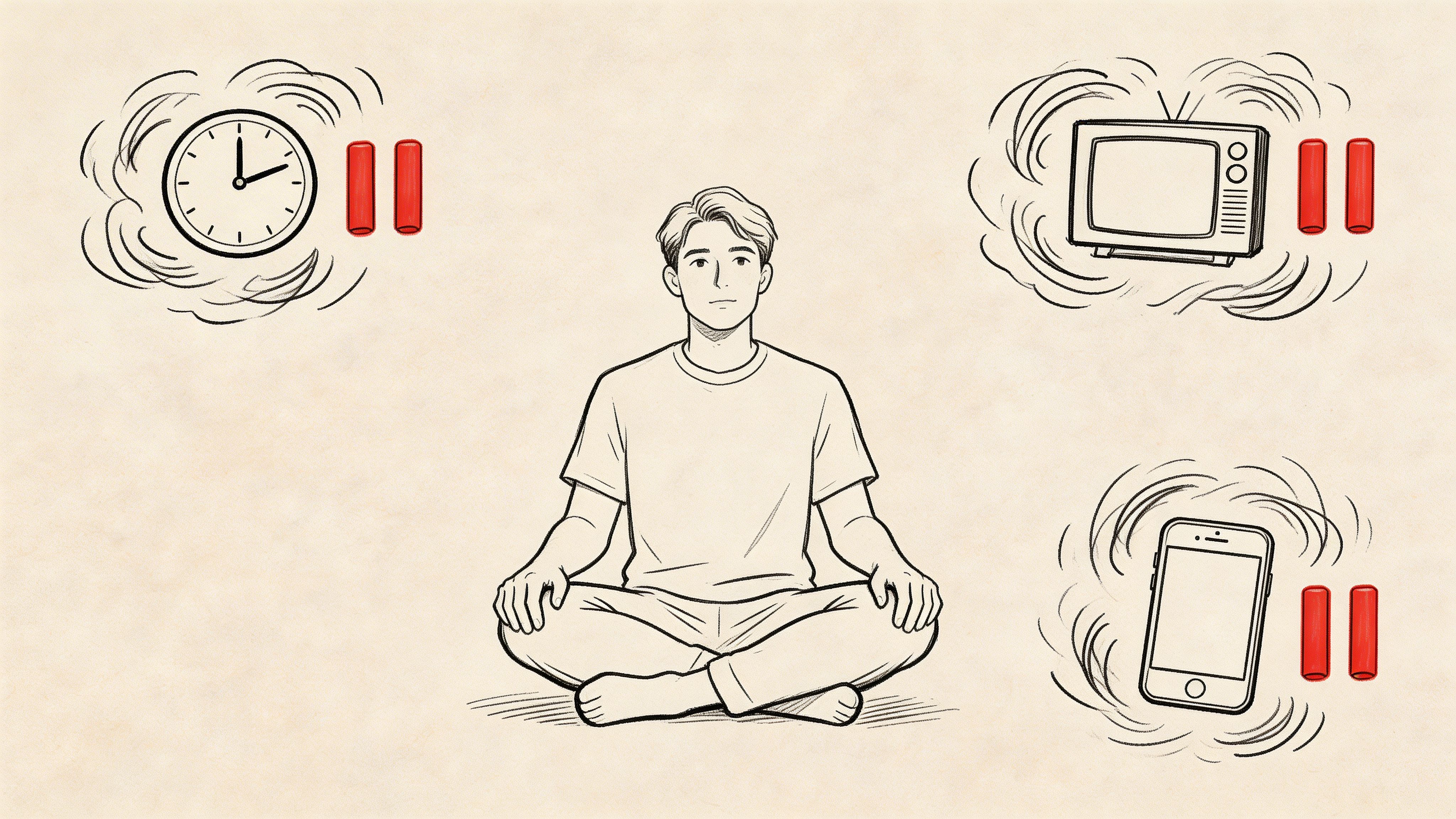
Learn your cue routine reward loop
A practical way to work with triggers is to identify three parts:
Cue
What happened first? A stressful email, boredom, seeing food, fatigue, social pressure.Routine
What did you do next? Snack, order food, skip the meal, keep grazing.Reward
What did your brain get? Relief, stimulation, comfort, distraction, ease.
If the reward is relief, telling yourself “just don’t snack” does not solve the problem. You still need relief.
Common triggers and better replacements
You do not need a perfect substitute. You need one that serves the same function well enough.
Stress at work
If snacking gives a break, take the break on purpose. Stand up, walk, breathe, refill water, step outside for a minute.Boredom eating
If food gives stimulation, change the sensory input. Move rooms, switch tasks, listen to music, do one tiny active chore.Late-night decompression
If eating marks the end of the day, create another signal. Tea, shower, stretching, a show you watch only after the kitchen is closed.Visual cues
If the sight of food triggers eating, adjust the environment. Put trigger foods out of sight, or portion them before they reach your desk or couch.
One useful sign of progress is not “I never want the snack.” It is “I noticed the cue before the routine took over.”
Performance is part of the picture
Eating habits shape more than weight or labs. They affect how you think and function.
In the CDC’s 2019 Youth Risk Behavior Survey, 42% of high school students with mostly A’s ate breakfast daily, compared with 20% of students with D’s and F’s (CDC data on diet and grades). The population is younger, but the lesson travels well. Consistent fueling supports performance, attention, and steadier decision-making.
That matters for adults with demanding schedules. A pattern that leaves you foggy, reactive, or constantly chasing energy is not just a nutrition problem. It is a workday problem.
A short explainer on changing stress-driven patterns can help if you think better with visuals:
Build friction in the right place
People often try to eliminate temptation. Usually, it is enough to change the path.
A few examples:
| Situation | Old default | Better setup |
|---|---|---|
| Afternoon office cravings | Snack appears on desk | Keep a planned option nearby and leave the area for a minute |
| TV snacking | Eat from the package | Portion first, then sit down |
| Stress ordering | Open delivery app immediately | Drink water, pause, then decide |
| Skipping lunch | Work through hunger | Calendar a short meal break |
These are environment changes, not character tests.
Practical tip: If a habit keeps repeating, adjust the cue or the environment before you question your motivation.
Reinforcing Habits and Troubleshooting Plateaus
Starting a habit gets attention. Repeating it consistently is what changes you.
Here, many people drift. The novelty wears off. Life gets noisy. The initial burst of motivation fades, and they assume the plan stopped working.
Usually, the plan did not fail. The reinforcement did.
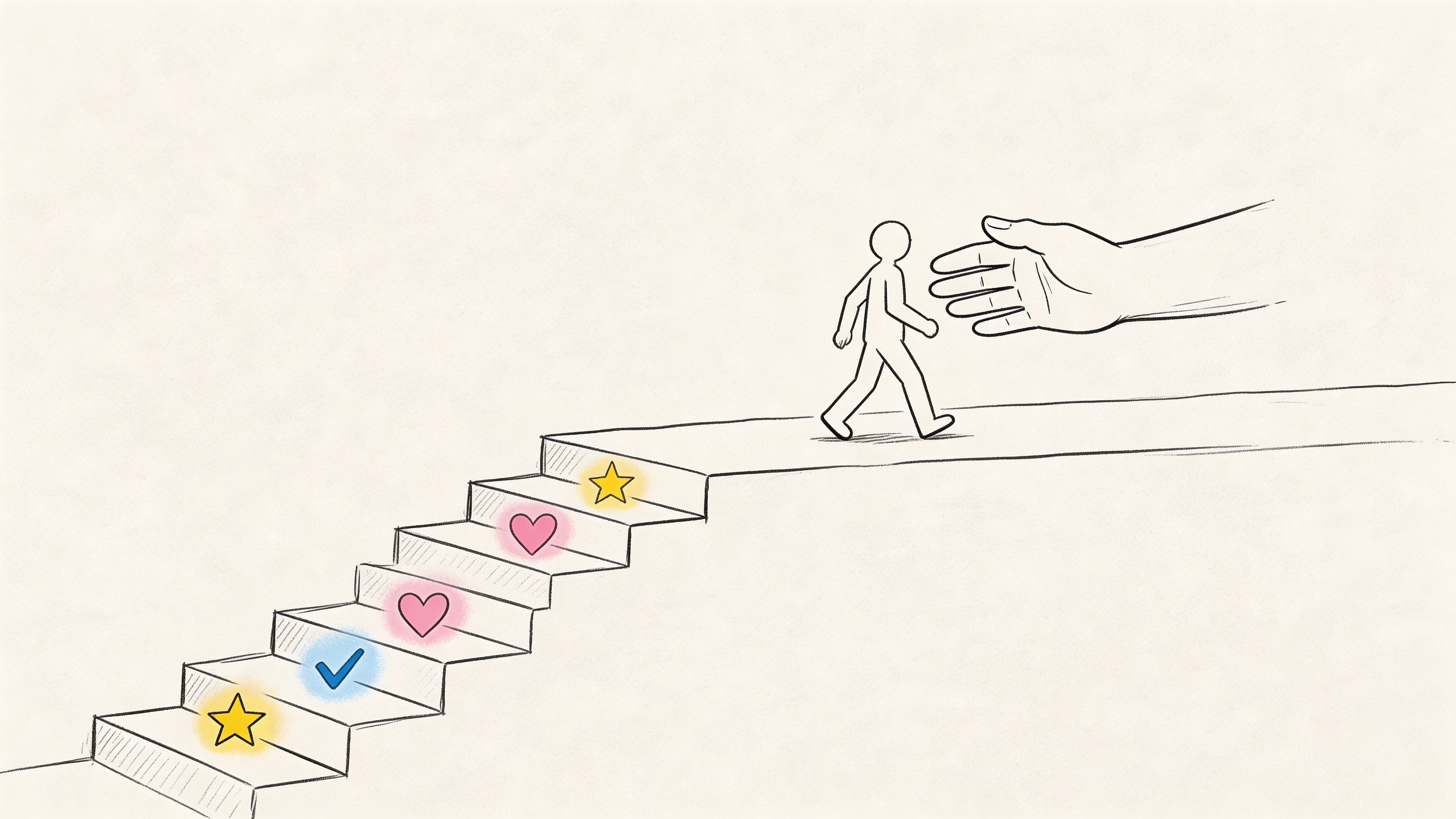
Reinforcement is what makes the habit sticky
A habit lasts when your brain gets a clear message that the new behavior is worth repeating.
That does not require a huge reward. It requires a noticeable one.
Good reinforcement can be:
- Visible progress: checking off consistent breakfasts or planned lunches
- Immediate payoff: fewer energy crashes, less chaos, better appetite control
- Small non-food rewards: a nicer coffee, new kitchen container, time for yourself
- Identity reinforcement: “I’m someone who plans one meal ahead,” not “I’m on a diet”
The reinforcement should match the effort. If the habit is small, keep the reward simple and close to the action.
Tracking keeps progress visible
When people say, “Nothing is changing,” they often mean, “I cannot see change.”
Tracking solves that. Not because you need to measure everything forever, but because visible evidence helps motivation survive normal fluctuations.
This is one reason gradual change tends to work better. According to the verified source on food-based dietary guidance and habit persistence, setting realistic goals improves long-term adherence, incremental goals yield twice the habit persistence compared with restrictive diets, and filling half your plate with produce is a useful benchmark that less than 50% of people meet without tracking (food-based dietary guidelines modeling and incremental change).
That supports a simple rule. If you want consistency, track the behavior that matters most.
Examples:
- breakfast eaten before work
- produce added to dinner
- lunches brought from home
- evening snack paused and reconsidered
- one planned grocery trip completed
Notice that these are behaviors, not moral judgments.
What to do when progress stalls
A plateau does not always mean you need more effort. Often it means you need a better adjustment.
Use this checklist.
If the habit feels harder than it did two weeks ago
Your plan may be too ambitious.
Shrink it:
- prep fewer meals
- simplify the grocery list
- repeat meals more often
- choose one anchor habit instead of three
If weekends erase your weekday progress
Your routine is too dependent on structure you only have at work.
Test one weekend anchor:
- same breakfast both days
- one planned grocery stop
- one fallback dinner
- one pause before ordering food
If you keep “starting over”
Drop the reset mentality.
The useful question is not, “How do I get back to perfect?” It is, “What is the next supportive action?” Sometimes that is a normal lunch. Sometimes it is putting produce on the plate at dinner and moving on.
Social events and imperfect weeks
Healthy eating habits have to survive birthdays, travel, deadlines, and restaurant meals.
That means flexibility is not a bonus. It is part of the skill.
A few practical rules help:
- Before an event, decide what matters most. Hunger, enjoyment, alcohol, late-night snacking, or portion awareness.
- During the event, slow the pace. Most overeating in social settings happens on autopilot.
- After the event, do not compensate dramatically. Return to your next normal meal.
That last point matters. Restrictive compensation often creates the next overeating episode.
Key takeaway: Consistency beats intensity. One grounded choice after a messy day is habit reinforcement in action.
Build a review habit
A weekly review can be more powerful than daily self-criticism.
Keep it short:
- What worked?
- What got in the way?
- Which meal was easiest to improve?
- Where did stress or convenience take over?
- What one change will I repeat next week?
That review is where habits become adaptive rather than rigid.
If a behavior no longer fits your schedule, budget, energy, or appetite, update it. Sustainable eating is not about obeying a fixed plan. It is about keeping a workable system alive.
Your Journey to Sustainable Healthy Eating
Healthy eating habits last when they are built, not forced.
That is why the most useful framework is still simple. Reflect so you can see your real patterns. Replace with changes small enough to repeat. Reinforce so the new behavior becomes your default instead of a temporary burst of effort.
This process is more compassionate than most diet advice, but it is also more demanding in the right way. It asks for honesty instead of perfection. It asks you to notice what is happening, not what you wish were happening.
That is the difference between a habit and a rule.
If you want a practical next step, choose one meal and one moment of friction. Maybe breakfast is inconsistent. Maybe lunch leaves you underfed. Maybe evenings unravel. Start there.
Keep the target narrow. Make the action easy. Repeat it long enough to learn from it.
For readers who want more specific nutrition guidance around heart health, this resource on what foods to reduce cholesterol can be a useful complement to the behavior side of the process.
You do not need a new identity overnight. You need a system that helps you make slightly better choices more often, especially when life is busy and your emotions are loud.
That is how to develop healthy eating habits that last.
If you want support putting this into practice, Superbloom offers AI-guided nutrition coaching built around reflection, pattern awareness, and small behavior changes. You can log meals, track moods and cravings, and get personalized feedback without strict dieting or calorie counting.