
How to Eat Healthy at Work: A Realistic Guide
You sit down to work with decent intentions. By midmorning, meetings stack up, lunch gets pushed, and by 3 PM you're staring at a vending machine, office pastries, or a delivery app because your brain wants fast energy now.
That cycle isn’t a character flaw. It’s what happens when a busy workday rewards convenience, speed, and constant attention switching. If you want to know how to eat healthy at work, the answer usually isn’t stricter rules. It’s better systems, better defaults, and a better read on why you reach for food in the first place.
Work nutrition matters for more than weight or long-term health. It affects your focus, your patience, and how steady you feel from one task to the next. Done well, it can make work feel easier.
Why Eating Healthy at Work Feels So Hard
The office is full of small decisions that drain you.
You skip breakfast because you're rushing. Then you answer emails for hours, drink coffee instead of water, and realize at lunch that you're too hungry to think clearly. Later, stress hits, your energy drops, and the fastest snack wins.
That pattern feels normal because most work environments are built around reactive eating, not intentional eating.
Your workday keeps nudging you off track
A healthy choice at work rarely depends on knowledge alone. Many people already know that chips and sugary snacks won't help them feel their best. The issue is timing, access, and mental bandwidth.
Common friction points look like this:
- Meetings replace meal breaks. You planned lunch, but a calendar invite took its place.
- Convenience beats intention. The snack drawer is closer than the cafeteria salad line.
- Stress changes appetite. Some people stop eating. Others graze all afternoon.
- Decision fatigue builds. By late afternoon, even smart people make impulsive food choices.
Healthy eating at work gets easier when you stop treating every food choice like a test of discipline.
Poor eating shows up in performance
This isn’t just about health goals outside the office. Food choices affect how you work.
Research involving nearly 20,000 employees found that unhealthy eaters were 66% more likely to report productivity losses, and poor nutrition had three times the impact of low physical fitness on job performance, making diet the top factor affecting on-the-job health status, according to Brigham Young University’s report on employee health and productivity.
That lines up with what many professionals notice in everyday life. When lunch is unbalanced or delayed, the afternoon often feels harder than it should. Concentration slips. Irritability rises. Small tasks take longer.
What works
The fix usually isn’t a perfect meal plan.
It’s a short list of repeatable habits:
- Eat before you’re desperate
- Keep backup food nearby
- Build meals from simple components
- Notice when stress, boredom, or fatigue is driving the craving
That last point gets ignored in most workplace nutrition advice. People are told what to pack, but not how to handle the moment they want crunch, sugar, or comfort because work feels heavy. That’s where lasting change usually starts.
The Sunday System for Stress-Free Workday Lunches
If weekday eating feels chaotic, fix it before Monday starts.
The most practical approach I recommend is component prep. Instead of cooking five complete meals, prep a few versatile foods that can turn into bowls, wraps, salads, or snack plates. You get structure without getting bored.
Use a simple eating rhythm
A structured workday eating pattern helps steady energy. Guidance from Nutrition Education for workplace productivity recommends a high-protein breakfast within an hour of waking, a protein-fiber snack around 10 AM, a balanced lunch, and a 3 PM snack with healthy fats to support sustained energy and reduce afternoon slumps.
That rhythm matters because it lowers the odds that you’ll arrive at lunch ravenous and eat whatever’s easiest.
The one-hour Sunday prep
Think in categories, not recipes.
Prep one or two options from each group:
Protein
Cook chicken, tofu, lentils, eggs, or Greek yogurt cups for the week.Vegetables
Roast a tray of vegetables, wash salad greens, slice cucumbers, or pack baby carrots.Smart carbs
Make rice, quinoa, potatoes, wraps, or keep fruit ready to grab.Add-ons
Hummus, salsa, nuts, olive oil-based dressing, or a dip you enjoy.Emergency backups
Shelf-stable options matter on chaotic days. A few professionals also like to keep calming routine items at home or in a desk bag, such as tea or other wellness staples. If that’s useful for your evening wind-down, premium organic hemp products can fit into a broader routine that supports recovery after high-stress workdays.
Build lunches with a formula
You don’t need five Pinterest-worthy containers.
Use one of these formulas:
- Bowl. Grain + protein + roasted vegetables + sauce
- Wrap. Protein + crunchy vegetables + spread
- Salad with substance. Greens + protein + beans or grains + fat source
- Snack plate lunch. Eggs or turkey + fruit + cut vegetables + hummus + crackers
Practical rule: If your lunch is mostly refined carbs and not much protein or fiber, don’t expect steady energy from it.
Keep storage boring and obvious
Healthy food should be the first thing you see.
A few practical rules help:
- Use clear containers so you remember what’s available.
- Label the first two days if leftovers tend to disappear into the back of the fridge.
- Pack tomorrow’s lunch at night if mornings are rushed.
- Keep desk-stable backups like nuts, roasted chickpeas, or whole-grain crackers for days when lunch gets derailed.
Five-minute healthy mini-meal and snack ideas
| Protein Source | Fiber/Carb Source | Healthy Fat (Optional) |
|---|---|---|
| Greek yogurt | Berries or apple | Chopped nuts |
| Hard-boiled eggs | Whole grain toast or fruit | Avocado |
| Hummus | Carrots, cucumbers, or crackers | Olive oil drizzle |
| Cottage cheese | Fruit or cherry tomatoes | Seeds |
| Turkey slices | Whole grain wrap | Cheese or avocado |
| Tofu cubes | Edamame or brown rice leftovers | Sesame seeds |
| Lentils | Roasted vegetables | Tahini |
| Nut butter | Apple or banana | Already included |
A shopping template that saves time
Write the same list each week and swap flavors, not the structure.
- Protein picks. Eggs, chicken, tofu, Greek yogurt, beans
- Produce basics. Salad greens, carrots, peppers, cucumbers, berries, apples
- Carb staples. Rice, quinoa, wraps, oats, potatoes
- Flavor helpers. Hummus, salsa, lemon, dressing, herbs
- Desk backups. Nuts, tuna packets, crackers, dried fruit
When people say meal prep doesn’t work for them, they usually mean rigid meal prep doesn’t work. Fair point. Component prep works better because it leaves room for appetite, schedule changes, and cravings.
Navigating Cafeterias Catered Lunches and Takeout
Even with a solid plan, some workdays go sideways. A catered lunch appears. You forget your container at home. The only realistic option is the cafeteria or takeout.
That doesn’t mean the day is ruined. It means you need a fast filter for making the best available choice.
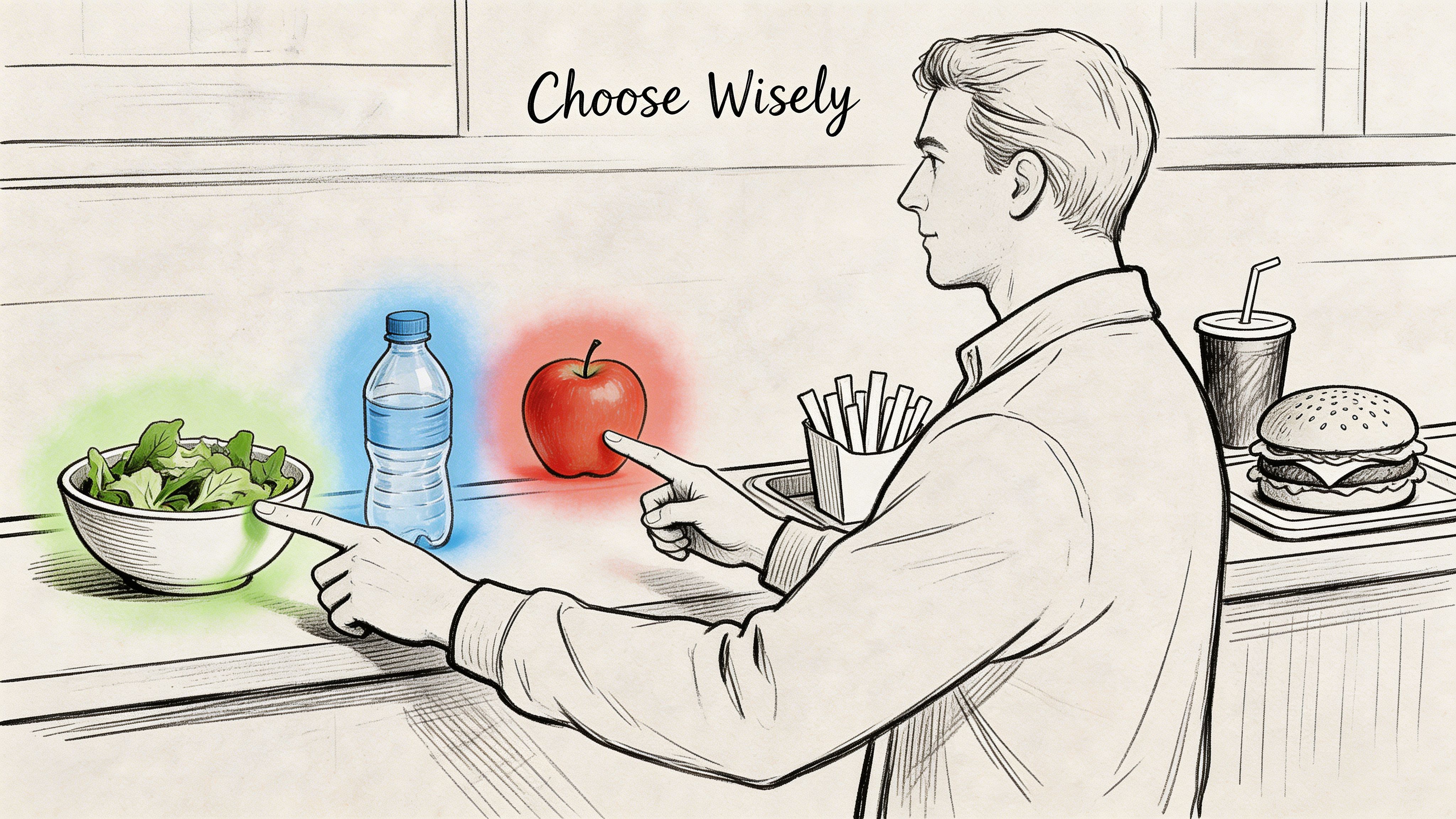
Use the plate rule
When options feel overwhelming, keep the visual simple.
Aim for:
- Half the plate from vegetables or produce-rich sides
- A quarter from protein
- A quarter from a carb that feels satisfying and steady
This works at buffets, cafeterias, and even fast casual spots because it gives you a structure without needing perfect ingredients.
What to do in common office food situations
At the cafeteria
Walk the full line once before grabbing a tray if you can. People often load up on the first convenient item and miss better options further down.
Look for:
- Protein first. Chicken, beans, fish, tofu, eggs
- Vegetable volume. Salads, cooked vegetables, soups with vegetables
- Carbs with staying power. Rice, potatoes, grain sides, whole grain bread if available
At catered meetings
Buffets reward quick grabbing, which usually leads to beige food and not much produce.
Try this instead:
- Start with vegetables or salad if they’re available
- Add protein before bread-heavy sides
- If pizza or sandwiches are the main option, pair them with a side salad, fruit, or vegetable tray rather than doubling up on chips and dessert
With takeout
Most takeout can be adjusted without making it weird.
Examples:
- Sandwiches: Keep the sandwich, add extra vegetables, skip one less useful extra if the meal already feels heavy
- Salads. Make sure there’s enough protein and don’t rely on a pile of crunchy toppings to make it filling
- Rice bowls. Ask for more vegetables and a sensible sauce amount
- Asian takeout. Choose dishes with visible vegetables and protein, then portion rice intentionally
- Mexican-style orders. Build around beans, protein, salsa, vegetables, and a carb portion that satisfies you
Better decisions beat perfect decisions. One catered lunch doesn't define your eating habits.
Why these choices matter
A study of worksite food purchases found that the healthfulness of what employees bought at work tracked closely with their broader diet quality and cardiometabolic risk. Employees making the healthiest worksite purchases had an obesity prevalence of 24%, compared with 38% among those making the least healthy purchases, according to the Journal of Occupational and Environmental Medicine study on workplace food purchasing.
That’s a useful reminder. Cafeteria and office choices aren’t isolated. They tend to reflect, and reinforce, your overall pattern.
A quick decision filter
When you’re ordering under pressure, ask:
- Where’s the protein?
- Where’s the produce?
- Will this keep me full for more than an hour?
- Am I choosing what sounds good, or just what’s fastest?
That last question matters. Fast food decisions at work are often less about taste and more about urgency. Once you notice that, you make better calls.
How to Manage Stress and Boredom-Driven Snacking
A lot of office snacking has very little to do with hunger.
It happens after a tense email. During a long spreadsheet block. Right before a difficult meeting. Or in that empty stretch between tasks when your brain wants stimulation.
Stop calling it a willpower problem
If you keep telling yourself to “just have more discipline,” you’ll miss the core issue.
Workplace stress is a major driver of poor eating habits, and behavioral psychology suggests that pattern recognition through reflection can reduce emotional eating by 30% over 12 weeks, as noted in this American Heart Association workplace eating article.
That matters because awareness changes the intervention. If your 4 PM snack is really a stress response, more food rules won’t solve it.
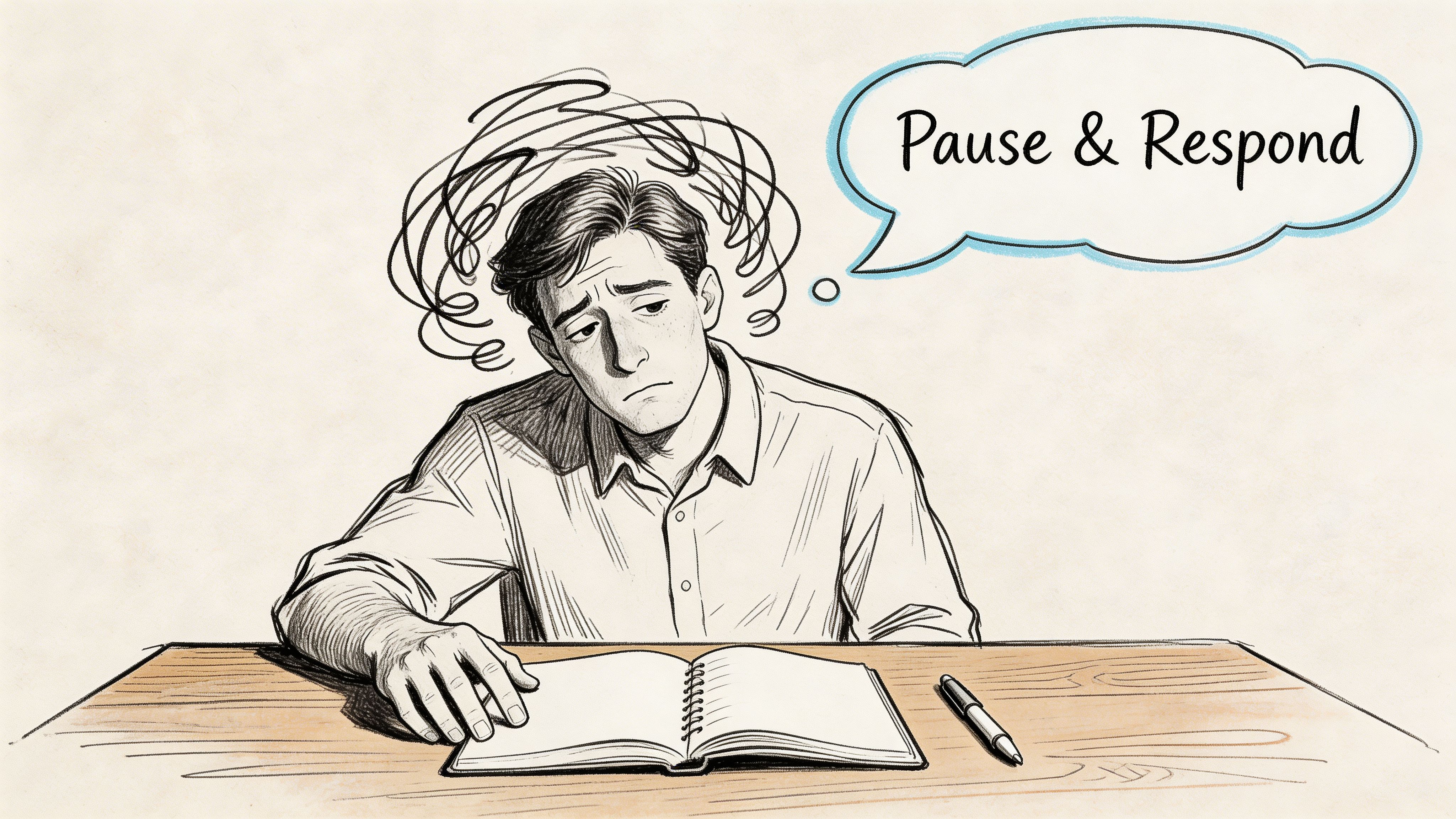
The pause and identify method
Before you eat something unplanned, pause for a few seconds and ask:
- Am I physically hungry?
- What happened right before I wanted this?
- What feeling is here right now?
- What would help besides food?
You don’t need a perfect journal entry. A quick note like “stressed after call” or “bored between tasks” is enough to reveal patterns over time.
Most cravings at work make more sense once you look at the moment right before them.
Match the response to the trigger
Different triggers need different tools.
If stress is high
- Walk to get water.
- Step outside for a short reset.
- Do one minute of slower breathing before deciding what to eat.
If boredom is the issue
- Change location for five minutes.
- Call or message a colleague.
- Switch to a small physical task like tidying your desk or refilling your bottle.
If fatigue is the problem
- Eat a planned snack with protein and fiber.
- Check whether you delayed lunch too long.
- Reduce the habit of using sugar as a substitute for rest and food.
If the urge is mostly habit
- Notice the cue. Same time, same drawer, same meeting?
- Replace the routine first. Tea, gum, a walk, or a preplanned snack often works better than white-knuckling it.
What mindless snacking usually gets wrong
Many people respond to reactive eating with extreme rules. No snacks. No treats in the office. Nothing after lunch.
That usually backfires.
A better approach is:
- Plan intentional snacks
- Separate hunger from emotion
- Make comfort visible in non-food forms too
Keep a short menu of non-food supports nearby. A playlist, notebook, tea bag, walking route, calming scent, or a short reset video can all interrupt the habit loop.
A quick reset can help in the middle of a stressful day:
Build self-awareness without obsessing
You don’t need to track every bite to learn something useful.
Try this for one workweek:
- Write the time when unplanned eating happens
- Note the feeling in one word
- Record the situation like “after meeting” or “while stuck on task”
- Check hunger later and see whether food solved the problem
That’s how people start eating more mindfully at work. Not by becoming perfect, but by becoming less automatic.
Design Your Work Environment for Automatic Success
The healthiest office eaters usually aren’t making heroic choices all day. They’ve made the good choice easier to reach.
That’s the value of choice architecture. Your environment shapes behavior before motivation even gets involved.
Make cues visible and friction low
Multi-level workplace nutrition programs that change environmental factors like food availability and visual cues, while also using motivational strategies, work better than education alone and can improve fruit and vegetable intake with lasting effects, according to this review of workplace nutrition interventions.
That principle applies on a small scale at your desk too.
If your candy is visible and your nuts are buried in a drawer, your environment has already made the decision.
Use the cue routine reward loop
Most work eating habits follow a simple pattern:
- Cue. Time, stress, boredom, or seeing food
- Routine. Grab snack, order food, sip something sweet
- Reward. Relief, stimulation, comfort, break from work
You don’t have to erase the whole loop. Replace one part of it.
Examples:
- The cue is a long meeting. The new routine is a packed snack after it ends.
- The cue is afternoon boredom. The new routine is tea and a short walk.
- The cue is seeing pastries in the break room. The new routine is eating your planned lunch first, then deciding.
Shift the environment first. Motivation is unreliable. Placement, visibility, and routine hold up better on busy days.
Practical office changes that work
A few small moves can make healthy eating feel much less effortful:
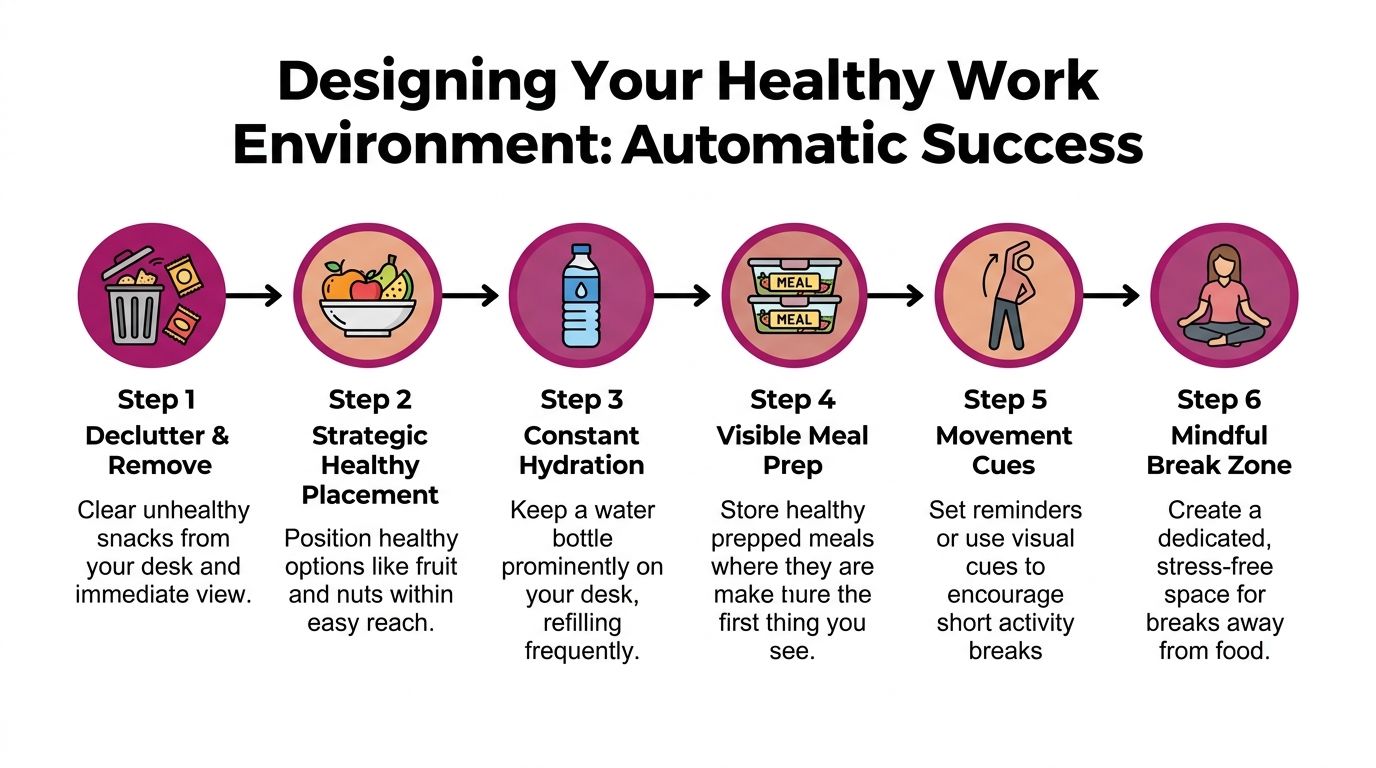
- Keep water in sight. A full bottle on your desk is a cue you’ll respond to all day.
- Use clear snack containers. Fruit, nuts, or cut vegetables should be easier to see than treats.
- Hide the frictionless junk. If you keep less helpful snacks, don’t store them in your direct line of sight.
- Block lunch on your calendar. If your lunch exists only as an intention, meetings will take it.
- Create a desk backup kit. Protein-rich and fiber-rich options prevent panic ordering.
- Set a movement cue. Stand up after calls, refill water at a certain time, or use a calendar alert.
The social environment matters too
Workplace food isn’t only personal. It’s social.
A few helpful moves:
- Find one ally. A coworker who also wants a real lunch break makes follow-through easier.
- Suggest better defaults for team meetings, such as fruit trays, sandwich platters with salad, or protein-forward options.
- Eat away from your keyboard when possible. That alone improves awareness.
Build a break zone that isn’t the snack zone
Many people use food as the only available break. That’s a central issue.
If every pause in your day happens beside the office kitchen, snacking becomes the default form of recovery. Create another reset option. A chair by a window, a hallway lap, a notebook in a quiet spot, or even a few minutes outside can become a competing habit.
When your workspace supports your goals, healthy eating at work stops feeling like a constant negotiation.
Your Path to Consistent and Mindful Eating at Work
If you want lasting change, stop chasing the perfect workweek.
The people who eat well at work most consistently usually do four things. They plan a few basics, make better choices when plans change, notice emotional triggers, and shape their environment so the healthy option requires less effort.
That’s a more realistic way to think about how to eat healthy at work. Not as a strict diet, but as a repeatable system.
Keep your standards realistic
You do not need a flawless meal prep routine, a pristine food journal, or a salad every day.
You need:
- a decent breakfast pattern
- one or two reliable lunches
- backup snacks
- awareness of your stress habits
- a workspace that doesn’t sabotage you
Coffee routines can fit into that picture too. If your workday starts with instant coffee, it’s worth learning what makes one option better than another. This guide to the healthiest instant coffee is a useful place to start if you want a more intentional caffeine habit.
Consistency beats intensity
Rigid plans tend to fall apart under pressure. Flexible systems hold.
A strong work nutrition routine sounds more like this:
“I know what I’ll eat most days, I know what I’ll do when plans change, and I can tell when I’m eating because I’m stressed instead of hungry.”
That’s the skill. Once you build it, healthy eating at work becomes less draining and more automatic.
If you want help turning these ideas into daily habits, try Superbloom. It gives you a practical way to log meals, notice patterns, check in on stress, and get personalized guidance without strict dieting or calorie counting.