
How to Eat Mindfully: Master Mindful Eating in 5 Simple Steps

To eat mindfully, you first need to learn how to pay attention. It’s about giving your meal your full, undivided focus, without judgment. This means putting down the phone, turning off the TV, and tuning in to the flavors, the textures, and your body's own signals of hunger and fullness.
It’s not a diet. Think of it more as a practice of awareness that helps you reconnect with the simple, physical act of nourishing yourself.
What Mindful Eating Really Means

Let’s be honest—most of us eat on autopilot. We scroll through social media during lunch, grab a quick snack while staring at a screen, or demolish a whole bag of chips without even tasting them. This kind of distracted eating has become the norm, but it robs us of both the pleasure of food and the ability to truly listen to what our bodies need.
Mindful eating is the complete opposite. It’s not another restrictive diet obsessed with "good" and "bad" foods. It’s a practice, rooted in mindfulness, that simply encourages you to bring your full attention to the present moment—specifically, to your plate. The goal is to rebuild your awareness of the entire experience from start to finish.
When you shift your focus like this, you start to reconnect with the physical sensations of eating. You notice the vibrant colors, smell the spices, and feel the different textures in each bite. Most importantly, you begin to recognize your body’s own internal cues for hunger and satisfaction.
Why Mindful Habits Are Gaining Ground
This approach is catching on for a reason. It’s now the second-most common eating pattern in the world, right behind high-protein diets. A 2023 survey found that 17% of people in the U.S. actively practice mindful eating, a number that's grown right alongside our stress levels.
The same study uncovered a critical link: 74% of people believe their food choices have a major impact on their mental well-being, while 61% feel their emotional state directly influences what they eat. You can dig into more of this data by checking out the full food and well-being report.
This practice is like hitting a reset button. It helps you break free from those unconscious eating patterns driven by boredom, stress, or just habit. By learning how to eat mindfully, you start to understand the why behind your food choices, not just the what.
Mindful eating isn't about being perfect; it's about paying attention. It’s the simple act of noticing your food and how your body responds, turning an automatic behavior into an intentional act of self-care.
Mindful Eating vs Traditional Dieting
To really get it, it helps to see how mindful eating stands apart from a conventional diet. Where diets impose external rules, mindful eating helps you cultivate your own internal wisdom. Here's a quick comparison that highlights the key differences.
Mindful Eating vs Traditional Dieting
AspectMindful EatingTraditional DietingFocusInternal cues (hunger, fullness, satisfaction)External rules (calories, carbs, points, "good" vs. "bad" foods)GoalBuild a healthier, more intuitive relationship with food and bodyWeight loss or achieving a specific physical outcomeFoodsAll foods are permitted; no guilt or moral judgmentFoods are often categorized and restricted, leading to deprivationSuccess MetricFeeling in tune with your body, enjoying food without stressAdherence to the diet plan, numbers on a scaleMindsetCuriosity, non-judgment, and self-compassionControl, restriction, and often self-criticism
As you can see, the philosophies are fundamentally different. Mindful eating is built on listening to your body, not fighting it.
Ultimately, this practice empowers you to become the expert on your own needs. It’s a sustainable skill that can improve your relationship with food for life, and modern tools like the Superbloom app can help guide you through the process in a really accessible way.
The Real-World Benefits of Mindful Eating (Backed by Science)
So, what does mindful eating actually do for you? It’s not just some abstract wellness concept; the practice delivers tangible, scientifically proven advantages that can genuinely reshape your health. This is about shifting from eating on autopilot to being an active participant in your own nourishment, and that small change can unlock some powerful results.
The benefits start right in your gut. When you’re stressed or rushing through a meal, your body enters a "fight or flight" mode, which pulls resources away from your digestive system. Ever felt bloated or uncomfortable after a frantic lunch? That’s why.
Slowing down and paying attention flips the switch to your "rest and digest" system. This simple change helps your body absorb nutrients more effectively and can make a real difference in reducing common issues like indigestion and bloating. Just chewing more thoroughly gives your body the time it needs to do its job right. It’s a tiny adjustment with a big physiological payoff.
A Healthier Relationship with Food and Your Weight
Mindful eating offers a welcome escape from the rigid rules and restrictions of traditional dieting. Instead of counting every calorie, you start tuning into your body's built-in hunger and fullness cues. You learn to eat when you're truly hungry and, just as importantly, stop when you're satisfied. This intuitive approach often leads to a more balanced energy intake, minus all the mental gymnastics.
This is especially powerful for breaking cycles that get in the way of managing your weight:
- It helps curb binge eating. Mindfulness creates a crucial pause between the urge to binge and the action itself. Research shows that mindfulness-based practices can significantly reduce how often and how intensely binge eating episodes occur.
- It uncovers emotional triggers. Are you actually hungry, or are you stressed, bored, or sad? Mindful eating helps you untangle the difference, so you can find better ways to cope with your feelings instead of turning to food.
- It boosts satisfaction from smaller portions. When you really savor every bite, you get so much more pleasure out of your food. You might discover that a couple of squares of really good dark chocolate, eaten slowly, are way more satisfying than a whole candy bar scarfed down without thinking.
If you want to go deeper, you can explore more of the life-changing benefits of mindful eating and see how they might play out in your own life.
The Psychological Perks of Paying Attention
Beyond the physical, the mental and emotional upside is huge. For so many of us, food is tied up with anxiety, guilt, and stress. Mindful eating helps you dismantle that negativity and build a more compassionate, even joyful, relationship with what you eat. Food stops being the enemy and becomes a source of pleasure and energy again.
This mindset shift also makes it easier to choose healthier foods—not because you have to, but because you want to. A landmark 2023 study with over 13,000 participants found a strong link between mindful eating and better dietary habits. People who practiced it were far more likely to eat wholesome, plant-based foods and less likely to reach for ultra-processed stuff. You can read the full research about these findings for yourself.
The ultimate benefit of mindful eating is that it puts you back in the driver's seat. You become the expert on your own body, free from external rules and internal judgment.
Ultimately, this is about transforming eating from a mindless chore into a genuine act of self-care. It’s about rediscovering the connection between your mind, your body, and the food that fuels you. That connection is the key to creating positive changes that actually last.
Simple Exercises to Start Eating Mindfully Today
Ready to turn theory into practice? Getting started with mindful eating doesn't mean you have to flip your life upside down. It’s all about weaving small, intentional moments into the routine you already have. Think of it as upgrading distracted meals into moments of real connection with your food and your body.
These simple exercises are your entry point. They’re designed to be manageable and effective, whether you’re grabbing a quick lunch at your desk or sitting down for a family dinner. The whole idea is to build awareness, one bite at a time.
The First-Bite Pause
One of the most powerful and simple ways to start is with the very first bite of your meal. Before you even touch your fork, just take a single deep breath. Now, take that first bite and put your utensil down.
Close your eyes if you want—it helps you focus. Zero in on that one mouthful. Chew it slowly. Really slowly. What’s the first flavor you notice? What’s the texture like? How does it all change as you keep chewing? Swallow, take another breath, and then you can pick up your fork again. This little two-second pause grounds you right in the moment and sets a much more intentional tone for the rest of the meal.
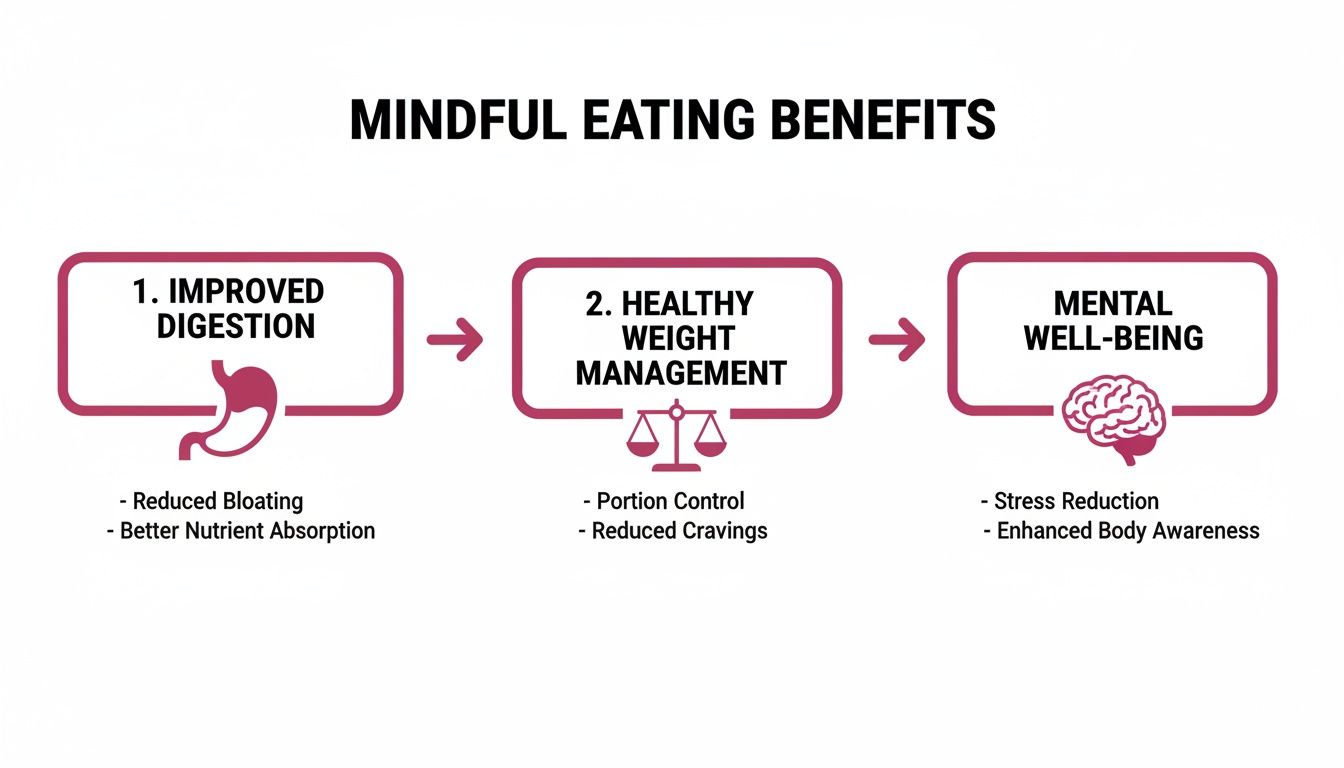
As you can see, simple practices like this one kick off a chain reaction of benefits—better digestion, a healthier relationship with your weight, and improved mental clarity. It goes way beyond the food on your plate.
The Five-Senses Check-In
So much of eating is on autopilot. We taste things, sure, but do we actually notice them? This exercise is designed to wake up all of your senses, which can turn a boring meal into a much richer, more vibrant experience. Before you eat, or even partway through, take a moment to do a quick check-in.
- Sight: First, just look at your food. Notice the colors, the different shapes, and how it’s all arranged. Appreciate how it looks before you even take a bite.
- Smell: Bring the plate a little closer and take a good whiff. What do you smell? Is it savory, sweet, earthy, spicy? Our sense of smell is powerfully tied to both flavor and memory.
- Sound: Believe it or not, food has a sound. Listen for the sizzle from the pan, the loud crunch of a fresh salad, or even the simple clink of your fork on the plate.
- Touch: Pay attention to texture and temperature. Is your food creamy, crunchy, soft, or firm? How does it feel in your mouth?
- Taste: And finally, the taste itself. Can you pick out any individual ingredients? Does the flavor change or deepen the longer you chew? Just try to savor it completely.
This check-in takes less than a minute, but it completely shifts your awareness. It gets you out of your head and into the physical experience of eating, which makes the meal so much more satisfying.
The point here isn't to add another chore to your day. It’s about creating a small pocket of awareness that helps you truly appreciate your food and finally listen to what your body is trying to tell you.
The Hunger-Scale Check-In
Let’s be honest: how often do you eat just because the clock says it’s noon, or maybe because you’re bored or stressed? The Hunger Scale is a fantastic tool for reconnecting with your body’s genuine hunger signals instead of just eating out of habit or emotion.
Imagine a scale from 1 to 10, where 1 is ravenous and 10 is uncomfortably stuffed. Before you start eating, ask yourself, "Where am I on the scale right now?" Ideally, you want to start your meal when you’re at a 3 or 4 (feeling some clear hunger pangs).
Then, pause about halfway through your meal and check in again. "Where am I now?" The goal is to stop when you feel satisfied, around a 6 or 7, not when your plate is empty or you feel bloated.
This simple check-in does a few key things:
- It helps you tell the difference between physical hunger and emotional triggers.
- It forces you to honor your body's fullness signals. It takes the brain about 20 minutes to get the message from your stomach that you’re full. Slowing down gives that signal time to arrive.
- It helps you rebuild trust in your own body's wisdom.
These foundational practices are simple but incredibly effective. If you’re looking to go deeper, explore these mindful eating exercises to reinforce your new habits.
Remember, this is about consistency, not perfection. Just pick one of these to try today. See what you notice, without any judgment. Every meal is a fresh start.
Connecting Your Emotions to Your Eating Habits
Mindful eating goes way beyond what’s on your plate. It’s really about getting to the "why" behind your food choices. The truth is, many of our eating habits aren't driven by actual hunger at all—they're driven by our emotions. We snack when we're stressed, bored, lonely, or even when we're celebrating. Figuring out these patterns is the secret to making more conscious decisions.
This is where a little bit of reflection and journaling can make a world of difference. When you pause to check in with yourself, you can finally connect the dots between how you feel and what you eat. This isn't about judging yourself; it's about getting curious. The goal is to become an observer of your own habits so you can see them clearly.

Uncovering Your Emotional Triggers
An emotional trigger is any feeling that sends you reaching for food, even when your stomach isn't growling. Pinpointing your personal triggers is the first real step toward breaking free from those reactive eating cycles. Think of it like mapping out a route; once you know the roads you always seem to take, you can consciously choose a different path.
For instance, do you find yourself wandering to the pantry right after a tense work call? That’s a classic stress trigger. Or maybe you grab a bag of chips the moment you sit down to watch TV? That could easily be a boredom or habit trigger. These patterns are often so automatic that we don't even notice them until we intentionally start looking.
And this isn't just a self-help gimmick; it's backed by solid research. Studies are consistently showing that mindfulness-based practices significantly improve eating behaviors. In fact, a 2023 study found that participants who learned to tune into their internal cues saw major drops in binge eating and unhealthy eating patterns, which even led to meaningful weight loss. You can explore the full findings on these remote mindfulness interventions to see just how powerful this stuff is.
Powerful Journaling Prompts to Get You Started
Journaling doesn't have to be some big, time-consuming production. Just a few targeted questions can uncover some incredible insights. The key is to be specific and totally honest with yourself.
Here are a few prompts I often recommend to help you dig deeper, whether you use them before or after a meal:
- Before Eating: "What am I really feeling right now? Am I stressed, tired, happy, or just bored?"
- Before Eating: "On a scale of 1-10, how physically hungry am I? Am I about to eat to fuel my body or to change how I feel?"
- After Eating: "How does my body feel after that meal? Energized and light, or sluggish and heavy?"
- After Eating: "Did that food satisfy a physical need or an emotional one? What’s the evidence?"
Answering these questions consistently helps you build a personal database of your own habits. You might discover that you almost always crave sweets when you feel lonely, or that you tend to overeat at family dinners out of social anxiety.
Your food journal isn't a log of "good" or "bad" days. It's a collection of data points that, over time, reveals the story of your relationship with food. Treat it with curiosity, not criticism.
Turning Insights into Actionable Change
Once you start seeing the patterns, you can begin making small, intentional changes. Awareness is the first step, sure, but action is what creates real, lasting results. This is where a tool like the Superbloom app can be a game-changer, helping turn your private reflections into a clear roadmap.
Let's walk through a common scenario. Through journaling, you realize you consistently stress-eat around 3 PM every single workday. Now that you have that insight, what's next?
Old Pattern vs. New Pattern
Old Pattern (Reactive)New Pattern (Intentional)Feel stress building at 3 PM.Notice the feeling of stress at 3 PM.Mindlessly walk to the kitchen.Pause and take three deep breaths.Grab the first sugary snack I see.Ask, "What does my body really need?"Eat quickly at my desk, still feeling stressed.Decide to go for a 5-minute walk instead.Feel guilty and even more sluggish afterward.Return to work feeling refreshed and in control.
See the difference? It's not about fighting your cravings with sheer willpower. It's about understanding the underlying need—in this case, a break from stress—and finding a better, more effective way to meet it. Learning how to eat mindfully is just as much about what you do between meals as it is about the meals themselves.
By connecting your emotional state to your eating habits, you move from being a passenger to being the driver. You learn to respond to your body's signals with intention and care, which is the foundation for a healthier, more peaceful relationship with food.
Let’s be honest: making mindful eating a real habit isn’t always a walk in the park. Life gets in the way. You might start the day with the best intentions, only to find yourself grabbing a snack while standing over the kitchen sink or realizing your lunch is gone but you can’t remember tasting it.
This is completely normal, so don't beat yourself up. The goal isn't perfection; it's being prepared for the inevitable bumps in the road. Knowing what to expect is half the battle, so let’s look at some of the most common hurdles and how to clear them without breaking a sweat.
The "I'm Too Busy to Eat Slowly" Dilemma
This is the big one. In a world that seems to reward constant motion, the very idea of sitting down for a slow, thoughtful meal can feel like an impossible luxury. When you're juggling back-to-back meetings and a never-ending to-do list, mindful eating can feel like just one more task you don't have time for.
The secret? Start incredibly small. Forget trying to transform every meal overnight. Instead, create tiny pockets of mindfulness that can realistically fit into the schedule you already have.
- The One-Meal Mission: Pick just one meal a week to be your dedicated "mindful meal." Maybe it's Saturday breakfast or Wednesday lunch. For that one meal, you commit to putting your phone away and just paying attention.
- The First-Five-Minutes Rule: A whole meal feeling like too much? No problem. Just focus on the first five minutes. For those initial bites, put your phone down, close the laptop, and just tune into your senses. You can always go back to your usual routine after if you absolutely have to.
- The Three-Bite Reset: Even on your most hectic days, you can do this. For the first three bites of your meal, simply chew slowly and notice the taste and texture. It's a 30-second reset that can instantly ground you.
Navigating Chaotic Family Dinners
Family meals are fantastic, but they can also be noisy, messy, and full of distractions. Trying to be a calm, mindful eater while passing dishes, managing kids, and keeping up with conversations can feel like a recipe for failure.
The key here isn't to isolate yourself, but to find an anchor in the storm. Your focus should be on internal awareness, even when there's external chaos. You can be fully present with your family while still checking in with yourself.
Progress, not perfection, is the goal. A single mindful moment in a chaotic day is a win. It reinforces the habit and proves that you can find calm even when your environment isn't.
Try to bring your attention back to your own plate and body. Notice when you start to feel full. Pay attention to the texture of your food between sentences. You can absolutely practice mindful eating without being silent or disengaged—it’s an internal practice, after all.
When You Simply Forget to Be Mindful
It happens to the best of us. You sit down to eat, and before you know it, autopilot takes over. You're scrolling, watching TV, or lost in thought, and the meal is over before you even registered it began. The real problem isn't the forgetting; it's the harsh self-judgment that often follows.
The fix is to create environmental cues that gently nudge you back to your intention. Don't rely on willpower alone.
It's common to hit these snags, but a little planning can make all the difference. Here’s a quick-glance table to help you troubleshoot when you get stuck.
Common Mindful Eating Challenges and Practical Solutions
Common ChallengeQuick TipHow Superbloom Can Help"I'm too busy."Practice the "First-Five-Minutes Rule" for just one meal a day.The app's quick check-ins are designed for busy schedules, helping you log meals and reflect in under a minute."My meals are chaotic."Focus on your own body's signals of fullness, even with distractions.Photo logging lets you capture your meal instantly, so you can reflect on it later when things are calmer."I just forget."Place a sticky note on your monitor or fridge that says "Breathe."Personalized reminders and notifications can prompt you to pause and check in before you start eating.
These small, strategic adjustments make mindfulness the path of least resistance. Instead of blaming yourself for forgetting, you create a supportive environment that remembers for you. Think of every roadblock as an opportunity to find a new, creative solution that truly works for your life.
A Few Common Questions About Mindful Eating
When you first start exploring mindful eating, it's natural for questions to pop up. It’s a shift in how most of us approach food, so let's tackle some of the most common things people wonder about. My goal here is to give you practical, no-fluff answers to help you get started with confidence.
Can I Lose Weight with Mindful Eating?
This is probably the most-asked question, and the answer is a bit nuanced. While weight loss can absolutely happen, it isn't the main goal. Think of it as a potential side effect rather than the primary objective.
The real focus of mindful eating is to heal your relationship with food. It’s about learning to listen to your body’s built-in hunger and fullness cues again—signals that often get drowned out by our busy lives. When you're truly tuned in, you're far less likely to overeat out of habit or distraction.
You also get better at spotting the difference between physical hunger and emotional triggers, like stress or boredom. That awareness alone can cut down on extra calories and often leads to a more stable, healthy weight over time, without the stress of a restrictive diet.
How Long Does It Take to See Results?
Mindful eating is a practice, not a diet with a finish line. The good news is you’ll probably notice some small, immediate shifts. Within the first week, many people find they enjoy their food more, feel less bloated, and are just more satisfied after eating. Those early wins are fantastic motivators.
The deeper changes, like untangling years of emotional eating habits, take more time. We're talking several weeks or even months of consistent practice. The most important thing is to be patient with yourself. Progress isn't a straight line, and that's completely normal. Using an app to track your non-scale victories—like feeling more in control or enjoying a meal without guilt—can really help you see how far you've come.
Remember, every meal is a fresh start. It’s not about being perfectly mindful every single time. It's the cumulative effect of all those small, attentive moments that creates lasting change.
Do I Have to Eat Every Single Meal Mindfully?
Definitely not! Trying to be perfectly mindful at every single meal, especially when you're just starting out, is a surefire way to feel overwhelmed. That kind of pressure is the exact opposite of what this practice is about.
The key is to start small and make it feel manageable.
- Pick one meal a day. Just one. Maybe it's your quiet morning breakfast or a lunch break where you can get a few minutes to yourself.
- Focus on the first few bites. If an entire meal feels like too much, just commit to being fully present for the first five minutes.
- Try it with a snack. A cup of tea, a piece of fruit, a handful of nuts—these are perfect low-stakes opportunities to practice checking in with your senses.
The goal is to build a skill, not to achieve perfection. As you get more comfortable, you'll find it easier to weave these moments into more of your meals. Learning how to eat mindfully is all about progress.
What If My Schedule Is Too Busy and Unpredictable?
I hear this all the time. A chaotic schedule is a huge barrier for many people, but mindful eating is surprisingly adaptable. You don't need long, leisurely meals to practice it. Instead, you focus on creating "mindful moments."
These are just tiny pockets of awareness you can sprinkle throughout your day. Take three deep breaths before you unwrap that sandwich at your desk. Put your phone down for the first three bites of whatever you're eating. Try chewing each bite a few more times than you normally would.
Even these incredibly small actions can interrupt the cycle of mindless eating and bring a powerful sense of calm to a hectic day.
Ready to turn these ideas into a real, consistent habit? The Superbloom app is built to guide you in creating a healthier relationship with food. With personalized feedback and simple check-ins, you can start understanding your own patterns and make changes that truly stick. Start your journey with Superbloom today!