
How to Increase Self-Awareness for Lasting Personal Growth
If you want to make changes that actually stick, the first step isn't a new diet or a strict workout plan. It’s building self-awareness. This is all about learning to honestly observe your own thoughts, feelings, and actions so you can understand why you do what you do. It's the key to moving off autopilot and making conscious choices.
The Self-Awareness Gap Holding You Back
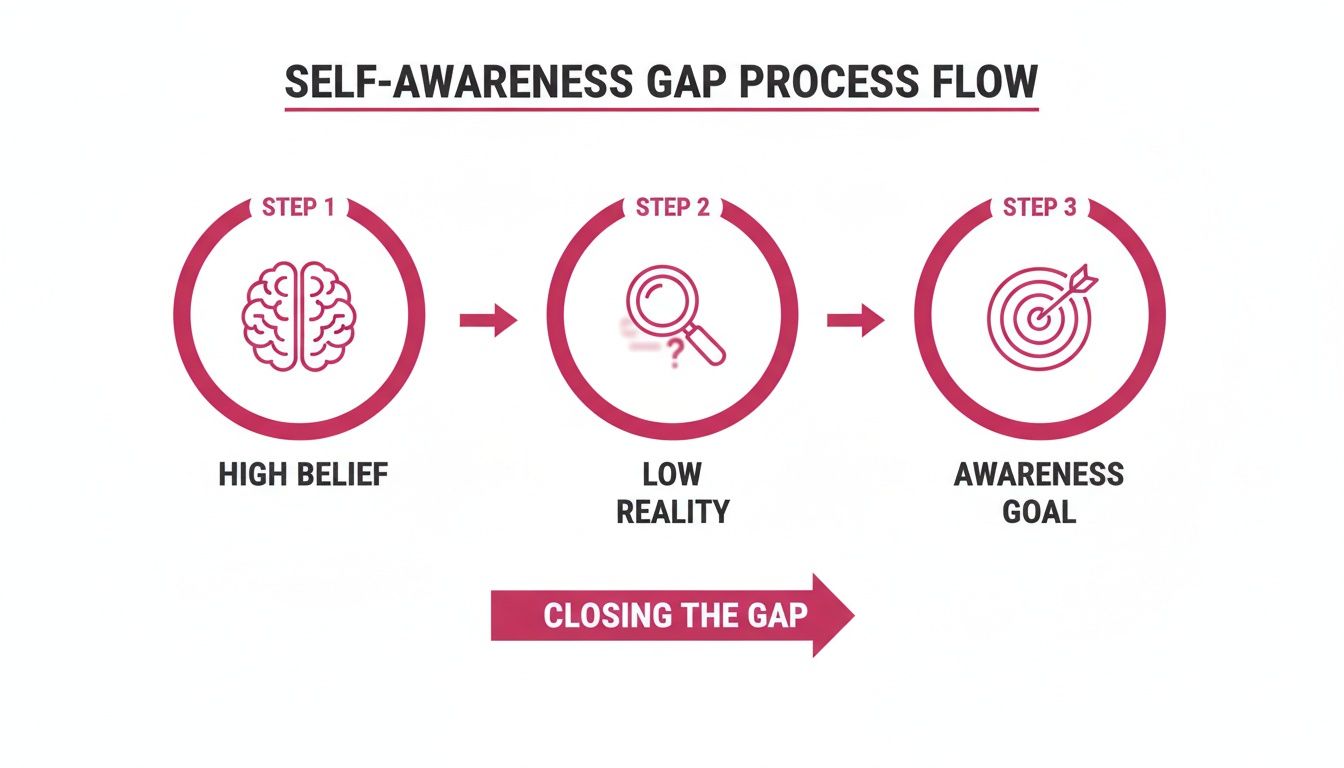
Most of us think we know ourselves pretty well, but that confidence can create a huge blind spot. It's like trying to read the label from inside the bottle—the perspective is completely skewed. You might see yourself as a mindful eater but not connect the dots on how that daily 3 PM sugary coffee is always triggered by a stressful meeting, not hunger.
This isn't a rare problem. In fact, it’s shockingly common. Organizational psychologist Tasha Eurich's research found that while 95% of people believe they are self-aware, only about 10-15% truly are. This disconnect is where our best intentions fall apart. We misjudge our own habits and what’s really driving them.
Internal vs. External Awareness
To get a clearer picture, it helps to think of self-awareness in two parts:
Internal Self-Awareness: This is your inward gaze. It’s about getting clear on your personal values, what you’re passionate about, your true feelings, and your thought patterns. It’s what helps you answer the question, "What do I really want?"
External Self-Awareness: This is your outward focus. It’s about understanding how you come across to other people. Knowing how your friends, family, or colleagues perceive you is crucial for building stronger relationships and communicating effectively.
You really need both. Internal awareness is your compass, but external awareness helps you navigate the terrain. Without them working together, we get stuck in reactive cycles—mindlessly scrolling after a long day or skipping a planned workout because we feel a little down—instead of making choices that line up with the healthier life we want.
Closing this awareness gap is the first step toward real change. It connects ancient wisdom, like the reflective practices of the Stoics, with modern, science-backed methods that show us how to observe our own lives without judgment.
This guide will walk you through the practical steps to build that skill. For another great resource on this topic, you can also explore other guides on how to improve self awareness.
Building Your Daily Reflection Habit
The secret to boosting your self-awareness isn't setting aside an hour for deep meditation or writing pages in a diary. Honestly, most of us don't have time for that. True insight comes from small, consistent moments of reflection you weave into your day. Even 5 minutes is enough to start seeing the hidden patterns that drive your mood, energy, and choices.
Forget the pressure of a blank page. Think of this as becoming a friendly observer of your own life. It’s about creating a simple, non-negotiable habit that gives you immediate clues about your own behavior. It's a small investment with a huge payoff.
Start With Guiding Questions
Instead of just wondering why you feel a certain way, start asking targeted questions. This is how you connect the dots. For example, did that stressful 10 AM meeting lead directly to your 3 PM sugar craving? Did getting a solid eight hours of sleep actually make you want a healthier breakfast?
The goal is to make the invisible visible. When you consistently ask why, you start turning vague feelings into concrete clues. This is how you uncover your unique triggers and patterns.
This simple act of noticing and recording your thoughts is a form of journaling, and it's one of the most powerful tools for self-discovery. It creates a personal log of your experiences, making it much easier to spot connections you'd otherwise miss.
Often, there's a big gap between how self-aware we think we are and what's actually happening. A daily reflection habit is what closes that gap.
A Simple Framework for Daily Check-Ins
You don't need a complicated system. Consistency beats intensity every time. A structured routine, like the daily check-ins we use in the Superbloom app, removes the guesswork. It prompts you to quickly log observations about your meals, mood, and energy, turning reflection into a simple, repeatable action.
You’d be surprised by the connections you find. In fact, some studies suggest that as many as 70% of people aren't fully aware of their emotional triggers, which leads to reactive, often regrettable, decisions. By simply checking in with yourself, you move from being reactive to being proactive. It’s a simple shift that puts you back in the driver's seat.
Here’s an easy framework to get you started today.
Use this simple table to guide your daily reflection, focusing on key areas that influence your well-being and eating habits.
Your 5-Minute Daily Reflection Framework
| Reflection Area | Morning Prompt (2 mins) | Evening Prompt (3 mins) |
|---|---|---|
| Energy & Mood | "How did I sleep? What's my energy on a scale of 1-10?" | "What one thing drained my energy today? What one thing boosted it?" |
| Intentions | "What's one choice I can make today that will help me feel my best?" | "Where did my actions line up with my intentions? Where did they drift?" |
| Physical Cues | "What physical sensations am I noticing in my body right now?" | "Did I have any cravings or discomfort today? What was happening just before?" |
This kind of structured reflection is so practical. It helps you stop just living your life and start observing it—and that is the first real step toward making meaningful, lasting change.
Becoming a Detective of Your Own Habits
Daily reflection is a great start, but the real breakthroughs happen when you start playing detective with your own life. This isn't just about noticing what you do; it's about digging in to understand why you do it. The goal is to connect the dots between a specific trigger—like stress, boredom, or even a social gathering—and how you react.
This is where true self-awareness is built: by gathering your own personal data and finally making sense of the story it tells.
Go Beyond What You Eat
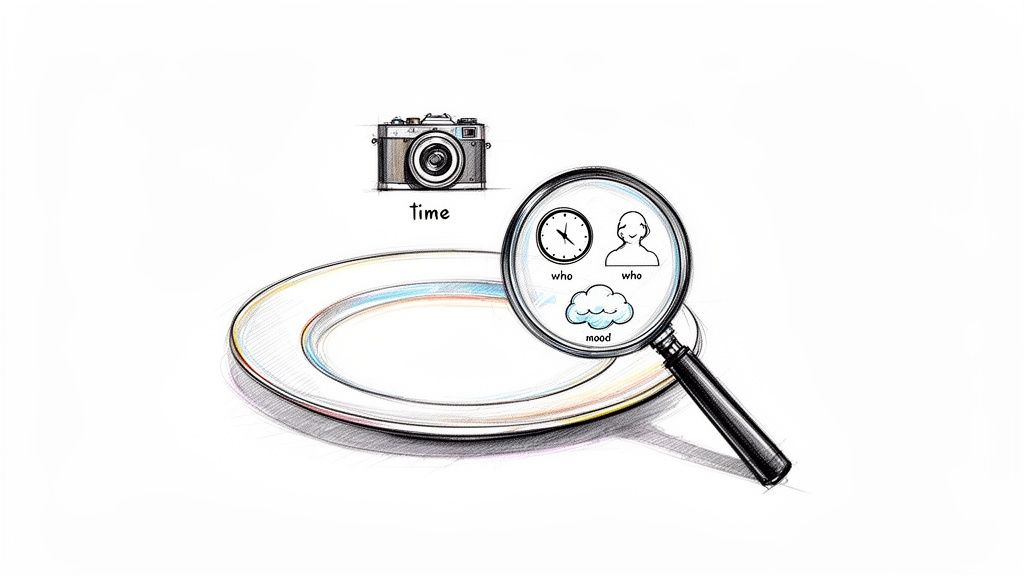
Most food trackers only care about the "what"—calories, carbs, protein. While that information can be useful, it’s missing the most important part of the puzzle: the context. Lasting change comes from understanding the full picture surrounding your choices.
So, instead of just noting that you ate a cookie, start asking more meaningful questions:
- When did I eat it? Was it at 3 PM, right after a string of draining work calls?
- Who was I with? Was I alone and seeking comfort, or did a coworker bring them in for everyone?
- How was I feeling? Was I truly hungry, or was I bored, anxious, or just plain tired?
- What happened just before? Did I wrap up a tough project or get into a disagreement?
This is where a simple tool like photo logging, a feature in the Superbloom app, really shines. A quick snapshot captures the food, but the real power comes from the mental note you make about the entire scene. The point isn't to police your food, but to recognize your patterns.
Identify Your Triggers
After a while, this detective work will start revealing clear connections. You might realize you consistently crave salty snacks after a phone call with a particular family member. Or maybe you find yourself mindlessly eating in front of the TV every night, long after you've had dinner.
Spotting this link between a trigger and a behavior is the single most important step toward changing your response. It gives you a specific, observable moment to work with.
For example, you might notice that every Tuesday and Thursday, you feel bloated and sluggish. Looking back at your logs, you see those are the days you have back-to-back meetings and end up grabbing a quick, processed lunch from the cafe downstairs. The trigger isn't the day of the week—it's the lack of time caused by your schedule. Suddenly, you have a real problem you can solve.
This kind of awareness is a game-changer. For 90% of successful entrepreneurs, self-awareness is the bedrock of personal growth. For your health, it means seeing exactly how your daily routines fuel your cravings. In emotional fitness training, daily check-ins—like the ones in Superbloom's AI-powered coaching—uncover triggers for stress eating or gut issues. Research shows that individuals who regularly seek feedback have 17% higher self-awareness, which helps close the blind spots where half of us tend to stumble. You can read more about how self-improvement is evolving at YourStory.
Connect Behaviors to Feelings
The final piece of the puzzle is linking your actions directly to your emotional and physical state. This is how you become a true expert on yourself.
Think about this common scenario:
- Behavior: You find yourself mindlessly eating chips around 4 PM.
- Initial Thought: "I must have just been hungry."
- Deeper Analysis: You check your log and remember feeling completely drained and mentally fried after a long afternoon of focused work.
- The Realization: The snacking wasn't about hunger. It was your brain's attempt to get a quick dopamine hit and a break from the cognitive load. The real trigger was mental fatigue.
Once you see that connection, you have the power to choose a different path. Instead of automatically reaching for the chips, you could decide to take a five-minute walk, do a few stretches at your desk, or just put on your favorite song. You’re no longer reacting on autopilot; you’re responding with intention. And that is the heart of building habits that actually last.
Using Mindfulness to Respond Instead of React
So, you’ve started to identify your triggers. That's a huge step. But what about when you're in the heat of the moment? Knowing that stress makes you reach for chips is one thing; actually stopping yourself when that 3 PM deadline looms is another challenge entirely.
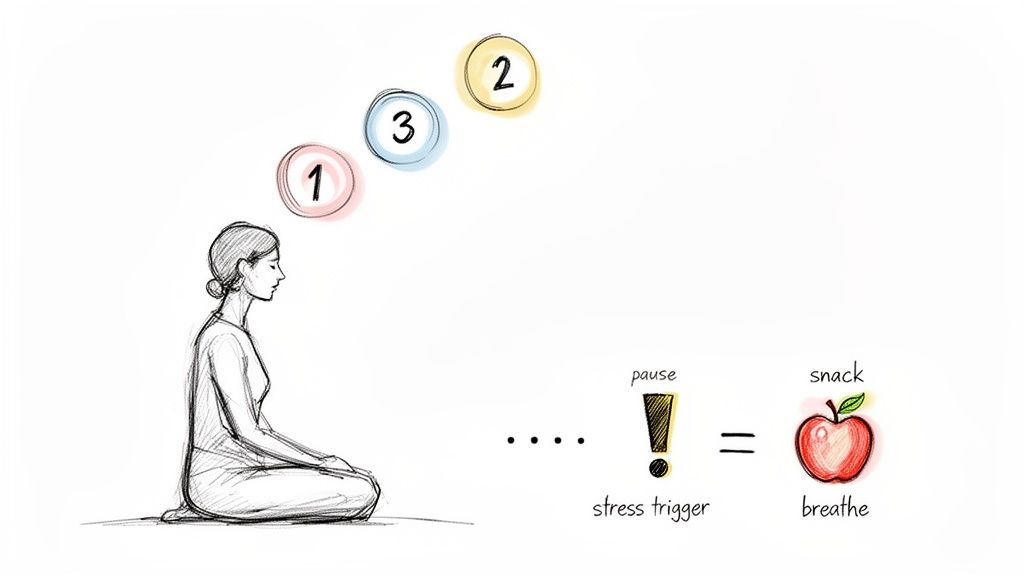
This is where mindfulness comes in, and not in the way you might think. It’s not about finding an hour for silent meditation. It’s about creating a tiny, crucial pocket of time—a "pause"—between the trigger (stress, boredom, fatigue) and your automatic reaction (mindless snacking).
Practicing mindfulness literally rewires your brain to be less impulsive by strengthening the regions responsible for self-regulation. Think of it as building muscle for your mind. It’s a game-changer for breaking ingrained habits like emotional eating.
The impact is well-documented. Regular mindfulness can boost self-awareness by as much as 30% and is linked to 40% higher emotional intelligence scores. For anyone struggling with stress eating, this is critical. That heightened awareness can slash impulsivity by 20%, making it easier to make nourishing choices without the mental fatigue of strict dieting. You can dive deeper into the data on how self-awareness statistics tell this story at Gitnux.
A Breathing Exercise for Stressful Moments
The next time you feel that familiar wave of stress or a craving hits you out of nowhere, try this simple breathing exercise. It takes less than 60 seconds and you can do it anywhere—at your desk, in your car, even in a bathroom stall if you need a private moment.
- First, just pause. Stop everything you’re doing and acknowledge the feeling without judgment. You can even say it to yourself: "Okay, I'm feeling stressed," or "I'm noticing a strong craving right now."
- Next, take three deep breaths. Breathe in slowly through your nose for a count of four, hold it for a second, then exhale slowly through your mouth for a count of six. The longer exhale helps calm your nervous system. Concentrate only on the feeling of the air moving.
- Finally, check in again. After that third breath, ask a simple question: "What do I truly need right now?" The answer might surprise you. More often than not, it’s not the snack you were about to grab. It might be a glass of water, a quick stretch, or just two minutes of quiet.
This simple exercise creates just enough space between the trigger and your action to allow your conscious mind to take over. You are shifting from a knee-jerk reaction to a thoughtful response.
Try the Mindful Bite Exercise
Mindfulness can also completely change how you experience food during meals. We've all been there—eating on autopilot while scrolling, watching TV, or working, only to look down and realize the plate is empty. The "Mindful Bite" exercise is a fantastic tool to pull you back into the present.
Here’s how it works.
- Focus on the very first bite. Before you dig in, commit to giving your full attention to the first mouthful of your meal.
- Engage all your senses. Really look at the food. What colors and textures do you see? Smell its aroma. When you finally take that bite, notice the temperature, the texture on your tongue, and the layers of flavor that appear as you chew.
- Chew slowly. Pay attention to the simple act of chewing and swallowing before you even think about the next bite.
You don't have to eat your entire meal this way—that can feel overwhelming. The goal is to use that first bite to ground yourself in the moment. This small act of focused attention can dramatically curb mindless eating and helps you tune back into your body's natural hunger and fullness signals. It makes mindfulness less of an abstract concept and more of a concrete, practical tool you can use every single day.
Tracking Your Progress and Navigating Setbacks
Let’s be honest: the path to greater self-awareness is rarely a straight line. It’s a messy, rewarding practice filled with a-ha moments, real progress, and—yes—the occasional setback. The key is learning how to measure what truly matters and, just as importantly, how to show yourself some grace when you stumble.
So, how do you know if all this work is actually paying off? Forget the bathroom scale or calorie counts for a moment. The real proof of progress is found in subtle, powerful shifts in your daily life. It’s that extra second you pause before reacting to a trigger. It’s a newfound sense of emotional stability, a quiet confidence that comes from feeling more in charge of your own choices.
Redefining What Progress Looks Like
Instead of getting hung up on outcomes like weight loss, it’s far more powerful to focus on the behavioral wins. These are the small, significant moments that prove real, lasting change is happening under the surface.
This is where a tool like the Superbloom app really shines. You can use its tracking features to log these crucial data points. Make a note every time you:
- Successfully paused: You felt a craving hit, but instead of immediately giving in, you took a few deep breaths and made a different choice.
- Identified a trigger: You finally connected the dots between feeling bored in the afternoon and mindlessly wandering to the fridge.
- Ate mindfully: You put your phone down during dinner and actually tasted your food.
- Felt an emotion without reacting: A wave of frustration washed over you, but you let it pass without reaching for a comforting snack.
Think of these small wins as your evidence. They're proof that you're building the mental muscle needed for self-regulation.
Navigating Common Pitfalls and Setbacks
Every journey worth taking has its bumps. The goal isn’t to avoid them entirely, but to have a game plan for when they show up. Remember, setbacks aren't failures; they're feedback.
One of the biggest hurdles I see people face is getting discouraged after a slip-up. You might have a fantastic week, feeling totally in control, and then one stressful day sends you right back to an old habit. It’s so easy to feel like you’ve erased all your hard work.
Don’t fall into the self-criticism trap. When you slip up, get curious instead of critical. Reframe it as a valuable data point. What was the trigger? What was happening in that moment? What can you learn from it?
Another common pitfall is feeling overwhelmed by all the new information. Trying to track every single thought, feeling, and craving can be exhausting. If you feel this happening, simplify. Pick just one thing to focus on for a few days. Maybe it’s noticing when you feel most energized or identifying what triggers your 3 PM sugar craving.
The effort is well worth it. Growing your self-awareness is directly linked to tangible benefits, including 20% higher job performance and 30% higher life satisfaction. For leaders, these reflective practices can improve effectiveness by 25%, and simply seeking feedback can boost self-awareness by 17%. You can explore more about the impact of these self-improvement trends at YourStory.
Ultimately, tracking your progress is about reinforcing your own efforts. Celebrating these small victories keeps you motivated, reminding you that every intentional step forward is building a more self-aware and empowered you.
Your Self-Awareness Questions Answered
When you first start digging into self-awareness, it’s completely normal for questions to pop up. You’re paying attention in a new way, and that naturally brings curiosity and a bit of uncertainty. Let’s walk through some of the most common hurdles people face, so you can move forward with more confidence.
Here are straightforward answers to the questions that often come up as you begin this journey.
| Question | Answer |
|---|---|
| How long until I see results? | You'll notice small shifts almost immediately—like catching a stress reaction before it happens. But true, deep self-awareness is a lifelong practice. The real win is making reflection a consistent habit, not chasing a quick fix. |
| What if I uncover difficult emotions? | This is a sign the process is working. When tough feelings like anxiety or sadness surface, approach them with gentle curiosity, not judgment. Acknowledge them, allow them to be there, and then get curious about their source. |
| How can I stay motivated when I feel stuck? | Everyone feels stuck sometimes. When you do, simplify. Instead of a deep dive, focus on one small thing: notice one sensation, identify one thought, or celebrate one tiny win. Small actions maintain momentum on the "off" days. |
| What if I have nothing to write about? | That's a perfect observation to write about! Journaling isn't about having profound insights every day. Some days, you might just write, "Felt tired today, not much on my mind." That in itself is an act of self-awareness. |
Feeling stuck or overwhelmed is part of the process, not a sign of failure. The goal isn't perfection; it’s about staying curious and being patient with yourself as you learn and grow.
How Long Does It Take to See Results?
This is the big one, isn't it? The honest answer is that you’ll see results both right away and over a lifetime.
Within the first week of paying closer attention, you’ll probably have small but powerful moments of clarity. You might catch yourself about to snap at a family member and choose to take a breath instead. Or maybe you'll realize that you reach for a snack out of boredom, not hunger. These are tangible wins, and they matter.
But the kind of profound self-awareness that truly changes how you navigate your life? That’s something you cultivate over time. Think of it less like a sprint and more like tending to a garden. You can’t force a plant to grow overnight, but with consistent care, it will flourish. The real magic isn't in one big "aha!" moment, but in the small, daily shifts.
The most significant changes happen when you stop looking for a single, big "a-ha!" moment and start appreciating the small, daily shifts in how you respond to your own life.
What If I Uncover Difficult Emotions or Memories?
This is a really important and valid concern. As you tune into your inner world, you’re bound to come across feelings you’ve been avoiding—anxiety, frustration, sadness, or old hurts. Seeing them isn’t a sign you’re doing it wrong; it's proof that the process is working. You're finally listening.
The trick is to meet these emotions with curiosity, not judgment.
- Just name it. Start by simply saying to yourself, "I'm feeling anxious," or "There's that feeling of sadness again." You don't have to fix it.
- Don't fight it. Trying to push an emotion away often gives it more power. Imagine it’s a cloud passing through your sky. Just observe it without trying to make it disappear.
- Get curious. Ask yourself gently, "Where might this be coming from?" You don't need a perfect answer. The simple act of inquiry can loosen the emotion's grip.
Of course, if you consistently unearth deeply painful or traumatic memories, that’s a signal to bring in support. A good therapist or mental health professional can provide a safe space to navigate those experiences.
How Do I Stay Motivated When I Feel Stuck?
Let’s be real: your motivation is going to come and go. Some days, reflecting will feel like a breakthrough. Other days, it will feel like a chore, or you’ll draw a complete blank. Feeling stuck is a totally normal part of growth.
When this happens, don't force it. Just simplify.
Instead of trying to analyze your whole day, shrink your focus to one tiny thing. Notice one sensation in your body. Identify one thought that’s floating around. Or just acknowledge one small win, like choosing to drink a glass of water when you were stressed. These micro-actions keep the engine running, proving that even on a tough day, you're still building the muscle of self-awareness.
Ready to turn these insights into action? Superbloom uses AI-powered coaching to help you understand your patterns and build healthier habits without the guesswork. Start your journey with personalized guidance by visiting the Superbloom website.