
How to Stop Counting Calories and Reclaim Your Life
The first step to stop counting calories is to start listening. Not to an app, but to your body. It's about shifting your focus from the rigid, external numbers on a screen to the internal cues you've probably been ignoring, like true hunger and gentle fullness. This means gradually letting go of the tracking apps and replacing that habit with more mindful practices like intuitive eating. It’s a journey from following rules to trusting your own wisdom.
Why Breaking Up with Calorie Counting Is Your Next Best Move

Let's be real for a moment: logging every single meal, snack, and drink is exhausting. Calorie tracking is often sold as the key to health, but for many, it morphs into a source of constant stress and anxiety, tethering your sense of well-being to a number.
This cycle of measuring, recording, and judging everything you eat can sever the connection you have with your own body. Instead of savoring a meal with loved ones, you're mentally calculating the macros in the salad dressing. This digital bookkeeping turns food—a source of joy, culture, and nourishment—into a math problem. It’s a huge mental burden.
The Paradox of Tracking Apps
The market for calorie-tracking apps is massive, valued at an estimated USD 1.75 billion in 2024, and it's growing. But here's the paradox: global consumer research shows that only 27% of people are actually counting their calories. That means almost three-quarters of the population has either tried it and quit, or never bothered to start in the first place. You can find more insights on this consumer behavior in the full report.
This gap tells an important story. Despite the endless stream of new apps, strict calorie counting just isn't a sustainable or enjoyable habit for the vast majority of people. And if a health practice feels like a relentless chore, it's not going to stick.
"When you rely solely on counting calories, you never learn to listen to your body’s hunger and satiety signals. This can be a powerful tool in helping to keep off unwanted pounds."
This point from experts at Harvard Medical School gets to the heart of the problem. Obsessive tracking essentially outsources your body’s built-in intelligence to an algorithm. Lasting wellness is about bringing that intelligence back home.
A More Sustainable Path Forward
What if you could pursue your health goals without the spreadsheets and the stress? The good news is, you can. The alternative is a more intuitive, mindful approach that puts you back in the driver's seat, making you the expert on your own body.
Instead of counting, you'll learn to:
- Listen to Your Hunger: Get reacquainted with the physical sensations of genuine hunger and learn to respond to them without guilt or panic.
- Honor Your Fullness: Tune into the subtle cues that signal you're comfortably satisfied, which is the key to preventing mindless overeating.
- Focus on How You Feel: Start using your energy levels, mood, and digestion as your primary health metrics. They tell a much richer story than any calorie count.
This transition is so much more than just deleting an app from your phone. It's about reclaiming your autonomy over food and finding a sense of freedom you may not have felt in years. It’s about building a foundation of self-trust that no calorie calculator could ever offer. The rest of this guide will give you a practical roadmap to make this liberating shift a reality.
Getting Your Head in the Game: Prepping for a Calorie-Free Future
Before you can even think about deleting that tracking app, we need to do some groundwork. And it all starts in your head. The habit of counting calories isn't really about the numbers, is it? It’s about feeling like you're in control. Learning to let go of that means building a new kind of trust with yourself—one that replaces the false sense of security those numbers gave you.
The first step is a big one: completely change how you define a "good" day of eating. Forget hitting a calorie target. Instead, start paying close attention to how your food actually makes you feel. A huge part of this transition is recognizing that so many things affect your body, like the impact of hormone imbalance on weight. Your body is so much more than a simple "calories in, calories out" machine.
Redefine What "Healthy" Actually Means to You
For a long time, your main measure of success was probably a number on a screen or a scale. It's time to shift your focus to the real, tangible signs of well-being that no app can track.
Instead of calories, try tracking these things:
- Sustained Energy: Did you power through your afternoon without needing that fourth cup of coffee?
- Stable Mood: How were you feeling today? Balanced and clear-headed, or all over the place?
- Digestive Comfort: Take note of any bloating, discomfort, or that feeling of lightness after a meal.
- Quality Sleep: Are you actually sleeping soundly through the night?
These are the metrics that truly matter. A meal that fits perfectly into your calorie budget but leaves you sluggish and bloated isn't a win. On the other hand, a delicious, satisfying meal that gives you energy for hours is a success, no matter what its calorie count was. This shift takes you from being a data-entry clerk for your body to its thoughtful, attentive caretaker.
Face Your Food Fears Head-On
One of the most common anxieties people have when they stop counting calories is the fear of gaining weight or "losing control" around food. The calorie budget can feel like a safety net, and the thought of removing it can feel like a free-fall. I get it. That anxiety is completely normal, but it’s rooted in the belief that you can't trust your own body.
Here’s the thing: your body already has a super-sophisticated internal tracking system. We call them hunger and fullness cues. Calorie counting basically trains you to ignore that system and listen to an external one instead. Our goal is to tune back into your body’s innate wisdom.
Start by getting curious, not critical. When you sit down for a meal without logging it first, just notice the anxiety that pops up. Acknowledge it. Don't judge it. Ask yourself, "What am I really afraid of here?" More often than not, the fear isn't just about food; it's about losing control. Just recognizing that is the first step toward dismantling the fear and rebuilding that trust with yourself.
Set New, More Meaningful Intentions
Finally, your motivation needs an upgrade. If your "why" has always been tied to a specific number, you need a new north star to guide you. This is where a journal can be an incredibly powerful tool for figuring out what you really want.
Try these prompts to uncover what truly drives you:
- What would my life be like without all this food anxiety? (Just imagine the mental space that would free up.)
- What things would I enjoy more if I weren't so worried about calories? (Think dinners with friends, vacations, holiday meals.)
- How do I truly want to feel in my body every day? (Focus on words like energized, strong, peaceful, or capable.)
Answering these questions helps you build a compelling vision for a life where food is a source of joy and nourishment, not a source of stress. This positive vision will be your anchor as you navigate the sometimes-choppy waters of unlearning old habits. It’s about choosing freedom over formulas, one compassionate decision at a time.
Your Phased Plan to Wean Off Calorie Tracking
Deciding to stop counting calories is a huge step, but you don't have to quit cold turkey. Think about it—you didn't start tracking everything overnight, so you don’t need to stop all at once, either. Easing into it gradually lets you build self-trust and get comfortable with a new way of eating without feeling completely overwhelmed.
The real goal here is to find a strategy that feels manageable and, frankly, empowering. This isn't a strict protocol; it's more like a menu of options. You can pick one, mix and match, or even create your own version. The right path is whatever helps you feel more connected to your body and less chained to the numbers on a screen.
This flowchart can help you visualize the initial mindset shift required, guiding you toward redefining health or building the self-trust needed for this journey.
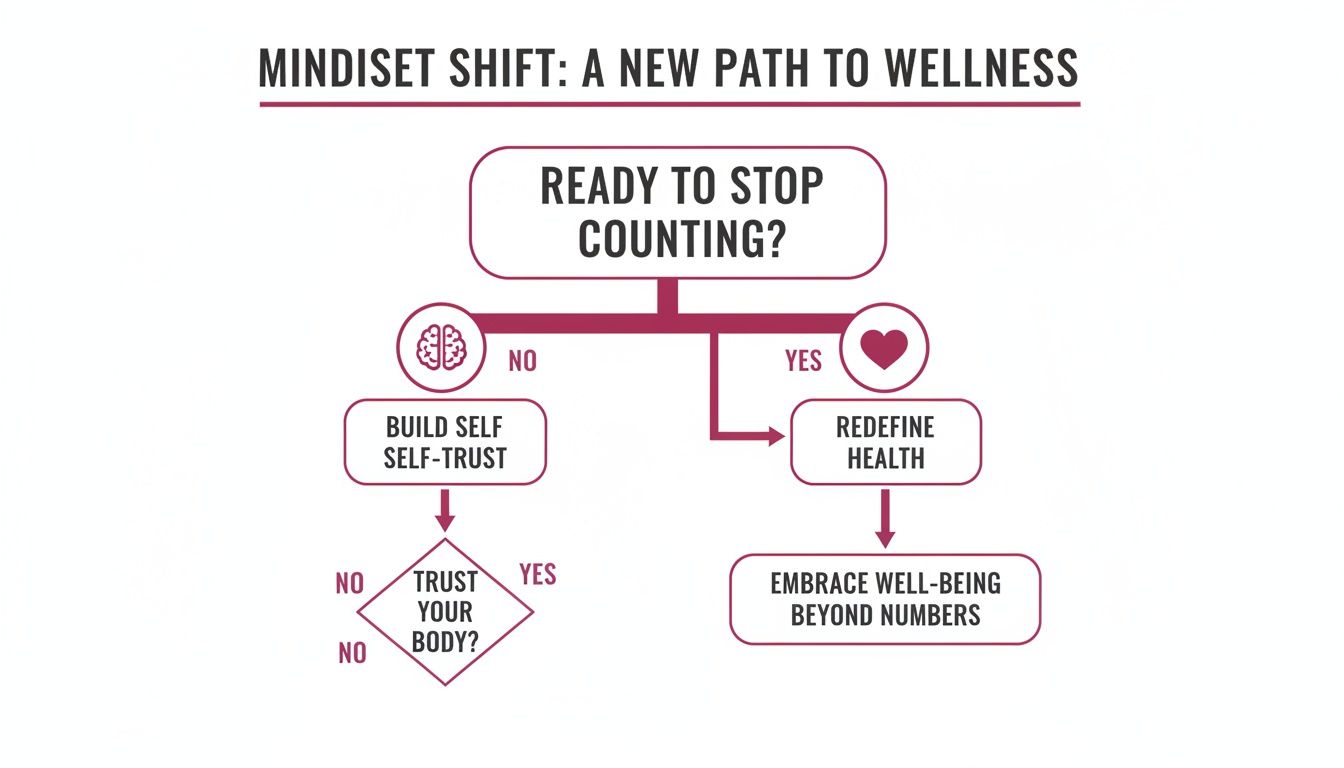
Whether you start by strengthening your mindset or jump right into redefining what health means to you, every path leads toward a more intuitive, peaceful relationship with food.
The Gradual Deletion Method
This approach is exactly what it sounds like. You slowly stop tracking parts of your day, one piece at a time. It’s a popular starting point because it feels less drastic and gives you a series of small, confidence-boosting wins along the way.
Here’s how you could put it into practice:
- Week 1: Stop tracking your snacks. Log breakfast, lunch, and dinner as usual, but let your snacks be "free."
- Week 2: Now, stop tracking your breakfast too. Pay attention to how it feels to start your day without logging a single thing.
- Week 3 & Beyond: Keep this pattern going, dropping one more meal each week (or every two weeks) until you’re not tracking anything. The pace is entirely up to you.
The biggest challenge here is the temptation to "compensate" for the untracked meals by being more restrictive with the ones you still log. You have to actively resist this urge. Remember, the point is to practice listening to your body, not to find a new way to manipulate the numbers.
The Estimation Phase
If you're someone who has accidentally memorized the calorie count of everything you eat, the estimation phase can be an incredibly useful bridge. This method uses your existing knowledge to build intuition, not to enforce restriction.
Before logging a meal, you’ll first guess its calorie or macro content. Just sit down with your plate, eyeball the portions, and make a mental estimate. Then, you can log it to see how close you were.
Over time, you’ll notice your estimates getting more accurate, which is tangible proof that you're developing a better internal sense of your food. After a week or two of this, you can stop the second step—the actual logging. You’ve already proven to yourself that you’ve got this. It’s fantastic for building the confidence you need to trust that you can eat appropriately without an app holding your hand.
The Focus Shift Strategy
Sometimes, the most effective way to break a habit is to replace it with a better one. The Focus Shift strategy involves changing what you track from a restrictive metric like calories to an additive, positive one.
This approach flips your mindset from "What can't I have?" to "What can I add to nourish my body?" It’s a powerful change in perspective that frames eating as an act of self-care, not self-control.
Instead of calories, you could start tracking something like this:
- Fiber Intake: Aiming for 25-30 grams of fiber a day naturally encourages you to eat more fruits, vegetables, and whole grains.
- Plant Diversity: Try to eat 30 different plant foods per week. This turns eating into a fun game of variety and discovery.
- Energy Levels: On a scale of 1-10, how did your lunch make you feel an hour later? This directly connects your food choices to your actual well-being.
This method teaches you which foods genuinely make you feel your best—a far more valuable skill than knowing the calorie count of a banana. It’s a practical way to learn how to stop counting calories by focusing on what truly matters.
Comparing Methods to Stop Calorie Counting
Each of these strategies offers a unique path away from calorie counting. To help you decide which might be the best starting point, this table breaks down who each method is best for, the main action involved, and a potential hurdle to watch out for.
Ultimately, there's no "wrong" choice. The best method is the one that feels the most sustainable and least stressful for you. You can even combine them—maybe you start with Gradual Deletion for a few weeks, then move to a Focus Shift once you’re tracking less. The journey is yours to design.
Building Awareness: What to Do Instead of Counting
So, you’re ready to ditch the numbers. But what do you actually do? The space that calorie counting used to occupy can feel a little empty at first, and that's completely normal. This is your chance to fill it with something far more powerful: genuine body awareness.
Think of it this way: instead of outsourcing your eating decisions to an app, you're going to start building a set of internal tools. It’s not about guesswork. It’s about learning to speak a new language—your body's language of hunger, fullness, and satisfaction.
Tune Into Your Body’s Natural Signals
For a long time, you’ve probably been letting an app or a calorie target override your body's built-in guidance system. It’s time to recalibrate and start listening again. The most important part of this is learning to tell the difference between true physical hunger and other eating triggers.
Before reaching for food, just pause for a second. Ask yourself, "Am I actually hungry?" Look for the classic physical signs:
- A gentle gnawing or an empty feeling in your stomach.
- Energy starting to dip or finding it hard to concentrate.
- Maybe a slight headache or a touch of irritability (hello, "hanger").
This simple check-in helps you separate real hunger from emotional cues like boredom, stress, or just habit. It’s the first step toward eating when your body actually needs fuel, not just when the clock says it's lunchtime. To really cultivate this deeper connection, practices like meditation can be a game-changer. You might find a simple guide to mindfulness meditation helpful here.
Ditch the Numbers for Real Insights
Your relationship with food is about so much more than data points. To build a healthier one, you need to shift your focus from quantitative tracking (calories, macros, grams) to qualitative observation (how food makes you feel).
Here are a few practical, number-free ways to start building this new kind of awareness:
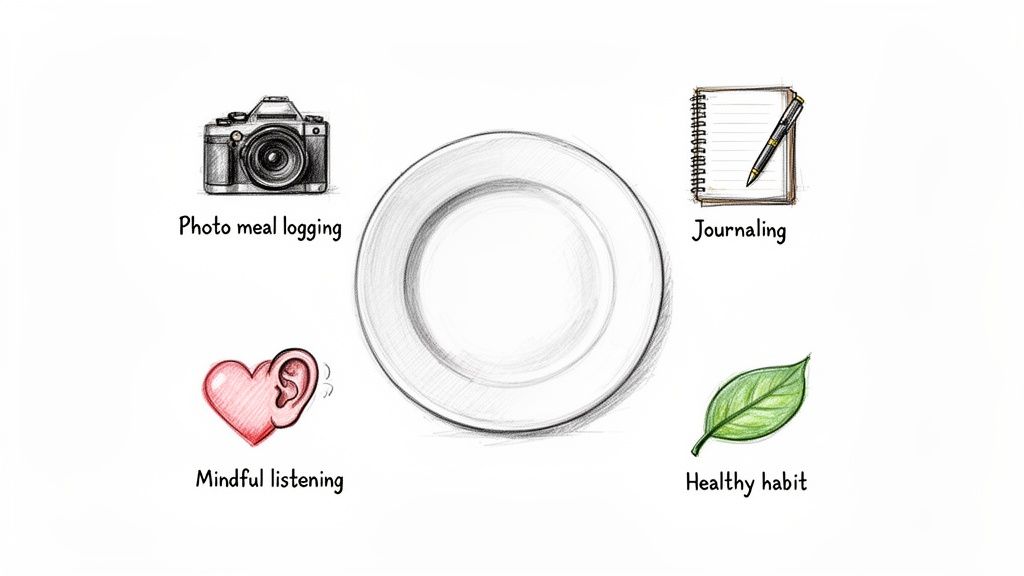
- Photo Meal Log: This is my favorite starting point for clients. Just snap a quick picture of your meals before you eat. At the end of the day, scroll through your camera roll. It gives you a no-judgment, visual diary of your food choices, helping you see patterns in color, variety, and balance without a single number in sight.
- Qualitative Journal: Keep a simple notebook. Jot down what you ate and—this is the important part—how you felt afterward. Did that salad leave you energized or searching for a snack an hour later? Did dinner feel satisfying or leave you feeling bloated? This practice creates a powerful, direct link between your food choices and your well-being.
- Habit-Based Tracking: Instead of focusing on what to restrict, track what you're adding. Your goal for the day might be "eat a vegetable with lunch" or "drink a big glass of water before my morning coffee." This reframes your entire effort around nourishment and self-care, which helps build positive momentum.
Think of this as shifting from being a food accountant to a food scientist, with your own body as the lab. The goal here is curiosity, not perfection.
The Power of Awareness Over Obsession
Now, I want to be clear: awareness of what you eat absolutely matters. Research from the National Health and Nutrition Examination Survey shows that people who track their intake lose nearly 400% more weight than those who don't. But here's the critical piece that often gets missed: the same research highlights that awareness of eating habits—not obsessive numerical tracking—is what drives long-term success.
Constant counting is psychologically taxing, which is why so few people can stick with it forever. The data confirms you don't need the rigid math. What you do need is the mindful presence to understand your own patterns and make conscious choices.
Let's Walk Through a Real-World Scenario
Imagine you're out at a restaurant. Your old habit might be to immediately pull out your phone, look up the menu online, and find the "safest" low-calorie option.
Here’s what you can do instead:
- Scan with Curiosity: Look at the menu. Instead of hunting for calorie counts, just notice what genuinely sounds delicious and satisfying to you.
- Check In With Your Body: Ask yourself, "What does my body feel like it needs right now?" Maybe you're craving something light and fresh. Or maybe you had a long day and need a heartier, more grounding meal.
- Order Mindfully: Make your choice based on that internal feedback. Trust that your body knows what it's doing.
- Eat with Presence: When the food arrives, put your phone away. Pay attention to the flavors, the textures, the smells. Eat slowly. Pause halfway through and just check in—how's your fullness level?
- Reflect Later: In your journal that evening, you might write, "Had the salmon and roasted veggies for dinner. Felt perfectly satisfied and had great energy all evening."
That one experience does more to build self-trust and intuitive eating skills than a month of obsessive logging ever could. By swapping calculation for curiosity, you start repairing your relationship with food and learn to nourish yourself with confidence, one mindful meal at a time.
How to Measure Success Without Using Numbers

When you decide to stop counting calories, one of the first questions that hits you is, "Okay... so how do I know if this is working?" It's a valid concern. Without a daily number to hit or a scale to check, it can feel like you’re navigating without a map. But this is your chance to redefine what "progress" actually means to you.
True progress is so much bigger than a single data point. It’s about the whole picture of your well-being. This means shifting your mindset from being a meticulous calorie accountant to becoming a curious observer of your own life, tuning into all the other signs that show you're on the right track.
Look for Non-Scale Victories
Non-scale victories (NSVs) are those real, tangible improvements you start to notice in your everyday life. They are powerful indicators that your mind and body are thriving with your new approach to food—and honestly, they’re far more motivating than a number because they reflect how you actually feel.
Start looking for wins in these key areas:
- Sustained Energy: Are you getting through that 3 p.m. slump without needing a caffeine hit? Do you have more gas in the tank for your workouts, or just for life in general?
- Better Sleep: Notice if you're drifting off to sleep easier, staying asleep through the night, and waking up feeling genuinely rested instead of groggy.
- Improved Digestion: Pay attention to less bloating, gas, or that heavy feeling after meals. Feeling light and comfortable in your own skin is a massive win.
- Mental Clarity: A well-fed brain is a sharp brain. Start noting those moments when you feel more focused, creative, or less scattered.
These are the metrics that truly matter. They tell a story about your health that a calorie count simply can’t.
Shifting your focus to how you feel, rather than what a number says, is the core of this journey. It’s about learning that true progress is measured in vitality, not just in digits.
Physical Cues That Signal Success
Beyond how you feel on the inside, your body offers plenty of external feedback that has absolutely nothing to do with the scale. These physical cues are often the first hints that your efforts are really paying off.
Keep an eye out for these subtle but significant changes:
- Your clothes fitting more comfortably: Maybe that pair of jeans feels a little less restrictive, or a favorite shirt hangs a bit more loosely. This is a practical, real-world measure of change.
- Feeling stronger and more capable: Can you suddenly carry all the groceries in one trip without struggling? Or hold that yoga pose for a few extra breaths? That's real strength.
- Reduced cravings for hyper-palatable foods: As your body gets the nourishment it truly needs, you might find those intense cravings for sugary or ultra-processed snacks naturally start to quiet down.
These aren't just small things; they are direct proof that your body is getting healthier, stronger, and more in tune. Celebrating these moments is what reinforces your new habits and shows you that you can reach your goals without obsessive tracking.
Your Progress Checklist
To make this feel more concrete, try creating a simple weekly check-in in a journal or the notes app on your phone. At the end of each week, take just a few minutes to reflect on these questions. This simple practice helps you actively see and appreciate how far you've come.
My Weekly Well-Being Check-In
- How was my energy this week on a scale of 1-5?
- Did I sleep well most nights?
- How did my digestion feel after meals?
- Did I feel more confident and less stressed around food?
- Did I notice my clothes fitting any differently?
- Did I feel strong during my physical activities?
Answering these questions consistently helps shift your focus from a single, often frustrating number to a whole collection of wins. It’s a powerful reminder that when you learn how to stop counting calories, you start gaining a much more complete and compassionate understanding of your own health.
Have Questions About Quitting Calorie Counting? You're Not Alone.
Taking the leap away from calorie counting can feel like stepping off a cliff. For so long, those numbers have been your guide ropes. It's completely normal to feel a rush of "what ifs" and anxieties. Let's walk through some of the biggest concerns that come up on this journey and give you some real, practical answers to build your confidence.
The number one fear I hear is, "Won't I just gain weight?" This worry is rooted in the belief that without external rules, you'll lose all control. But that way of thinking completely overlooks the incredible, built-in wisdom your body already has.
For months or even years, you've been letting an app tell your body what it needs. This process is all about bringing that awareness back home, to you. Your weight might fluctuate a bit at first—that's normal as your body finds its happy place—but learning to trust your own hunger and fullness cues is the only truly sustainable way to maintain your natural, healthy weight for the long haul.
"How Do I Know If I'm Eating Enough—or Too Much?"
Without a calorie budget, how can you be sure you're on track? The secret is to shift your focus from numbers on a screen to feelings in your body. Instead of asking, "Did I stay under my limit?" you'll start asking, "Do I feel energized, satisfied, and good?"
Your body gives you all the data you need. You just have to learn to listen for it.
- Your Energy Levels: Can you get through your day without that dreaded afternoon slump? Feeling consistently energized is a fantastic sign you're fueling your body well.
- Your Hunger and Fullness Cues: Are you eating when you feel that gentle nudge of hunger and stopping when you're comfortably full, not stuffed? This is your body's own perfect portion control system.
- Your Mental Clarity: A well-fed brain is a sharp brain. If you're feeling focused and clear-headed, you're likely giving it what it needs.
Think of these signals as your new, more reliable metrics. They paint a much richer, more accurate picture of your well-being than a simple calorie number ever could.
"What If I Have a Day Where I Just... Overeat?"
First things first, let's redefine "overeating." In the calorie-counting world, going 100 calories over your target feels like a massive failure. When you're eating intuitively, it’s just a learning experience. Maybe you ate past fullness at a friend's birthday party, or maybe that homemade pasta was just too good to stop. It happens to everyone.
The most important thing isn't that it happened; it's what you do next. The old habit is to panic and restrict the next day to "make up for it." The new, healthier response is to simply get back to your normal rhythm of listening to your body.
Your body is remarkably resilient. One day of eating more than usual won't derail anything. Just check in with yourself, notice how you feel, and see what your body tells you at your next meal. You might find you're naturally a little less hungry, and that's okay. The goal is to respond with compassion, not compensation.
"Is This Intuitive Approach Actually Backed by Science?"
Absolutely. While calorie awareness isn't inherently bad, decades of a singular focus on "calories in, calories out" just haven't worked. Look at the big picture: the global obesity epidemic shows that a simple math problem isn't the answer. With 16.2% of adult women and 12.3% of adult men worldwide living with obesity—and no country on track to reverse this trend—it's clear that restriction alone has failed us. You can dive deeper into these global nutrition insights and trends to see for yourself.
This is exactly where intuitive and mindful eating come in. These are evidence-based approaches that help you rebuild your interoceptive awareness—your innate ability to feel and interpret your body's internal signals. It’s about cultivating self-regulation skills that are far more effective than logging numbers for the rest of your life. At its core, this is about building a trusting, respectful relationship with food and your body, which is the true foundation of lasting health.
Ready to stop counting and start listening? The Superbloom app is designed to be your personal coach on this journey. It helps you understand your patterns, build healthier habits, and tune into your body’s signals—all without a single calorie count in sight. Get started with Superbloom today and discover a more peaceful, sustainable path to well-being.