
How to Stop Yo Yo Dieting for Good
If you feel like you're stuck on a hamster wheel of losing and then regaining the same weight, I want you to know one thing: it’s not a personal failure. You don't lack willpower. You’re simply caught in a biological trap set by traditional dieting.
The very act of severely restricting what you eat triggers your body's ancient survival instincts, making rebound weight gain almost inevitable. It's a frustrating pattern, but understanding the why behind it is the first step to breaking free.
The Real Reason You're Stuck in the Yo-Yo Diet Cycle
Most diets are designed to fail you. It’s a hard truth, but it’s a physiological one. When you drastically cut calories, your body doesn't know you're trying to fit into a new pair of jeans; it thinks there's a famine. It then does everything in its power to protect you.
This is the vicious cycle it creates.
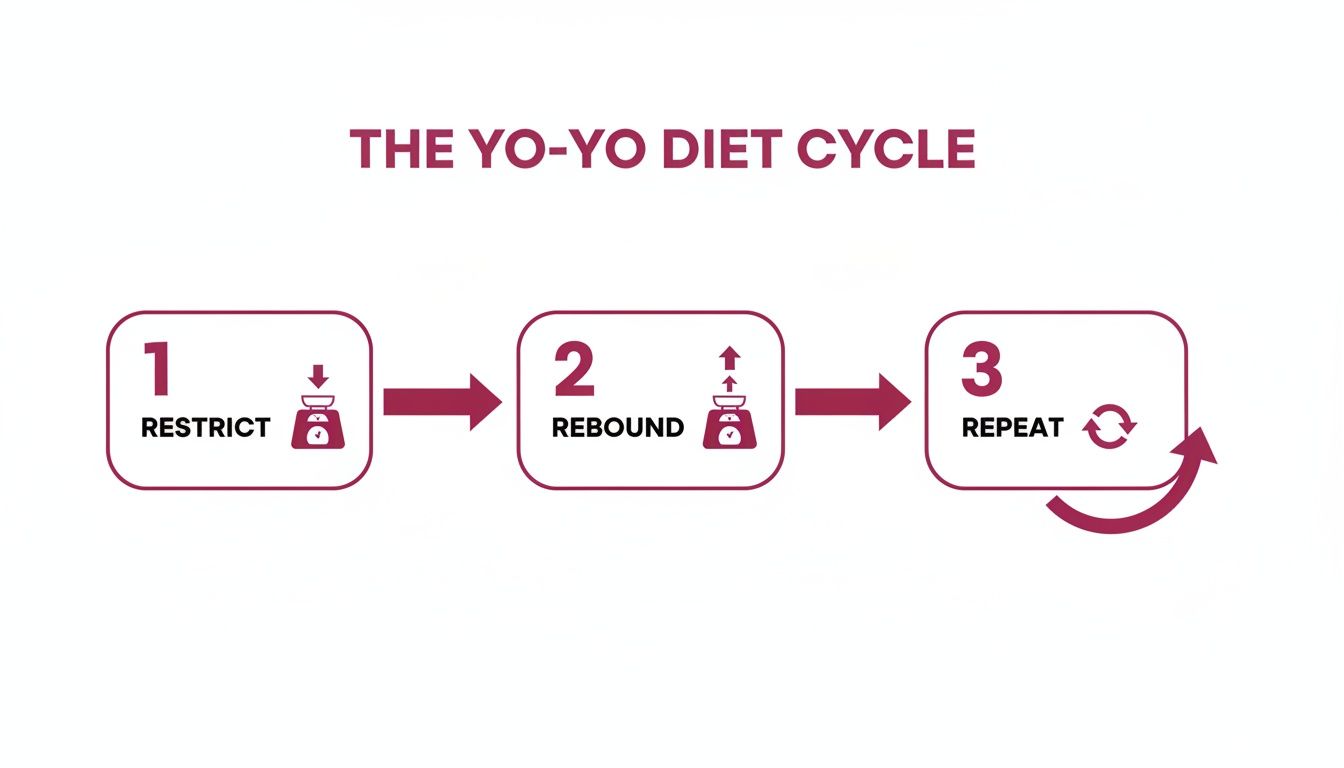
This cycle of restriction, rebound, and repeat isn’t driven by a lack of discipline. It's your biology working exactly as it's supposed to. To get out, you need a new map.
Your Body's Defense Against Dieting
Think of your body as a fiercely loyal bodyguard. The moment you start a restrictive diet, you've signaled a threat—starvation—and your bodyguard goes into high-alert mode to keep you safe.
This isn’t just a metaphor. A powerful hormonal and metabolic defense system kicks in:
- Your Metabolism Slams on the Brakes: Your body becomes incredibly efficient, burning fewer calories at rest to conserve every bit of energy.
- Hunger Hormones Skyrocket: Ghrelin, the hormone that screams "I'm hungry," goes into overdrive. This is why cravings feel so intense and impossible to ignore.
- "I'm Full" Signals Vanish: Meanwhile, the hormones that tell you you're satisfied after a meal take a nosedive, making it hard to feel full.
This powerful combination makes long-term restriction a battle you can't win. As soon as the "diet" is over, your body is primed to not only regain what you lost but often to add a few extra pounds as an insurance policy against the next perceived famine.
The Scope of the Yo-Yo Dieting Problem
You're far from alone in this struggle. This cycle entraps 10% to 40% of people in the Western world, who find themselves repeatedly losing and regaining 10 to 50 pounds. It's a demoralizing experience.
But there’s real hope. A 2012 study from the Fred Hutchinson Cancer Research Center found that women with a history of severe weight cycling were just as successful at losing weight as those who had never dieted—when they used a sustainable approach. Your past doesn't dictate your future.
Key Insight: The problem isn’t your willpower; it's the method. The biological pushback to severe calorie cutting is what fuels the yo-yo cycle. Rebound weight gain is a feature of the diet, not a bug in your character.
To truly get off this rollercoaster, you have to completely reframe your approach. This begins with understanding the core principles of safe and sustainable weight management.
Moving from Restriction to Building Habits
The only way to stop yo-yo dieting for good is to stop dieting. Instead of focusing on what you need to cut out, you shift your energy toward what you can add in. This is the fundamental difference between a temporary diet and a lifelong, habit-based approach.
Let's look at how these two paths diverge. One is a closed loop, while the other is a continuous upward spiral.
The Diet Cycle vs The Sustainable Habit Cycle
| Phase | The Yo-Yo Diet Cycle (Restriction-Based) | The Sustainable Habit Cycle (Awareness-Based) |
|---|---|---|
| Motivation | Based on an external goal (e.g., event, number on the scale). | Based on an internal desire for well-being, energy, and health. |
| Action | Drastic restriction, eliminating foods, all-or-nothing mindset. | Small, consistent additions (e.g., adding protein, a short walk). |
| Physiology | Body enters "starvation mode," metabolism slows, cravings increase. | Body feels safe and nourished, metabolism stays stable, hunger is managed. |
| Psychology | Feelings of deprivation, guilt, and anxiety around food. | Feelings of empowerment, confidence, and trust in your body's signals. |
| Outcome | Initial weight loss, followed by rebound gain, and a sense of failure. | Slow, steady progress, sustained results, and increased self-efficacy. |
As you can see, the sustainable cycle builds on itself, creating positive momentum. The diet cycle is designed to collapse.
Instead of counting every last calorie, you might focus on adding a source of protein to your breakfast. Instead of banning carbs, you might go for a 10-minute walk after lunch. You start small.
Each tiny success gives you a win, building confidence and creating a positive feedback loop. This approach works with your body's biology, not against it. You're building a foundation of health that will support you for life, not just for the next 30 days.
If you want to stop yo-yo dieting for good, the most important work you'll do isn't in the kitchen or the gym. It's in your head. The real key is to dismantle the very "diet mentality" that traps you in the first place—that rigid, all-or-nothing thinking that sets you up to fail.
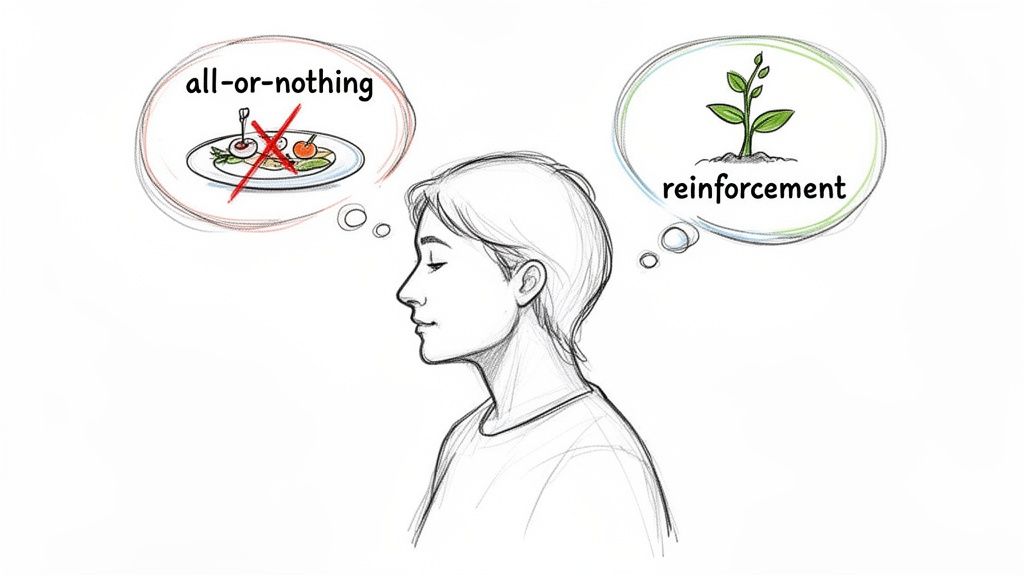
You know the drill. You create a long list of rules, labeling foods "good" and "bad." Then, life happens. You eat a slice of cake at a birthday party, and that one "bad" choice unleashes a tidal wave of guilt. Before you know it, you've given up completely, promising to start a new, even stricter diet next Monday.
The only way out is to shift toward a mindset of reinforcement and self-compassion. This is where you build the mental resilience for a journey that celebrates progress, not impossible perfection.
Dismantling the All-or-Nothing Mindset
That all-or-nothing approach is the engine that powers the yo-yo cycle. It demands perfection, so the moment you deviate—which is inevitable—you feel like a total failure. Reinforcement, on the other hand, is about building yourself up, not tearing yourself down after one misstep.
Instead of judging a meal as a "success" or "failure," you can learn to see it as just information. Did that lunch leave you feeling energized or sluggish? Satisfied or searching for snacks an hour later? This simple shift from judgment to curiosity changes everything.
The goal is to move from "I messed up" to "What can I learn from this?" Every meal becomes a data point, not a moral test. This shift is the core of sustainable change.
This isn't just about feeling better, either; your health is on the line. The cycle of extreme restriction followed by rebound weight gain can wreak havoc on your metabolism and blood sugar. In fact, dramatic weight cycling can spike your risk for type 2 diabetes by 78% over five years because of worsening insulin resistance.
Think about it: when you lose weight on a crash diet, up to 25% of that loss can be precious muscle. When the weight comes back, it's mostly fat. This tanks your metabolism, making it even harder to manage your health long-term—a vicious cycle the $427.5 billion diet industry profits from. Rejecting this mentality is the first step to reclaiming your body. To learn more, it's worth exploring the dangers of yo-yo dieting.
Cultivating a Kinder Inner Voice
What does the voice in your head sound like? For so many people stuck in the diet cycle, it’s a relentless critic, quick to point out every single flaw. A huge part of breaking free is actively rewriting that internal script.
Start by just noticing how you talk to yourself after you eat. If you hear that harsh, critical tone, gently challenge it.
- Instead of: "I can't believe I ate that pizza. I have zero self-control."
- Try this: "I really enjoyed sharing that pizza with my friends. For my next meal, I'll focus on getting some great protein and fiber to feel balanced."
This isn't about letting yourself off the hook; it's about treating yourself with basic compassion. You'd never talk to a friend that way, so why is it okay to talk to yourself like that? A kinder inner voice builds resilience, making it so much easier to get right back on track without spiraling.
Celebrate Non-Scale Victories
Let's be honest: the scale can be a powerful trigger. One number can instantly erase all the positive effort you've put in. A crucial piece of the reinforcement mindset is learning to measure success in ways that have nothing to do with weight.
These non-scale victories (NSVs) are the real, tangible signs that your new habits are making a difference. They're what build momentum and provide motivation that actually lasts.
What should you look for? Start tracking wins like these:
- Increased Energy: Realizing you no longer need that 3 PM caffeine hit to get through the day.
- Better Moods: Feeling less irritable and more emotionally steady.
- Improved Sleep: Falling asleep faster and waking up feeling genuinely rested.
- Physical Strength: Carrying all the groceries in one trip without struggling, or noticing your daily walk feels easier.
- Food Freedom: Ordering exactly what you want at a restaurant, completely free of anxiety.
When you celebrate these kinds of wins, you reinforce the very behaviors that led to them. This creates a powerful, positive feedback loop that makes you want to keep going because it feels good, not because you have to. This is how you build a healthy lifestyle that you can actually live with—and enjoy.
Learning Your Body’s Language: Hunger vs. Emotion
If you want to get off the yo-yo dieting rollercoaster for good, you first have to learn how to speak your body’s language. So often, what we think is a signal for food is actually an emotional signal in disguise. Is your stomach truly empty, or are you just feeling bored, stressed out, or a little lonely?
Figuring out the difference is a genuine superpower.
When you can finally pinpoint what’s really driving you to the pantry, you can give yourself what you truly need instead of just using food as a temporary patch. It’s about moving from reacting on autopilot to responding with real intention.
Tuning Into True Hunger
The first step is getting clear on the difference between physical hunger and emotional hunger. I promise you, they feel completely different once you start paying attention. One is a biological need; the other is a feeling looking for an escape route.
Physical hunger has patience. It doesn't scream at you. It starts as a gentle thought—"Hmm, I could eat soon"—and slowly builds into noticeable pangs in your stomach. When you're physically hungry, a lot of different foods sound pretty good. After you eat, you feel satisfied and energized, not stuffed or guilty.
Emotional hunger, on the other hand, is a sudden ambush. It shows up out of nowhere as an intense, specific craving for a particular comfort food. Think pizza, ice cream, a whole bag of chips. Giving in rarely provides real relief and is almost always followed by a wave of regret.
Here’s a quick cheat sheet to tell them apart:
- Onset: Physical hunger builds slowly. Emotional hunger hits you like a ton of bricks.
- Craving Type: Physical hunger is flexible. Emotional hunger needs one specific thing, and it needs it now.
- Location: Physical hunger is a feeling in your stomach. Emotional hunger is an urgent thought, a craving felt “above the neck.”
- Feeling After Eating: Physical hunger leads to satisfaction. Emotional hunger often leaves you feeling guilty or even more emotionally unsettled.
Learning to honor your body’s real needs is a cornerstone of this entire process. A big part of that is understanding the benefits of intuitive eating, which is all about building back that trust between your mind and body.
Your Go-To Plan for Emotional Triggers
Okay, so you’ve identified an emotional craving. Now what? Just knowing isn't enough; you have to have a plan. This is where your "emotional coping toolkit" comes in—a pre-planned set of simple, non-food activities you can turn to the moment an emotional urge strikes.
This isn't about white-knuckling it or "distracting" yourself. It’s about genuinely addressing the feeling that's bubbling up.
Key Takeaway: When you feel an intense, sudden craving, just pause. Take a breath and ask yourself, "What am I really feeling right now?" Simply naming the emotion is half the battle and the first step toward choosing a better way to cope.
So, what goes in this toolkit? It has to be personal to you, filled with things you’ll actually do.
Here are a few ideas to get you started:
- Feeling Stressed or Anxious? Put on a 5-minute guided meditation, do some box breathing, or just blast a song that always calms you down.
- Feeling Bored? Step outside and walk around the block, call a friend you haven't talked to in a while, or spend 15 minutes on a hobby you've been neglecting.
- Feeling Sad or Lonely? Scribble down how you’re feeling in a journal, scroll through old photos that bring back happy memories, or go cuddle with your pet.
- Feeling Exhausted? Instead of grabbing a sugary snack for that quick (and fleeting) energy burst, give yourself permission to take a 20-minute power nap. Or just sit quietly without a screen for a few minutes.
The real magic of this strategy is in the prep work. It’s nearly impossible to come up with a brilliant new coping skill when you're in the middle of a stress-fueled craving. Having your list ready to go makes it so much easier to make a choice that serves you, breaking that powerful link between feeling and eating that keeps the cycle going.
Alright, let's talk about what actually goes on your plate. If you want to finally break free from the rollercoaster of yo-yo dieting, your meals need to do one thing really well: keep you feeling full and satisfied. This isn't about forbidding foods or living by a calculator; it's about learning the simple craft of building a meal that works with your body, not against it.
The feeling we're chasing is satiety—that comfortable, lasting fullness that silences food noise and prevents you from raiding the pantry an hour after lunch. The key to unlocking it is surprisingly simple.
Master the Power Trio Formula
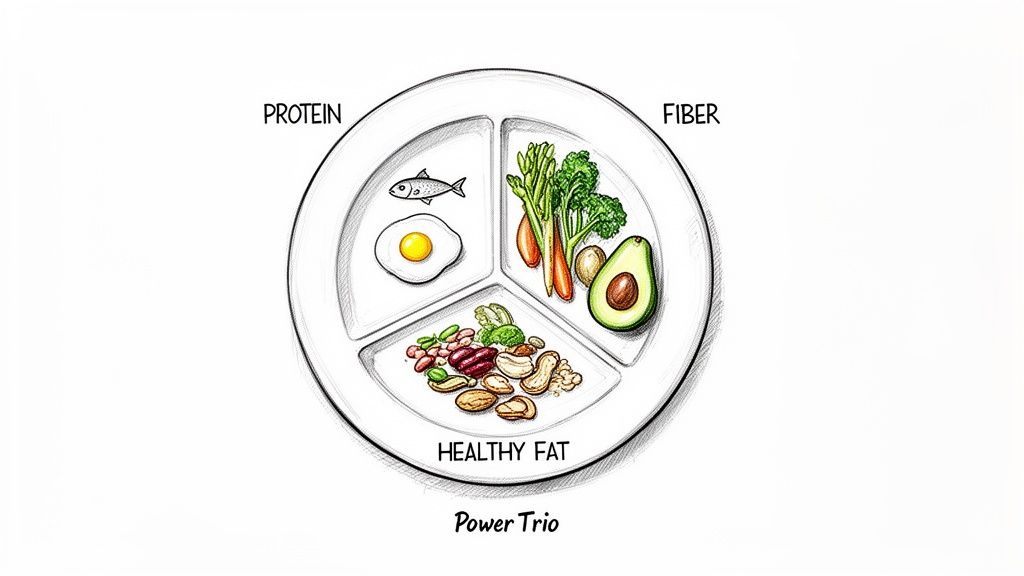
Forget everything you’ve heard about complicated diet rules. From now on, your main goal is to build your meals around the "Power Trio": protein, fiber, and healthy fats. This combination is your best defense against the energy slumps and ravenous cravings that send you right back to square one.
So, why is this trio so effective? Think of them as a team working together to keep your blood sugar stable and your hunger in check.
- Protein: This is the heavy lifter for satiety. It's the most filling macronutrient and helps you hold onto precious muscle, which keeps your metabolism humming.
- Fiber: Found in all those good-for-you plants (fruits, veggies, whole grains), fiber acts like a brake, slowing down digestion. This prevents the sharp blood sugar spikes and subsequent crashes that leave you feeling wiped out and hungry.
- Healthy Fats: Foods like avocado, nuts, and olive oil also slow digestion. They're also non-negotiable for absorbing certain vitamins and producing hormones that regulate everything from mood to appetite.
When you bring these three together, you create a meal that releases energy slowly and steadily. It's one of the most fundamental shifts for anyone learning how to stop yo yo dieting for good.
Putting the Power Trio on Your Plate
You don't need a food scale to make this happen. Just use your eyes.
Next time you build a meal, picture your plate. Start by filling half of it with a riot of color from non-starchy vegetables. Think broccoli, bell peppers, leafy greens, or zucchini. These are packed with fiber and nutrients.
Then, dedicate one-quarter of your plate to a solid source of lean protein. This could be anything from grilled chicken or fish to lentils, tofu, or a scoop of Greek yogurt.
Fill the last quarter of your plate with high-fiber carbohydrates—things like quinoa, sweet potato, brown rice, or beans. These provide that slow-burn, satisfying energy. Finally, add a touch of healthy fat. Maybe it’s a drizzle of olive oil, a few slices of avocado, or a sprinkle of sunflower seeds.
This isn’t a restrictive rule; it's a flexible template that makes balanced eating second nature.
By focusing on adding more protein and fiber to your plate, you naturally start to crowd out the less-nourishing stuff. It's a subtle but powerful shift that never feels like a diet.
Simple Swaps for Sustainable Nutrition
Making this your new normal doesn't mean you need to throw out your entire pantry. The real magic happens with small, consistent upgrades that add up over time. The goal is to make your favorite meals work harder for you by boosting their staying power and nutritional value.
Here are a few simple food swaps to get you started on the right foot.
Simple Swaps for Sustainable Nutrition
| Instead Of (Common Diet Pitfall) | Try This (Sustainable Habit) |
|---|---|
| Plain bagel with cream cheese | Whole-grain toast with avocado and a hard-boiled egg |
| Sugary breakfast cereal with skim milk | Plain Greek yogurt with berries and a sprinkle of nuts |
| A large bowl of plain pasta with red sauce | A smaller portion of pasta mixed with roasted vegetables and grilled chicken |
| A bag of pretzels for a snack | An apple with a tablespoon of peanut butter |
Notice how each swap doesn't eliminate what you like—it just upgrades it. Trading a bagel for toast with avocado and an egg, for instance, adds a powerful dose of protein and healthy fat that can keep you full for hours longer.
This isn't about being perfect. It’s about making the better choice, more often. If you're having pasta for dinner, just find a way to add protein, like some chickpeas or leftover chicken. If you’re making a salad, toss in a handful of walnuts.
These small adjustments are what build an eating style that supports you. You'll feel more satisfied, have more consistent energy, and finally get off that frustrating yo-yo dieting hamster wheel.
Designing Your Environment for Automatic Success
Let's be honest: lasting change isn't about having superhuman willpower. It's about being smarter than your own brain. If you're serious about getting off the yo-yo diet rollercoaster, you have to rig the game in your favor by setting up your surroundings to make the healthy choice the easiest choice.
This isn't a hack or a cheat. It's simply applying the science of habit design and choice architecture to your own life.
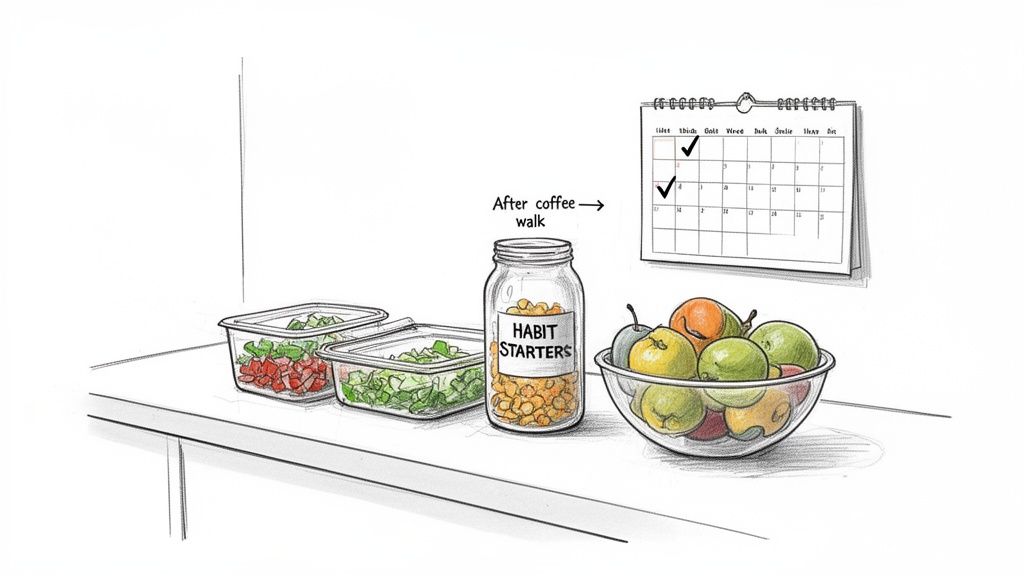
Think about it. Your environment is constantly whispering suggestions to you. That bag of chips on the counter, the friction of needing to wash and chop vegetables for a salad, the dusty running shoes hidden in the back of your closet—they all nudge your decisions one way or another.
When you intentionally shape that environment, you create an external support system. This frees up the mental energy you'd otherwise spend wrestling with temptation, making good choices feel less like a battle and more like second nature.
Create a Kitchen That Supports You
Your kitchen is ground zero for your nutritional habits. A few strategic adjustments here can make all the difference, shifting you from being reactive and grabbing whatever's available to being proactive and building nourishing meals without a second thought.
The goal is simple: make the good stuff obvious and the not-so-good stuff invisible.
For instance, stop relying on willpower to ignore the cookies. If they’re sitting on the counter, you're creating a battle you will eventually lose. Instead, make them a pain to get to. Put them in an opaque container on a shelf you can’t easily reach. Out of sight, out of mind.
On the flip side, make healthy options jump out at you. Keep a big, beautiful bowl of fresh fruit on your counter. After you grocery shop, immediately wash and cut up some veggies and store them in clear containers right at eye-level in the fridge. When hunger strikes, that's what you'll see first.
The most successful people don't have more willpower; they just have better systems. They design their environment so they don't have to use willpower in the first place.
It all comes down to reducing the friction for your good habits and adding a ton of friction for the ones you want to ditch.
Engineer Your Habits with 'Habit Starters'
Sometimes the hardest part of any new routine is just starting. This is where I love to use what I call "habit starters"—tiny, pre-prepped actions that make it almost effortless to get going.
Here are a few real-world examples I've seen work wonders:
- For Morning Workouts: The night before, lay out your entire workout outfit, down to the socks. Fill your water bottle and put it in the fridge. Place your sneakers and keys right by the door. When your alarm goes off, the decision is already made. You just have to execute.
- For Healthier Lunches: Spend an hour on Sunday prepping. Cook a big batch of quinoa or brown rice. Grill a few chicken breasts. Hard-boil half a dozen eggs. Wash and chop bell peppers and cucumbers. Now, throwing together a satisfying salad or grain bowl takes two minutes, not twenty.
- For Smarter Snacking: Forget the giant bag of almonds. Create single-serving baggies of nuts and seeds you can grab on the go. Keep Greek yogurt cups and washed berries at the very front of your fridge.
When you do the prep work ahead of time, you eliminate the in-the-moment fatigue and decision-making that so often lead us astray.
Use Habit Stacking to Build Momentum
One of the most powerful techniques I teach is habit stacking. The idea is incredibly simple yet effective: you anchor a new habit you want to do to an existing habit you already do without thinking. The old habit acts as a trigger for the new one.
The formula is straightforward: After I [CURRENT HABIT], I will [NEW HABIT].
Let's see how this plays out:
Instead of: "I'm going to try to meditate." (This is too vague and will never happen.)
Try: "After I pour my morning coffee, I will sit and meditate for five minutes."
Instead of: "I really should drink more water."
Try: "After I brush my teeth, I will drink a full glass of water."
This works because your brain already has a deeply grooved pathway for that existing habit. By tacking the new behavior onto it, you’re basically hijacking that pre-built momentum. The key is to start ridiculously small—even a one-minute action. The goal isn't perfection; it's building the neural connection. You can always add more time later once the habit sticks.
Your Questions About Leaving Dieting Behind, Answered
If you're thinking about finally breaking up with dieting, you probably have a lot of questions. That's completely normal, especially when you've been stuck in the world of strict rules and quick fixes for so long.
Let's tackle some of the biggest concerns that come up on the path to food freedom.
I've Tried Everything. How Is This Different from Another Diet?
I get it. After trying so many things that promised the world and didn't deliver, it’s natural to be skeptical. The simple answer is that this approach is the exact opposite of a diet.
Diets hand you a set of external, temporary rules built on restriction. They tell you what to eat, but they never help you understand why you eat the way you do. Your body often rebels against this because it’s designed to survive, not to be deprived.
Instead of another set of rules, we focus on building a new, lasting relationship with food and your body from the inside out. This isn't a quick fix. It's about developing self-awareness and sustainable habits so you can feel calm and in control around food for good.
What Happens if I "Mess Up" and Overeat?
First things first, let's remove "messing up" from our vocabulary. A single meal or even a whole day of eating more than you intended isn't a failure—it's just feedback. It’s a data point.
In the old diet mindset, this moment would trigger a spiral of guilt and shame, leading to the classic "I'll start over fresh on Monday" mentality. That's what keeps the yo-yo cycle going.
Here, we treat it as a moment to get curious, not critical. You can simply ask yourself: "What was going on for me right then? Was I stressed? Celebrating? Bored? Exhausted?"
This simple shift turns a moment of potential shame into a powerful learning opportunity. The goal is consistency and self-compassion, not perfection. This mindset is absolutely crucial for anyone learning how to stop yo yo dieting for the long haul.
Will I Still Lose Weight if I Stop Dieting?
This is the big one, isn't it? For many people, the answer is yes. Once you stop the stressful cycle of restricting and binging, your body often finds its way to a healthy, stable weight all on its own.
When you start honoring your hunger, managing emotional eating, and fueling your body with satisfying, balanced meals, you give it a chance to find its natural set point.
More importantly, though, we encourage you to shift your focus to what we call "non-scale victories." These are the truest signs of real health:
- Having steady energy all day long, without the 3 p.m. crash.
- Noticing your moods are more stable and positive.
- Feeling empowered and confident when making food choices, not anxious.
Weight loss can absolutely be a welcome side effect of these new, healthier behaviors. It just stops being the only goal that matters.
How Long Does It Take to Stop Yo-Yo Dieting?
Breaking free from the diet cycle is a process, not a 30-day challenge. Think about it: it probably took years to build your current habits and mindset, so it's only fair to give yourself time and patience to unlearn those patterns.
Some people feel a huge mental shift within a few weeks. For others, truly internalizing these new skills might take several months or even longer. There's no right or wrong timeline.
The key is to focus on the small, consistent wins. Celebrate the first time you notice you're emotionally hungry and choose to go for a walk instead. Acknowledge the first week you feel great without once thinking about calories. This is a journey of unlearning and relearning, one compassionate step at a time.
Ready to turn awareness into action with personalized support? Superbloom uses AI to help you understand your unique eating patterns and build habits that last. Get real-time guidance that adapts to your life, helping you feel more in control, one small step at a time. Start your journey with Superbloom today.