
How to Track Macros: how to track macros in a simple, sustainable way
If you’ve ever felt trapped by the endless cycle of calorie counting, you’re not alone. It’s a restrictive approach that often misses the bigger picture. Tracking macros is about shifting your focus from just the quantity of food to its quality—the protein, carbs, and fats that fuel your body.
This guide will walk you through how to track macros in a mindful, sustainable way. Forget obsessive counting. We're going to build healthier habits by truly understanding what your body needs, using simple methods and smart tools to make tracking an empowering part of your day, not a chore.
A Smarter Way to Think About Your Food
So, what does tracking macros actually look like? Instead of just asking, "How many calories was that?" you start asking better questions. "Did I get enough protein to feel full and support my muscles?" Or, "Do I have enough quality carbs to power through my workout?" This small shift in thinking is the key to creating lasting change.
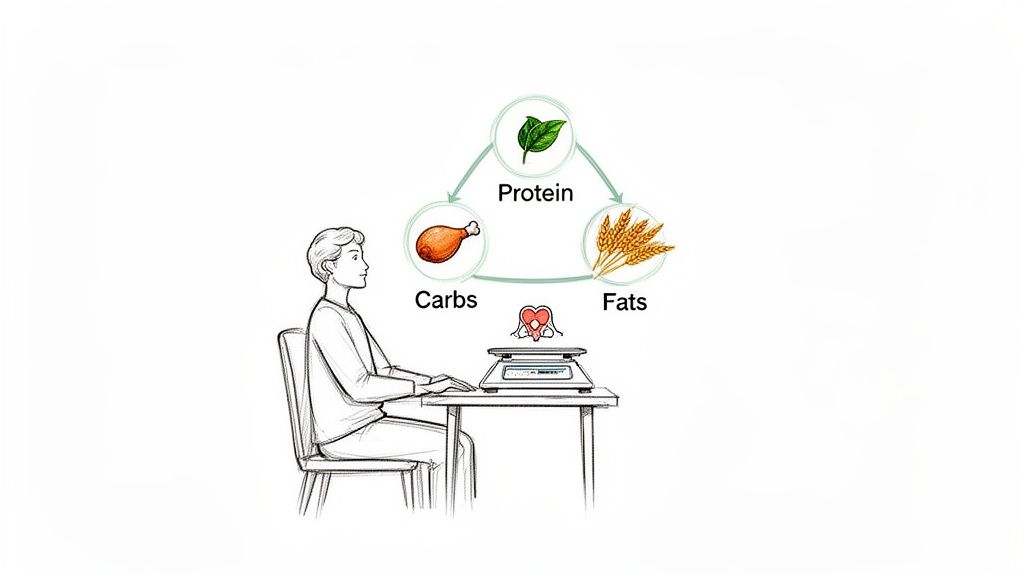
The goal here isn't about hitting your numbers perfectly every single day. It’s about building awareness. When you understand your macronutrient intake, you start connecting the dots between what you eat and how you feel, perform, and even look.
This approach helps you:
- Build habits that stick by focusing on balanced meals instead of cutting out entire food groups you love.
- Improve your body composition by making sure you get enough protein to build or maintain muscle, which is crucial, especially if you're trying to lose weight.
- Boost your energy levels with the right mix of carbs and fats to fuel your day effectively.
- Find real food freedom by learning how to fit any food into your life while still crushing your goals.
To get started, it's helpful to know what each macronutrient does for you. Here’s a quick rundown.
Quick Guide to Macronutrients and Their Roles
Understanding these roles is the first step toward making more intentional food choices every day.
Why It’s More Effective Than Just Counting Calories
While counting calories can be a starting point, it’s a bit like trying to build a house by only counting the total number of bricks—it tells you nothing about the blueprint. Two people could eat the exact same number of calories and have wildly different results based on what those calories were made of.
A diet rich in protein and healthy fats will affect your body, hormones, and hunger levels very differently than one filled with sugary, simple carbs, even if the final calorie tally is identical.
This is exactly why macro tracking has become so popular, with the diet and nutrition app market booming to a value of USD 2.14 billion in 2024. The science backs it up, too. A 2022 meta-analysis found that people following macro-balanced diets achieved 20-30% greater fat loss compared to those just counting calories over a 12-week period.
Even more impressive? They also boosted their muscle retention by 15% while losing weight, mostly because they were hitting their protein targets. If you're curious about the broader trends in what we eat, you can dig into some fascinating global food data on sites like Our World in Data.
By moving from a purely quantitative view (calories) to a qualitative one (macros), you give yourself the power to make smarter food choices. It’s about fueling your body for your specific goals, whether that’s getting stronger, managing your weight, or just feeling fantastic every day.
Finding Your Personal Macro Targets
Before you can start tracking macros, you need to know what you’re aiming for. Think of it as your nutritional blueprint, a custom plan built for your body and your goals. Just diving into tracking without this baseline is like starting a road trip with no destination on the GPS. The point isn’t to lock yourself into a rigid set of rules, but to create a solid, flexible starting point.
The bedrock of any good macro plan is understanding how much energy your body actually uses each day. This is your Total Daily Energy Expenditure (TDEE)—the total number of calories you burn in a 24-hour period. It’s a mix of your resting metabolism (what you burn just being alive), the energy it takes to digest food, and of course, all the calories you burn through movement.
While there are a million online calculators out there, they all boil down to a few key inputs:
- Basal Metabolic Rate (BMR): This is the energy your body needs just to keep the lights on—things like breathing, circulating blood, and basic cell function.
- Activity Level: This one’s a huge multiplier. Someone with a desk job has a vastly different TDEE than a construction worker or an athlete hitting the gym every day.
- Personal Factors: Your age, weight, height, and sex all play a major role in your body's overall energy burn.
First, Set Your Calorie Goal
Once you have a ballpark idea of your TDEE, you can tweak it based on what you’re trying to accomplish. This is the single most important decision you'll make.
- To Lose Fat: A sensible starting point is a modest calorie deficit. Try subtracting 300-500 calories from your TDEE. This nudges your body to tap into stored fat for fuel without making you ravenously hungry or causing you to lose precious muscle.
- To Build Muscle: You need to be in a slight calorie surplus to build new tissue. Adding 200-400 calories on top of your TDEE gives your body the extra resources it needs for repair and growth.
- To Maintain: If you're happy with your current weight and just want to improve your body composition or performance, your goal is simple: eat right around your calculated TDEE.
Remember, these numbers are just a starting point. The real magic happens when you start listening to your body and adjust based on your energy levels, hunger, and how you're progressing week to week.
Choosing the Right Macro Split
With a calorie target locked in, the next step is to figure out how to divide those calories among the three macronutrients. The ideal ratio—or "split"—is totally dependent on your goals, your lifestyle, and even what foods you enjoy eating. There's no one-size-fits-all answer; the best split is the one you can actually stick with.
Here are a few common frameworks to get you started:
A Balanced Approach (40% Carbs, 30% Protein, 30% Fat)
This is a fantastic, sustainable starting point for general health and wellness. It gives you a great mix of nutrients to support energy levels, preserve muscle, and keep your hormones happy. For most people, this split doesn't feel overly restrictive.
For Building Muscle (40% Carbs, 40% Protein, 20% Fat)
If getting stronger and adding lean mass is your primary goal, bumping up your protein is a no-brainer. Protein provides the building blocks (amino acids) needed to repair and grow muscle after a tough workout. Keeping carbs high also ensures you have plenty of fuel in the tank for those intense training sessions.
A Lower-Carb Approach (25% Carbs, 40% Protein, 35% Fat)
Some people just feel and perform better with fewer carbs, especially if they have a more sedentary lifestyle. This split prioritizes protein to keep you full and maintain muscle, while relying more on healthy fats for energy.
These splits are just popular examples, not gospel. If you're looking for a plan that’s truly customized, working with a professional through nutrition therapy can provide expert guidance to build a plan that fits your unique body and life perfectly.
Ultimately, the best way to learn how to track macros is to find what makes your body feel its best. Your personal targets should be a tool that empowers you, not a cage that confines you.
Sustainable Ways to Track Your Macros Every Day
So you've figured out your macro targets. Now for the real question: how do you actually track them without it taking over your life?
Let's be clear—the goal is to build awareness, not an obsession. The best method is always the one you can stick with, turning tracking from a chore into a simple, sustainable habit. Thankfully, you can ditch the tedious spreadsheets. There are plenty of modern, user-friendly ways to track macros that fit into a busy life.
It's all about finding your personal balance between precision and practicality.
For the Data-Lover: High-Tech Precision with Tracking Apps
If you love data and want the most accurate picture of your intake, a dedicated macro tracking app is your best bet. These apps are loaded with huge food databases, barcode scanners, and recipe builders that do most of the heavy lifting for you. They're fantastic for getting a real feel for the macro content in different foods and what proper portion sizes actually look like.
There are a ton of options out there, so it's worth exploring the best fitness apps for iOS to see which interface and features click with your routine.
But remember, an app is a tool, not a rulebook. Some platforms, like Superbloom, are taking a different approach. Instead of manual entry, you can snap a photo of your meal, and the AI coaching provides instant feedback and suggestions. It’s an effortless way to log while still getting the insights you need to stay on track.
For the Rest of Us: Intuitive, Less Obsessive Tracking
If the thought of logging every single gram makes you want to quit before you start, don't worry. There are more intuitive methods that deliver excellent results with way less mental energy.
These "eyeballing" techniques are perfect for maintaining progress when you're on the go, out with friends, or once you’ve got a good handle on your nutritional needs.
The Hand Portion Method
This is my go-to trick for eating out. It uses your own hand as a surprisingly effective and discreet measuring tool.
- Protein: A palm-sized portion (like a chicken breast or fish fillet).
- Carbs: A cupped handful (think rice, quinoa, or potatoes).
- Fats: A thumb-sized portion (for things like nuts, seeds, or oil).
- Veggies: One to two fist-sized portions.
This method is a game-changer for navigating restaurant menus or family dinners without pulling out a food scale. It encourages you to build balanced meals visually instead of getting stuck on exact numbers.
The Plate Method
Here's another brilliant visual trick that helps you build a well-rounded meal without any counting. Just divide your plate into sections:
- Fill half of your plate with non-starchy vegetables (broccoli, spinach, bell peppers).
- Fill one-quarter of your plate with a lean protein (grilled chicken, tofu, fish).
- Fill the final one-quarter with a complex carb (sweet potatoes, brown rice, quinoa).
- Finally, add a serving of healthy fats to top it off.
These intuitive methods are all about shifting your focus from hitting perfect numbers to building consistently balanced meals—and that’s the real secret to long-term success.
Comparison of Macro Tracking Methods
Choosing the right method comes down to your personality and goals. Some people thrive on data, while others need a more flexible approach. This table breaks down the pros and cons of each technique.
Ultimately, the best approach is often a hybrid. You might use an app for a few weeks to get your bearings, then switch to the hand or plate method for long-term maintenance. The key is to find what works for you.
Finding What Works For You
Your tracking method should align with your primary goal. Are you aiming for muscle gain, fat loss, or overall wellness? This decision tree can help you figure out where to focus.
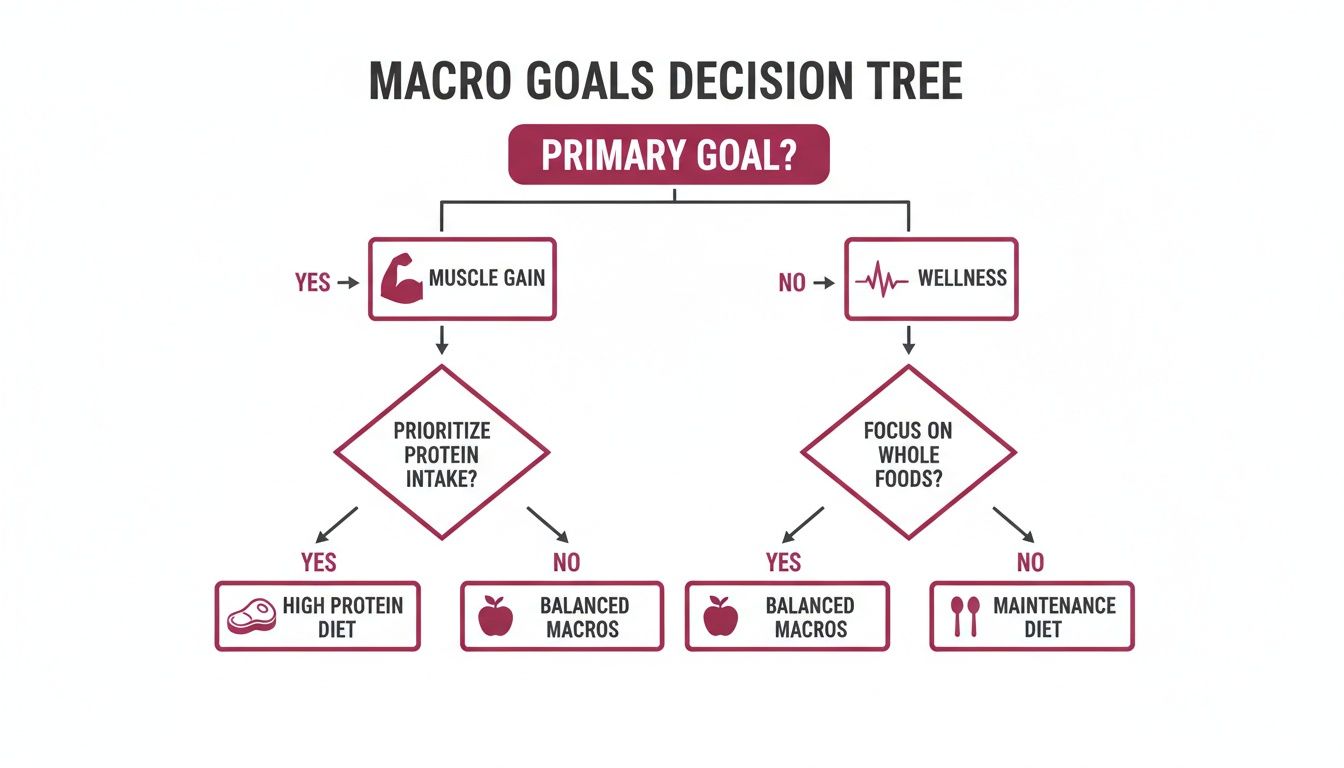
As the chart shows, whether you’re prioritizing protein for muscle or aiming for a balanced split, having a structured approach is what matters most.
The rise of macro tracking isn’t a coincidence; it’s linked to major shifts in our global food supply. With protein availability more than doubling since 1961, we have more control than ever to fine-tune our nutrition. And the data shows it works. A 2021 study of 10,000 app users revealed that consistent trackers lost 12% of their body weight in six months—compared to just 5% for non-trackers. Why? Their adherence was 40% higher, proving that habit reinforcement is powerful.
For stress eaters, tracking can be a lightbulb moment. For instance, data might show that 35% of your cravings are for carbs when you're under pressure. Armed with that knowledge, you can make smart swaps that have been shown to reduce emotional eating by 28%.
The most sustainable method is the one that empowers you without adding stress. Experiment, find what feels good, and stick with it.
A Realistic Day of Tracking Macros
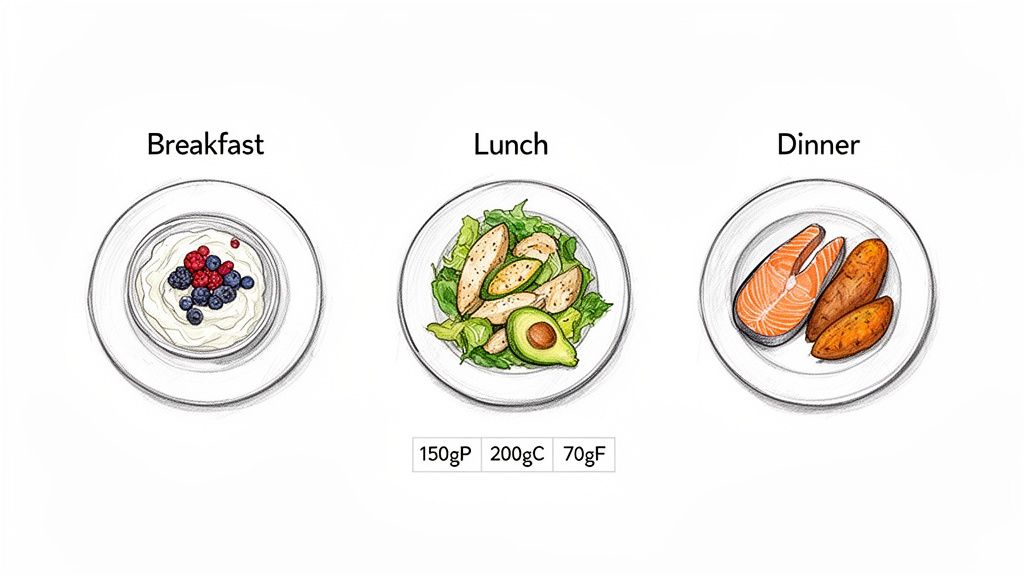
Theory is one thing, but seeing how macro tracking plays out in real life is what makes it all click. Let's walk through a sample day of eating to see how you can build satisfying meals that line up with your goals. For this example, we'll use a hypothetical target of 150g Protein, 200g Carbs, and 70g Fat.
Remember, the goal isn't to be perfect. It’s about making intentional choices that nudge you closer to your targets day by day. This walkthrough will help you visualize what a balanced day actually looks like, from the food on your plate to the different ways you might log it.
Morning Fuel: Breakfast
Starting your day with a solid dose of protein is one of the best habits you can build. It crushes early-day hunger and sets a strong foundation, so you're not scrambling to hit your protein goal at 9 PM.
A simple, powerful choice is Greek yogurt with some berries and nuts.
- Meal Example: 1 cup (227g) of Fage 5% Greek Yogurt, a half-cup of mixed berries, and a 1/4 cup of almonds.
- Approximate Macros: 30g Protein, 25g Carbs, 20g Fat.
How to Log It: This one’s easy. In an app, you can scan the barcodes for the yogurt and almonds, then just search for "mixed berries." If you’re using the hand portion method, this would look like a generous cupped handful of yogurt and about a thumb-sized portion of almonds.
Midday Power: Lunch
A good lunch should refuel you without making you want to take a nap at your desk. The classic big salad with a solid protein source is popular for a reason—it’s packed with nutrients and incredibly easy to customize.
- Meal Example: A large bowl of mixed greens, 6 oz grilled chicken breast, half an avocado, some cherry tomatoes, cucumber, and a light vinaigrette.
- Approximate Macros: 50g Protein, 15g Carbs, 25g Fat.
This meal is a perfect example of how you can eat a huge volume of food with very few carbs by loading up on non-starchy veggies. The chicken gives you a massive protein boost, and the avocado delivers those healthy, satisfying fats.
Expert Tip: Notice how we're prioritizing protein at both breakfast and lunch. Front-loading your protein like this makes hitting your daily target so much easier. A common mistake is saving most of your protein for dinner, which often leads to falling short or chugging a last-minute shake.
Afternoon Refuel: Snack
Feeling hungry in the afternoon isn't a failure—it's your body asking for fuel. A smart snack is a tool to bridge the gap between lunch and dinner, keeping your energy stable and preventing you from arriving at dinner absolutely ravenous.
A great option is pairing a fruit with a protein source.
- Meal Example: 1 medium apple with 1 cup of 2% cottage cheese.
- Approximate Macros: 28g Protein, 30g Carbs, 5g Fat.
This snack perfectly illustrates the power of food pairing. The carbs from the apple give you a quick energy lift, while the protein from the cottage cheese slows down digestion for a more sustained release, keeping you fuller for longer than if you just ate the apple by itself.
Evening Wind-Down: Dinner
Dinner is your last chance to fill in any remaining macro gaps. A balanced meal with lean protein, complex carbs, and healthy fats is exactly what your body needs to repair and recover while you sleep.
- Meal Example: 6 oz baked salmon, 1 medium roasted sweet potato, and a cup of steamed broccoli with a teaspoon of olive oil.
- Approximate Macros: 40g Protein, 40g Carbs, 20g Fat.
How to Log It: This is where a feature like photo logging in the Superbloom app really shines. You can just snap a picture, and the AI will identify the ingredients and estimate the macros for you. Or, using the hand method, you'd aim for a palm-sized piece of salmon, a fist-sized portion for the sweet potato, and another generous fist for the broccoli.
The Day’s Final Tally
So, where did we land after a full day of eating? Let’s add it all up.
- Protein: 148g (Goal: 150g)
- Carbs: 110g (Goal: 200g)
- Fat: 70g (Goal: 70g)
Look at that—we’re spot-on with protein and fat. We’re still under on carbs, which leaves a ton of flexibility for a post-dinner snack. You could have a bowl of oatmeal, some fruit, or even a small treat without derailing your progress. This is the whole point: tracking isn't about restriction. It's about creating a framework that gives you freedom and control.
Navigating Common Macro Tracking Challenges
Look, even the best-laid plans can hit a few snags. When you're learning how to track macros, it's never about perfection right out of the gate. It's about learning to roll with the punches when real life—like a last-minute dinner invitation or a frustrating plateau—inevitably happens.
The trick is to see these moments as data, not disasters. Every challenge is a chance to learn something new about your body and fine-tune your approach. This simple mindset shift turns macro tracking from a rigid pass-fail test into a flexible tool for figuring out what truly works for you.
The Dreaded Restaurant Meal
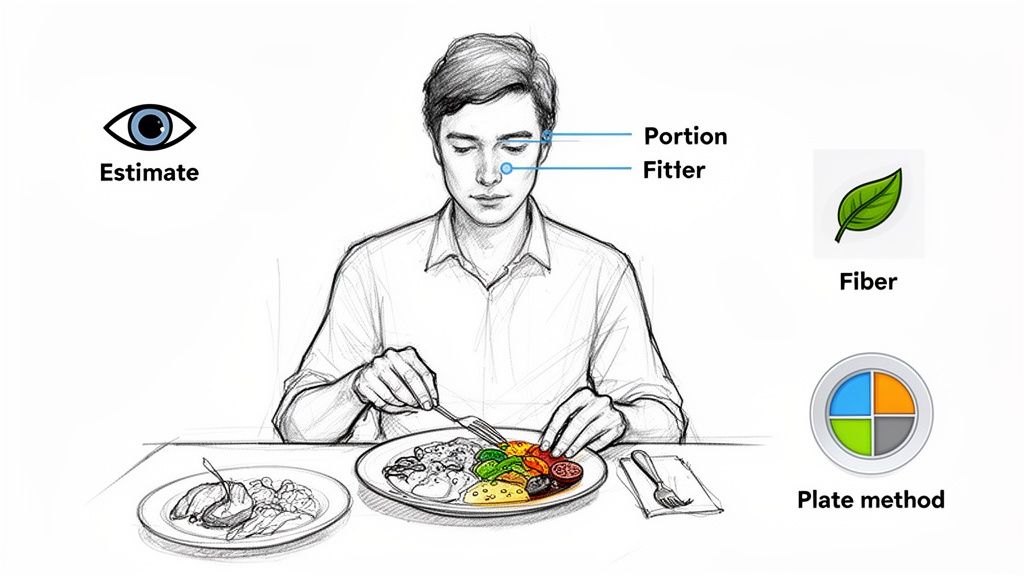
Eating out can feel like the ultimate macro-tracking hurdle. Restaurant menus almost never list macros, and eyeballing portion sizes is a guessing game. Instead of throwing in the towel, just focus on making the best estimation you can.
- Deconstruct your plate: Mentally separate your meal into its core parts: protein, carbs, and fats. Your palm is a great tool for estimating the protein (chicken, fish, steak).
- Watch out for sauces and dressings: This is where hidden fats and carbs always lurk. The easiest fix? Ask for them on the side. A thumb-sized portion is a good ballpark for oils and creamy dressings.
- Find a "stunt double" in your app: If you're at a local spot, search for a similar dish from a big chain restaurant. You’d be surprised how close you can get to an accurate ballpark figure.
The goal isn't to be perfect. It's just about staying mindful and making an educated guess.
Feeling Hungry Despite Hitting Your Numbers
This one can be maddening. Your app says you've hit your targets, but your stomach is still rumbling. This usually comes down to the quality of your food, not just the numbers.
Your body doesn’t just run on macros; it thrives on nutrient density. If you’re hitting your targets with highly processed foods, you might be missing out on key micronutrients and, most importantly, fiber.
Fiber is the secret weapon for feeling full. It adds bulk and slows digestion, keeping you satisfied for hours. If hunger is a constant issue, take a hard look at your food log and ask yourself:
- Where are the non-starchy vegetables?
- Are my carbs coming from whole grains like oats and quinoa?
- Am I including fiber powerhouses like beans, lentils, or berries?
Sometimes a simple swap, like choosing brown rice over white or adding a big salad to dinner, can make all the difference.
Breaking Through a Frustrating Plateau
You were cruising along, making great progress, and then... nothing. The scale freezes, and your motivation tanks. Plateaus are a completely normal part of the process—your body is incredibly smart and adapts to your new routine.
Before you make any drastic changes, run through this quick checklist:
- Audit your adherence: Are you really tracking as carefully as you were in the beginning? Those little bites and weekend treats add up. Get honest with your logging for one full week to see the real picture.
- Re-evaluate your activity: Have your workouts gotten a little stale, or are you sitting more? Sometimes just adding more daily steps or one more set to your lifts is enough to get the needle moving again.
- Consider a diet break: If you’ve been in a calorie deficit for months, your metabolism has likely down-regulated. Taking a planned one- or two-week break to eat at maintenance calories can do wonders for resetting your hormones and giving you a mental refresh.
This is where accountability becomes a game-changer. A 2023 study of 5,000 users found that people tracking macros maintained an 85% adherence rate—way higher than the 55% for traditional diets—and lost an average of 10kg. For those battling emotional eating, using tools to spot patterns cut binge frequency by an incredible 32%. Superbloom’s photo logs and craving insights tap into this, with progress visualizations boosting consistency by 65%. You can dig into the specifics in the full report on global nutrition trends.
Learning to navigate these challenges is what builds real, lasting confidence. It teaches you to listen to your body, adjust your strategy on the fly, and ultimately turn macro tracking into a sustainable skill for life.
Your Top Macro Questions, Answered
Jumping into something new always brings up a few questions, and learning to track your macros is no different. You’re bound to hit some bumps as you try to apply all this to your actual life. My best advice? Think of it less like a rigid diet and more like a personal science experiment. You're just gathering data on what makes your body feel and perform its best.
Let’s walk through some of the most common questions I hear from people just starting out. The goal here is to give you straightforward, practical answers so you can feel confident and build a habit that actually sticks.
Do I Really Have to Weigh All My Food?
This is the big one, and the answer is a resounding no—at least not forever. While a food scale is the gold standard for accuracy, it’s much more effective as a short-term learning tool than a lifelong ball and chain.
Think of it like training wheels for your eyes. Use it for the first few weeks to see what an actual serving of peanut butter (16g) or a four-ounce chicken breast really looks like. You’d be surprised. This initial phase is all about calibrating your perception of portion sizes, a skill you can take with you anywhere, long after the scale is back in the cupboard.
Once you have a feel for it, you can graduate to more sustainable methods.
- The Hand Method: This is a game-changer. Use your palm to estimate protein, a cupped hand for carbs, and your thumb for fats. It's simple, always with you, and surprisingly effective.
- Photo Logging: With an app like Superbloom, you can just snap a picture of your meal. The AI does the heavy lifting, estimating the macros for you without a scale in sight.
Look, the best method depends on your goals. A competitive bodybuilder needs that pinpoint precision. But for the rest of us just trying to improve our health or lose fat sustainably, consistency with a good-enough method is way more powerful than a week of perfection followed by burnout.
The real goal is to internalize this knowledge so you can make smart choices on the fly, no gadgets required.
What Happens If I Go Over My Macro Targets?
First thing's first: take a breath. It's okay. A single day of going over your targets isn't going to undo all your hard work. The most important thing is to avoid the "all-or-nothing" trap, where one off-plan meal spirals into feeling like the entire day is a write-off.
That mindset is a fast track to a toxic cycle: you overeat, feel guilty, then try to "fix" it by restricting everything the next day. This just messes with your metabolism and your relationship with food. It's not sustainable.
Instead, just get back on track with your next meal. That's it. Treat the experience as a data point, not a failure. Ask yourself a few questions, judgment-free:
- What led to going over? Was it a special occasion? A stressful day? Did I just forget to plan ahead?
- How did I feel afterward? Did that extra food make me feel sluggish and bloated, or did I actually have more energy for my workout?
The answers are pure gold. They teach you about your habits and emotional triggers. Remember, progress is built on consistency over weeks and months, not perfection in a single day. Every meal is a fresh start.
How Often Should I Tweak My Macro Targets?
Your body isn't static, so your macro targets shouldn't be either. Think of them as a starting point, not a permanent prescription. As your body changes, so do its needs.
A good rule of thumb is to reassess your targets every 4-6 weeks, or whenever you hit a major milestone or a big change in your routine.
It might be time for an adjustment if:
- You've hit a weight loss plateau that’s stuck around for more than two or three weeks.
- Your activity has changed in a big way (like starting a new strength program or training for a 10k).
- Your lifestyle has shifted (maybe you went from a desk job to one where you're on your feet all day).
- You’ve reached a goal and are ready to shift from a fat loss phase into maintenance.
When you do decide to adjust, think "tweak," not "total overhaul." Small, gradual changes work best. If fat loss has stalled, try pulling back your carbs or fats by just 10-15 grams per day. If you're feeling constantly drained in the gym, maybe a small bump in carbs is exactly what your body is asking for. Listening to your body’s feedback is the most important skill you can develop in this whole process.
Ready to stop guessing and start understanding your body’s unique patterns? Superbloom uses AI-powered coaching and simple daily check-ins to help you build sustainable habits without the stress of obsessive counting. Get personalized feedback on your meals, uncover your emotional triggers, and make progress that feels good. Start your journey with Superbloom today.