
A Guide to Intuitive Eating Coaching for Lasting Change

Intuitive eating coaching is all about letting go of the rigid rules of dieting and learning to listen to your own body again. Think of it as a partnership where you unlearn everything diet culture taught you and start trusting your internal signals—like hunger, fullness, and satisfaction—to guide how you eat.
What Is Intuitive Eating Coaching
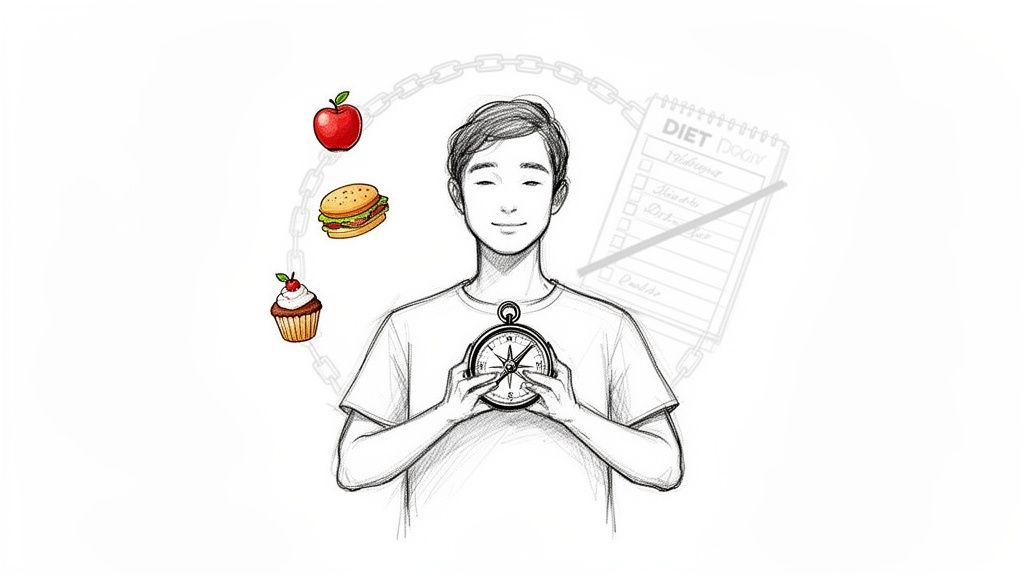
Picture yourself trying to find your way through a new city. A diet is like a strict, turn-by-turn GPS that freaks out if you miss an exit. Intuitive eating coaching, on the other hand, is like being handed a compass. You learn to read the map, understand the terrain, and trust your own sense of direction to get where you need to go.
This kind of coaching is a supportive process designed to help you tear down the "good food vs. bad food" mindset that most of us have internalized. Instead of giving you more rules to follow, a coach acts as a guide, helping you tune into the subtle messages your body has been sending all along.
Your Coach Is a Guide, Not a Guru
A traditional diet coach hands you a plan and expects you to follow it. An intuitive eating coach does the opposite—they help you cultivate your own inner wisdom. There are no meal plans here. Instead, you get the tools to figure out what your body truly wants and needs in any given moment.
The entire process is built on curiosity and self-compassion, not on restriction and shame. The main goal is to repair the trust between your mind and body, a connection that often gets broken after years of yo-yo dieting.
This work really boils down to three key areas:
- Unpacking Food Rules: You’ll start to identify and challenge all those hidden beliefs you have about food—like "carbs are bad" or "I can't have dessert."
- Honoring Your Body's Signals: This is where you learn to tell the difference between true physical hunger and the emotional triggers that make you want to eat.
- Cultivating Body Respect: The focus shifts from trying to shrink or change your body to appreciating everything it does for you, right now.
The whole point is to break free from the exhausting cycle of restriction and guilt. It's about building a relationship with food that’s based on freedom, pleasure, and genuine well-being, not temporary control.
To really see the difference, it helps to put them side-by-side.
Intuitive Eating Coaching vs Traditional Dieting
AspectIntuitive Eating CoachingTraditional DietingAuthorityYou are the expert of your own body.The diet plan or guru is the expert.FocusInternal cues (hunger, fullness, satisfaction).External rules (calories, macros, points).FoodAll foods are neutral; unconditional permission to eat.Foods are labeled "good" or "bad."Success MetricInner peace, body trust, and well-being.Weight loss, body size, and rule-following.MindsetCuriosity, flexibility, and self-compassion.Perfectionism, rigidity, and guilt.OutcomeSustainable, lifelong relationship with food and body.Temporary results, often leading to a diet-binge cycle.
As you can see, the two approaches couldn't be more different in their philosophy and goals.
Building Skills That Actually Last
Ultimately, intuitive eating coaching gives you skills you can use for the rest of your life. You learn how to handle holidays, social events, and stressful days without feeling like you've "failed" or fallen off the wagon.
For anyone who feels inspired by this approach and is thinking about becoming a coach, there are great resources for starting an online coaching business that can help you get started.
This journey is all about progress, not perfection. It’s a powerful path for anyone who is just plain tired of the dieting hamster wheel and wants to finally feel comfortable in their own skin.
The 10 Principles of Intuitive Eating
Intuitive eating is guided by ten core principles. Think of them less as rigid rules and more as a compass, pointing you away from the exhausting world of dieting and back toward your body’s own wisdom. Working with an intuitive eating coach is about exploring these ideas and learning how to apply them in your own life, rebuilding that deep sense of trust with your body.
Let's unpack what these principles actually look like in the real world.
1. Reject the Diet Mentality
This is the first, and arguably most important, step. It’s about finally acknowledging that diets just don’t work long-term. The endless cycle of restricting, feeling like you've "failed," and starting over? That’s the problem, not you. This principle is your permission slip to get angry at the diet industry for all its false promises.
So, how do you start? Delete the calorie-tracking apps. Toss out the diet books. Unfollow the social media accounts that make you feel bad about your food choices. You need to create some breathing room to even begin hearing what your body has to say.
2. Honor Your Hunger
Hunger isn't the enemy. It's a completely normal, biological signal that your body needs fuel. When you ignore it, you trigger a primal drive to overeat later.
Imagine your body’s hunger is like your phone battery. If you consistently let it drain down to 1%, you’ll end up frantically searching for a charger and probably overdo it. Waiting until you're absolutely starving often leads to eating past fullness because your body is in survival mode. Honoring your hunger means responding to its first gentle nudges, which keeps your body fueled and teaches it to trust that you’ll take care of it.
3. Make Peace with Food
It's time to call a truce in the war against certain foods. This means giving yourself unconditional permission to eat anything. When you label foods as "bad" or "off-limits," you create an intense feeling of deprivation. And what does that lead to? Uncontrollable cravings and, often, bingeing.
Think about it: when you finally give in and eat that "forbidden" food, it feels like a last-chance, all-or-nothing moment. This mindset almost guarantees you'll overeat and feel guilty afterward. Making peace is about stripping away the "good" and "bad" labels and seeing all food as neutral.
"Scream a loud 'NO' to thoughts in your head that declare you're 'good' for eating minimal calories or 'bad' because you ate a piece of chocolate cake. The Food Police monitor the unreasonable rules that dieting has created."
Silencing that inner critic is the goal. It's about replacing judgment with curiosity.
4. Challenge the Food Police
The "Food Police" are those nagging, judgmental voices in your head that scream diet rules at you. They're the source of all the guilt and shame you feel around eating. A huge part of intuitive eating coaching is learning how to stand up to them.
You’ll start by noticing these thoughts and then actively reframing them with a little self-compassion. Instead of beating yourself up for eating a cookie, you might simply acknowledge that you enjoyed it and move on with your day.
5. Discover the Satisfaction Factor
In the constant rush to be "healthy," we've forgotten one of life's simplest joys: the pleasure of eating. When you allow yourself to eat what you truly want in a nice setting, that feeling of satisfaction helps you recognize fullness much more easily. Forcing down a bland "diet" meal when you’re craving something rich and comforting will almost always leave you prowling the kitchen for something else, even if you’re technically full.
6. Feel Your Fullness
Just as you learn to listen to your hunger, it’s equally important to respect your fullness. This is a skill, and it takes practice. It’s about pausing in the middle of a meal to check in with yourself. How does the food taste now? On a scale of hungry to full, where are you? This simple pause helps you find that sweet spot of comfortable fullness where you can stop eating and feel great.
7. Cope with Your Emotions with Kindness
Let's be real: emotional eating happens. This principle isn't about vowing to never do it again. It's about finding kinder, more effective ways to handle your feelings so that food isn't your only tool. An intuitive eating coach can help you build a whole "toolbox" of coping strategies—things like journaling, calling a friend, or just stepping outside for a walk. The more options you have, the less you'll need to rely on food alone.
8. Respect Your Body
This one is big. It means accepting your genetic blueprint and letting go of the unrealistic body ideals that diet culture sells us. It's about treating the body you have right now with dignity and respect. You don't have to love every single part of it, but you can commit to taking care of it, no matter its shape or size.
9. Movement—Feel the Difference
Time to shift your focus from grueling, calorie-burning exercise to joyful movement. The goal here is simple: find ways to move your body that you actually enjoy. When you start focusing on how movement makes you feel—more energized, less stressed, stronger—it stops being a punishment for eating and becomes a sustainable part of your life.
10. Honor Your Health with Gentle Nutrition
This is the final piece of the puzzle. Once you’ve healed your relationship with food and your body, you can start making food choices that honor both your health and your taste buds. Gentle nutrition is about progress, not perfection. It’s the understanding that you don't have to eat perfectly to be healthy and that your overall pattern of eating over time is what really counts.
Why This Coaching Method Is Backed by Science
Intuitive eating coaching isn't just some feel-good trend; it’s a powerful approach built on a solid foundation of scientific research. Unlike the diet fads that come and go, this method has been studied for years, consistently showing real-world links to better mental and physical health. This is why learning to trust your body isn't just a nice idea—it's a credible path to wellness that actually works.
The science is pretty clear: when you step away from restrictive diets, you open the door to some profound mental health benefits. Study after study connects intuitive eating with higher self-esteem, better body appreciation, and a more positive outlook on life. It helps you break free from the cycles of shame and guilt that diet culture thrives on.
This holistic approach also has a ripple effect on your overall well-being. By dialing down food-related stress, you can better manage other areas of your life, which is why some people find that intuitive eating supports other lifestyle and diet changes for anxiety management. You're simply freeing up mental and emotional energy that was once spent obsessing over food.
This infographic captures three of the big ideas at the heart of the intuitive eating process.
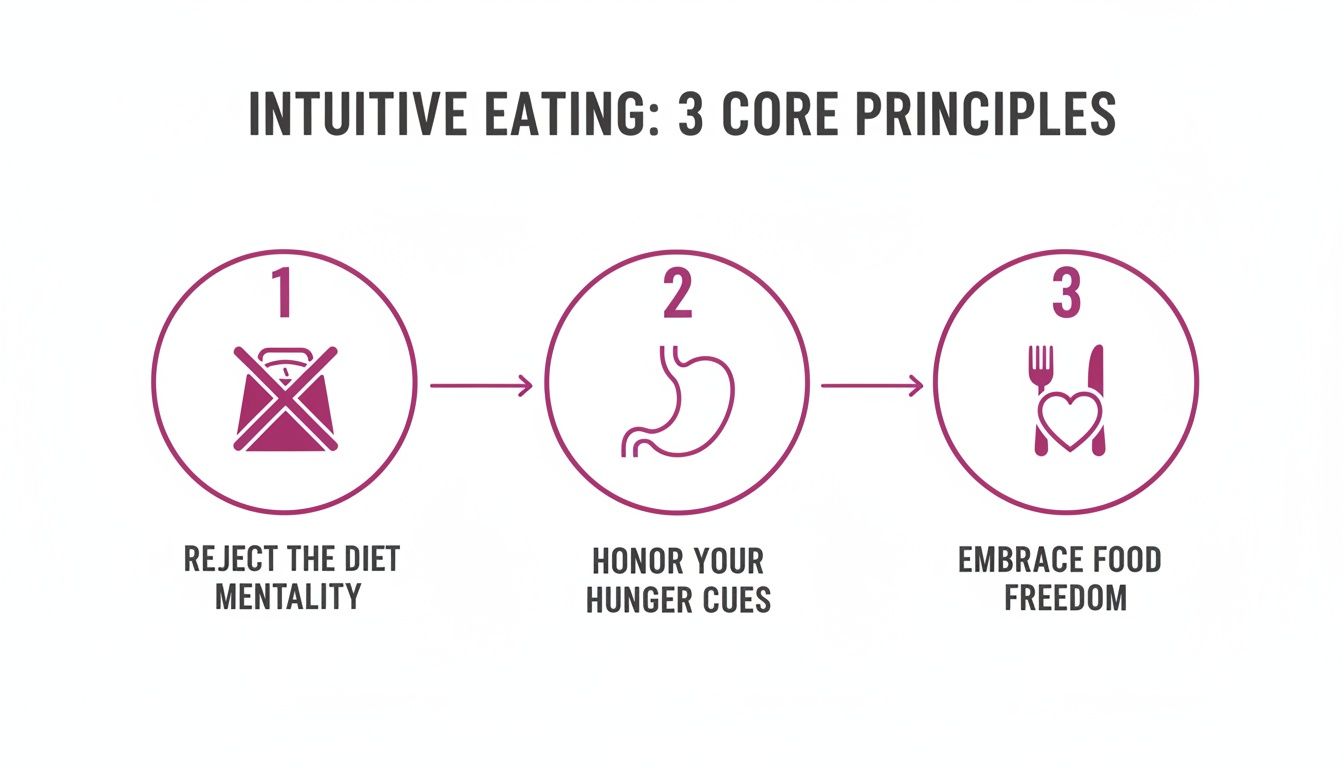
These principles are all about shifting from following external rules to tuning into your own internal wisdom—and that's what this science-backed coaching is all about.
The Impact on Your Physical Health
The benefits don't just stop at your mindset. Research consistently points to significant physical improvements for people who adopt intuitive eating, especially when guided by a coach.
While it’s definitely not a weight-loss program, many studies have found a strong link between intuitive eating and maintaining a more stable, healthy body weight over time. This happens naturally because you're learning to listen to your body's hunger and fullness cues, which helps prevent the biological rebound effect that almost always follows restrictive dieting.
Here are a few key physical outcomes researchers have noted:
- Better Metabolic Health: Studies often see improved cholesterol levels and more stable blood sugar in people who practice intuitive eating.
- Lower Rates of Disordered Eating: When you stop labeling foods as "good" or "bad," you dismantle the very thought patterns that can fuel bingeing and other unhealthy behaviors.
- A Deeper Connection With Your Body: You get much better at recognizing—and trusting—your body's signals for hunger, fullness, and satisfaction.
Think of it this way: instead of the exhausting rollercoaster of dieting, intuitive eating helps you find a sense of equilibrium. It's about letting your body settle at its natural set point, where it can thrive without you having to constantly micromanage it.
A Closer Look at the Clinical Evidence
The research backing intuitive eating coaching has been growing steadily since the early 2000s. A huge turning point was a landmark systematic review in 2023, which analyzed 26 different studies, including high-quality randomized controlled trials.
A powerful takeaway? Across 19 of those studies, intuitive eaters consistently had a lower BMI than non-intuitive eaters. This connection was particularly strong for groups like university students and Caucasian women, suggesting that the more a person relied on their internal cues instead of diet rules, the lower their BMI tended to be.
This mountain of evidence confirms that intuitive eating isn't about "letting yourself go." It's a structured, mindful framework for healing your relationship with food and your body. The science is in: learning to trust yourself, often with the support of a coach, leads to lasting positive changes that you can see and feel.
Your Journey with an Intuitive Eating Coach
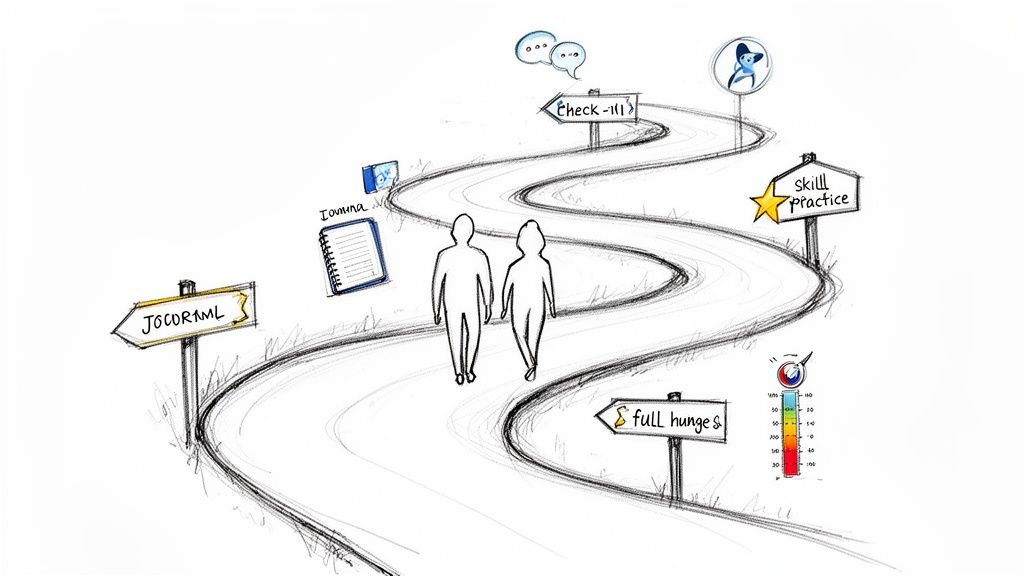
Starting with an intuitive eating coach can feel both exciting and a little mysterious. What actually happens in a session? This isn't just another program; it's a partnership. Your coach is there to meet you exactly where you are, guiding you away from the noise of food rules and toward a place of clarity and self-trust.
Think of it as a journey of unlearning old habits and building new, compassionate skills that will genuinely last a lifetime.
The first few sessions are all about building a foundation. This is where you and your coach get to know each other in a safe, completely non-judgmental space. You'll share your history with food, dieting, and body image, and your coach will help you start spotting the invisible "food rules" that have been running the show—those sneaky beliefs you might not even realize are dictating your choices.
What a Typical Session Looks Like
While every coach has their own style, most sessions in intuitive eating coaching follow a gentle, supportive flow. Forget weigh-ins or food log inspections. These conversations are about curiosity and connection, creating a space for you to explore your experiences without any fear of getting it "wrong."
A session usually kicks off with a simple check-in. You'll talk about your wins, challenges, and any "aha!" moments you’ve had. This isn't about confessing what you ate; it’s about noticing the thoughts and feelings that came with it. For instance, you might discuss a time you felt an urge to emotionally eat and dig into what was really going on in that moment.
From there, you’ll dive deeper into a specific principle or a challenge you're facing, whether it's navigating a dinner out with friends or practicing body respect. The real work happens here, with your coach asking thoughtful questions that help you uncover your own insights, rather than just handing you answers.
The goal isn't to follow a new set of rules perfectly. It's to build self-awareness and compassion. Your coach is there to help you connect the dots between your actions, thoughts, and feelings.
To wrap things up, you’ll work together to define a small, actionable step to focus on before your next session. This isn’t strict homework; it's more like a gentle experiment. It might be as simple as pausing for 30 seconds before a meal to check in with your hunger or noticing the language you use when you look in the mirror.
Powerful Exercises You Might Explore
An intuitive eating coach uses a variety of tools and exercises to turn these big ideas into practical, everyday skills. These aren't tests you can pass or fail—they are experiments designed to help you learn more about yourself.
Here are a few examples of what you might work on together:
- The Hunger-Fullness Scale: Instead of counting calories, you’ll learn to rate your hunger and fullness on a scale of 1 to 10. This simple practice is a game-changer for reconnecting with your body's physical cues, helping you honor gentle hunger and recognize comfortable fullness.
- Challenging the Food Police: You might do an exercise where you write down a judgmental thought about food (e.g., "I was so bad for eating that cake") and then practice reframing it with a more neutral, compassionate voice ("I enjoyed a piece of cake, and that's okay").
- Body Image Reflection Prompts: Your coach may give you journal prompts like, "What is one thing my body did for me today that I'm grateful for?" or "How can I show my body respect today, regardless of how I feel about its appearance?"
This whole journey is a gradual process of building skills, one small step at a time. Through this supportive partnership, you learn to become the expert of your own body, finally finding the food freedom you’ve been looking for.
How to Find the Right Coach for You
Choosing someone to guide you on your intuitive eating journey is a big deal. It’s a deeply personal decision. The right coach will be more of a partner—someone who creates a safe, compassionate space for you to dismantle old habits and build new, more freeing ones.
To make sure you connect with a supportive and truly qualified professional, you need to know what to look for and, just as importantly, what questions to ask. The search really begins with their credentials. A solid background in intuitive eating coaching goes far beyond personal experience; it demands specialized training to really understand the complex interplay of food behaviors, body image, and the whole non-diet philosophy.
Look for Key Credentials
When you start vetting potential coaches, put those with formal education and certifications at the top of your list, especially if their training aligns with a Health at Every Size (HAES) approach. This is your assurance that they have a firm grasp of both the psychological and physiological sides of this work.
Here are the top qualifications to keep an eye out for:
- Certified Intuitive Eating Counselor: This is the gold standard. It means they’ve been trained and certified directly by the creators of the Intuitive Eating framework, Evelyn Tribole and Elyse Resch.
- Registered Dietitian (RD) or Registered Dietitian Nutritionist (RDN): An RD who specializes in a non-diet or weight-inclusive practice brings a deep, science-backed understanding of nutrition to the table, but without the focus on restriction.
- Licensed Therapists or Counselors: Professionals with a background in psychology (like an LPC, LMFT, or LCSW) can be incredibly helpful, particularly if you're navigating challenges with emotional eating or body image.
Insightful Questions to Ask in a Consultation
Once you have a shortlist of qualified coaches, the next step is a consultation call. This is your opportunity to feel out their philosophy and coaching style to see if it resonates with you. Treat it like an interview—after all, you're hiring them for a very important job.
Here are a few powerful questions to get the conversation started:
- How do you define health? A great answer will center on well-being behaviors—things like managing stress, finding joyful ways to move, and practicing self-care—rather than focusing on weight or body size.
- What does progress look like for your clients? You want to hear them talk about things like improved body image, less guilt around food, and a more peaceful, easy relationship with eating. Progress shouldn't be about numbers on a scale.
- What is your experience working with clients who have a history of dieting? It's crucial to find a coach who genuinely understands the diet cycle and can offer both empathy and practical strategies to break free from it.
- How do you incorporate the principles of Intuitive Eating into your practice? They should be able to speak clearly and confidently about how they guide clients through each of the 10 principles.
A great coach won’t just give you answers; they will help you find your own. Their role is to empower you, not to prescribe another set of rules for you to follow.
Red Flags to Watch Out For
Knowing what to look for is only half the battle; you also need to know what to avoid. Certain phrases or promises are dead giveaways that a coach might still be stuck in diet culture, even if they use buzzwords like "wellness" or "intuitive."
Be wary of any coach who:
- Guarantees weight loss. This is a massive red flag and flies in the face of what intuitive eating is all about.
- Labels foods as "good," "bad," or "clean." This kind of moralizing language just reinforces the restrictive diet mentality.
- Promotes "cheat days" or any kind of restrictive eating plan. This is just dieting dressed up in a different outfit.
- Lacks formal credentials in nutrition, dietetics, or mental health. While personal experience is valuable, it's no substitute for professional, evidence-based training.
By doing a little homework and trusting your gut, you can find a coach who will be a true champion on your journey toward food freedom.
How AI Can Support Your Intuitive Eating Journey
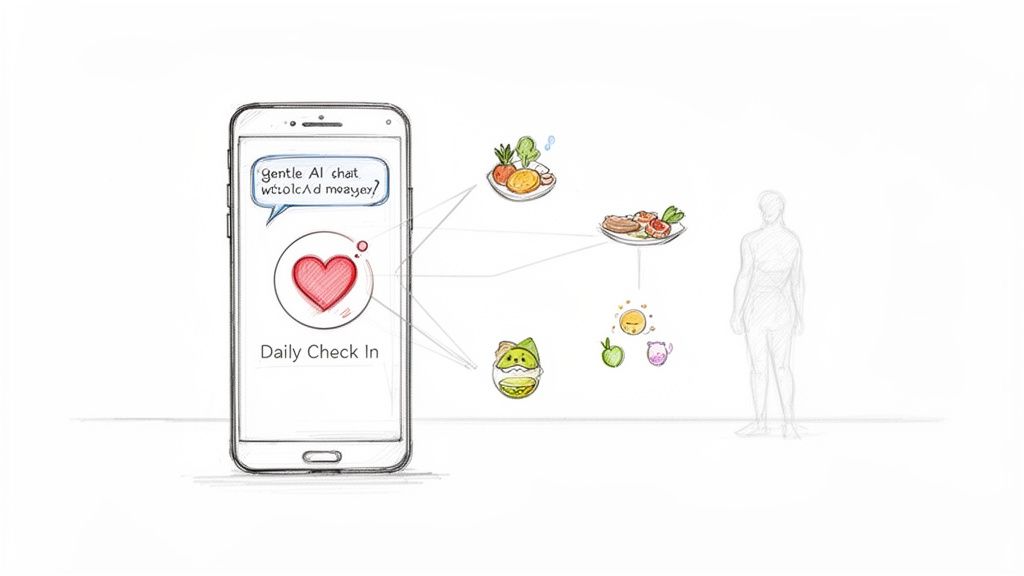
Your sessions with an intuitive eating coach are where you do the deep, foundational work. But what about all the moments in between? That’s where technology can step in as a pretty incredible ally, helping you practice what you’re learning when you're actually living your life.
Tools like the Superbloom app can act as a supportive companion on this path. It’s designed to bridge the gap between those big "aha!" moments in coaching and the small, everyday decisions you make at home, at work, or on the go.
Think of it this way: your human coach is the experienced guide who helps you map out the journey and navigate the tricky parts. The AI is like your pocket field guide, there to help you notice the details and practice your skills day-to-day.
Reinforcing Mindfulness with Daily Check-Ins
A huge piece of intuitive eating coaching is shifting from eating on autopilot to eating with awareness. AI-powered daily check-ins create a simple, low-effort habit that makes this practice stick.
These aren't about logging calories or judging your food choices. Not at all. They’re just gentle nudges to pause and ask, "How hungry am I? How full do I feel? What's my mood right now?" This consistent, gentle reflection helps you get much better at hearing your body's signals, which makes the work you do with your coach even more productive.
Connecting Cravings to Emotions Through Journaling
Journaling is one of the best ways to start untangling your eating patterns. An AI app makes it easy to quickly jot down what you ate, how you felt, and anything you noticed that might have triggered a certain craving.
Over time, the AI can start to connect the dots in ways you might not see yourself. Maybe it points out that you always seem to crave something sweet after a stressful meeting, or that you reach for salty snacks when you’re feeling lonely.
This isn't about shaming emotional eating—it's about understanding it with curiosity. When you see these patterns clearly, you and your coach can come up with real strategies for managing those feelings that don't always have to involve food.
Combining tech with coaching really works. Studies have found that intuitive eating coaching, whether online or in-person, can slash body dissatisfaction by 22% and binge eating by 15%. For people using tools like Superbloom, those numbers come to life. The AI’s insights help cement new habits, and we know that simple reflection alone boosts self-regulation. If you're curious about the data, you can explore more research on these coaching outcomes yourself.
Getting Personalized Guidance in the Moment
Let's be real—one of the hardest parts of this journey is remembering what to do when you’re in a tough spot. An AI coach can offer that immediate, non-judgmental support you need, right when a craving hits or a difficult emotion surfaces.
This combination of a human coach for deep, relational work and an AI tool for consistent, daily support creates a really powerful environment for change. The AI helps you gather your own data and practice new skills every day, which means your coaching sessions can become even more focused and impactful. It’s a dual approach that can truly help you build a lasting, peaceful relationship with food.
Common Questions About Intuitive Eating Coaching
It’s completely normal to have a ton of questions when you first consider intuitive eating coaching. After all, if you've spent years living by diet rules, this path can feel like stepping into a whole new world. It's okay to be curious, and maybe even a little skeptical.
Let's walk through some of the most common questions and concerns. The goal here is to build a flexible, peaceful relationship with food, and getting a clear picture of what that looks like can make starting this journey feel a lot less intimidating.
Is This Only for People with Eating Disorders?
Not at all. While intuitive eating is a cornerstone of recovery for many individuals, this coaching is designed for anyone who feels trapped in a difficult relationship with food.
It’s for the chronic dieter, the person who struggles with emotional eating, or anyone who’s just plain tired of the endless cycle of food guilt and anxiety. Think of it as a proactive way to build mental and physical well-being, helping all sorts of people find what we call "food freedom."
Will I Lose Weight with Intuitive Eating?
This is probably the most-asked question, and the honest answer is: maybe, but it’s not the goal. The real focus of intuitive eating coaching is to heal your relationship with food and your body. Weight loss is not the endgame.
As you start to tune into your body's signals and move away from restriction, your weight might go down, go up, or stay exactly the same.
Your body will eventually find the weight where it is naturally most comfortable. A great intuitive eating coach will help you shift your focus from the numbers on the scale to health-promoting behaviors and your own internal cues. That shift is where sustainable well-being truly begins.
How Long Does the Coaching Process Take?
There’s no one-size-fits-all timeline. This is deeply personal work, and it involves unlearning habits and beliefs that you may have carried for a lifetime. Everyone moves at their own pace.
Most people find that working with a coach for several months to a year gives them the time they need to feel confident in their new skills. It’s definitely not a quick fix; it’s about building a foundation that will support you for the rest of your life. Progress is always valued over perfection.
How Is an AI Tool Different from a Human Coach?
Think of an AI tool as a powerful supplement to coaching, not a replacement for it. A human coach brings nuance, deep empathy, accountability, and a personal connection that technology just can't match. They are your guide and your strategist.
An AI tool like Superbloom comes in to support you between sessions. It offers 24/7 support for those in-the-moment challenges, helping you track patterns and practice mindfulness every single day. This provides a steady stream of data and consistency that can make your sessions with a human coach even more powerful and productive.
Ready to bridge the gap between your coaching sessions and daily life? Superbloom acts as your personal AI companion, helping you turn awareness into action with gentle check-ins and personalized insights. Start building a better relationship with food today.