
A Guide to Sustainable Eating Habits for Lasting Health
Let's get real for a minute—the constant cycle of dieting is draining. It’s a rollercoaster of restriction, guilt, and eventually, giving up. This guide is about getting off that ride for good.
We’re going to redefine what sustainable eating habits mean. Forget the idea of it being some rigid environmental code. Think of it instead as a personal health approach—one focused on you. We're ditching deprivation and complicated rules. The goal is to make mindful, intuitive choices that actually energize you and put you back in the driver's seat of your own health.
What Are Sustainable Eating Habits, Really?
Sustainable eating isn't about saving the planet (though that can be a happy side effect). In this context, it's about finding a way of eating that you can sustain for a lifetime without feeling miserable or deprived. It means finally breaking up with the all-or-nothing thinking that most diets demand.
Instead, we're building a foundation of well-being. It's about prioritizing how food makes you feel—your energy, your mood, your focus—over some arbitrary number on a scale.
I've worked with countless people, and the breakthrough moment is always the same. It's when they stop obsessing over calories and start tuning into their body's signals of energy and satisfaction. That’s when they finally break free from the exhausting cycle of restriction and binging.
Sustainable eating is about freedom. The freedom to enjoy food, listen to your body, and make choices that genuinely support your long-term health and happiness.
The Mindset Shift: From Dieting to Well-Being
The fundamental difference between a temporary diet and a sustainable habit comes down to the goal. One is chasing a short-term outcome, like losing 10 pounds for an event. The other is about cultivating a long-term process, like feeling more vibrant and energized every single day.
To see what I mean, let's compare the two approaches.
Traditional Dieting vs. Sustainable Habits
This table makes it pretty clear why one approach leaves you feeling defeated while the other empowers you for life.
The core idea is to shift from a mindset of restriction to one of nourishment. It’s about adding beneficial foods and practices to your life, not just taking things away.
This is where things get interesting. Most people want to eat better and feel better, but there's a disconnect between what we know we should do and what we actually end up doing.
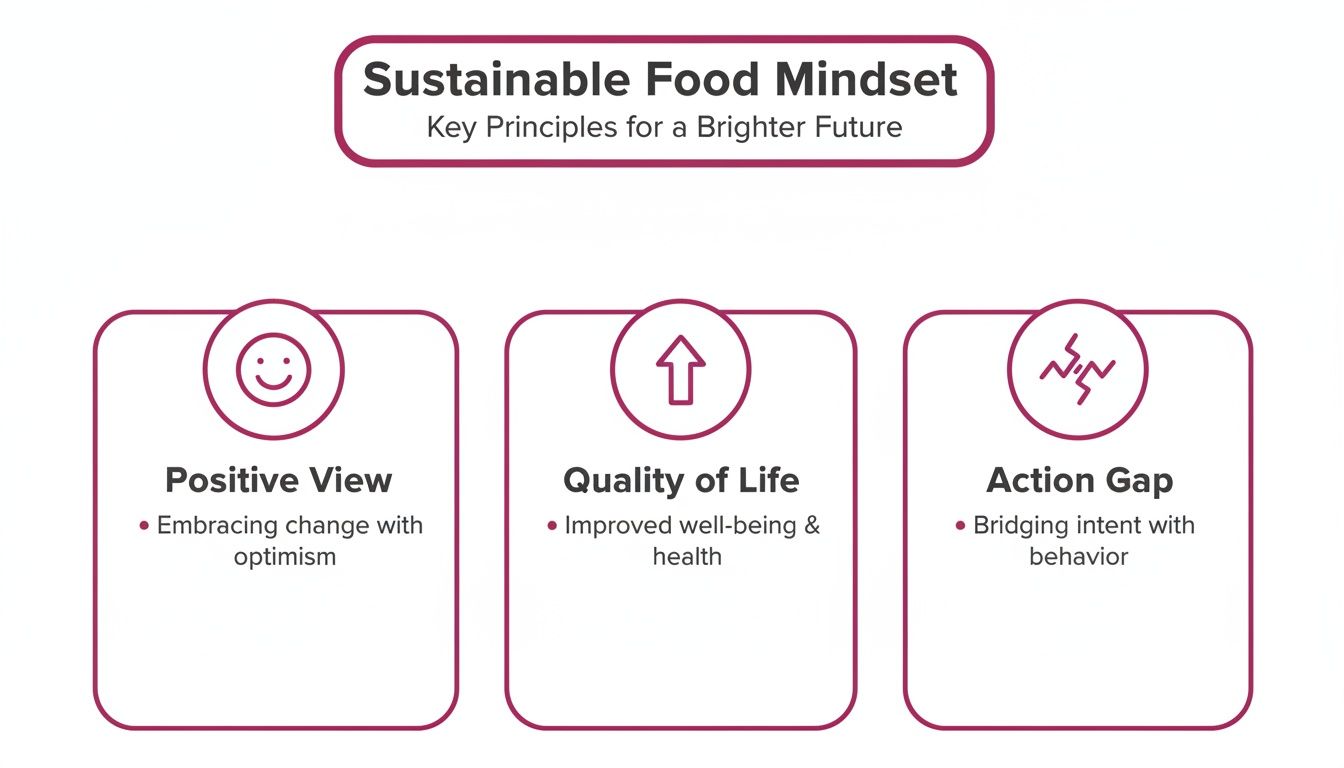
This "Action Gap" is where so many of us get stuck. It’s the space between our good intentions and our daily reality, and it's exactly what we're going to tackle throughout this guide.
Why Most Diets Fail You
The desire for healthier habits is nearly universal. According to the 2023 International Sustainable Food Barometer, a massive 75% of people have a positive view of sustainable food, and 60% believe it directly improves their quality of life.
But here’s the catch. While many of us are trying to cut food waste or buy local, the same study found a major gap: 56% of people believe their meals are already sustainable, even when meat and dairy are central to their diet. You can dive deeper into these insights by reading the full findings on the Sodexo sustainable food barometer.
This disconnect highlights exactly why traditional diets are set up to fail. They impose a set of one-size-fits-all rules that just don't mesh with the reality of our lives, leading to the inevitable rebound.
Sustainable habits, on the other hand, are built from the inside out. They start with understanding your unique body and lifestyle. By using tools like Superbloom to get personalized feedback on your patterns, you can finally close that gap between intention and action, turning your desire for better health into real, lasting change.
Setting Goals You’ll Actually Keep
So many of us have been there.We’ve all been there. You decide, “This is it. I’m going to eat healthier.” It feels great to say, but a week later, nothing has really changed. Why? Because a goal like “eat healthier” is a wish, not a plan. It’s too vague, with no clear starting line or next step.
To build eating habits that actually stick, we need to stop thinking about a distant, fuzzy outcome and start focusing on small, immediate actions. The real magic isn't in grand, sweeping changes; it’s in the tiny, repeatable things you do every single day that slowly reshape your normal.
Use “When-Then” Plans to Turn Intentions into Actions
A brilliant way to do this comes from a psychological concept called Implementation Intentions. It sounds a bit academic, but the idea is incredibly simple and practical. You create a “when-then” plan that links the new habit you want to build with something you already do.
It’s all about taking the decision-making out of the moment. You’re not waiting to feel motivated; you’re setting up a clear, automatic trigger for a new behavior.
Let’s see what this looks like in the real world:
Instead of: "I'll try to eat more protein."
Try: "When I pour my morning coffee, then I will add a scoop of collagen or protein powder."
Instead of: "I should snack healthier."
Try: "When I feel that 3 PM energy slump, then I will walk to the kitchen and grab a handful of almonds and an apple."
This simple formula—When [EXISTING CUE], then I will [NEW ACTION]—puts your new habit on autopilot. It makes it so much easier to follow through, day in and day out.
The trick is to give your goal a time and a place to live in your life. A vague intention doesn’t have an address, but a “when-then” plan has a specific home right in your daily schedule.
Before long, your new habit starts to feel as automatic as putting on your seatbelt. The mental effort it takes to make the "right" choice just fades away.
Master Habit Stacking to Build Effortless Momentum
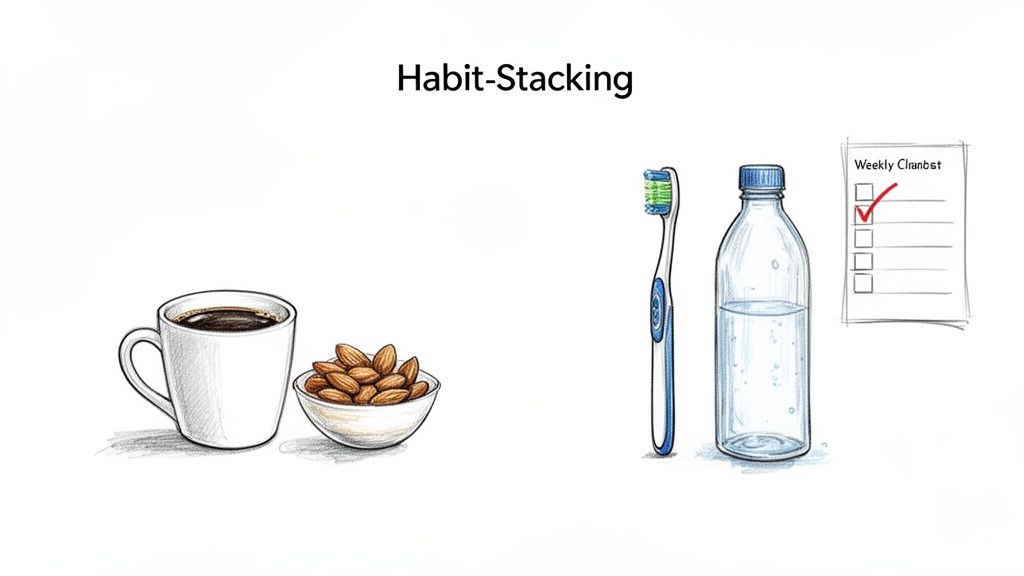
Once you’ve got one small change down, you can start building on that success using a technique called Habit Stacking. It’s exactly what it sounds like: you stack a new habit on top of one that’s already completely ingrained in your routine.
Think of it as creating a small chain reaction for your well-being. The end of one familiar task immediately kicks off the next one.
Here’s how you might use it:
Existing Habit: Brushing your teeth in the morning.
Habit Stack: "After I brush my teeth, I will immediately fill my large water bottle for the day."
Existing Habit: Arriving home from work and putting down your keys.
Habit Stack: "After I put my keys on the counter, I will immediately take a bag of frozen vegetables out of the freezer for dinner."
I once worked with a client, a busy professional, who used this exact method to transform her week. Her stack was: "After I unpack my groceries from my Sunday shopping trip, I will immediately spend 15 minutes washing and chopping vegetables for the week's snacks and lunches." That one tiny, stacked routine was a complete game-changer for her.
Why Small, Health-Focused Goals Really Work
This approach of focusing on small, actionable steps does more than just help you personally. It taps into a much larger trend. The 2021 Global Nutrition Report paints a picture of big challenges—for example, red meat consumption in some places is up to 8-9 times higher than sustainable levels.
But the report also shows where the hope is. It found that 39% of consumers were leaning into a flexitarian diet by 2023, mostly driven by personal health goals. This is powerful evidence that when we make small changes for our own well-being—like swapping one meat dish for a plant-based one each week—we also contribute to bigger, positive shifts. You can dive deeper into the global nutrition findings here.
This is why we start small and focus on a process we can actually control. The goal isn’t to be perfect overnight. It’s about celebrating consistency. Did you remember to pack your healthy snack three out of five days? That's a huge win. Did you successfully stack a new habit onto your morning routine? That’s real momentum. These are the small victories that build the foundation for truly sustainable, lifelong eating habits.
Building Your Plate Without a Calculator
Let's be honest, nobody wants to carry a food scale or log every single bite into an app for the rest of their lives. That’s not freedom, it's a chore. Real, sustainable eating is about building an instinct for what your body needs to feel its best—energized, satisfied, and clear-headed.
This is all about training your eye to see a nourishing meal, not just a pile of food. Forget the numbers. We're going to focus on a few simple, powerful principles that work whether you're at home, a work lunch, or your favorite restaurant. By keying in on specific food groups, you can build meals that balance your blood sugar, keep you full for hours, and support a happy gut.
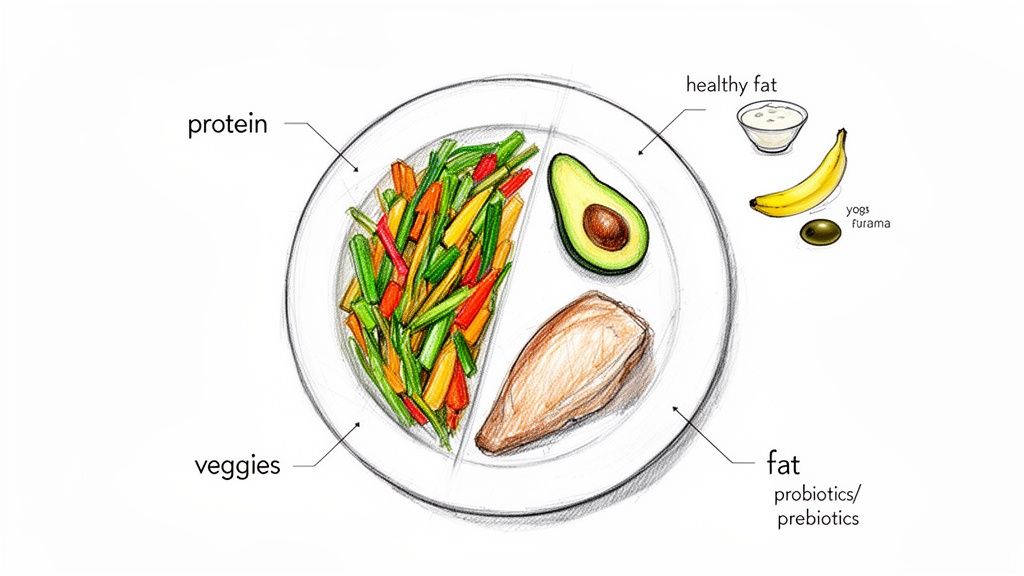
The cornerstone of this whole approach is what I call the PFF trifecta: Protein, Fiber, and Fat. When these three show up to the party together, they create a powerhouse combination for satiety and a slow, steady release of energy. This is your secret weapon against that 3 p.m. slump and the intense cravings that usually come with it.
The Power of Protein, Fiber, and Fat
Think of these three as a team. Each has its own job, but they work together to keep you feeling full and your energy stable. The best part? You don't need to measure a single gram. All you need are a few visual cues.
Let’s break down what to look for:
- Protein: This is what signals to your brain that you're full. It's the most satisfying macronutrient and it's essential for building and repairing everything in your body. A good rule of thumb is to aim for a portion about the size and thickness of your palm.
- Fiber: Found in veggies, fruits, and whole grains, fiber is the slow-burn hero. It slows down digestion, which keeps your blood sugar from spiking and crashing. An easy target is to fill half of your plate with colorful, non-starchy vegetables.
- Fat: Healthy fats are non-negotiable. They are critical for absorbing vitamins, producing hormones, and adding that rich, satisfying flavor to meals. Just a thumb-sized portion of avocado, nuts, seeds, or a drizzle of good olive oil is all you need.
This isn’t a rigid diet rule; it's a flexible template. A perfect example would be a palm-sized fillet of salmon (protein and fat), with half the plate piled high with roasted asparagus and bell peppers (fiber), and maybe a small scoop of quinoa on the side (more fiber and a bit of protein).
The real goal here is to train your eye. You want to get to a point where you can glance at a plate and instinctively know what’s missing. You stop asking, "How many calories is this?" and start asking, "Where's my protein? Got my fiber? Where's the healthy fat?"
That small shift in questioning changes everything. It moves your focus from restriction and deprivation to nourishment and abundance.
Nurturing Your Gut for Better Health
Once you've got the PFF trifecta down, there's another layer we can add to truly optimize how you feel: gut health. The health of your gut microbiome—that bustling community of trillions of bacteria in your digestive tract—is connected to nearly everything, from your digestion and immunity to your mood and mental clarity.
Don't worry, this isn't as complicated as it sounds. Supporting your gut really boils down to including two key players in your diet: probiotics and prebiotics.
- Probiotics: These are the "good guys"—live beneficial bacteria found in fermented foods that help keep your internal ecosystem in balance. Think kimchi, plain yogurt, kefir, and kombucha.
- Prebiotics: This is the food for your good gut bacteria. It's a type of fiber that we can't digest but that your microbiome thrives on. You'll find it in foods like garlic, onions, bananas, and oats.
Weaving these into your day is simple. A spoonful of plain Greek yogurt on your morning oats, a little sauerkraut with your lunch, or sipping on some kombucha in the afternoon are all easy wins. You're probably already eating prebiotic-rich foods without even realizing it.
By focusing on these visual, intuitive principles—building your plate with PFF and sprinkling in gut-friendly foods—you develop the skill to nourish yourself properly, anywhere, anytime. You become your own nutrition expert, all without a single calculation.
Navigating Emotional and Stress Eating
We've talked about setting goals and building a balanced plate, but let's be honest—even the most perfect plan can get thrown off course by one of the biggest challenges out there: the powerful link between our feelings and our food.
Whether it’s the pressure from a crazy workday, boredom on a quiet afternoon, or just feeling down after a tough day, our emotions can send us straight to the kitchen for comfort.
This isn’t a failure of willpower. Emotional eating is a deeply rooted coping mechanism, often a learned response that gives us a quick (but temporary) sense of relief. The first step to breaking this cycle isn't about restriction; it's about developing a kinder self-awareness. Figuring out why you’re reaching for food when you’re not physically hungry is the real key.
Truly sustainable eating habits require us to look past the food itself and get curious about what’s driving our behavior.
Identify Your Personal Triggers
Think of yourself as a detective in your own life. Start by just noticing the patterns. Does a stressful email from your boss immediately make you crave something salty and crunchy? Does that lonely feeling in the evening have you searching for something sweet?
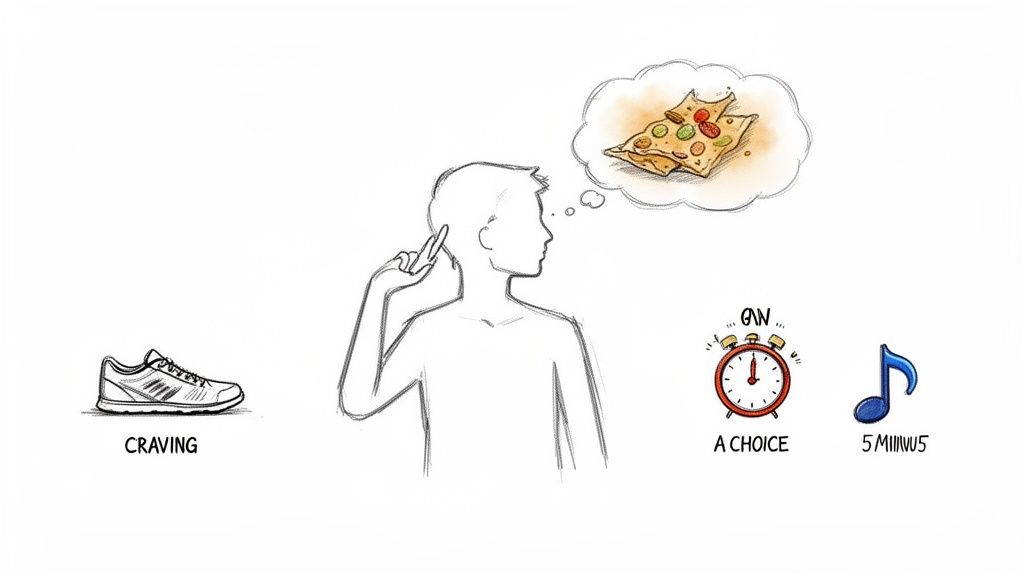
The next time you feel a sudden, intense craving, just pause for a second. Ask yourself: "What am I really feeling right now?"
Here are some of the most common emotional triggers I see:
- Stress: That pesky stress hormone, cortisol, can ramp up your appetite and make you crave high-fat, high-sugar foods.
- Boredom: When your mind isn't engaged, food can feel like a quick and easy form of entertainment.
- Sadness or Loneliness: Comfort foods often bring up a sense of nostalgia or soothe us, acting as a temporary stand-in for connection.
- Procrastination: Sometimes, grabbing a snack is really just a way to put off a task you’re dreading.
The moment you can name the emotion, you create a tiny bit of space. That small gap between the feeling and the action is where you find the power to make a different choice.
The goal isn't to stop having cravings. It's to understand what they're telling you and to respond with intention instead of reaction.
This is where real, lasting change begins. Instead of mindlessly eating, you can start to address what you’re actually feeling.
Build a Toolkit of Non-Food Coping Mechanisms
Once you know what’s triggering you, you need a new game plan. If food is the only tool in your toolbox for dealing with stress, you’ll always reach for it. The solution is to build a whole new toolkit filled with non-food strategies that actually address the underlying emotion.
This takes a little bit of experimentation. What works for a friend might not be your thing. The key is finding activities that give you genuine relief or a welcome distraction.
Here are a few ideas to get you started:
- If you're stressed: Try a brisk five-minute walk outside, put on a calming song, or do a few simple stretches at your desk.
- If you're bored: Call a friend for a quick chat, listen to an engaging podcast, or spend ten minutes on a hobby you love.
- If you're sad: Journal your feelings, wrap yourself in a cozy blanket with a cup of herbal tea, or watch a funny video that always makes you laugh.
If you find that navigating emotional eating feels overwhelming, exploring professional guidance and various counselling options can be an incredibly brave and helpful step.
Ultimately, this is about shifting your focus. It's interesting to see this trend reflected on a larger scale, too. Globally, 39% of consumers cut back on animal protein between 2022 and 2023, with health being a major motivator.
For those of us wrestling with emotional eating, getting personalized, psychology-backed insights can make all the difference. Sometimes, a gentle nudge to swap a stress-induced snack for some fiber-rich seasonal fruit helps you connect the dots between your feelings and a healthier choice. This simple shift helps you focus on overall wellness, not just on food.
Finding Your Rhythm with Daily and Weekly Routines
Building eating habits that actually stick isn't about grand, sweeping changes. It’s about the quiet rhythm you build into your everyday life. The real, lasting change comes from the small, deliberate actions you weave into your days and weeks. Forget about being perfect; the aim is to create a personal system where healthier choices become second nature.
This is where routines come in. I’m not talking about rigid, unforgiving schedules, but flexible frameworks that cut down on decision fatigue. They make the healthy choice the easy choice. It all begins with a simple, powerful moment of connection with yourself each day.
The Two-Minute Daily Check-In
Imagine closing out your day not with a mental tally of everything you did “wrong,” but with a moment of genuine curiosity. That’s the entire idea behind a two-minute daily check-in. It’s not just another task for your to-do list; it’s a dedicated pause to reflect and learn from your own experiences.
Think of this practice as your personal pattern detector. By consistently asking yourself a few key questions, you’ll start to see the connections between what you eat and how you actually feel—your energy levels, your mood, your ability to focus.
To get started, just pick one or two of these questions each evening. You can mull them over in your head, but it’s even more powerful to jot your thoughts down in a notebook or use an app like Superbloom to track your reflections.
- Which food today made me feel the most energized?
- Did I have a strong craving at some point? What was going on at that moment?
- Which of my new habits felt easiest to do today?
- How did my meals affect my focus this afternoon?
This simple act of reflection is what turns a single day’s actions into long-term learning. You're creating a feedback loop that makes your next choice just a little bit easier and a whole lot more informed.
A daily check-in isn't about judgment; it's about data collection. You're simply gathering information on what works for your body, empowering you to make better choices tomorrow.
This daily habit feeds perfectly into a broader, more strategic weekly review. That’s when you zoom out, look at the bigger picture, and plan your next week with intention.
Planning Your Week with Flexibility and Self-Compassion
Your weekly routine is where you set the stage for success. Now, this doesn't mean you have to plan every single meal and snack for the next seven days down to the last olive. That kind of rigidity often backfires. Instead, focus on building a flexible plan that supports your sustainable eating habits.
A great place to start is with simple food prep—and no, I don't mean spending your entire Sunday stuck in the kitchen. I’m a huge fan of "component prepping," which is just making a few key ingredients you can mix and match all week long.
A Simple Weekend Prep Routine
- Roast a big tray of seasonal vegetables: Think broccoli, bell peppers, and sweet potatoes tossed in olive oil and your favorite spices.
- Cook a batch of a versatile grain: Quinoa, brown rice, or farro are perfect bases for salads and grain bowls.
- Prep one or two proteins: Grill a few chicken breasts, hard-boil half a dozen eggs, or simply rinse and drain a couple of cans of chickpeas.
- Wash and chop fresh greens: Having a container of ready-to-go spinach or mixed lettuce makes adding fiber to any meal completely effortless.
With these building blocks ready, pulling together a nourishing meal takes minutes, not an hour. This approach is also a fantastic way to cut down on food waste, since you’re more likely to use what you’ve already prepared. For more great ideas on running an eco-friendly kitchen, check out these practical tips on how to reduce food waste at home.
Just as important as the planning is the reflection. Set aside 10 minutes to look back on your week and ask yourself:
- Where did I struggle this week, and what can I learn from it?
- What was my biggest win, and how can I set myself up to do it again?
Most importantly, be kind to yourself. If you had an "off" day, that’s all it was—one day. It is not a failure. True sustainability is about your ability to get back on track without guilt, using what you’ve learned to make the next day just a little bit better.
Your Questions About Sustainable Eating Answered
As you start putting these ideas into practice, you're bound to have questions. That’s a great thing! It means you're actually doing the work and moving from abstract concepts to real-life situations.
Let's walk through some of the most common questions I hear from people, breaking them down with practical answers that all come back to our core ideas: be flexible, stay aware, and choose progress over perfection every time.
How Can I Eat Sustainably on a Tight Budget?
This is a huge one, but the good news is that eating well and saving money often go hand in hand. The most impactful thing you can do right away is to drastically reduce your food waste. It might sound simple, but think about it: every bit of food that goes bad is money literally thrown in the trash. Studies even show that wasted food is responsible for about 8% of global emissions.
Start by getting into the habit of shopping with a list and having a loose plan for your meals. This alone will stop those impulse buys that end up forgotten in the back of the fridge.
Once you have that down, you can add in a few other powerful strategies:
- Buy what's in season: Fruits and vegetables are always cheaper and more nutritious when they're at their peak. A pint of local strawberries in June is going to be a much better deal (and taste better) than one shipped from across the world in December.
- Embrace plant proteins: Lentils, beans, chickpeas, and tofu are incredibly affordable sources of high-quality protein and fiber. Swapping just a few meat-based meals a week can make a noticeable dent in your grocery bill.
- Shop the bulk bins: Pantry staples like oats, rice, and dried beans are almost always cheaper when you can buy the exact amount you need from a bulk section.
By weaving these tactics together, you'll quickly see that building sustainable eating habits is as good for your wallet as it is for your health.
I Am a Picky Eater How Do I Even Start?
When you only enjoy a handful of foods, the idea of changing your diet can feel completely overwhelming. The key is to start small—so small that it feels almost silly. Don't even think about a total diet overhaul.
Instead, let's begin with what you already like and build from there. This is a far more successful approach than trying to force-feed yourself kale if you can't stand it.
The goal is to gently expand your palate, not shock it into submission. Progress, no matter how small, is still progress.
A great technique I've seen work wonders is "food chaining." You simply introduce a new food by linking it to a familiar favorite. For example, if you love pasta with butter, maybe you mix a single tablespoon of pureed butternut squash into the sauce. If you’re a big fan of chicken nuggets, try one plant-based nugget alongside your usual ones.
Another gentle method is to add just one new thing each week. If you like carrots, maybe try purple carrots, or eat them roasted instead of raw. This is all about celebrating small, consistent wins, not chasing an imaginary finish line.
What if I Have No Time to Cook Every Day?
Welcome to the club! This is a reality for almost everyone I work with. The myth that you need to cook a complex meal from scratch every night is what holds so many people back. The point of sustainable eating is to be resourceful, not to become a part-time chef.
I highly recommend embracing what I call "component prepping." Instead of making five complete, separate meals for the week, just spend an hour on the weekend prepping a few versatile ingredients.
Simple Component Prep Ideas
- Cook a large batch of a grain like quinoa or brown rice.
- Roast a big tray of mixed vegetables (whatever you enjoy).
- Prepare a simple protein, like grilling some chicken or hard-boiling a dozen eggs.
With these building blocks waiting in your fridge, you can throw together a balanced, satisfying meal in less than five minutes. Think a quinoa bowl with roasted veggies and chicken. And this mindset works for takeout, too. Just apply the Protein, Fiber, and Fat principle. A chicken shawarma salad or a burrito bowl can be a fantastic, well-rounded meal when you know what to look for.
How Long Does It Really Take to Build a New Habit?
Ah, the million-dollar question. The honest answer is: it depends. Behavioral science research shows that the time it takes for a new action to feel automatic can be anywhere from a few weeks to several months. It really hinges on the complexity of the habit and, most importantly, how consistent you are.
But what matters more than the timeline is your mindset. Focus on being consistent, not on how fast you're going. I often encourage clients to just aim for one week of consistency. That's it. Then, we celebrate that win and go for another week.
The feeling of "automaticity" will sneak up on you. One day, you'll just find yourself filling your water bottle without a second thought. It's these small, repeated actions that compound over time, creating a foundation for habits that truly last.
Ready to turn awareness into action? Superbloom is your personal AI nutrition coach, designed to help you build sustainable habits without the stress of calorie counting. Through simple daily check-ins and personalized feedback, the app helps you understand your patterns and make healthier choices that stick. Start your journey to lasting health change at superbloomapp.com.