
Tired Always Hungry: Causes and Quick Fixes (tired always hungry)
That feeling of being simultaneously exhausted and ravenous isn't just in your head. It’s a real biological loop where being tired makes you crave food, and the food choices you make can leave you even more tired.
This frustrating cycle often points to something deeper than just needing an extra hour of sleep or a bigger lunch. It could be unstable blood sugar, hormonal static, or hidden nutrient deficiencies that leave your body screaming for energy it can't properly access.
The Vicious Cycle of Fatigue and Hunger
Ever feel like you’re running on empty, no matter how much you eat? It’s like putting low-grade fuel in a high-performance car. It sputters, it stalls, and the "low fuel" light stays on, even after you've just filled the tank. That’s a perfect picture of what it’s like to be stuck in the fatigue-hunger cycle.
This isn't about a lack of willpower; it’s a biological cascade. When your internal systems are out of whack, your body sends out powerful SOS signals—crippling fatigue and relentless hunger—in a desperate attempt to get the resources it needs to function.
Key Drivers of the Cycle
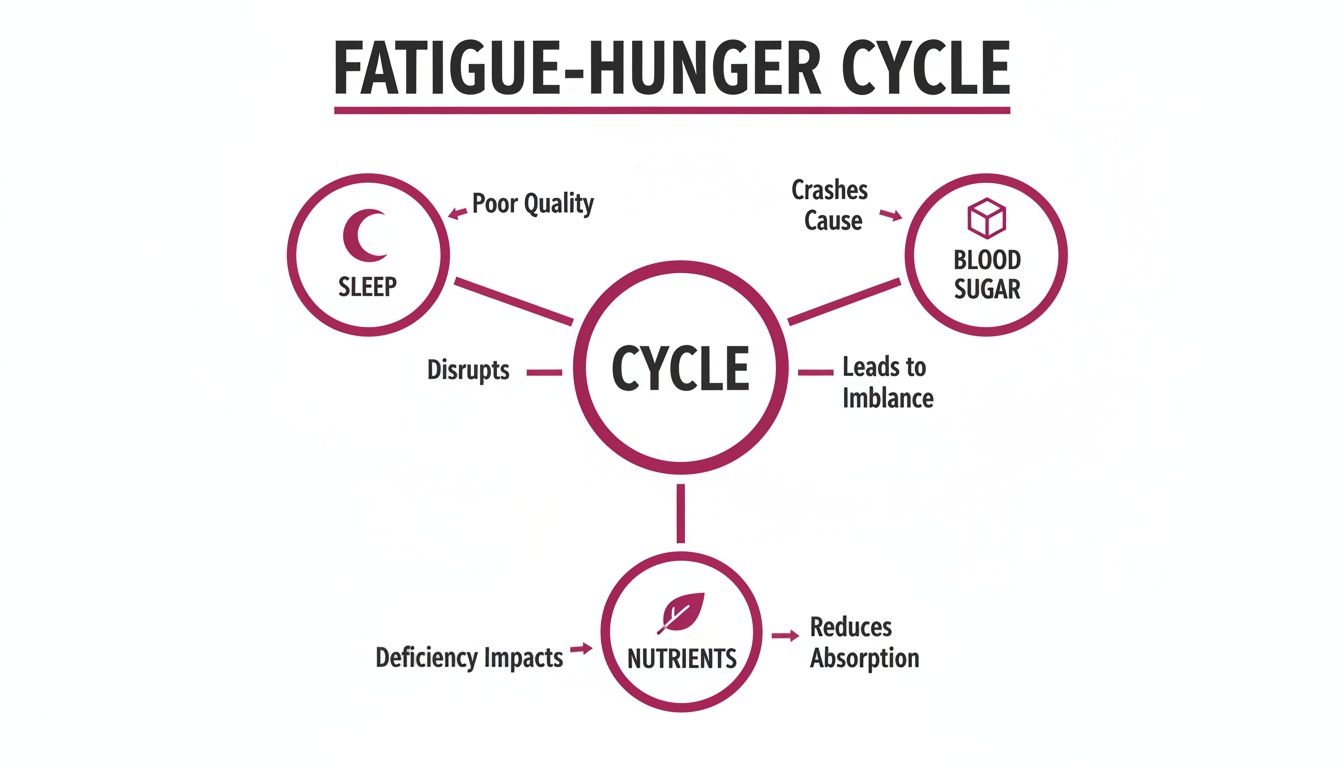
So, what’s really pulling the strings behind this draining cycle? It usually comes down to three interconnected culprits that feed off each other.
- Poor Sleep: Skimping on sleep throws your appetite-regulating hormones into chaos. It causes levels of leptin (the hormone that says, "I'm full") to drop while cranking up ghrelin (the "feed me now" hormone). The result? You're left craving high-calorie, quick-energy foods while feeling too drained to make a better choice.
- Blood Sugar Rollercoasters: When you eat meals loaded with refined carbs and sugar, you get a massive blood sugar spike followed by an equally dramatic crash. That crash is what leaves you feeling completely wiped out and triggers intense cravings for more sugar to get your energy back up. And so the cycle continues.
- Nutrient Gaps: It's entirely possible to be overfed but undernourished. If you're low on key players like iron, magnesium, or B vitamins, your body can't efficiently convert the food you eat into usable energy. This leads to profound fatigue and a constant, nagging hunger as your body keeps asking for the raw materials it’s missing.
To help you connect the dots, here’s a quick overview of how these common issues manifest.
Quick Guide to Common Causes of Fatigue and Hunger
.tbl-scroll{contain:inline-size;overflow-x:auto;-webkit-overflow-scrolling:touch}.tbl-scroll table{min-width:600px;width:100%;border-collapse:collapse;margin-bottom:20px}.tbl-scroll th{border:1px solid #ddd;padding:8px;text-align:left;background-color:#f2f2f2;white-space:nowrap}.tbl-scroll td{border:1px solid #ddd;padding:8px;text-align:left}Symptom DriverHow It Causes FatigueHow It Causes HungerPoor SleepDisrupts cellular repair and brain function, leading to physical and mental exhaustion.Decreases leptin (satiety) and increases ghrelin (hunger), driving cravings for high-calorie foods.Blood Sugar ImbalanceThe "crash" after a sugar spike leaves you feeling drained, lethargic, and foggy.Low blood sugar triggers urgent hunger signals as the body seeks a quick energy source.Nutrient DeficienciesLack of key micronutrients (like iron or B12) impairs energy production at a cellular level.The body signals for more food in an attempt to get the specific nutrients it's missing.DehydrationReduces blood volume, forcing the heart to work harder and leading to feelings of sluggishness.The brain often mistakes thirst signals for hunger, leading to unnecessary snacking.Hormonal ImbalancesIssues with thyroid, cortisol, or insulin can disrupt metabolism and energy regulation.Hormones like cortisol can increase appetite and cravings, particularly for "comfort foods."Mental Health StrainChronic stress and depression can cause emotional and physical exhaustion.Can lead to "emotional eating" or cause physiological changes in appetite-regulating hormones.
Breaking this cycle requires a targeted approach that addresses the root cause, not just the symptoms.
This is a microcosm of a much larger global problem. In 2023, an estimated 733 million people faced hunger worldwide, a stark reminder of how essential proper nourishment is for basic energy and well-being. You can explore the full WHO report on global hunger statistics to learn more.
Decoding Your Body's Hunger and Energy Signals
If you're constantly fighting off fatigue while also dealing with a nagging hunger that never seems to go away, your body isn't broken. It's actually trying to tell you something important, sending out urgent signals that something is out of balance. Most of the time, this frustrating loop comes down to two main culprits: unstable blood sugar and a breakdown in hormonal communication.
Let's start by thinking about your energy like a campfire. When you eat something high in refined carbs or sugar—say, a morning pastry or a syrupy latte—it's like tossing a piece of paper onto the flames. You get a big, bright flare-up for a moment (that's your blood sugar spike), but it vanishes almost instantly. You're left with ash and a desperate need for more fuel.
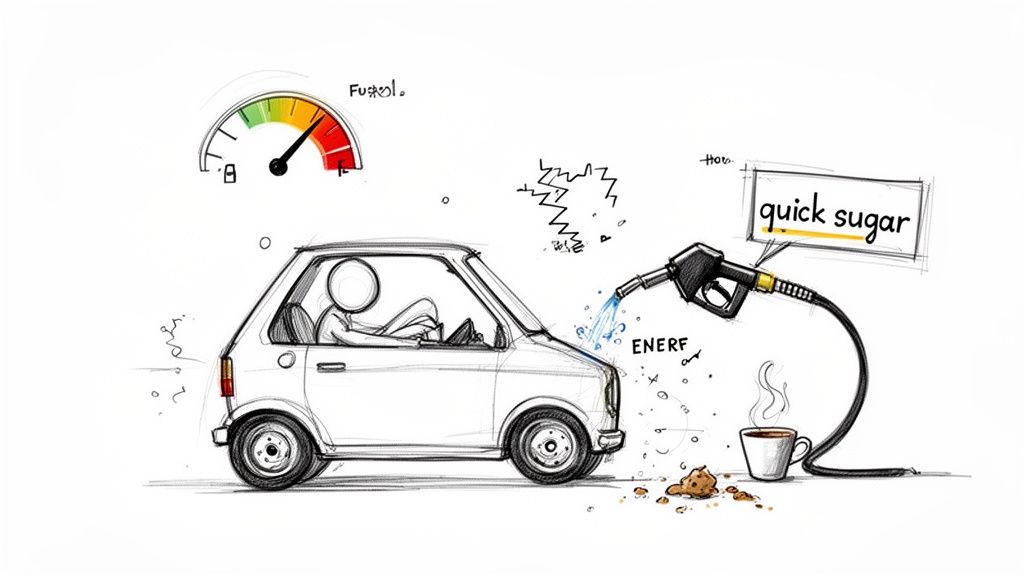
This is the classic blood sugar rollercoaster. After that initial spike, your blood sugar plummets, and your body hits the panic button. It reads this "crash" as a full-blown energy crisis, which is why you suddenly feel exhausted, irritable, and even hungrier than you were before. Your brain starts screaming for another quick fix, and the cycle begins all over again.
The Hormonal Conversation Gone Wrong
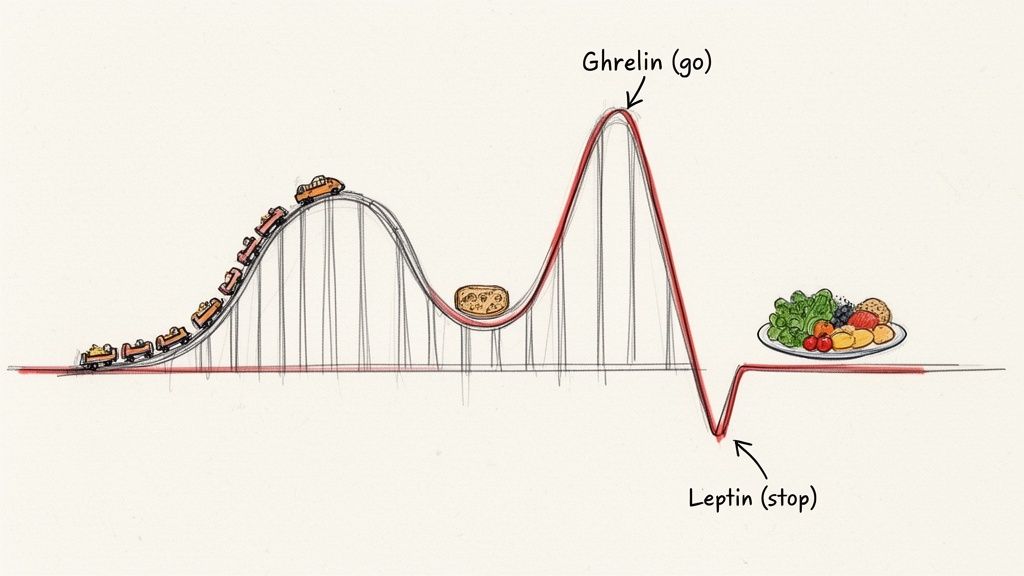
This rollercoaster doesn't just mess with your energy levels; it completely scrambles the delicate conversation happening between your key hunger hormones. Think of these hormones as the traffic signals for your appetite.
- Ghrelin: This is your body's green light. It’s often called the "hunger hormone" because its main job is to signal your brain that it's time to eat.
- Leptin: This is the red light. Leptin is released from your fat cells to tell your brain, "Okay, we're full now, you can stop."
When everything is working correctly, these two are in perfect sync. But things like poor sleep, chronic stress, and those wild blood sugar swings can throw the whole system into chaos. In fact, just one night of bad sleep can cause ghrelin levels to shoot up while suppressing leptin, making you feel ravenous the next day no matter what you eat.
When your hormonal signals get crossed, your body can get stuck in a perceived "starvation mode," even if you've eaten plenty of food. Your brain isn't getting the "I'm full" memo from leptin, so the "feed me" alarm from ghrelin just keeps blaring. This is what drives that vicious cycle of feeling tired and always hungry.
This isn't just a personal battle; it's a reflection of a much larger pattern of nutritional stress. Globally, acute food insecurity is surging, affecting over 258 million people in 2022—a staggering 34% increase from the year before. For those of us struggling with stress-eating, this statistic hits home. It highlights just how critical it is to understand our body's signals to break reactive cycles. You can find more information on this in the 2023 Global Report on Food Crises.
Realizing that your symptoms are rooted in these physiological processes—the blood sugar crashes and the hormonal static—is incredibly empowering. It reframes the problem. This isn't a failure of willpower; it's a matter of rebalancing your body's core systems. Once you understand the "why," you can finally start to work on the "how" and get off this exhausting ride for good.
Uncovering Hidden Stressors Like Nutrient Gaps
Sometimes, that constant "tired and hungry" feeling has nothing to do with the usual suspects like sleep or blood sugar. The real culprits can be more subtle, working behind the scenes. We're talking about hidden stressors like micronutrient deficiencies and an out-of-whack gut. You might feel like you're eating plenty, but your body could still be starving for the actual tools it needs to create energy.
It’s a classic case of being overfed yet undernourished. You’re getting calories, sure, but you're missing the specific vitamins and minerals that your internal power plants—the mitochondria—need to run properly.
Think of it like trying to build a house. Calories are the piles of lumber, but micronutrients are the nails, hammers, and saws. You can have all the wood in the world, but without the right tools, you can't build a thing. The project just stalls. It's the same in your body; without key nutrients, you can't efficiently convert food into usable energy. This leaves you feeling exhausted and, ironically, craving more food as your body desperately searches for those missing pieces.
The Role of Key Micronutrients
A few specific deficiencies are notorious for triggering both fatigue and hunger. These tiny nutrients pack a huge punch when it comes to how you feel day-to-day.
- Iron: This mineral is the star player in hemoglobin, the protein that carries oxygen from your lungs to every cell in your body. When iron is low, oxygen delivery plummets. The result is a deep, profound fatigue, weakness, and sometimes even strange cravings for non-food items (a condition called pica).
- B Vitamins: The whole B-vitamin family, but especially B12, is critical for converting the food you eat into glucose—your body's primary fuel source. A shortage can throw a wrench directly into your energy metabolism, leaving you feeling sluggish and mentally foggy.
- Magnesium: This is a true workhorse. It’s involved in over 300 biochemical reactions in your body, playing a foundational role in energy production, muscle function, and even blood sugar regulation. When levels are low, all of these processes can suffer, leading to both fatigue and intense sugar cravings.
It’s a frustrating cycle. Your body sends out strong hunger signals asking for more fuel, but it doesn't have the specific micronutrients needed to actually light the fire. So you eat, but the underlying energy problem never gets solved.
How Gut Health Impacts Your Energy
Beyond individual nutrients, the health of your gut microbiome is a huge piece of the puzzle. Your gut is home to trillions of bacteria that do essential work: they break down food, help you absorb nutrients, and even produce certain vitamins for you.
When this delicate ecosystem gets knocked off balance—a state called dysbiosis—problems start to crop up. The bad bacteria can start to outnumber the good guys, leading to chronic inflammation that constantly drains your energy.
What’s more, an unhealthy gut can’t properly absorb the very nutrients you need to fight fatigue. You could be eating a perfectly iron-rich diet, but if your gut isn't absorbing that iron effectively, you'll end up deficient anyway. This is often why people who eat "healthy" can still feel completely wiped out and hungry. Your gut is the foundation for everything.
How to Eat to Reclaim Your Energy
Alright, we've unpacked the science behind why you're feeling both wiped out and ravenous. Now for the practical part: turning that knowledge into a game plan for your plate. This isn't about another restrictive diet. It’s about eating smarter to build meals that deliver steady, long-lasting energy and keep you feeling genuinely full for hours.
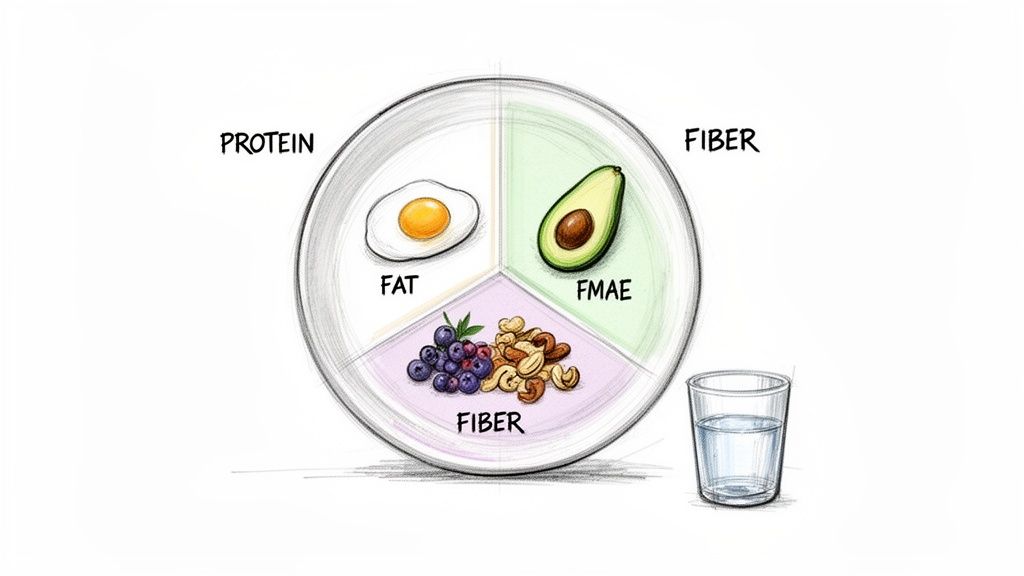
The secret weapon here is what I call the PFF principle: making sure you have Protein, healthy Fat, and Fiber in every meal. This trio is your ticket to stable blood sugar. They work together to slow down digestion, which prevents those dramatic energy spikes and the inevitable crashes that leave you drained and hunting for your next sugar hit. Think of PFF as the foundation for your daily energy.
Build a Better Breakfast
Your morning meal sets the stage for the rest of the day. If you start with something full of refined carbs, like a plain bagel or a sugary cereal, you're pretty much guaranteed to hit an energy wall by 10 AM. It’s a fast track to a slump.
Instead, kick things off with a PFF-powered breakfast.
- Protein Power: Protein is the king of satiety—it’s what makes you feel full. Think eggs, Greek yogurt, or a scoop of a good-quality protein powder in a smoothie.
- Healthy Fats: Fats are crucial because they slow down how quickly your stomach empties. That means you stay satisfied for much longer. Avocado, a handful of nuts, or a spoonful of seeds are perfect.
- Fiber First: Fiber adds bulk to your meal and is another all-star for stabilizing blood sugar. Berries, chia seeds, and whole grains like steel-cut oats are fantastic sources.
Just imagine the difference: swapping a plain bagel with cream cheese for two scrambled eggs with half an avocado and a side of berries can completely redirect your energy for the entire day.
Reimagining Lunch and Dinner
The PFF principle isn't just for breakfast; it's the framework for lunch and dinner, too. The goal is always to build a plate that nourishes you and prevents that dreaded afternoon slump or those late-night cravings.
So instead of a simple bowl of pasta, picture this: a base of quinoa (which has both protein and fiber) topped with grilled chicken (more protein), a pile of roasted vegetables (fiber!), and finished with a drizzle of olive oil and some crumbled feta (healthy fats). That kind of meal gives you a slow, steady release of energy, keeping you sharp and productive all afternoon.
Building a balanced plate is really about adding, not subtracting. Just focus on weaving a source of protein, a healthy fat, and a ton of fiber into the meals you're already making. It’s a small shift that makes a world of difference for hunger and fatigue.
This way of eating is also incredibly effective for breaking the cycle of emotional or stress eating. That constant feeling of being tired and hungry isn't just in your head; it’s a personal struggle that echoes a much larger global challenge. In 2024, 8.2% of the world's population faced hunger, a stark reminder of the feedback loops that can drive our behaviors. By making intentional, nourishing choices, you're not just feeding your body—you're building resilience. You can learn more about this on a global scale from the World Food Programme's reporting on global hunger trends.
The Critical Role of Hydration
Last but not least, let's talk about water. It’s so simple we often forget it, but dehydration is one of the most common culprits behind fatigue. When you're even mildly dehydrated, your blood literally thickens. This forces your heart to pump harder, which is a massive drain on your energy.
What’s more, our brains often get their wires crossed and mistake thirst for hunger. It happens all the time. Before you grab a snack, try this: drink a full glass of water and wait 15 minutes. You might be shocked to discover your "hunger" vanishes. Keeping a water bottle within arm's reach is easily one of the most powerful habits you can build to get your energy back.
Lifestyle Habits That Restore and Replenish
Fixing what’s on your plate is a huge first step, but it’s only one piece of the puzzle. To really break the cycle of being tired and hungry all the time, we need to look at the foundational lifestyle habits that run the show behind the scenes—the ones governing your hormones and energy.
Think of your body like a battery. Good food helps charge it, for sure. But poor sleep, constant stress, and the wrong kind of movement can drain that battery faster than you can ever hope to fill it. You can eat the most perfect diet in the world, but you’ll still feel stuck if these other areas are out of whack.
Prioritize Quality Sleep
Sleep is absolutely non-negotiable for hormonal balance. It's that simple. Even just one night of bad sleep can cause cortisol, your body's main stress hormone, to go haywire. That same night of tossing and turning also ramps up ghrelin (the "I'm hungry" hormone) while shutting down leptin (the "I'm full" hormone), creating a perfect storm for brain fog and intense cravings the next day.
Dialing in your sleep hygiene is one of the most powerful things you can do for your energy.
- Stick to a Schedule: Try to go to bed and wake up around the same time every day, even on weekends. This simple act helps anchor your body's internal clock, or circadian rhythm.
- Create a Sanctuary: Your bedroom should be dark, cool, and quiet. If you haven't already, invest in some blackout curtains or a white noise machine. They can be game-changers.
- Build a Wind-Down Routine: Give yourself 30-60 minutes before bed to signal to your body that it's time to rest. Step away from the screens, as their blue light messes with melatonin production. Pick up a real book, do some gentle stretching, or take a warm bath.
Manage Your Daily Stress
When you're chronically stressed, your body is stuck in "fight or flight" mode, and that is incredibly draining. High cortisol doesn't just make you feel wiped out; it also actively drives cravings for those high-sugar, high-fat comfort foods.
Stress management isn't about getting rid of stress—that's impossible. It's about building resilience and giving your nervous system a chance to come back down to "rest and digest."
Small, consistent practices can work wonders here by lowering cortisol and calming that fatigue-hunger feedback loop. A quick 10-minute walk outside can do more to regulate your nervous system than you might think. Even just pausing to focus on your breath for two minutes can interrupt a stress spiral. Many people also find that journaling before bed helps to offload the day's worries so they don't follow you into your sleep.
To truly get your energy back and quiet those constant hunger pangs, you have to look at these core lifestyle habits. Getting a handle on your hydration, nutrition, exercise, and sleep is key. For a deeper dive, check out these top tips on hydration, nutrition, exercise, and sleep.
Finally, think about moving mindfully. If you’re already exhausted, pushing through a high-intensity workout can sometimes dig you into a deeper hole by adding more stress. Gentle activities like yoga, walking, or tai chi can actually boost your energy without completely depleting your reserves.
Putting It All Together One Step at a Time
Knowing the science behind why you feel so tired and hungry is one thing. Actually *doing* something about it? That can feel like a whole different mountain to climb.
The secret isn’t to blow up your entire life overnight. It’s about becoming a detective for your own body and taking small, intentional steps that add up to real change. This process starts with gentle curiosity, not a long list of rigid rules.
Think about it: which specific foods give you steady energy, and which ones send you crashing an hour later? When that ravenous hunger hits, is it true physical hunger, or could it be boredom, stress, or sadness wearing a clever disguise?
From Awareness to Action
Once you start paying attention, you can shift from just reacting to your symptoms to responding with solutions that actually work for you. Each small adjustment is a win, and those wins build momentum.
- Start with Just One Meal: Don't try to fix every single meal from day one. For the next week, focus only on building a PFF-balanced breakfast. Just observe how that single change affects your energy and cravings for the rest of the day.
- Observe Without Judgment: If you find yourself reaching for that 3 p.m. cookie, just notice it. Pause and ask yourself, "What am I really feeling right now?" That tiny pause creates the space you need to make a more conscious choice.
- Link Habits Together: Try "habit stacking." Attach a new, desired habit to one you already do without thinking. For instance, after you pour your morning coffee, make it a rule to drink a full glass of water. Pairing them together makes the new habit feel almost automatic.
The real goal here is to move from a mindset of restriction to one of nourishment. You’re not just trying to silence your hunger—you're fueling your energy, stabilizing your mood, and helping your body find its balance again.
This is where a tool like an AI nutrition coach can be incredibly helpful. An app like Superbloom acts as your personal detective's assistant. It lets you log your food and track how you feel, then helps you connect the dots between your habits and your symptoms. It shows you where you're making progress, turning those small steps into visible, motivating results.
Getting back in control isn’t about a perfect diet or a flawless lifestyle. It's about learning to listen to your body’s signals and responding with care, one compassionate choice at a time. You have everything you need to turn this newfound awareness into sustainable habits that bring your energy back.
Frequently Asked Questions
It’s completely normal to have questions as you start untangling the connection between your energy, hunger, and daily habits. Here are some straightforward answers to the questions we hear most often.
How Long Will It Take to Feel Better After Changing My Diet?
Everyone’s timeline is a little different, but you’ll likely feel the first positive shifts pretty quickly. Many people notice their energy and hunger starting to even out within the first one to two weeks. That initial boost usually comes from getting your blood sugar on a more stable, even keel.
For more deep-seated, lasting change, give it about a month. That’s a realistic timeframe for your body to fully adapt and for key hunger hormones like ghrelin and leptin to recalibrate to your new, more nourishing routine.
I Already Eat Healthy, So Why Am I Still So Tired?
This is an incredibly common and frustrating situation. You might be eating all the "right" foods, but if your meals aren't properly balanced with protein, healthy fats, and fiber, you can still experience those sneaky energy dips from subtle blood sugar swings.
But it’s not always just about the food on your plate. Other factors could be at play, even with a great diet:
- Hidden nutrient gaps: You could be low in key nutrients like iron or vitamin B12, which are crucial for energy production.
- Gut health issues: An unhappy gut can struggle to absorb all the goodness from the food you’re eating.
- Chronic stress: Persistently high cortisol levels can leave you feeling completely drained, no matter what you eat.
- Poor sleep: If you’re not getting enough quality rest, no diet in the world can make up for it.
When Is It Time to See a Doctor?
Listen to your body. If your fatigue feels debilitating, appeared out of nowhere, or isn't getting better after making consistent lifestyle changes, it’s time to book an appointment with your doctor. It's also important to pay attention to any other symptoms that are tagging along.
Crucial Red Flags: Don’t ignore things like unexplained weight loss or gain, constant dizziness, extreme thirst, or sudden changes in your mood or vision. These can be signs of underlying conditions like thyroid problems, anemia, or diabetes that need a proper medical diagnosis to be managed effectively.
Ready to stop guessing and start understanding what your body is trying to tell you? Superbloom is an AI nutrition coach that helps you connect the dots between your meals, mood, and energy. It gives you personalized insights to build healthier habits that stick, one small step at a time. Start your journey with Superbloom today!