
What Are Negative Calorie Foods? The Myth and The Reality

A lot of diet advice about what are negative calorie foods starts with a promise that sounds almost magical. Eat celery, lettuce, cucumbers, or other watery vegetables, and your body will burn more calories digesting them than the food contains.
That idea is popular because it offers an easy shortcut. No tracking. No planning. Just a list of “free” foods that supposedly create fat loss on their own.
The problem is simple. Negative calorie foods aren’t real. Scientific sources are clear that foods don’t require more energy to digest than they provide, and Tufts University Nutrition Letter states that “there is no such thing as a negative-calorie food” in its discussion of the myth of negative calorie foods (https://www.nutritionletter.tufts.edu/general-nutrition/myth-of-the-month-negative-calorie-foods/).
That doesn’t mean these foods are useless. Far from it.
Low-calorie, high-water, high-fiber foods can be some of the most helpful foods for appetite, meal satisfaction, and long-term weight management. The win just isn’t a secret calorie-burning trick. It’s that these foods help you build meals that feel generous, filling, and easier to repeat.
There’s also another issue that gets less attention. People often use so-called negative calorie foods in ways that backfire. A side salad can make a heavy meal feel lighter than it is. A plate with celery sticks can make someone feel like they’re “being good” while overlooking the rest of the meal. That mental shortcut matters.
Science becomes more useful than diet mythology. Once you understand what these foods do, you can stop chasing gimmicks and start using them in a way that works in real life.
The Appealing Idea of Foods That Burn Fat
The myth makes emotional sense before it makes scientific sense.
If you’ve ever felt tired of dieting, the idea is attractive. You hear that certain foods are so light and fibrous that your body has to work harder to process them than the food gives back. It sounds like a loophole in the system.
Why the myth spreads so easily
Diet culture loves simple labels. “Fat-burning.” “Guilt-free.” “Free foods.” “Eat all you want.”
Negative calorie foods fit that pattern perfectly. They turn eating into a math trick. Instead of asking, “Will this meal keep me full?” people start asking, “Can I hack digestion?”
That’s part of why the idea keeps showing up around foods like celery, lettuce, cucumber, broccoli, and watermelon. These foods are light, crunchy, watery, and often associated with dieting. So the myth feels believable even before anyone checks the biology.
Reality check: A food can be very low in calories and still not be “negative calorie.”
What people usually mean when they ask about negative calorie foods
Those asking aren’t really asking for a biology lecture. They’re asking one of these questions:
- Can I eat foods that support weight loss without strict tracking?
- Are there foods that help me feel full for fewer calories?
- Can I stop overthinking every meal and still make progress?
Those are good questions.
The answer is yes, but not because food creates a calorie deficit by canceling itself out. The answer is yes because some foods make it easier to eat in a satisfying, balanced way.
The more useful frame
Instead of dividing foods into “fat-burning” and “fattening,” it helps to ask:
- Does this food add volume to my plate?
- Does it bring fiber or water that helps with fullness?
- Does it help me build a meal I can enjoy and repeat?
That’s a much steadier way to think about eating.
The foods usually called negative calorie foods deserve a better reputation. They aren’t magical. They’re practical. And practical beats magical every time when you’re trying to build habits that last.
The Science of Digestion Why Negative Calories Are a Myth
Your body does use energy to digest food. That part is true.
The mistake is assuming that this energy cost can exceed the food’s own energy. It can’t.
Think of digestion as an energy tax
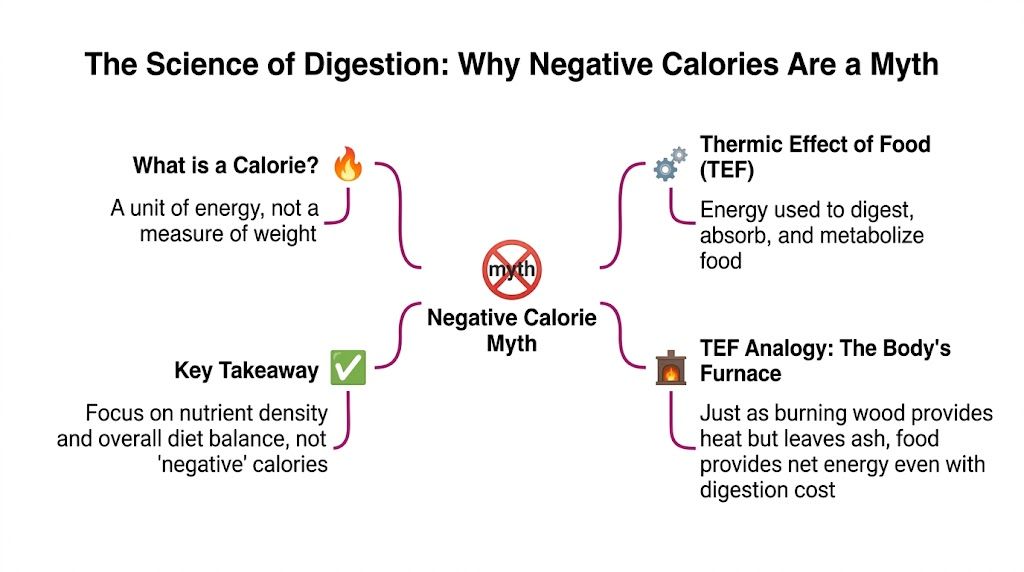
A simple way to understand digestion is to view it as a small processing fee. When you eat, your body has to chew, digest, absorb, transport, and metabolize nutrients. That takes work.
Nutrition science calls this the thermic effect of food, or TEF.
If food were money coming into a business, TEF would be the cost of handling the transaction. You never keep every bit of incoming energy, but you still come out ahead. The processing fee doesn’t swallow the whole payment.
What TEF actually looks like
The idea of negative calorie foods falls apart once you look at the size of that processing cost.
Tufts University Nutrition Letter explains that the thermic effect of food accounts for only 5 to 10% of daily energy expenditure, with TEF for carbohydrates around 5 to 10%, proteins around 20 to 30%, and fats around 0 to 3%. It also notes that these figures are nowhere near the 100% required for a negative calorie effect (https://www.nutritionletter.tufts.edu/general-nutrition/myth-of-the-month-negative-calorie-foods/).
That’s the key point. For a food to be “negative calorie,” your body would need to spend all of its energy, and then some, just processing it. Human digestion doesn’t work that way.
The celery example people always bring up
Celery is the poster child for this myth, so it’s worth dealing with directly.
Healthline’s review notes that celery contains 14 calories per cup and has a thermic effect of only around 8%, which is far below the level needed to create a negative impact (https://www.healthline.com/nutrition/negative-calorie-foods).
So yes, celery is very low in calories. No, it doesn’t create an energy deficit by existing on your plate.
Even extreme examples still show a net gain
One reason the myth survives is that people assume very watery, fibrous foods must come close to “canceling out.”
The same Tufts source summarizes a pre-print lizard study in which celery still produced a net 24% energy profit after digestion and excretion, and human extrapolations suggested about 64% net energy retention from foods like blueberries, celery, and broccoli. Even in that exaggerated test case, the food didn’t become negative energy.
So the science answer is blunt. All foods provide a net energy gain.
What to focus on instead
If you’re trying to lose weight, the useful concept isn’t negative calories. It’s overall intake, meal composition, and consistency. If you want a plain-English guide to understanding a calorie deficit, that resource can help connect the big picture without turning every meal into a spreadsheet.
A smarter way to use this information is:
- Use low-energy-density foods to make meals larger and more satisfying.
- Pair them with protein, fats, and other staples so meals hold you.
- Stop expecting one ingredient to do the whole job.
Digestion costs energy, but not enough to turn food into a calorie debt.
Why this matters in everyday eating
When people believe in negative calorie foods, they often give those foods a magical role they don’t deserve. That can lead to frustration.
You eat a big bowl of raw vegetables. You’re hungry again later. Then it feels like your body failed you.
It didn’t. The myth did.
Low-calorie vegetables are excellent tools. They just aren’t standalone fat-loss machines. They work best when you see them for what they are: foods that help with fullness, nutrition, and meal volume.
The Negative Calorie Illusion A Hidden Psychological Trap
The biology matters, but the psychology may matter even more in real life.
Once people hear that some foods are “negative calorie,” those foods can start acting like permission slips. Not in your metabolism. In your mind.
How the health halo works
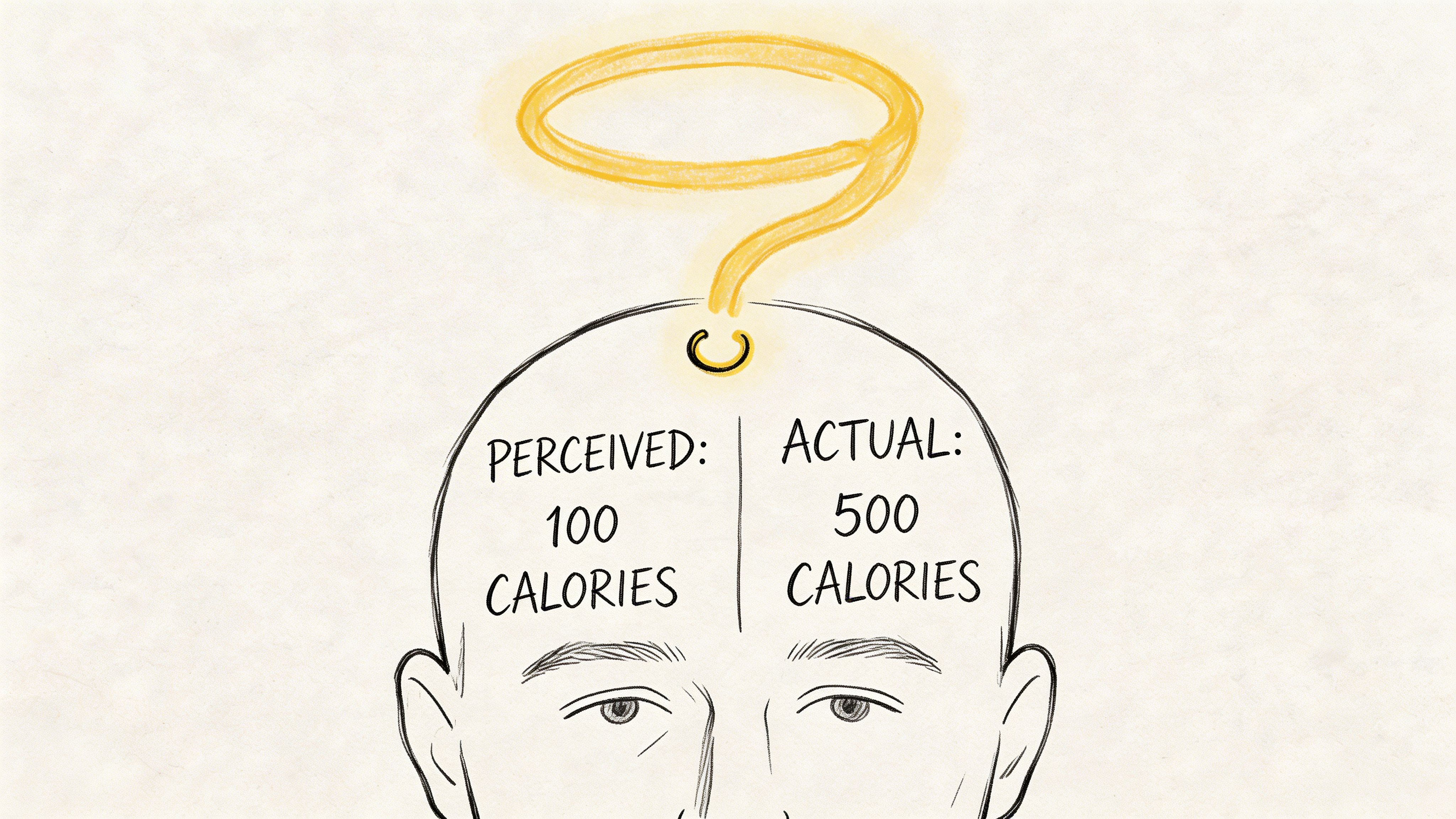
A meal can seem lighter than it is when it includes something visibly healthy.
Add a salad to a burger and fries, and many people feel the whole meal is more balanced. Add celery sticks to wings, and the plate can feel less indulgent. Put fruit next to a dessert, and the dessert can seem less intense.
Researchers studying this found that people’s calorie estimates for an unhealthy meal dropped when the meal appeared alongside a healthy item like a salad, a pattern described as a reference-dependent anchoring heuristic in the study on meal calorie estimation and healthy side items (https://pmc.ncbi.nlm.nih.gov/articles/PMC3743811/).
That’s a big deal because it means the myth doesn’t only confuse people about digestion. It can also distort how they judge an entire meal.
The trap isn’t the celery. It’s the story attached to it
Celery, lettuce, cucumber, and similar foods are not the problem. The problem starts when the brain turns them into evidence that the whole eating experience is lighter than it is.
That can sound like:
- “I got fries, but I also got a salad.”
- “I had a big sandwich, but I loaded it with lettuce and tomato.”
- “I snacked on chips, but I also had cucumber slices.”
Those choices aren’t bad. But they can become misleading if the “healthy” item erases awareness of the rest.
Mindset shift: Adding a nourishing food to a meal improves the meal. It doesn’t automatically neutralize everything else on the plate.
Why this matters for emotional and reactive eating
The health halo effect is especially sneaky when you’re stressed, distracted, or rushing. In those moments, your brain wants shortcuts. “This meal has vegetables” becomes “this meal is basically fine.”
That shortcut can make it harder to notice patterns like:
- eating heavier portions when a meal appears healthier
- choosing a treat more often because there’s a “good” food next to it
- feeling confused about why progress has stalled
A short explainer can help make this bias easier to spot in yourself:
A better question to ask at meals
Instead of asking whether a meal includes a “good” food, ask:
- What is this meal likely to feel like in my body an hour from now?
- Did I build balance, or did I add one healthy item to justify a very reactive choice?
- Am I eating intentionally, or trying to cancel one food with another?
That’s a more honest way to eat. It also tends to be more useful than trying to mentally offset foods against each other.
Meet the Real Stars The So-Called Negative Calorie Foods
The foods that get called negative calorie foods are still worth eating often. They’re just worth eating for the right reasons.
Their real strengths are volume, water, fiber, and nutrient density. They help build meals that look abundant without becoming overly heavy.
What these foods actually contribute
Healthline’s review makes the case clearly. Lettuce has 5 calories per cup and is 95% water, cucumbers have 8 calories per cup and are 95% water, and celery has 14 calories per cup. These foods still provide a net positive energy gain, but they can support satiety and lower overall energy density in meals because of their water and fiber content (https://www.healthline.com/nutrition/negative-calorie-foods).
Here’s a better way to look at them.
The real value of “negative calorie” foods
| Food | Calories (per 1 cup) | Water Content | Key Benefit/Nutrient |
|---|---|---|---|
| Lettuce | 5 | 95% | Adds crunch and volume to meals |
| Cucumber | 8 | 95% | Hydrating, refreshing, easy snack base |
| Celery | 14 | Noted as very high water in common examples | Crisp texture that adds volume |
| Kale | 7 | Not specified here | Very low-calorie leafy green |
| Tomatoes | 32 | 94% | Provides vitamin C and carotenoids |
| Watermelon | 46 | 91% | Sweet option with high water content |
| Broccoli | 31 | Not specified here | Provides 81.2 mcg vitamin C and 2.4g fiber per cup |
Celery isn’t magic. It’s useful.
Celery gets mythologized because it’s crunchy, fibrous, and extremely light.
Its real job is much more practical. It slows down snacking, adds chew, and gives meals a sense of bulk. If you dip it into something flavorful or pair it with a more substantial snack, it can make that snack more satisfying.
Celery helps because it supports the structure of a filling eating pattern. It doesn’t help because it burns itself off.
Lettuce and cucumbers are volume builders
Lettuce and cucumber often get dismissed as “empty” foods. That misses the point.
They’re not there to carry a meal on their own. They’re there to expand a meal. A sandwich with more watery, crunchy produce feels larger. A grain bowl with cucumber and lettuce feels fresher and more substantial. A snack plate with raw vegetables takes longer to eat than a handful of crackers.
That’s useful, especially for people who want less restriction and more fullness.
Broccoli shows what matters more than calorie myths
Broccoli is a strong example of why the myth is too small for the actual value of food.
Healthline notes that broccoli has 31 calories per cup, provides 81.2 mcg vitamin C, which is nearly daily needs, and contains 2.4g fiber per cup (https://www.healthline.com/nutrition/negative-calorie-foods).
That’s a much better reason to eat broccoli than pretending it has negative calories. It helps nourish you and fill you.
The most helpful foods aren’t the ones that “subtract.” They’re the ones that make balanced eating easier.
Foods that support fullness without drama
These foods shine when you use them in combinations.
- At meals: Add lettuce, tomatoes, or cucumbers to sandwiches, wraps, bowls, and plates to increase size and freshness.
- At snacks: Pair crunchy vegetables with a more satisfying anchor so the snack doesn’t feel flimsy.
- At dinner: Build the plate so there’s plenty of visible food. That matters for satisfaction.
A more mature way to think about low-calorie foods
Instead of asking whether a food burns calories, ask what it helps you do.
Some foods help you stay full longer. Some help you enjoy larger portions. Some improve texture and satisfaction. Some help you eat more slowly. Some bring nutrients your body needs.
That’s the story behind so-called negative calorie foods. They’re not loopholes. They’re supports.
Building a Smarter Plate Practical Guidance for Real Life
Once you let go of the myth, these foods become much easier to use well.
The goal isn’t to eat giant bowls of raw vegetables and hope for the best. The goal is to build meals that feel satisfying, balanced, and calm.
Start with addition, not restriction
A lot of people try to “be good” by removing foods first. That often backfires.
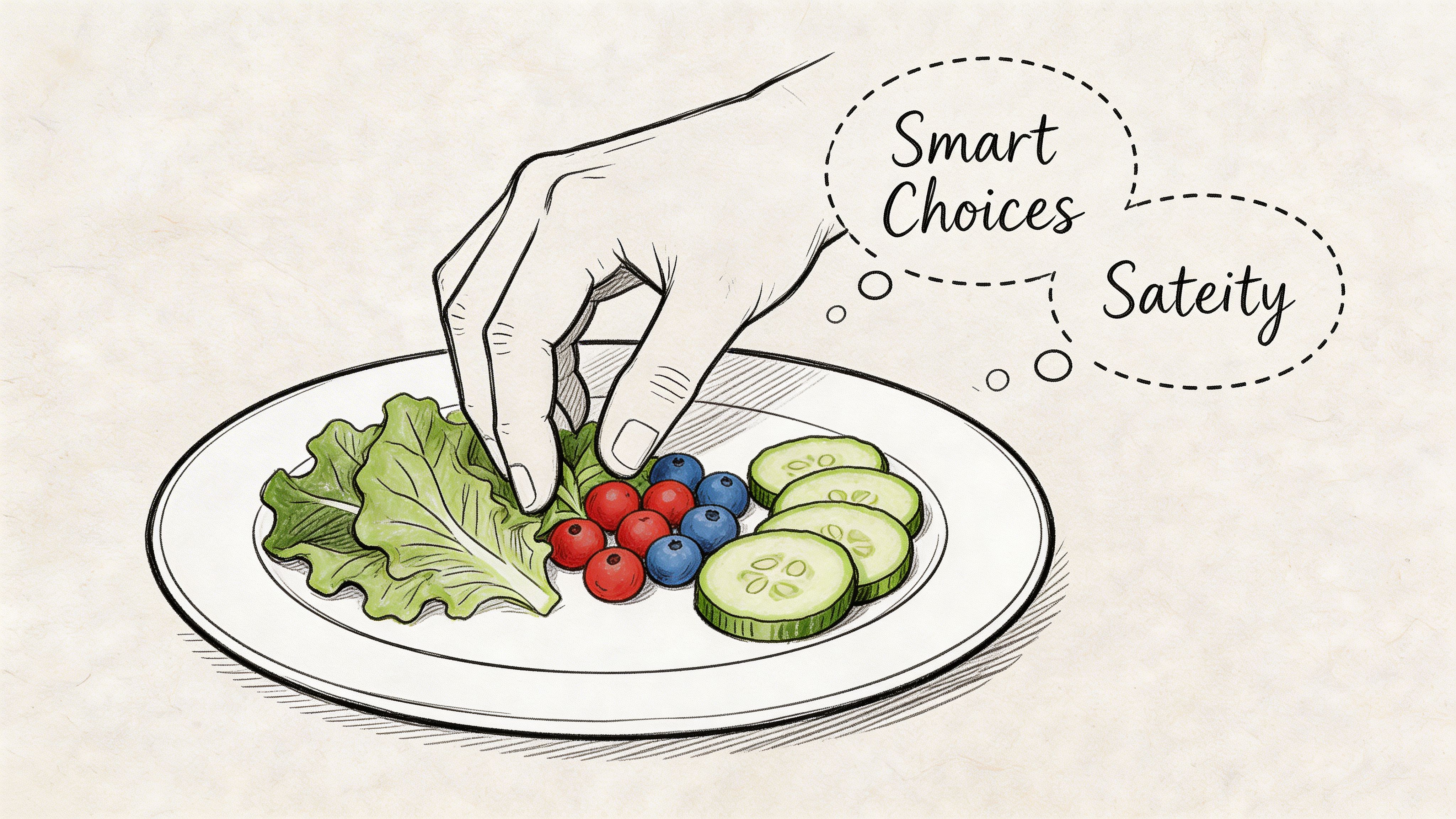
A more sustainable approach is to ask, “What can I add that makes this meal more filling and more steady?” That’s where low-calorie, high-water, high-fiber foods are helpful.
Additions that often help:
- Extra crunch: Cucumber, celery, lettuce, or tomatoes can make a meal feel bigger.
- More visible volume: A side of vegetables or fruit can make a plate look satisfying, which matters psychologically.
- Texture balance: Crisp, juicy foods can make richer meals feel less heavy and easier to enjoy slowly.
Build meals that can actually hold you
Low-calorie produce works best as part of a team.
A practical plate might include:
- a source of protein
- a satisfying carbohydrate or other staple
- some fat or richness for flavor
- one or more high-volume fruits or vegetables
That combination tends to work better than trying to fill up on “light” foods alone.
Smart swaps that don’t feel punishing
Swaps are useful when they preserve pleasure.
Try ideas like:
- Lettuce wraps sometimes, not always: Great when you want freshness and crunch, less great when you want bread. Know the difference.
- A larger salad base under a meal: This can add volume before you ever feel deprived.
- Cucumber or tomato added to sandwiches and bowls: A simple way to make the same meal feel more substantial.
- Watermelon or tomatoes with a meal: Helpful when you want something juicy and lighter alongside denser foods.
The point isn’t to erase favorite foods. It’s to make meals work better.
Practical rule: If a swap makes you feel deprived, it probably won’t last. If an addition makes the meal more satisfying, you’ll repeat it.
Use snacks to reduce reactivity
A lot of overeating starts long before dinner. It starts with getting too hungry, too stressed, or too mentally depleted.
Keep snack options that combine convenience with satisfaction. If you want ideas that go beyond plain produce, this guide to healthy snacks for weight loss can spark combinations that are easier to stick with.
A good snack often does one of two things:
- takes the edge off hunger before you become impulsive
- adds enough structure that you don’t start grazing without noticing
Think in patterns, not perfect meals
You don’t need every meal to look like a wellness ad.
What helps most is repeating a few simple patterns:
- a lunch that includes something crunchy and watery
- a dinner plate that looks abundant, not sparse
- a snack setup that doesn’t leave you hunting for more food soon after
Those patterns lower friction. And low friction is one of the biggest predictors of whether a habit sticks.
Beyond Myths How Superbloom Builds Lasting Habits
Knowing that negative calorie foods are a myth can clear up confusion. It doesn’t automatically change behavior.
People don’t struggle because they lack facts. They struggle because eating happens in real conditions. Stress, convenience, mood, time pressure, social settings, and old routines all shape choices in the moment.
That’s why lasting nutrition change usually comes from pattern recognition, not rule collecting.
Awareness beats food mythology
When someone chases myths, they often stay focused on the wrong question. They ask, “Which food burns calories?” instead of “What keeps leading me to eat in ways that don’t feel good?”
Behavioral change starts when you can notice things like:
- meals that leave you unsatisfied and lead to later snacking
- moments when a “healthy” side gives a meal a halo effect
- patterns of stress eating, rushed eating, or distracted grazing
- foods that help you feel grounded versus foods that make you feel reactive
That kind of awareness is more powerful than any list of supposed miracle foods.
Small feedback loops matter
A tool like Superbloom is useful. It’s built around daily check-ins, meal reflection, photo logging, journaling, and personalized guidance instead of strict dieting.
That changes the experience in a few important ways.
A photo-based log can help you see whether your meals consistently include enough structure. Personalized feedback can suggest practical upgrades, like adding more fiber or building better meal balance. Journaling prompts can help you connect cravings, stress, and routines to what you’re eating, which matters if the issue isn’t knowledge but reactivity.
The real shift is from judgment to data
Many people approach food with moral language. Good. Bad. Clean. Cheat. Free.
That mindset often creates more confusion, especially around myths like negative calorie foods. Superbloom offers a more useful lens. It helps people observe without dramatizing.
Instead of saying, “I blew it,” you can notice, “I tend to underestimate meals that include a healthy side,” or “I eat more reactively when lunch is too light.”
That’s actionable.
Sustainable nutrition gets easier when you stop trying to win each meal and start learning from patterns.
Why this works better than calorie obsession
For many adults, especially busy professionals or people dealing with emotional eating, calorie counting can become exhausting or inconsistent. A habit-based approach gives you another path.
You still build awareness. You still improve decisions. But you do it through repetition, reflection, and support.
That’s what makes long-term change possible. Not a list of mythical foods, but a system that helps you notice what’s happening and respond differently next time.
Frequently Asked Questions About Low-Calorie Eating
Can eating these foods help with weight loss?
Yes, they can help. Just not because they have negative calories.
Low-calorie, high-water, high-fiber foods can make meals more filling and lower in overall energy density. That can make it easier to eat in a way that supports weight loss without feeling as restricted.
Are any foods truly negative calorie?
No.
The scientific consensus described earlier is that foods still lead to a net energy gain after digestion. The myth comes from misunderstanding the thermic effect of food.
Are any whole foods truly zero-calorie?
No whole food should be treated as zero-calorie in the way people use that term online.
Some foods are very low in calories, which is different. That distinction matters because “basically nothing” can turn into “I don’t need to pay attention” very quickly.
Should I still eat celery, lettuce, cucumber, and similar foods?
Absolutely.
These foods can be excellent additions to your routine. They add crunch, freshness, water, and often fiber. They help build meals that feel larger and more satisfying.
The key is to stop expecting them to do a magical job they were never meant to do.
Why do I feel like I’m eating healthy but not seeing progress?
One common reason is the health halo effect.
If a meal includes something that looks healthy, it can be easy to underestimate the total meal or overlook portion size, extras, or frequent snacking around it. That doesn’t mean you’re failing. It means your brain may be simplifying the story.
What should I focus on instead of chasing food myths?
Focus on habits that are easier to repeat:
- Build satisfying meals: Include foods that help with fullness, not just foods that seem “light.”
- Add volume strategically: Use produce to support satisfaction, not to compensate for chaotic eating.
- Notice patterns: Pay attention to meals, moods, and situations that make intentional eating easier or harder.
- Aim for consistency: Repeating solid basics usually works better than searching for the perfect fat-burning food.
Low-calorie foods can absolutely support your goals. They just work best when you see them as tools for fullness, balance, and routine.
If you want help turning this kind of nutrition insight into everyday habits, Superbloom can help. It gives you personalized guidance, daily check-ins, meal feedback, and behavior-focused coaching so you can understand your eating patterns, catch triggers early, and build a healthier way of eating without strict diets or calorie counting.