
What Are Net Carbs? A Practical Guide to Smarter Eating

You've probably seen the term "net carbs" on food labels or in articles about healthy eating, but what does it actually mean?
Think of it this way: the "total carbohydrates" listed on a nutrition label are like a big bundle of mail. Some of that mail is important—bills and letters you need to open and deal with. The rest is just junk mail you toss right out.
Net carbs are the important mail—the carbohydrates your body actually breaks down, digests, and turns into energy. This is the stuff that affects your blood sugar. We subtract the “junk mail,” like fiber, because it mostly just passes right through your system without being used for energy.
Why Do Net Carbs Matter?
To really get what net carbs are, let's look at how your body handles energy. The total carbohydrate number on a label lumps everything together: starches, sugars, and fiber. But your body is smarter than that; it treats them all very differently.
Most starches and simple sugars are quickly converted into glucose, which your body uses for immediate fuel. This is what can cause your blood sugar to spike. Fiber, on the other hand, is the odd one out. It slows everything down, acting more like a traffic cop for your digestion and helping you avoid those sharp energy crashes. Since your body doesn't turn fiber into glucose, we can subtract it from the total.
At its core, the net carb concept is all about measuring a food's real impact on your blood sugar. It gives you a much clearer picture of how that food will actually fuel your body.
This idea really took off with low-carb diets, but its value goes way beyond that. It’s a game-changer for anyone who wants more stable, sustained energy. For instance, a whole avocado has about 12 grams of total carbs, but a whopping 10 of those are fiber. That leaves it with just 2 grams of net carbs, which explains why it keeps you feeling full and energized for hours without the crash.
Total Carbs vs. Net Carbs At a Glance
Getting a handle on this difference is key to making smarter food choices. Here’s a quick breakdown to help make it stick.
While the idea of calculating net carbs gained traction in the early 2000s, it's more relevant now than ever. For the 422 million adults worldwide living with diabetes, focusing on digestible carbs is absolutely critical for managing insulin needs and energy levels. You can dive deeper into the history and science with these insights on net carbs from Dr. Perlmutter.
The Simple Math for Calculating Net Carbs
Figuring out net carbs is thankfully pretty simple—no advanced math degree required. It all boils down to one basic formula that helps you quickly see how a food will actually affect your body.
The core equation is this: Total Carbohydrates - Dietary Fiber = Net Carbs. That's it. This simple subtraction tells you how many carbs your body will digest and use for energy. We'll get to sugar alcohols in a bit, as they add a small wrinkle, but for most foods, this is all you need.
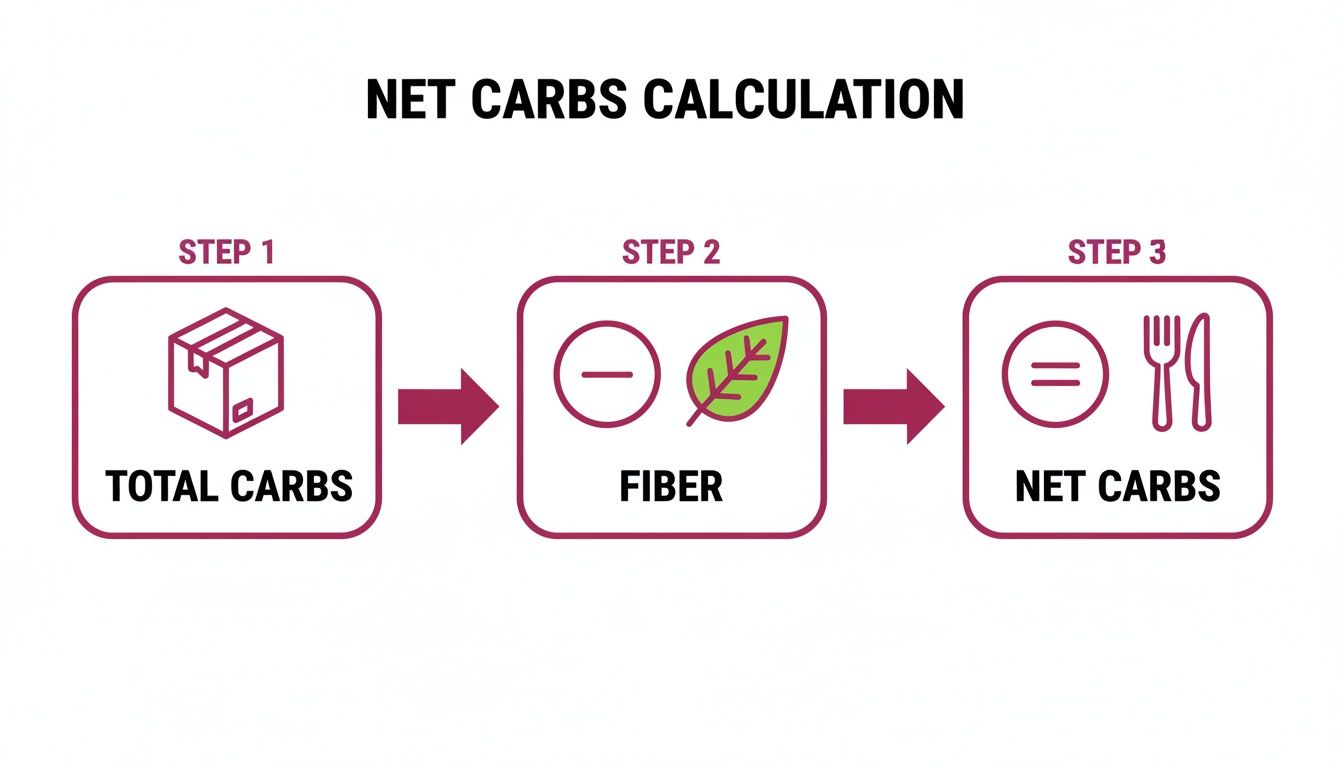
This calculation works because fiber, while technically a carb, passes through your digestive system largely untouched. Your body doesn't break it down for energy, so we can subtract it from the total.
Putting the Formula into Practice
To do the math yourself, you just need two numbers from any standard nutrition label: Total Carbohydrate and Dietary Fiber. You’ll usually find them listed right under each other, making them easy to spot.
Simply grab the "Total Carbohydrate" value and subtract the "Dietary Fiber" number right below it. Let's walk through a few real-world examples to make this second nature. Soon, you'll be able to do this in your head while walking through the grocery store.
Example 1: A Medium Avocado
A whole medium avocado has about 12 grams of Total Carbohydrates and a whopping 10 grams of Dietary Fiber.- Calculation: 12g (Total Carbs) - 10g (Fiber) = 2g Net Carbs
Example 2: A Handful of Almonds (1 ounce)
That handful of almonds has around 6 grams of Total Carbohydrates and 3.5 grams of Dietary Fiber.
- Calculation: 6g (Total Carbs) - 3.5g (Fiber) = 2.5g Net Carbs
Notice a pattern? High-fiber whole foods often have a much lower net carb count than you'd expect just from looking at the total carbs. This is a huge reason why they're so good at providing steady energy without sending your blood sugar on a roller coaster.
Now, think about a low-carb snack bar. The label might say 20 grams of Total Carbohydrates and 15 grams of Dietary Fiber. The math is the same: 20g minus 15g leaves you with just 5g of Net Carbs. This simple skill helps you look past the big numbers on the front of the package and understand what's really going on inside.
Why Fiber Is the Unsung Hero of Carb Counting
So, why do we get to subtract fiber from the total carb count? It’s because fiber behaves completely differently from other carbs once it’s in your body.
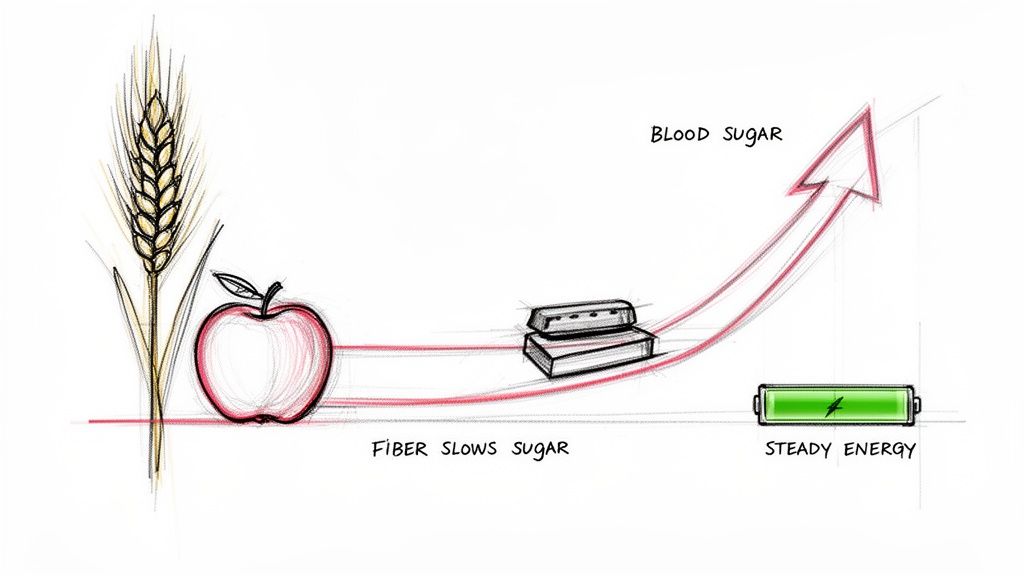
Think of it this way: most carbs are like quick-burning fuel, breaking down into sugar and giving you a fast energy boost. Fiber, on the other hand, is more like the traffic controller of your digestive system. It doesn’t get converted into sugar. Instead, its main job is to slow down how quickly other sugars hit your bloodstream.
This simple action is a game-changer. It prevents those dramatic energy spikes and the inevitable crashes that leave you feeling tired and hunting for your next snack. Fiber essentially puts the brakes on sugar absorption, giving you more stable, sustained energy throughout the day.
More Than Just a Deduction
The benefits of fiber go way beyond simple carb math. It’s absolutely essential for your overall health, especially for maintaining a happy gut microbiome. The friendly bacteria in your digestive system actually feed on fiber, which helps them flourish and support everything from smooth digestion to a strong immune system.
By focusing on the net carb count, you naturally start gravitating toward foods that are higher in fiber. This simple shift encourages a move toward whole foods that keep you feeling full, energized, and satisfied, transforming your mindset from restriction to mindful nourishment.
Choosing high-fiber foods is one of the most sustainable ways to build better eating habits. When you pick an apple instead of apple juice, or whole-grain bread over white bread, you’re not just lowering your net carb intake. You’re also loading up on crucial vitamins, minerals, and gut-friendly nutrients.
Fiber in Action: Practical Examples
Once you really get the role fiber plays, it can completely reframe how you look at food. You stop thinking about just avoiding carbs and start actively seeking out the beneficial ones.
Here’s what that looks like in the real world:
- Promotes Satiety: Fiber adds bulk to your meals, which is a fancy way of saying it helps you feel full and satisfied for much longer. This can lead to eating less overall without ever feeling like you’re on a diet.
- Improves Digestion: It’s famous for keeping you regular and preventing constipation, ensuring your whole digestive tract runs like a well-oiled machine.
- Supports Heart Health: Certain types of soluble fiber have been shown to help lower cholesterol levels, which is a big win for your long-term cardiovascular health.
A great way to see this in action is to look at some healthy vegan snack ideas, which are often packed with fiber-rich ingredients. Seeing these examples helps build an intuitive sense for the kinds of foods that will fuel your body best.
Decoding Sugar Alcohols on Nutrition Labels
Just when you think you’ve got the fiber deduction down, another ingredient pops up on the nutrition label: sugar alcohols. You’ll see them in products marketed as "keto," "sugar-free," or "low-carb," with names like erythritol and xylitol. Though they sound like something straight out of a chemistry lab, they're simply a type of carbohydrate our bodies don't completely break down.
Because they aren't fully absorbed, they're often subtracted from the total carb count, much like fiber. But here’s where things get a bit tricky. Not all sugar alcohols behave the same way in your body, and their impact on blood sugar can vary quite a bit.
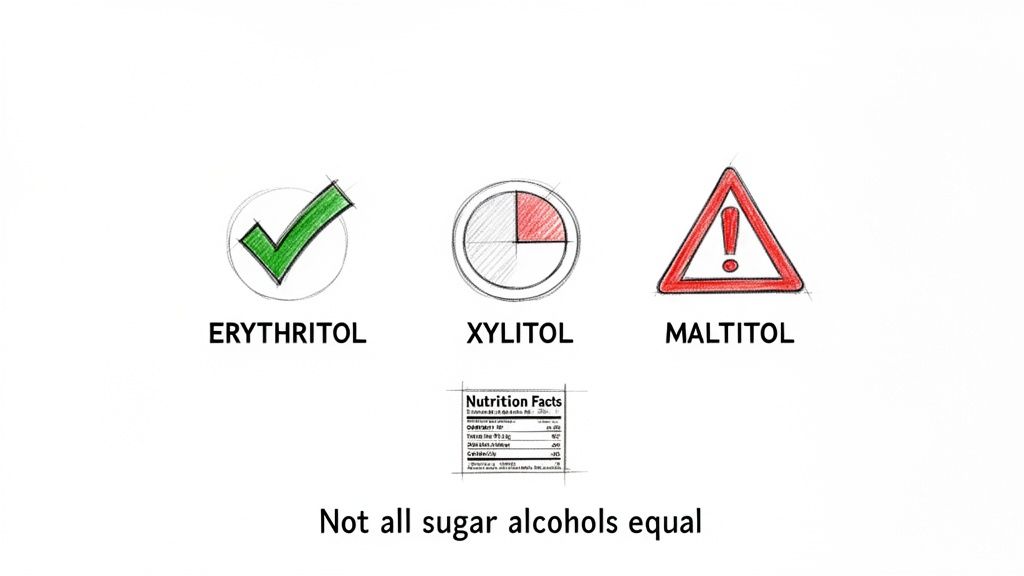
This is a really important distinction. Some sugar alcohols have almost no effect on your system, while others can cause a small but noticeable blood sugar response. Knowing the difference lets you see past the flashy marketing claims and understand what you're actually eating.
The Full vs. Half Deduction Rule
To get an accurate net carb count when sugar alcohols are in the mix, you have to know which ones you can subtract completely and which ones only get a partial pass. It’s simpler than it sounds.
Here’s a quick guide to the most common types:
- Subtract 100%: Erythritol has a glycemic index of zero. That means it has virtually no effect on blood sugar or insulin levels. If you see erythritol on the label, you can confidently subtract its full gram amount from the total carbs.
- Subtract 50%: Other sugar alcohols like xylitol, maltitol, sorbitol, and isomalt are only partially digested. Because they have a mild impact, the general rule of thumb is to subtract only half of their total grams.
Let's walk through an example. Say you have a protein bar with 22g Total Carbs, 6g Fiber, and 10g of Maltitol.
- Start with your total carbs: 22g
- Subtract all the fiber: 22g - 6g = 16g
- Subtract half the maltitol: 16g - (10g / 2) = 11g Net Carbs
The formula for what are net carbs expands to: Total Carbs - Fiber - (Sugar Alcohols / 2). This more precise calculation is crucial for anyone managing their blood sugar or digestive health, as it prevents you from underestimating a food's real impact.
This is the kind of know-how that empowers you to read labels with a critical eye and sidestep marketing traps that might hide less-than-ideal ingredients. Since sugar alcohols like erythritol provide sweetness without spiking insulin or feeding bad gut bacteria, they can be a helpful tool, especially for the 70 million Americans dealing with digestive issues. You can dive deeper into how these polyols affect the body and why the different calculations matter. For Superbloom users, this kind of insight is automated—just log a photo of your snack bar, and the app can break down the net carbs for you, connecting the data to your energy levels and cravings.
So, if tracking net carbs is so helpful, why isn’t the term plastered all over every official nutrition label? This is where things get a little complicated, and it's worth understanding both sides of the argument.
The main issue is that “net carbs” is not an officially regulated term by the U.S. Food and Drug Administration (FDA).
Because there are no official rules, food manufacturers are free to use it as a marketing buzzword. You’ll often see a low net carb count highlighted on highly processed snack foods to give them a "health halo." Critics have a good point when they say this can lead people to eat more packaged goods that are low in the vitamins and minerals you’d get from whole foods.
It’s true that the net carb calculation can be twisted to justify eating junk food. But when you understand how to use it correctly, it gives you a much more accurate picture of how food affects your body than total carbs alone.
Finding a Balanced Perspective
On the flip side, ignoring the concept completely means you’re leaving a really useful tool on the table. If you're managing your blood sugar, following a low-carb diet, or just trying to avoid that afternoon energy crash, thinking in terms of net carbs is incredibly insightful.
A food’s total carb count includes everything, but net carbs zero in on what your body actually digests and uses for energy. That distinction is key to making smarter choices.
For instance, a medium apple has about 25 grams of total carbs. But it also packs 4.5 grams of fiber, which drops its net carb count to a more manageable 20.5 grams. That apple is a much better option than a glass of apple juice, which has been stripped of all its fiber during processing.
This very distinction is what has helped the keto diet grow into an $11 billion global industry. Many people who follow it say that paying attention to net carbs is the secret to hitting their goals without feeling overly restricted. For a deeper dive, you can explore more on how net carbs differ from total carbs on Healthline.
Ultimately, the goal isn't to treat net carbs as good or evil. It's about using the concept as a practical guide—a way to see past the marketing hype and understand the real impact of your food choices. This empowers you to build eating habits that feel good and are truly sustainable.
Applying Net Carb Awareness in Your Daily Life
Knowing the math behind net carbs is one thing, but actually using that knowledge in your day-to-day life is where the real benefit lies. This isn’t about jumping into another strict diet or obsessively tracking every single gram. Think of it as a new awareness—a tool to help you make smarter food choices that fit your energy needs and personal goals.
It's about understanding the why behind what you eat. For example, knowing that a handful of high-fiber raspberries will likely keep you more focused than a higher-sugar banana before a big meeting can make a real difference. That’s how a simple number on a label turns into a practical, sustainable habit.
From Counting to Intuition
Ultimately, the goal is to get to a place where you don't have to count anymore. You start to develop an intuitive feel for how different foods affect your body. Instead of getting bogged down in the numbers, you'll begin to notice the connection between what you ate, how energized you feel, and how long you stay full.
Net carb awareness is a flexible guide, not a rigid rulebook. It helps you build meals that support stable energy and keep you feeling full, turning a dietary concept into a practical skill for everyday life.
You can start small with simple tweaks to the meals you already love. A great example is learning how to make a delicious low carb coffee at home with keto-friendly ingredients. It's a tiny change that can have a noticeable impact without feeling like a sacrifice.
Building this skill is really a process of observation. Superbloom-style coaching guides you in connecting the dots without the pressure of a diet. By simply logging your meals and noting how you feel, you start to see what works for your body. This helps you build a more intentional relationship with food, creating lasting habits that just feel natural.
Got Questions About Net Carbs? We’ve Got Answers.
Once you’ve got the basics down, you’ll probably find a few more questions bubble up. That’s a good thing—it means you’re really thinking about how this all works. Let’s clear up some of the most common points of confusion so you can use this knowledge as a flexible guide, not a rigid rulebook.
You’ve probably seen a few different terms floating around on food packages and in articles. This can make the whole concept feel way more complicated than it actually is.
Are “Net Carbs” and “Impact Carbs” the Same Thing?
Yes, they pretty much are. “Net carbs,” “impact carbs,” and even “active carbs” are all terms companies use to get at the same idea: figuring out which carbohydrates actually get digested and used by your body for energy.
No matter what they call it, the math is usually the same. You take the total carbohydrate count and subtract the ingredients that have a minimal effect, like fiber and certain sugar alcohols. The name on the box might change, but the goal is to give you a clearer picture of how a food will likely affect your blood sugar.
Do I Really Need to Track Net Carbs to Be Healthy?
Not at all. Think of tracking net carbs as a specific tool for a specific job—it's incredibly useful in certain contexts, but it’s definitely not a must-do for everyone. For most people, a simpler and more sustainable approach is to just focus on eating whole foods that are naturally high in fiber, like vegetables, nuts, seeds, and legumes.
So, when is paying attention to net carbs most helpful? It really shines if you are:
- Carefully managing your blood sugar for medical reasons.
- Following a very low-carb diet, like keto, where precision matters.
- Just curious about why some foods make you feel energetic and others leave you feeling sluggish.
The goal is to use net carb awareness as a source of insight, not a source of stress. True control comes from understanding the why behind your food choices, not just obsessively counting every gram.
Why Aren’t Net Carbs Listed on Nutrition Labels?
This is a great question, and the answer gets to the heart of the whole net carb debate. The term "net carbs" is not officially recognized or regulated by the U.S. Food and Drug Administration (FDA). The law requires that official nutrition labels list Total Carbohydrates and Dietary Fiber, but that’s it.
Because there isn't one single, legally defined way to calculate net carbs (especially with all the different types of sugar alcohols out there), it remains a marketing term. This is exactly why knowing how to read a label and do the quick math yourself is so empowering. It allows you to make your own informed decisions, regardless of what the front of the package says.
Building this kind of food awareness is about learning to listen to your body, not just following a set of rules. Superbloom helps you connect what you eat with how you feel, all without the tediousness of strict tracking. You can discover your own patterns and build healthier habits that actually stick. Learn more about personalized nutrition coaching at Superbloom.