
What is set point? Understanding Your Weight's Natural Balance
Have you ever felt like your body has a mind of its own when it comes to your weight? Like there's a specific number on the scale it always wants to return to, no matter what you do? That’s the core idea behind the body weight set point theory.
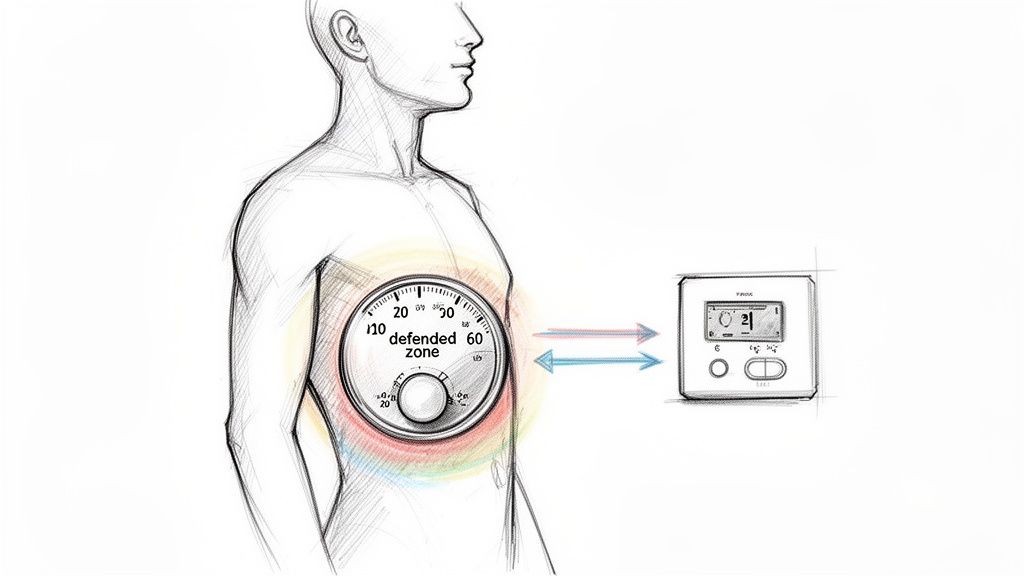
Think of it as your body's internal thermostat. It’s not about a single, unchangeable number, but a comfortable weight range your body is genetically programmed to defend.
Your Body’s Internal Thermostat
Imagine setting the thermostat in your house to 72°F. If the temperature drops, the furnace kicks on. If it gets too warm, the AC starts up. Your body works in a surprisingly similar way to maintain its preferred weight range.
This “set point” is a zone, usually spanning about 10 to 20 pounds, where your body feels it's operating at its best. When your weight drops below the bottom of this range, your body pulls out all the stops to bring it back up. And if it creeps too far above, it has mechanisms to try and guide it back down.
What’s Happening Under the Hood?
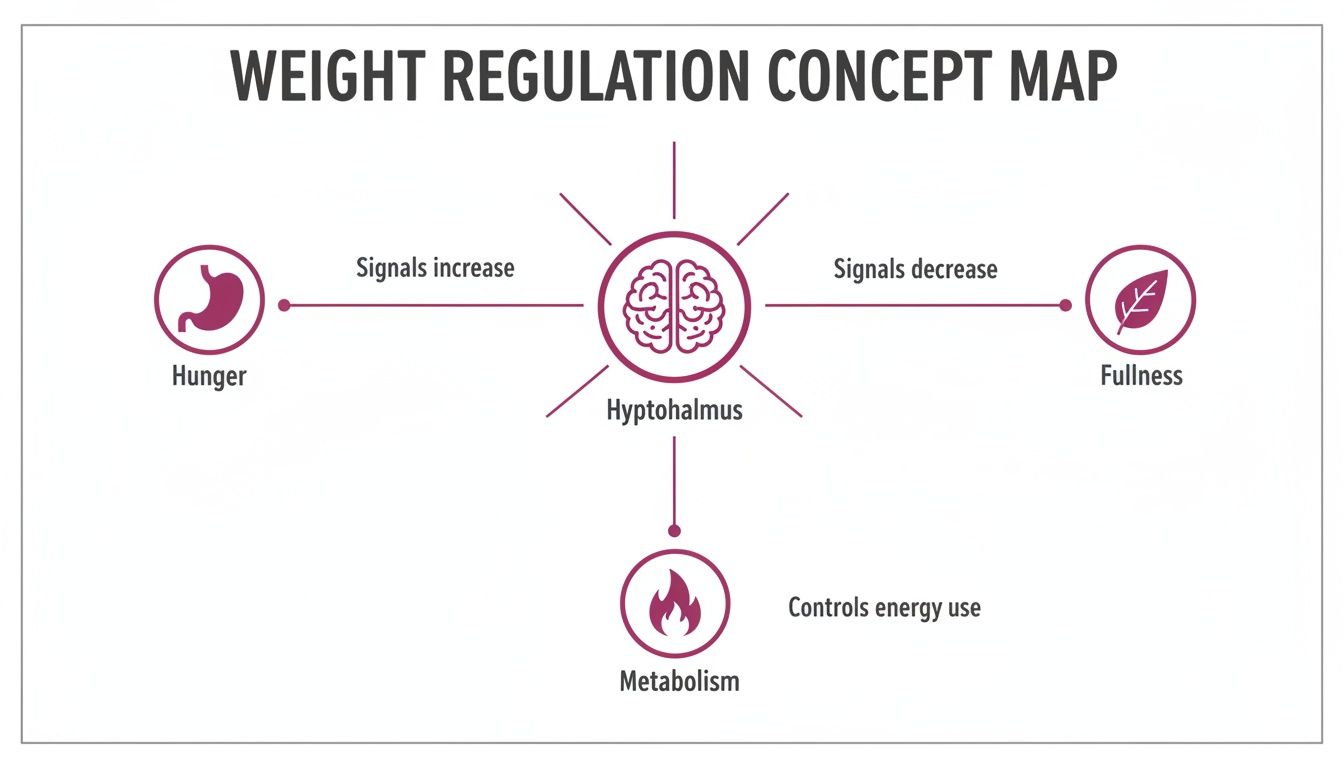
This isn’t just a neat analogy—it’s driven by a complex web of physiological signals. Your brain's hypothalamus acts as the command center, constantly monitoring internal data to keep things in balance.
What is it looking at?
- Hormone Levels: It listens for leptin (the "I'm full" hormone) and ghrelin (the "I'm hungry" hormone) to rise and fall.
- Energy Stores: It keeps tabs on how much body fat is available for fuel.
- Metabolic Rate: It can dial your metabolism up or down, changing how many calories you burn just by being alive.
When you lose weight, especially through a restrictive diet, your brain doesn't see your effort to fit into old jeans. It sees a threat. It thinks a famine has started and immediately goes into survival mode.
In response, your metabolism slows down to conserve every last calorie. Hunger hormones surge, making you feel ravenous. And cravings for calorie-dense foods become almost impossible to ignore. This isn’t a lack of willpower; it's a powerful, ancient survival instinct kicking in.
A Different Way of Thinking About Weight
The idea of a biological set point completely changed how scientists understood weight. Pioneered in the mid-20th century and more formally developed in 1982 by William Bennett and Joel Gurin, this theory moved us beyond the simplistic "calories in, calories out" mindset. It showed that our bodies are active participants, not passive calculators.
This new perspective highlights a key difference between what our bodies want and what traditional diets demand.
Set Point Theory vs Traditional Dieting
Here's a quick comparison of the core assumptions behind set point theory and traditional calorie-counting diets.
Understanding this distinction is crucial. It helps explain why fighting against your body's natural tendencies often feels like an uphill battle that you just can't win.
To truly get a handle on this, it helps to understand the fundamentals of energy balance. Your body’s set point is the master system trying to keep that balance stable for the long haul, often in spite of our best-laid plans. It's why a gentle, sustainable approach almost always wins out over a forceful, restrictive one.
The Biological Systems That Defend Your Weight
Your body’s loyalty to its set point isn't just a vague idea—it's a real, active process run by a complex network of internal systems. Think of your brain as the command center for a high-stakes survival mission, constantly scanning internal signals to keep you alive and well. This defense system is incredibly powerful, using a whole toolkit of hormones, metabolic tweaks, and brain signals to hold your weight steady.
When your weight dips below this preferred range, your body doesn't celebrate a successful diet. Instead, it sounds the alarm, sensing a potential famine. This perceived threat kicks off a cascade of powerful, coordinated responses designed to stop weight loss and drive regain. These aren't signs of weak willpower; they're sophisticated survival mechanisms perfected over thousands of years of human history.
Your Brain's Weight Regulation Center
Deep inside your brain lies the hypothalamus, the master regulator of your body weight. It works like a diligent security guard, constantly checking on your energy status. It gets real-time updates from all over your body, keeping tabs on your fat stores, nutrient levels, and hormonal signals to decide whether you need more fuel or have plenty in the tank.
Based on this stream of information, the hypothalamus adjusts two critical levers:
- Appetite and Hunger: It can crank up the volume on hunger cues, making food seem almost impossible to resist.
- Energy Expenditure: It can also dial down your metabolism, reducing the number of calories you burn just by being alive.
This constant push and pull is how your body fiercely defends its set point.
The Key Hormonal Players
Several key hormones act as messengers, carrying vital intel from your body to your brain. Getting to know them helps make sense of why you feel the way you do when you try to lose weight.
Leptin is often called the "satiety" or "fullness" hormone. It's produced by your fat cells and essentially tells your brain, "We're good, we have enough energy stored, you can stop eating now." When you lose fat, leptin levels plummet. This drop screams "We're starving!" to your hypothalamus, which immediately responds by ramping up your appetite and slamming the brakes on your metabolism.
Then there's ghrelin, the "hunger" hormone. Released mainly by the stomach, its job is to signal your brain that it's time to seek out food. When you're dieting and in a calorie deficit, ghrelin levels surge, creating those intense, gnawing feelings of hunger that are so hard to ignore.
Finally, insulin plays a dual role in managing blood sugar and signaling fat storage. After you eat, it helps shuttle glucose out of your blood and into your cells for energy. It also communicates with your brain about your body’s long-term energy status, which subtly influences your appetite over time.
The Metabolic Slowdown Effect
One of the most powerful weapons in your body's arsenal is something called adaptive thermogenesis. That's the scientific term for your metabolism intentionally slowing down more than would be expected from weight loss alone.
As you lose weight, your body becomes hyper-efficient with its energy. It basically learns to run on fewer calories, a clever trick to conserve resources when it thinks food is scarce. A famous study on "The Biggest Loser" contestants revealed just how dramatic this can be. Years after the show, their metabolisms had slowed down so much that they were burning up to 500 fewer calories per day than you'd expect for someone of their size.
This metabolic adaptation is a major reason why weight regain is so common after restrictive diets. It also explains why you might feel colder after losing weight—your body is literally producing less heat to save energy. It’s not a flaw in the system; it’s a brilliant feature designed to keep you alive. Together, these biological forces create a powerful current that makes fighting against your own physiology a very real challenge.
Exploring The Difference Between Set Point And Settling Point
To really get a handle on how our bodies regulate weight, we need to unpack a crucial distinction in the science: the difference between your set point and your settling point. They might sound alike, but understanding what separates them is a game-changer for how you approach your health.
Think of your genetic set point as being biologically hardwired. It’s the weight range your body is programmed to defend—sometimes ferociously—and it’s determined by factors mostly outside your control, like your DNA. This is your body’s true north, a physiological default it’s always trying to get back to.
The settling point, on the other hand, is a more flexible and practical idea. It’s the actual weight your body settles at based on the constant conversation between your biology and your current environment. This includes everything from your daily habits and food choices to your activity levels, stress, and sleep.
The Anchor And The Ship: A Useful Analogy
Here’s a helpful way to visualize it: Imagine your set point is a heavy anchor buried deep on the seabed. It’s fixed and incredibly difficult to move. Your settling point is the ship floating on the surface, attached to that anchor by a chain.
The length of that chain is determined by your lifestyle and environment. Strong currents—like a high-stress job, a lack of sleep, or a diet filled with ultra-processed foods—can push the ship further away from the anchor, causing it to settle at a higher weight. Conversely, calmer waters created by nourishing foods, regular movement, and good sleep allow the ship to drift closer to its anchor.
This concept helps explain how our brain's hypothalamus acts as a control center, constantly adjusting things like hunger, fullness, and metabolic rate based on the signals it receives.
The big takeaway here is that while you can't easily change the anchor's position (your genetics), you have a ton of influence over the currents (your habits). And those currents are what determine where your body ultimately settles.
Set Point vs Settling Point Key Distinctions
To make this even clearer, let's break down the core differences between these two models of weight regulation. While set point theory focuses on a rigid biological baseline, the settling point model provides a more dynamic view that accounts for our everyday lives.
Seeing them side-by-side really highlights why the settling point concept is so empowering—it puts the focus back on the things we can actually control.
Why This Distinction Matters So Much
The set point theory, on its own, can feel a little defeating. It can leave you feeling like your weight is completely out of your hands. The settling point model, however, offers a much more optimistic and actionable path forward. It acknowledges that your biology is a powerful force, but confirms that your behaviors and environment are just as important.
This shift in thinking is profound. It moves the goal from fighting an unwinnable war against your body's set point to gently influencing your settling point through sustainable lifestyle changes. You aren't trying to overpower your biology; you're creating an environment where it can find a new, healthier equilibrium.
This means you have agency. By focusing on consistent, positive behaviors, you can effectively "shorten the anchor chain" and guide your body toward a lower and healthier settling point over time. It’s not about a quick fix, but about creating a new normal that your body can adapt to and eventually defend.
So, what does that look like in practice? It involves focusing on the fundamentals:
- Improving Diet Quality: Shifting focus to fiber, protein, and nutrient-dense foods that help you feel full and keep your hormones balanced.
- Consistent Movement: Weaving regular physical activity into your life, especially strength training, which builds metabolically active muscle.
- Prioritizing Sleep: Getting enough quality rest is non-negotiable for regulating hunger hormones like ghrelin and leptin.
- Managing Stress: Finding ways to lower chronic stress can reduce levels of cortisol, a hormone directly linked to fat storage.
By making small, repeatable changes in these areas, you start sending your body signals of safety and nourishment. This cooperative approach helps dial down the biological pushback that so often sabotages restrictive diets, making lasting change not just possible, but sustainable.
Why Restrictive Diets Trigger a Famine Response
Have you ever started a diet feeling unstoppable, only to find yourself a few weeks later fighting intense hunger, overwhelming cravings, and crushing fatigue? It’s a common story. But that wasn’t a failure of willpower. It was your body’s ancient, powerful survival programming kicking into high gear.
When you drastically cut calories, your body has no idea you’re trying to fit into old jeans. It can't distinguish between a new diet and an actual food shortage. It interprets the situation as a famine, and its one and only mission becomes keeping you alive.
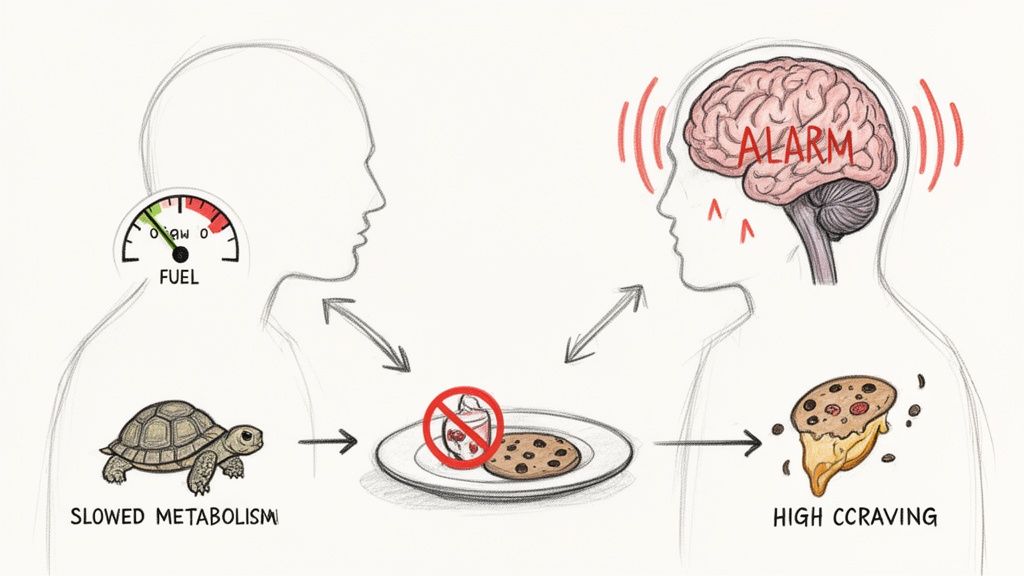
This perceived threat launches a cascade of defensive measures designed to conserve energy and drive you to find food. In short, your body goes to war with your diet.
Your Body’s Survival Toolkit
The moment your brain's hypothalamus senses a significant energy deficit, it unleashes a powerful counter-attack. This isn't one single action but a coordinated, multi-front defense against what it perceives as starvation.
The main weapons in this survival arsenal include:
- A Metabolic Slowdown: Your body becomes incredibly efficient. Your metabolism slows down to burn fewer calories—a process known as adaptive thermogenesis. Suddenly, the calorie deficit that was working before stops producing results.
- A Surge in Hunger Hormones: Levels of ghrelin, the "I'm hungry" hormone, go through the roof. This creates a persistent, gnawing hunger that feels far more intense than your normal appetite.
- A Plunge in Satiety Hormones: At the same time, leptin—the hormone that signals fullness to your brain—takes a nosedive. This leaves you feeling unsatisfied, even after eating what should be a filling meal.
This biological response is the very definition of fighting an uphill battle. Your body isn't just asking for food; it's using every tool at its disposal to demand it, creating a state of constant physical and mental pressure to eat.
But the fight isn't just hormonal. The famine response fundamentally changes how your brain sees food.
The Brain on a Diet
During this perceived famine, your brain’s reward centers become hyper-sensitive to high-calorie foods. That slice of pizza or bowl of ice cream doesn't just look good; it promises a much stronger dopamine hit than it normally would. Your brain is essentially screaming, "Energy! Get it now before it's gone!"
This neurological shift makes cravings feel less like a simple want and more like an urgent, biological imperative. It’s a primal drive that willpower alone can rarely overcome. This is why you might find yourself obsessing over foods you’d normally just eat in moderation.
This internal conflict also creates a psychological storm that can be just as difficult as the physical one.
The Psychological Fallout of Restriction
When you're caught in this biological tug-of-war, it's easy to see the struggle as a personal failure. This often traps dieters in a destructive cycle that many know all too well.
- Restriction: You start a strict diet, severely limiting calories or entire food groups.
- Biological Pushback: Your body fights back with the famine response, triggering intense cravings and hunger.
- "Giving In": Eventually, the biological pressure becomes overwhelming, and you eat a "forbidden" food.
- Guilt and Shame: You blame yourself, feeling like you failed or lacked the necessary self-control.
- Renewed Restriction: To "fix" the mistake, you double down on the diet, making the rules even stricter—and starting the entire cycle over again.
This cycle systematically ruins your relationship with both food and your body, cementing an all-or-nothing mindset. It reinforces the lie that you are the problem. In reality, your body was just doing its job—and doing it successfully. Understanding what is set point and its powerful defense mechanisms helps reframe past dieting experiences not as failures, but as proof of a healthy, functioning survival system.
How to Work with Your Body Instead of Against It
So, you understand your body has these powerful survival instincts. The next logical step is to stop fighting that system and start working with it. The whole idea is to shift away from a scarcity mindset and begin sending your body consistent signals of safety, nourishment, and abundance.
This isn't about tricking your body or trying to force it into submission. It's about creating an environment where it feels safe enough to relax its tight grip on your current settling point. Over time, it can then gradually adapt to a new, healthier equilibrium. Lasting change always comes from cooperation, not conflict.
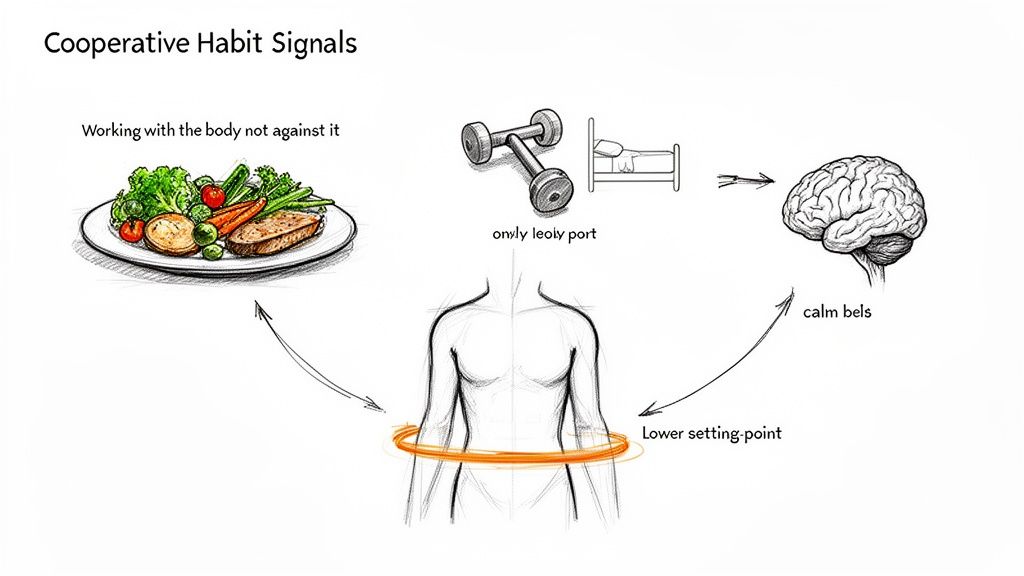
This means your focus has to pivot from aggressive calorie-slashing to building sustainable habits that support your total health. Think of each healthy habit as a reassuring message to your brain, letting it know that resources are plentiful and there’s no famine on the horizon.
Build Your Diet Around Quality, Not Just Quantity
Instead of obsessing over what to remove from your diet, let's reframe: what can you add? When you prioritize diet quality, you help naturally regulate your appetite and give your body the nutrients it needs to thrive, which helps calm that primal famine response.
Two of the biggest players in this strategy are protein and fiber. Both are champions of satiety, helping you feel fuller for longer on fewer calories. A diet rich in these sends powerful "I'm full" signals to your brain, which dials down the hormonal drive to overeat.
Simple ways to boost quality include:
- Adding Protein to Every Meal: Think eggs at breakfast, beans in your salad at lunch, or a solid serving of fish with dinner. Protein takes longer to digest and has a huge impact on satiety hormones.
- Increasing Your Fiber Intake: Aim to add more fruits, vegetables, whole grains, and legumes to your plate. Fiber adds bulk to your meals and supports a healthy gut, which also plays a key role in weight regulation.
By filling your plate with these nutrient-dense foods, you naturally crowd out the less nutritious, hyper-palatable options without that nagging feeling of deprivation. It's a strategy of abundance, not restriction.
Strengthen Your Foundation with Muscle
While any and all movement is good for you, strength training is uniquely powerful for influencing your settling point. Why? Because building and maintaining muscle mass has a profound effect on your metabolism.
Muscle is metabolically active tissue, which is just a fancy way of saying it burns calories even when you’re binge-watching your favorite show. The more muscle you have, the higher your resting metabolic rate (RMR). This gives you a crucial buffer against the metabolic slowdown that so often comes with weight loss.
Building muscle essentially upgrades your body's engine. It allows you to burn more energy throughout the day, making it easier to maintain a healthy weight without resorting to extreme dietary restrictions.
This doesn't mean you need to become a bodybuilder. Consistency trumps intensity here. Just incorporating two to three strength training sessions per week can make a significant difference over time.
Master Your Hormones with Better Sleep
Sleep isn't a luxury; it's a non-negotiable pillar of metabolic health. Seriously. A single night of poor sleep can throw your key hunger hormones, ghrelin and leptin, completely out of whack.
When you're sleep-deprived, your body pumps out more ghrelin (the "I'm hungry" hormone) and less leptin (the "I'm full" hormone). This hormonal double-whammy makes you feel ravenous while also making it harder to feel satisfied. It's a perfect recipe for overeating that has absolutely nothing to do with willpower.
Making 7-9 hours of quality sleep a priority is one of the most effective things you can do to support your body's natural appetite regulation system. It helps ensure your brain gets accurate hunger and fullness signals, setting you up to make more mindful food choices.
Manage Stress to Reduce Fat Storage
Chronic stress keeps your body in a constant state of high alert, flooding your system with the hormone cortisol. While cortisol is useful in short-term "fight or flight" situations, having persistently high levels can sabotage your health goals.
High cortisol can:
- Jack up cravings for sugary, high-fat comfort foods.
- Signal your body to store more fat, particularly around your midsection.
- Interfere with sleep, which, as we just saw, messes with your metabolic hormones.
Finding sustainable ways to manage stress—like mindfulness, walking in nature, journaling, or just connecting with loved ones—is essential for creating a physiological environment that supports a healthy weight.
To truly work with your body's complex systems, it helps to take a scientific approach to understanding your overall health, like exploring methods for engineering your biological age. By building these gentle, consistent habits, you can finally stop fighting your body and start working together toward a new, sustainable settling point.
Finding Your Healthy Weight with Modern Tools
Knowing the science behind your body's set point is one thing. Actually using that knowledge in the real world? That's the part that matters. The good news is, we're finally seeing a shift away from old-school restrictive diets and toward tools designed to work with our biology.
This approach flips the script on traditional dieting. It’s not about rigid calorie counting, which, as we've seen, can backfire and kick your body's famine response into high gear. Instead, it’s about learning to tune into your body’s unique signals. For example, apps like Superbloom lean on simple, psychology-backed methods to help you see your own patterns clearly—without the stress of endless numbers and rules.
Listening to Your Body with AI Coaching
Think of this kind of technology less as a drill sergeant and more as a helpful guide for listening to your body. Features like photo meal logging let you see your habits at a glance, and AI-driven coaching offers gentle, personalized feedback. It creates a space for reflection, not judgment.
Imagine snapping a quick photo of your lunch. In a moment, you might get a simple, non-judgmental nudge from the AI—maybe suggesting a source of fiber to help you feel full longer, or gently pointing out a pattern of reaching for sugary snacks mid-afternoon.
This isn't about being perfect; it's about paying attention. The goal is to connect your food choices with how you actually feel, identifying patterns related to stress, energy levels, and hunger that you might otherwise miss.
When you start doing this, you can finally begin to untangle the "why" behind your eating habits. That kind of self-awareness is the key to making small, sustainable changes that don’t feel like a punishment.
From Dieting to Sustainable Habit Building
This data-informed journey is about stepping away from the classic dieting mindset for good. It’s a far more compassionate way to figure out where your body’s healthy and sustainable settling point really is. You’re not fighting your biology anymore; you’re giving it better information and support.
This process helps you build real, lasting skills, like:
- Recognizing Hunger Cues: Learning to tell the difference between true physical hunger and emotional triggers.
- Improving Diet Quality: Gradually adding more protein and fiber to your meals to feel more satisfied.
- Building Sustainable Habits: Making small, consistent tweaks that really add up over time.
Ultimately, when you use tools that work in sync with your body’s natural systems, you make changes that actually stick. It’s a powerful shift—from battling yourself to partnering with your body, using awareness and gentle consistency to find your healthiest weight.
Common Questions About Body Weight Set Point
Even when you grasp the science, the whole idea of a body weight "set point" can feel a little confusing, maybe even discouraging. It's totally normal to wonder what it all means for your personal health goals. Let's tackle some of the most common questions head-on with clear, science-backed answers.
Can I Ever Lower My Body Weight Set Point?
This is the big one, and the answer is a mix of yes and no. Your genetically influenced set point is incredibly stubborn and hard to change directly. But—and this is a huge but—you absolutely can influence your settling point. That’s the weight your body actually settles at based on your environment and habits.
Think of it this way: instead of launching a full-on war against your body's biology, you're creating a new environment where it feels safe to find a lower, healthier weight. By making gradual, sustainable changes, you're essentially telling your brain, "Hey, we're good here. No famine, no crisis. You can relax."
This is how you can nudge your settling point downward over time:
- Fill up on the good stuff: Prioritize whole foods packed with protein and fiber that keep you full and satisfied.
- Move your body consistently: Regular activity, especially strength training which builds metabolism-supporting muscle, is key.
- Master your sleep: Getting enough high-quality sleep helps regulate your appetite hormones, ghrelin and leptin.
- Find your calm: Chronic stress can wreak havoc on your hormones and drive weight gain, so finding healthy ways to manage it is non-negotiable.
This whole approach is about working with your body to establish a new normal, not fighting against it.
How Long Does It Take to Change My Settling Point?
Honestly, there's no magic number here. Shifting your settling point is a marathon, not a sprint. It takes time for your body to learn that a new, lower weight is safe and not a threat. We're talking many months, or even a few years, of consistency before your biology fully adapts and stops trying so hard to pull you back up.
This is where patience becomes your superpower. Your body is slowly recalibrating its baseline, and that process just can't be rushed.
Instead of obsessing over the scale, start celebrating the other wins. Are you feeling more energetic? Is your mood better? Are your clothes fitting differently? Those are the real-time signs that your new habits are making a positive impact.
Is My Set Point the Same as My Ideal Weight?
Probably not, and getting clear on this is a game-changer for your mental health. Your set point is a biological reality—the weight range where your body functions best and feels safest. This might be, and often is, higher than the "ideal" weight you see in magazines or even a weight you remember from your younger years.
A truly healthy weight isn't just a number. It's the weight where you feel vibrant and strong, have plenty of energy, and can live your life without constant, exhausting restriction. The goal isn't to chase some arbitrary number, but to find the sustainable, happy place for your unique body.
Learning to listen to your body is the first step in working with your biology instead of against it. Superbloom's AI coaching can help you tune into those signals, using simple check-ins and personalized feedback to guide you toward habits that last. Ready to find your healthier settling point? Get started by visiting https://superbloomapp.com.