
What Should My Macros Be for My Goals
If the whole "what should my macros be?" question has your head spinning, you're not alone. It's easy to get lost in a sea of percentages and calculators. So let's cut through the noise and give you a powerful, dead-simple place to start.
Forget juggling three different numbers for now. Just focus on one: protein.
Your Simple Starting Point for Macros
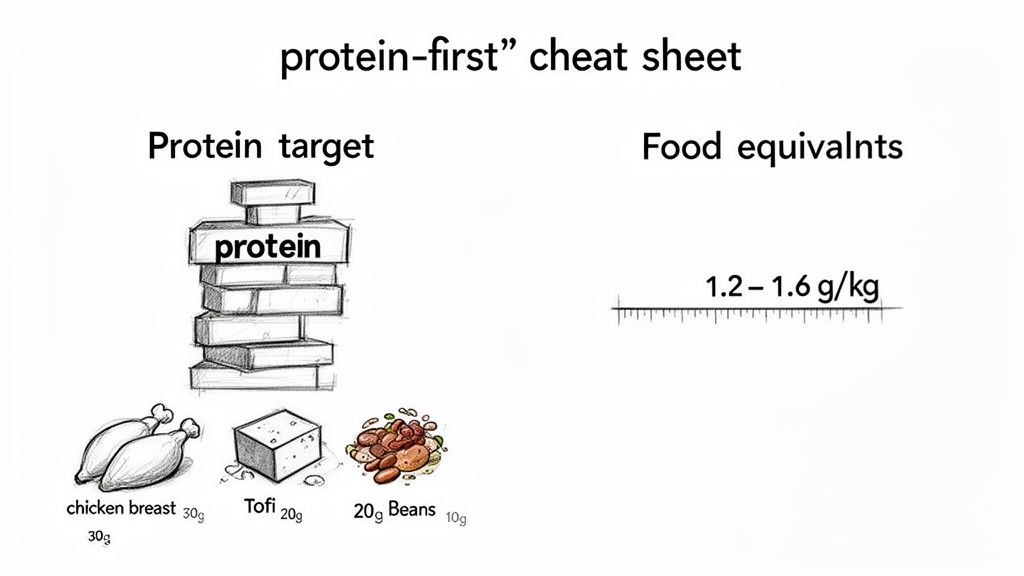
This protein-first approach isn't just a random shortcut; it’s a strategy that builds a rock-solid foundation for your nutrition. Think of protein as the anchor for your daily diet. It’s the single most important nutrient for building and repairing muscle, keeping you full after meals, and supporting a healthy metabolism.
When you nail your protein intake, everything else tends to fall into place more easily.
The Power of a Protein-First Approach
This isn't just our opinion—it’s a strategy backed by a major shift in nutritional science. The upcoming 2025-2030 U.S. Dietary Guidelines are poised to recommend a significant protein boost for most adults, suggesting a range of 1.2 to 1.6 grams of protein per kilogram of body weight.
That’s a huge jump from the old recommendation of 0.8 g/kg that stood for decades, and it reflects a much more modern understanding of protein's role in overall health. You can learn more about these updated macronutrient guidelines to see why experts are making this change.
Figuring out your personal protein target is refreshingly simple:
- First, get your weight in kilograms (just divide your weight in pounds by 2.2).
- Then, multiply that number by something between 1.2 and 1.6.
For instance, if you weigh 150 pounds (which is about 68 kg), your daily protein goal would be somewhere between 82 and 109 grams. That single number gives you a clear, concrete target to aim for every day.
Here's the key: When you prioritize hitting your protein goal, you’re automatically taking care of your body's most critical needs for repair and satiety. Once that becomes a consistent habit, fiddling with carbs and fats becomes a much smaller, more manageable task.
Your Macronutrient Cheat Sheet
Of course, knowing your gram target is one thing; turning it into actual food on your plate is another. To help you connect the numbers to real life, here’s a quick overview of what each macronutrient does and where you can find it.
| Macronutrient | Primary Role in Your Body | Common Food Sources |
|---|---|---|
| Protein | Builds and repairs tissues, muscle maintenance, promotes satiety. | Chicken breast, fish, eggs, tofu, lentils, Greek yogurt, protein powder. |
| Carbohydrates | Provides primary energy for your brain and muscles. | Oats, rice, potatoes, fruits, whole-wheat bread, quinoa, beans. |
| Fats | Supports hormone production, absorbs vitamins, provides long-term energy. | Avocado, nuts, seeds, olive oil, fatty fish like salmon. |
By starting with a clear protein goal and using this cheat sheet as a guide, you can start building balanced meals without feeling overwhelmed. It’s all about focusing on one high-impact habit at a time.
Why Cookie-Cutter Macro Plans Fail
If you've ever grabbed a "perfect" macro split from a fitness influencer or an online calculator only to end up feeling frustrated and defeated, you’re not alone. It’s a classic story, and the reason is surprisingly simple.
Following a generic nutrition template is like trying to navigate your hometown with a map of a completely different city. You’re putting in the effort, but you’re almost certainly not heading in the right direction.
Your Body Is Not a Template
The hard truth is that your body's needs are entirely unique. What works for a friend or a favorite athlete might do nothing for you, or even work against you. Your age, genetics, daily activity, and specific goals—whether you're trying to shed fat, build muscle, or just have more energy to chase your kids around—all dictate your personal fuel requirements.
An office worker who enjoys light yoga has vastly different energy needs than a construction worker who hits the gym after a physically demanding shift. A generic plan completely misses this context, often leading to one of two outcomes: you’re either under-fueled and miserable, or you’re over-consuming and sabotaging your goals.
A nutrition plan that isn’t designed for your life is a plan that is designed to fail. True sustainability comes from fitting your nutrition into your world, not forcing your life into a nutrition box that doesn't fit.
The Gap Between Guidelines and Reality
This problem goes way beyond just macros. There’s a huge disconnect between what general health guidelines suggest and what people actually do.
Think about it: even well-meaning public health advice often falls flat. Research has found that 80-90% of adults in the U.S. don’t hit the recommended fruit intake, and a staggering 90-99% don't eat enough vegetables. You can see more on how big this gap is between guidelines and actual eating habits on macrosinc.net.
This tells us something critical: simply telling people what to eat isn't enough. A plan has to be practical and fit into the chaos of a real person's life to stand a chance.
Your macro split should feel like a custom-tailored suit, not a straitjacket. It needs to be built around the realities of your life, accounting for things like:
- Your Lifestyle: Are you running around all day or sitting at a desk?
- Your Food Preferences: Do you feel best with higher-fat foods, or do you thrive on carbs?
- Your Body's Feedback: How does your energy, sleep, and performance change when you adjust your macros?
Ignoring these details is precisely why cookie-cutter plans fail. The first and most important step is to understand your own context. From there, you can build a macro balance that’s not only effective but that you can actually stick with for the long haul.
How to Find Your Personalized Macro Numbers
Alright, let's get practical. It's time to move from the theory of macros to the real-world application—finding the numbers that work for you. Don't worry, you don't need to be a math whiz. We're going to keep this simple and focused on what matters.
The process is pretty straightforward. It all boils down to three steps: figuring out your daily calorie needs, setting your protein target, and then dividing the rest between carbs and fats. Think of it less like a rigid prescription and more like building a flexible starting point.
This is crucial because, as anyone who's tried a generic diet plan knows, one-size-fits-all usually fits no one.
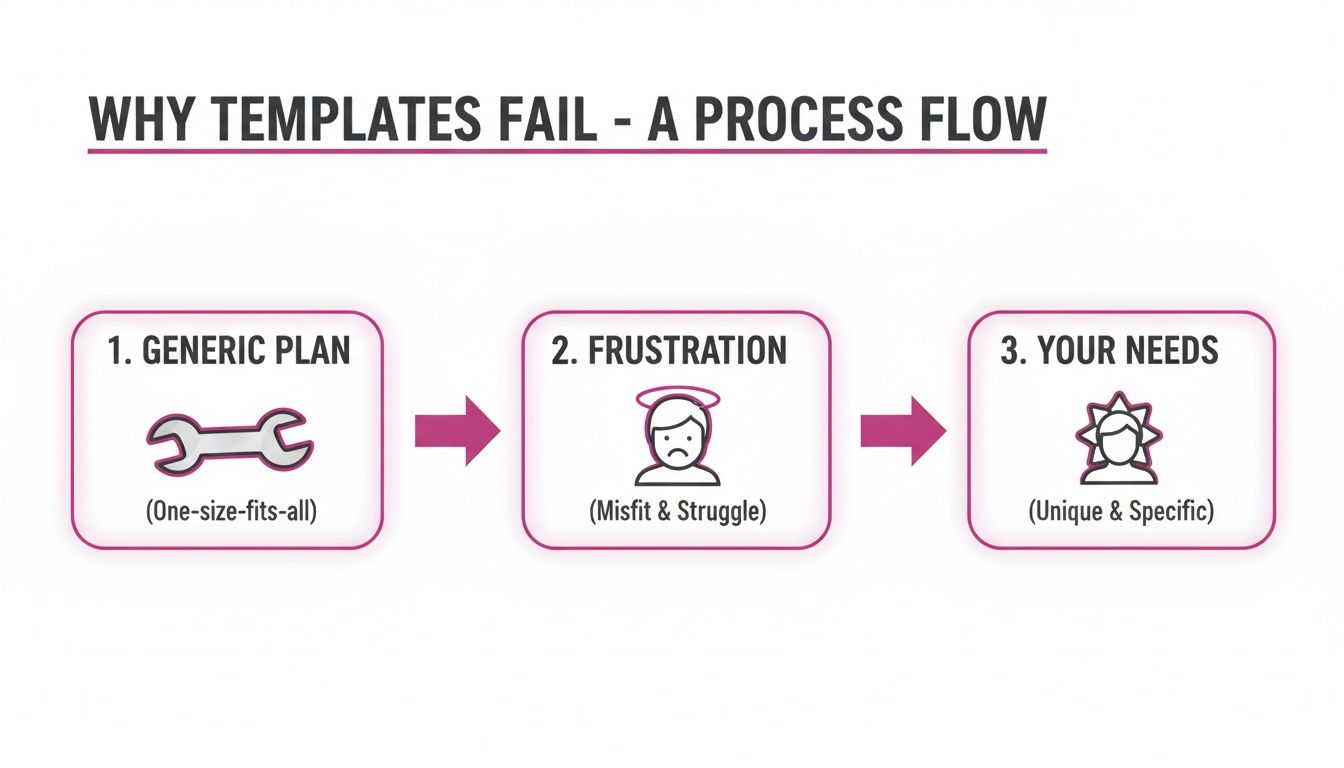
Starting with a template often leads to frustration precisely because it ignores your unique body, goals, and lifestyle. Your personal context is the most important piece of the puzzle.
Step 1: Estimate Your Daily Calorie Needs
Before we can split calories into macros, we need a baseline to work from. This is your Total Daily Energy Expenditure, or TDEE. It’s the total number of calories your body burns in a day, covering everything from sleeping and breathing to your workouts.
While getting a 100% precise TDEE is a lab-coat affair, a good online calculator gets you surprisingly close. If you're looking to change your body composition, using a dedicated macro calculator for weight loss can be a smart move to dial in your targets. These tools estimate your maintenance calories based on your age, weight, height, and activity level.
Let's walk through it with an example. Meet Alex, who weighs 175 lbs (79.5 kg), works a desk job, and strength trains three times a week. A TDEE calculator puts Alex’s maintenance at roughly 2,400 calories per day. This is the energy needed to stay at the same weight.
Step 2: Set Your Protein Goal
Next up, we lock in your protein. I call this your nutritional anchor because it’s the non-negotiable part of the plan, essential for muscle repair, growth, and keeping you full. The easiest and most effective way to set this is with the grams-per-kilogram method.
For most people, a range of 1.2 to 1.6 grams of protein per kilogram of body weight is the sweet spot.
Let’s calculate this for Alex, who is 79.5 kg:
- Low End: 79.5 kg × 1.2 g/kg = 95 grams of protein
- High End: 79.5 kg × 1.6 g/kg = 127 grams of protein
Alex decides to aim right for the middle of that range, setting a goal of 110 grams of protein per day. Since protein has 4 calories per gram, that’s 440 calories accounted for (110g × 4 cal/g).
The Takeaway: Alex's protein target is now set. This is the cornerstone of the macro plan. From here, we just need to figure out what to do with the remaining calories.
Step 3: Assign Carbs and Fats
With protein sorted, the rest is simple math. We subtract the protein calories from the daily total:
2,400 total calories – 440 protein calories = 1,960 calories remaining.
These calories will come from carbs (4 calories per gram) and fats (9 calories per gram). This is where your personal preferences and energy needs really come into play. Do you feel more energized for workouts with more carbs? Or do higher-fat meals keep you feeling full longer? There's no single right answer.
Here are two potential ways Alex could split the remaining calories:
Balanced Approach (50/50 Calorie Split):
- 980 calories from carbs = 245g of carbs
- 980 calories from fats = 109g of fats
Higher-Carb Approach (60/40 Calorie Split):
- 1,176 calories from carbs = 294g of carbs
- 784 calories from fats = 87g of fats
To get started, Alex picks the balanced approach. This isn't set in stone; it’s a starting hypothesis. The real goal is to test it out for a few weeks, pay attention to energy levels, hunger, and performance, and then adjust based on that feedback.
Example Macro Splits for Your Goals
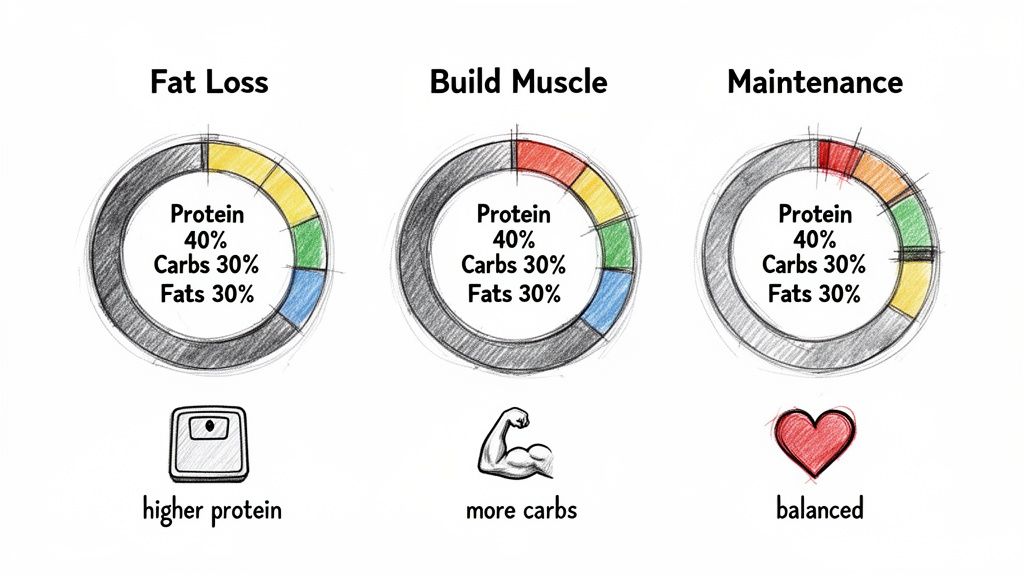
Alright, we've covered the "how." Now let's get into the "what" and, more importantly, the "why." Seeing some common macro splits can give you a fantastic starting point, but the real power comes from understanding the logic behind them.
Each macro ratio tells a story about your body's priorities. Are you signaling it to burn fat for fuel? Or are you giving it the raw materials to build new muscle? Thinking about it this way turns a generic template into a personalized game plan.
Example Macro Splits by Goal
Let's look at some typical starting points. Remember, these are not rigid rules but flexible frameworks. The goal is to align your fuel sources with your primary objective.
| Goal | Protein (%) | Carbohydrates (%) | Fat (%) | Primary Rationale |
|---|---|---|---|---|
| Fat Loss | 30-40% | 20-40% | 30-40% | Higher protein promotes satiety and preserves muscle mass in a calorie deficit. |
| Muscle Gain | 25-35% | 40-55% | 20-30% | Higher carbohydrates fuel intense workouts and help replenish glycogen stores for muscle recovery and growth. |
| Maintenance | 20-30% | 35-50% | 25-35% | A balanced approach supports overall health, energy levels, and stable body composition without extreme focuses. |
As you can probably tell, protein is the star player no matter what you're trying to achieve. When you're aiming for fat loss, it’s your best friend—it helps you feel full on fewer calories and protects your hard-earned muscle from being used as energy.
Why Your Goal Dictates Your Carbs and Fats
Once you’ve set your protein target, the main dial you’ll be turning is the one for carbohydrates and fats. If your focus is building muscle, you need more carbs. Period. They provide the immediate energy required to crush your workouts and are vital for recovery afterward.
Think of it this way: for muscle gain, carbs are the high-octane fuel for the construction crew, and protein is the pile of bricks. For fat loss, you’re in preservation mode—you use just enough fuel (carbs) to keep the engine running while prioritizing the foundational structure (protein).
If you’re an athlete or your training is particularly intense, fine-tuning your macros can be a total game-changer for your results. For anyone serious about leveling up their game, you can learn how to improve athletic performance with proven nutrition strategies.
Ultimately, the best macro split is the one that fuels your body effectively, makes you feel great, and is something you can actually stick with long-term.
Moving Beyond Strict Macro Counting
Figuring out your macro numbers is a fantastic starting point. But let’s be honest: the goal isn’t to live with a food scale and a calculator for the rest of your life. Think of your macros as training wheels. They’re there to help you learn, to build a new kind of intuition, not to box you in forever.
Because there's a real dark side to obsessive tracking. For too many people, it spirals into food anxiety and an all-or-nothing mentality. You have one "off" meal, and suddenly the whole day feels like a failure. When nutrition feels like a stressful math test you’re always on the verge of failing, it’s just not going to stick.
The real success happens when you move from strict counting to mindful eating. You start to internalize what you've learned about food, portions, and how your body feels.
From Counting Grams to Building Habits
Instead of being chained to an app, you can use your macro targets to create a few simple, flexible rules for yourself. This is all about consistency over perfection. It gets your eyes off the screen and back on your plate.
Here’s how you can start making that shift:
- Adopt a "Protein-First" Mindset: At every single meal, just ask yourself, "Where's the protein?" When you build your plate around a quality protein source, you’ll be amazed at how often you hit that crucial macro target without even trying to count.
- Use Fiber for Fullness: Don't stress about the exact number of carbs. Instead, just make a point to add a source of fiber—vegetables, fruits, or whole grains—to your lunch and dinner. This is a simple trick that helps manage hunger and dramatically boosts the quality of your diet.
- Learn Your Visual Cues: Get to know what 30 grams of protein actually looks like (hint: it's about a palm-sized chicken breast). Or what a serving of healthy fats is (think a thumb-sized portion of almonds). These visual shortcuts are so much faster and less stressful than weighing every little thing.
This is the turning point: you stop just reacting to numbers in an app and start proactively building balanced meals. You're using the knowledge you gained to make smarter choices on autopilot—and that's the secret to making it last.
This move toward nutrient-dense, high-protein eating isn’t just a niche strategy; it’s a massive trend. The global demand for supplements is booming as people look for easier ways to hit their nutritional goals. We're even seeing it shape the market in response to new GLP-1 medications, where people are specifically seeking out convenient, high-protein, and high-fiber foods to support their health. You can see more data on these emerging food and nutrition statistics on Market.us.
At the end of the day, your macros are a tool that should work for you, not the other way around. Use them to get a feel for your body's signals—your energy, your hunger, your performance. Before you know it, you'll be making great choices instinctively, long after you’ve put the food scale away for good.
Got Your Numbers? Here's What Comes Next
Okay, so you’ve run the calculations and have your first set of macro targets. It’s totally normal to feel a bit of uncertainty now. What do you do with these numbers? Are they set in stone? What if you have an off day?
Think of nutrition as a dynamic conversation with your body, not a one-time math problem. Let's walk through some of the most common questions that pop up once you start living with macros.
How Often Should I Adjust My Macros?
Your first set of macros is your starting point, not your final destination. Give your body at least 2-4 weeks to respond before you even think about making a change. You need to gather some real-world data first.
Pay attention to the feedback your body is giving you. These are the big signals that it might be time for a tweak:
- You've hit a plateau. If your fat loss or muscle gain has stalled for a few weeks, it might be time to make a small adjustment, like trimming a bit from your daily carbs or fats.
- Your energy is in the tank. Feeling sluggish or weak during your workouts? That’s a classic sign you might need more carbohydrates to properly fuel your activity.
- Your goals have shifted. Moving from a fat loss phase to a muscle-building one is a big change. You'll need more calories, mostly from carbs and protein, to support new growth.
- Your lifestyle has changed. Did you start a more active job or begin training for a 10k? Your daily energy needs just went up, and your macros should, too.
The golden rule here is to make small, gradual changes. A huge, sudden drop or jump in calories can backfire. Adjust one thing at a time, then give it another couple of weeks to see what happens.
Do I Need to Hit My Macros Perfectly Every Single Day?
Absolutely not. Chasing perfection is the fastest way to burn out and quit. Please don't fall into that trap.
The real goal is consistency, not perfection.
A much saner and more sustainable approach is to focus on weekly averages. Some days you might go over on carbs, and other days you'll be a little under on fats. It happens. As long as your protein intake is fairly steady and your weekly calorie average is where it needs to be, those daily ups and downs don't really matter in the long run.
An all-or-nothing mindset is your enemy. If you have a meal or even a whole day that’s off-plan, just get back on track with your very next meal. One "imperfect" day will never erase weeks of consistent effort.
How Can I Hit My Protein Goal on a Vegan or Vegetarian Diet?
Hitting a high protein target without meat or dairy is 100% possible—it just requires a little more planning. The trick is to be deliberate about including a solid plant-based protein source with every single meal.
Stock your kitchen with some of these powerhouses:
- Tofu and Tempeh: These soy-based staples are true chameleons in the kitchen and are loaded with protein.
- Lentils and Beans: Chickpeas, black beans, red lentils—they're all fantastic sources of protein and gut-friendly fiber.
- Seitan: Made from wheat gluten, seitan is a protein heavyweight and has an amazing, meaty texture that’s great in many dishes.
- Edamame and Soy Milk: Perfect for a quick snack or a smoothie base to easily bump up your protein intake.
- Nuts, Seeds, and Quinoa: While not as protein-dense as the others, they add up and contribute quality protein to your daily total.
A great strategy is to combine different plant proteins throughout the day (like rice and beans) to ensure you're getting all the essential amino acids your body needs. A good-tasting vegan protein powder can also be a game-changer, making it simple to hit your daily goal without any stress.
Feeling like this is a lot of numbers to juggle? You're right. But the goal isn’t to count macros for the rest of your life. Superbloom is designed to help you move beyond the tedious tracking. We focus on your behaviors, helping you build sustainable habits so you can make healthy choices intuitively, without the constant mental math. Ready to build a better relationship with food? Learn how Superbloom can help.