
When Do You Notice Weight Loss? A Realistic Timeline
When you first start a weight loss journey, the most immediate changes are often the ones you feel rather than see. It's common to feel lighter and notice less bloating within the first one to two weeks, which is a fantastic early sign that your new habits are taking effect.
The First Four Weeks: What's Really Happening?
That first month is a whirlwind of adaptation for your body. While the scale might show some dramatic drops right away, it's important to know what’s actually going on under the surface. That initial "whoosh" isn't what you think it is.
It’s almost entirely water weight.
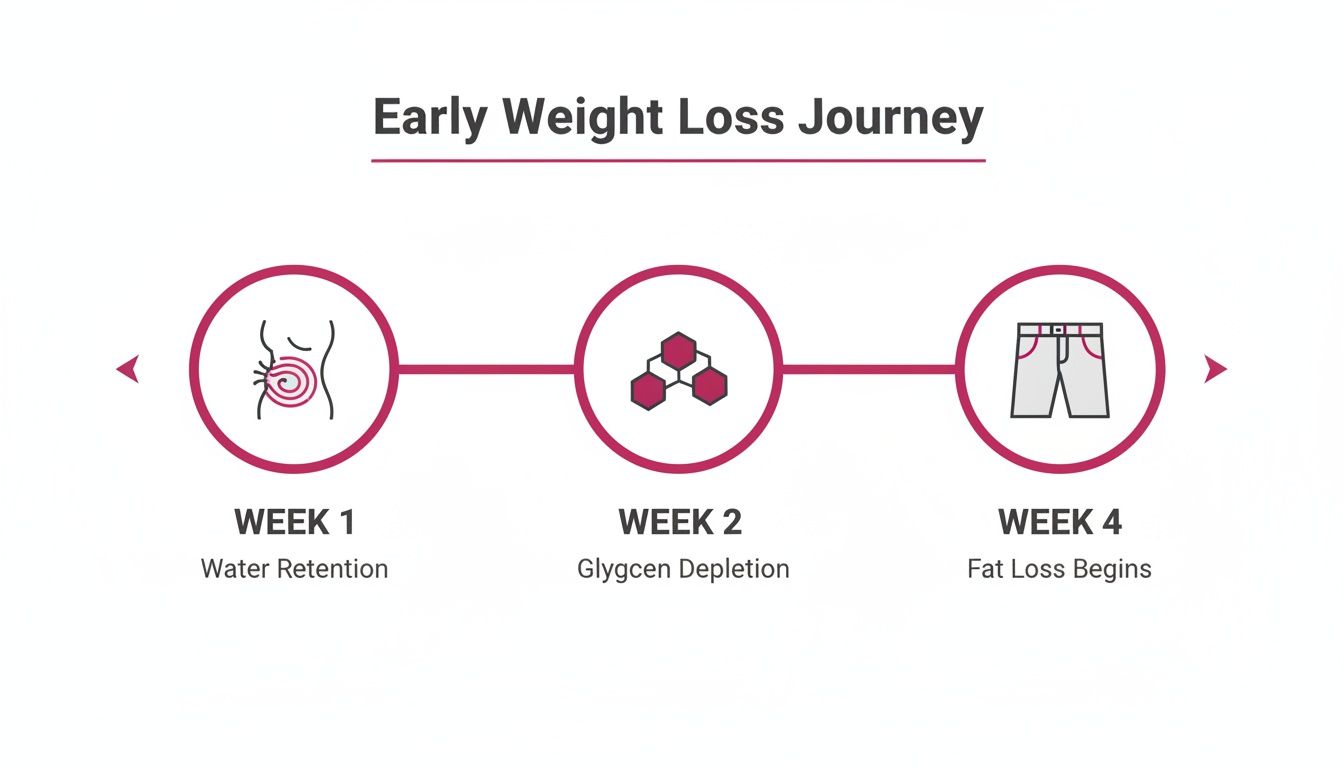
Think of your body's backup energy source, called glycogen, like a sponge. For every gram of glycogen your muscles and liver store, they hold onto about three or four grams of water. When you start eating cleaner and cutting back on things like processed carbs, your body naturally starts to burn through this stored glycogen.
As that glycogen "sponge" gets squeezed out, all the water attached to it gets released. This is why you can see a surprisingly big drop on the scale—sometimes several pounds—in the very first week.
The Initial Water Weight Drop
This initial drop is a great sign! It confirms your body is responding to the changes you're making. Still, managing expectations is key. Experts note that lower-carb eating plans can lead to a quick loss of a few pounds in just days as the body uses up its glycogen. If you have a higher starting weight, this could even be 5-10 pounds in that first week. It’s incredibly motivating, but it’s not the pace you should expect for actual fat loss. You can learn more about these early weight loss stages from Found.
This initial drop is a physiological response to dietary changes. It's the first step your body takes before it begins to tap into fat stores for sustained energy. Celebrating this progress is key, as long as you recognize it as part of the process.
To give you a clearer picture, here's a quick rundown of what you can generally expect during that first month.
Your Weight Loss Timeline In The First Month
This table is just a general guide, of course. Everyone's body responds differently, but it helps frame the process so you know what to look for beyond just the number on the scale.
From Water Loss to Fat Loss
After that initial flush of water weight in the first week or two, your progress will settle into a more sustainable rhythm, typically around 1-2 pounds per week. This is the sweet spot where your body is consistently burning stored fat for energy.
By the time you hit week four, you'll likely start noticing more tangible rewards for your hard work:
- Less Bloating: Your digestive system has had time to adjust, making you feel lighter and more comfortable.
- More Energy: As your body gets more efficient at using fuel, you’ll probably feel a welcome boost in your energy levels throughout the day.
- Clothes Fit Differently: This is a big one. That favorite pair of jeans might button up a little easier or feel looser in the waist, even if the scale didn’t budge much that week.
These early victories are the building blocks of long-term success. They’re proof that your consistency is paying off and provide the motivation you need to keep going.
Your Personal Timeline: Unpacking The Factors That Matter
It’s so easy to scroll through social media and get caught up comparing your progress to someone else’s highlight reel. But here’s the truth: the timeline for seeing weight loss is deeply personal. It's not a race with a universal finish line; it’s a unique journey shaped by your body’s individual blueprint.
When you start to understand these key factors, you can finally set realistic expectations and appreciate your body's unique process. It’s about shifting your focus from a generic schedule to a strategy that actually works for you. That’s where real, lasting change happens.
Starting Weight and Body Composition
Where you begin your journey plays a huge role in how quickly you'll see changes. Someone with a higher starting weight often sees a more dramatic drop on the scale in the beginning.
Think of it this way: a heavier body needs more energy just to get through the day. So, when you create a calorie deficit, the initial results can be more rapid. For example, a person weighing 250 pounds might lose 4-5 pounds in their first week with moderate changes, while someone at 150 pounds making the same effort might see a 1-2 pound loss. It’s all relative.
But weight is only half the story. Your body composition—the ratio of fat to muscle—is just as important. Two people can be the exact same weight but look completely different. Muscle is metabolically active tissue, meaning it burns more calories at rest than fat does. So, if you have more muscle mass, you have a natural fat-loss advantage.
Diet Quality and Exercise Consistency
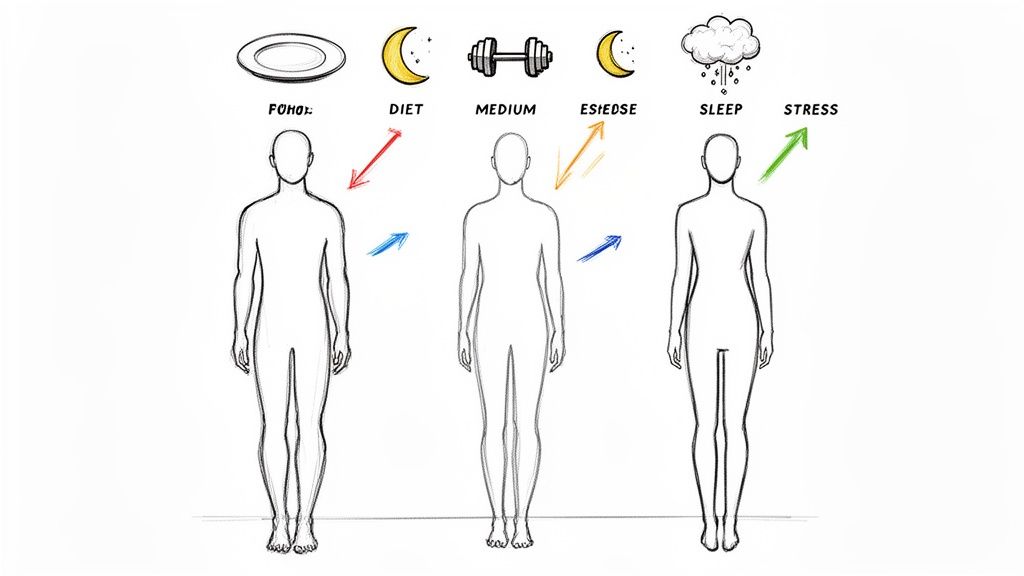
What you eat is so much more than just a number of calories. A diet built on protein and fiber will keep you feeling full, prevent blood sugar spikes, and help you hold onto precious muscle while you lose fat. On the flip side, a diet heavy in processed foods can trigger inflammation and hormonal chaos that makes progress feel impossible, even if your calories are in check.
And then there's exercise. While your diet is the primary driver of fat loss, exercise is what reshapes your body and revs up your metabolism.
- Cardio: Things like jogging, swimming, or cycling are fantastic for torching calories and strengthening your heart.
- Strength Training: This is your secret weapon. Lifting weights builds lean muscle, which raises your resting metabolic rate. That means you burn more calories 24/7, even when you’re relaxing on the couch.
This is exactly why you might notice your clothes fitting better or your body looking more toned, even when the scale refuses to budge. You're swapping out bulky fat for dense, lean muscle—a process known as body recomposition.
Weight loss isn't just about "calories in, calories out." It’s a complex dance between your hormones, sleep, stress, and nutrition. A holistic approach that honors all these pieces is infinitely more effective than obsessing over calories alone.
The Hidden Influencers: Sleep and Stress
Never, ever underestimate the power of a good night's sleep and solid stress management. When you're chronically sleep-deprived, it throws your hunger hormones, ghrelin and leptin, completely out of whack. This cranks up cravings for sugary, high-calorie foods. On top of that, a lack of quality sleep spikes your cortisol levels.
Cortisol is the body's main stress hormone, and when it’s constantly elevated, it signals your body to store fat—especially around your belly. High stress levels from work or life do the exact same thing. This is why getting 7-9 hours of sleep and finding healthy ways to unwind are non-negotiable. They create the stable, healthy foundation that allows all your hard work with diet and exercise to actually pay off.
When Other People Start To Notice Visible Changes

There’s a powerful milestone in every weight loss journey: the first time someone else comments on your progress. It’s that moment of external validation that makes all your hard work feel real to the outside world.
This typically happens somewhere between the four and eight-week mark. By then, you’re past the initial water weight fluctuations and have been consistently chipping away at fat loss. The small, daily changes start to compound, creating a visible difference in your overall shape that others begin to pick up on.
Where Changes Appear First
Genetics is the boss when it comes to deciding where your body sheds fat first. Unfortunately, you can't just tell your body to lose fat from your belly or thighs—that’s called spot reduction, and it’s a myth. However, most people first see fat loss in areas with less stubborn fat.
These common "first-to-shrink" spots often include:
- The Face: A slightly sharper jawline or less puffiness in the cheeks is often one of the earliest compliments you’ll receive.
- The Wrists and Fingers: You might suddenly notice your watch is a little loose, or a ring that was once snug now slips on and off with ease.
- The Collarbones: As that thin layer of fat diminishes, your collarbones can become more defined and prominent.
These subtle shifts are the first real clues that your body composition is genuinely changing.
The moment someone says, "Have you lost weight? You look great!" is more than just a compliment. It's confirmation that your dedication is creating a visible transformation, providing a massive psychological boost to keep you motivated and focused on your goals.
The Turning Point for Noticeable Fat Loss
While you might feel your jeans getting looser by week three, it usually takes a bit longer for those changes to become obvious to friends, family, or coworkers who see you all the time. But once you hit weeks four to six, even a cumulative loss of 3-5 pounds of actual fat starts to become more evident.
Consistency is what makes this happen. Studies have repeatedly shown that steady adherence to healthier habits is what produces these noticeable results within this timeframe. You can read more about what to expect on this timeline from the experts at Found.
Think of it like building with LEGOs. Adding one or two bricks at a time doesn't look like much. But after a month of adding bricks every single day, you suddenly have a structure that’s recognizable to everyone.
This is exactly why tracking your progress with photos and measurements is so valuable. Using a tool like Superbloom's photo logging feature helps you see the gradual transformation your own eyes might miss day-to-day. When you can compare your "before" with your "now," you give yourself the proof you need, often long before anyone else says a word.
How To Track Progress Without The Scale
Let’s be honest: the number on the scale tells such a small part of your story. It can jump up or down based on a salty dinner, a tough workout, or how much water you drank, often hiding the real, meaningful progress you're making. Stepping away from this one number can free you from that daily frustration and give you a much clearer picture of your success.
When you start focusing on these "non-scale victories," you begin to appreciate all the positive changes happening in your body. This builds a much healthier relationship with your fitness journey and provides the kind of motivation that a fluctuating number just can't.
Take Body Measurements For A More Accurate Picture
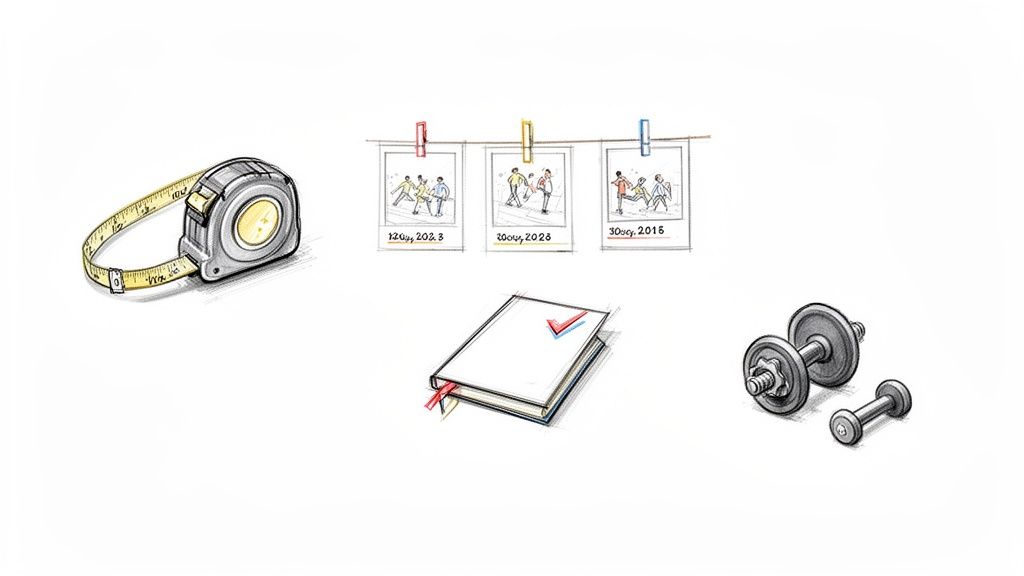
While the scale measures your total body mass—including bone, muscle, and water—a simple measuring tape can tell you where you’re actually losing fat. This is a far more precise way to see if your body composition is improving.
For the most consistent results, measure yourself first thing in the morning every 2-4 weeks. Pick a few key areas and jot down the numbers so you can spot the trends over time.
- Waist: Find the narrowest point, which is usually right above your belly button.
- Hips: Wrap the tape around the absolute widest part of your hips and glutes.
- Chest: Measure around the fullest part of your chest.
- Arms and Thighs: Find the widest point on both your upper arm and your thigh.
Watching these numbers shrink is direct proof that you’re losing inches. That's a powerful sign of fat loss, especially when the scale is being stubborn.
Your body is so much more than a number. It's a system that's getting stronger, healthier, and more efficient every day. Tracking how you feel and how your measurements change gives you credit for all the hard work that the scale completely ignores.
Use Progress Photos To See What You Can’t
Your brain sees your reflection every single day, which makes it almost impossible to notice slow, gradual changes. This is exactly where progress photos become one of your most powerful tools. They provide objective, visual proof of your transformation that you just can’t argue with.
Try to take photos once a month in the same spot, with similar lighting, and wearing the same (or a similar) outfit. Capturing front, side, and back views gives you the full story. When you put your Week 1 photos next to your Week 8 photos, all those subtle shifts suddenly become undeniable.
You might see a slimmer waistline, more definition in your arms, or even an improvement in your posture that you never would have caught otherwise. It’s incredibly motivating.
Other Powerful Non-Scale Victories To Look For
Beyond measurements and photos, countless other signs tell you you're on the right track. It's easy to get fixated on a single metric, but true progress is about so much more. While the scale is a simple tool, it’s worth understanding its limits and exploring things like the accuracy of BMI scales to get a more well-rounded view.
Start celebrating these real-world wins:
- Your clothes fit better: That favorite pair of jeans now buttons up without a fight.
- You have more energy: You’re getting through your workday or playing with your kids without feeling completely wiped out.
- Your stamina improves: You can walk up a flight of stairs without getting winded or you can add another rep to your workout set.
- Your mood is better: You feel clearer and more positive, which is a huge benefit of consistent healthy habits.
These victories are the true reward for your efforts. They reflect genuine improvements in your health, strength, and quality of life—and that's what really matters.
Effective Ways To Measure Your Progress
To truly understand your journey, it's best to use a combination of methods. Each one tells a different part of the story, giving you a complete and encouraging view of how far you've come.
Using these indicators together gives you a rich, multi-dimensional view of your progress. You'll see that even on weeks when the scale doesn't move, you're still making incredible strides in your health and fitness.
Building Habits That Create Lasting Results
Seeing those first signs of weight loss is an incredible feeling, a real shot of motivation. But that initial excitement? That's just the starting fuel. The real engine that drives long-term success is the system of habits you build to keep going, long after the novelty wears off. This is where we shift our focus from the what to the sustainable how.
Lasting change isn't about being perfect—it's about being consistent. The real goal is to create routines that are tough enough to survive an off-day or a busy week. Instead of seeing a slip-up as a total failure, the key is learning to bounce back quickly. Don't let one less-than-ideal meal derail your entire week.
Shifting Your Mindset From Dieting To Living
A huge part of making this stick is getting away from that restrictive "diet" mentality. Take mindful eating, for example. It's a powerful way to rebuild the connection with your body's natural hunger and fullness cues. It helps you finally understand the difference between actual physical hunger and the kind of eating that’s driven by stress or boredom.
This kind of awareness is what gives you the power to make intentional choices that support your well-being for good. It’s not about following a set of rigid, unforgiving rules. It’s about developing a mental framework that guides you toward healthier decisions, even when life gets hectic. This might also mean finding movement you actually like, such as exploring the best low-impact workout for weight loss instead of forcing yourself to do something you dread.
True progress isn't measured by a perfect streak. It's measured by your ability to get back on track after a detour, reinforcing your commitment to yourself without judgment or guilt.
The Power of Consistent, Small Actions
Building solid habits is less about making massive, dramatic changes and more about stringing together small, repeatable actions until they become second nature. Think of it like learning to play the piano. You don't master a whole symphony overnight. You practice scales, one note at a time, day after day, until it becomes effortless.
This is where consistency beats intensity, every single time. Here are a few foundational habits you can start with:
- Mindful Meal Planning: You don't need a full week's plan. Just thinking ahead about one or two meals can stop you from making impulsive, less-healthy choices when you're starving and short on time.
- Prioritizing Protein and Fiber: These two nutrients are the champions of satiety. They help you feel full and satisfied, which naturally helps curb overeating.
- Staying Hydrated: It’s amazing how often we mistake thirst for hunger. Keeping a water bottle handy can prevent unnecessary snacking and give your metabolism a little boost.
- Non-Negotiable Movement: This doesn't have to be a punishing hour at the gym. A brisk walk after dinner or a few minutes of stretching when you wake up absolutely counts.
These small wins start to stack up, creating a powerful ripple effect across your entire lifestyle. Tools like Superbloom's daily check-ins are great for spotting these patterns early on. They reinforce your small wins with personalized feedback on things like your protein or fiber intake, helping that initial motivation stick around. For busy professionals or anyone struggling with emotional eating, the app’s insights can highlight stress triggers, turning fleeting scale victories into lasting self-awareness. This is what helps you avoid that common pitfall where the initial hype fades and old habits creep back in.
Your Weight Loss Timeline Questions, Answered
Starting a weight loss journey is exciting, but it also brings up a ton of questions. As you start making changes, it's completely normal to wonder about the timeline, what you should be experiencing, and how to get past the inevitable bumps in the road.
Let's dive into some of the most common questions we hear. Think of this as your personal FAQ, filled with straightforward advice to keep you feeling confident, informed, and motivated.
Will I Notice Weight Loss Faster If I Exercise More?
Yes, exercise definitely helps you see results faster, but maybe not in the way you're thinking. Most people jump straight to cardio to burn calories, which is great, but strength training is where the real magic happens for changing your body's shape.
Muscle is much more compact than fat. So, as you build lean muscle, you might find your jeans fitting better or your arms looking more defined, even if the number on the scale hasn’t budged much. This is a classic sign of body recomposition, and it's fantastic progress.
The trick is to view exercise and nutrition as a team. Exercise revs up your metabolism and sculpts your physique, but your diet is the primary driver of fat loss. When you get both working together, that's when you'll really accelerate your results.
Why Does My Weight Fluctuate So Much Day-to-Day?
If you've ever stepped on the scale two days in a row and seen a three-pound difference, you know how frustrating it can be. But take a deep breath—those daily ups and downs are totally normal and almost never mean you’ve actually gained or lost fat overnight.
These wild swings are usually just shifts in water weight. Here are a few common culprits:
- Sodium and Carbs: Had a salty meal or a pasta dinner? Your body will hold onto a bit more water for a day or so.
- Hydration: Oddly enough, both being a little dehydrated and drinking a ton of water can make the scale temporarily tick up or down.
- Hormonal Cycles: Women, in particular, will notice hormonal shifts can cause significant water retention at certain times of the month.
- A Tough Workout: Intense exercise creates tiny micro-tears in your muscle fibers. As your body repairs them, it holds onto water to help the healing process.
The key is not to let these daily blips derail your motivation. Focus on the overall trend from week to week and celebrate all the non-scale victories along the way—those are much better signs of real progress.
What Should I Do If I Hit a Weight Loss Plateau?
First off, don't panic. Hitting a plateau is an incredibly common, and honestly, expected part of the process. It's not a sign that you've failed; it's a sign that your body has successfully adapted to your new routine and lower weight. Your metabolism has just gotten more efficient.
So, what now? Take this as a signal to reassess, not to give up. Start by looking back at your habits. Have you gotten a little less strict with tracking your food? Have your workouts become a bit less challenging as you've gotten fitter?
Often, a few small tweaks are all it takes to break through. You could try adding a new type of exercise, slightly increasing your protein intake to feel fuller, or making sure you’re consistently getting 7-9 hours of quality sleep. A plateau is just your body asking for a new challenge.
Ready to see progress beyond the scale and build habits that last? Superbloom uses daily check-ins and smart insights to help you understand your body's patterns and stay motivated. Discover a more mindful approach to your health journey today.