
Why Do I Eat When Stressed? A Practical Guide to Craving Control
Ever found yourself reaching for a cookie after a rough day at work? You’re not alone, and it’s definitely not a lack of willpower. Stress eating is a deeply wired biological response, an ancient survival instinct that gets a little confused by modern life.
When stress hits, your body goes into high alert and releases a hormone called cortisol. This hormone basically cranks up your appetite, creating powerful cravings for the quickest energy sources it can find: sugary, fatty, high-calorie foods. It’s a primal mechanism designed to fuel a "fight or flight" response, but it misfires when the threat is an overflowing inbox instead of a saber-toothed tiger.
The Science Behind Stress and Cravings
To really get why you crave certain foods when you're stressed, you have to understand your body's internal alarm system. Imagine stress as someone pulling a fire alarm inside your brain. That alarm instantly triggers a flood of hormones, mainly adrenaline and cortisol, to get you ready for danger.
First, adrenaline gives you that immediate surge of energy, which actually puts your appetite on the back burner for a bit. But once that initial jolt wears off, cortisol hangs around. And that's when the real cravings begin. Cortisol’s job is to restock your body's energy reserves, and it does so by sending loud and clear signals to your brain demanding high-calorie fuel, fast.
Your brain doesn’t just ask for any food; it specifically calls for "comfort foods." These high-sugar, high-fat options light up the pleasure centers in your brain by releasing dopamine, a feel-good chemical that offers a temporary escape from the stress.
The Cortisol and Craving Connection
This whole process is brilliant for surviving a real threat, but it becomes a problem when your stress is emotional or psychological. Your body can't tell the difference between a looming deadline and a physical danger. The result is a tough cycle: chronic stress keeps cortisol levels high, which in turn fuels a constant desire for unhealthy foods.
And this is an incredibly common experience. A recent study found that 38% of adults admitted to overeating or grabbing unhealthy foods because of stress in the past month. Nearly half of those people said it happens every single week. This isn't a personal flaw; it’s a widespread pattern baked into our biology, as detailed in research from the American Psychological Association.
This chart really breaks down the direct line from a stressful trigger to the specific food cravings that follow.
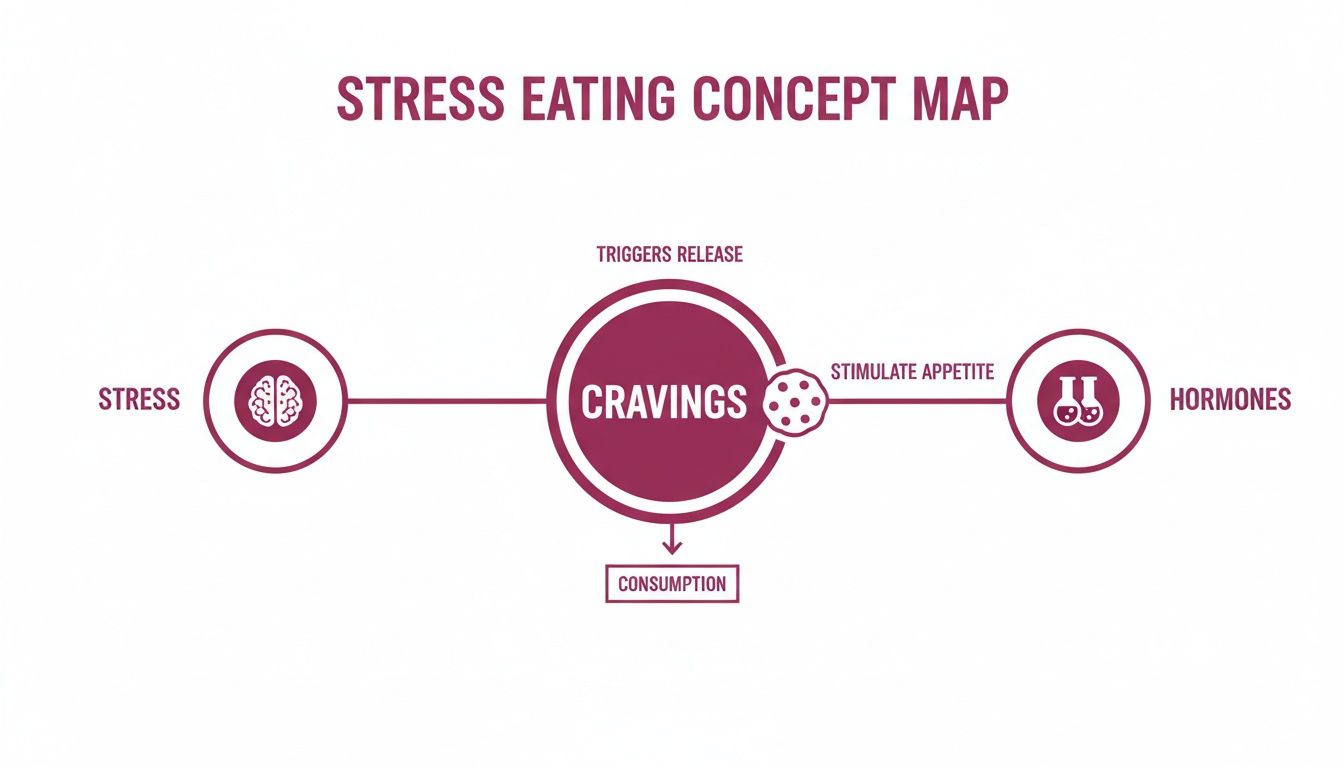
As you can see, it's a clear chain reaction. The stressful event unleashes a hormonal cascade that directly drives you toward high-reward foods for a quick fix.
Your Body's Response to Stress vs Calm
Let's look at what's happening under the hood. The difference between how your body operates under stress versus when it's calm is night and day, especially when it comes to hormones that control hunger.
This table shows why it feels almost impossible to resist that pint of ice cream when you're stressed out. Your hormones are actively working against your best intentions, pushing you toward quick-energy foods to handle the perceived crisis.
How Your Brain Builds the Stress Eating Habit
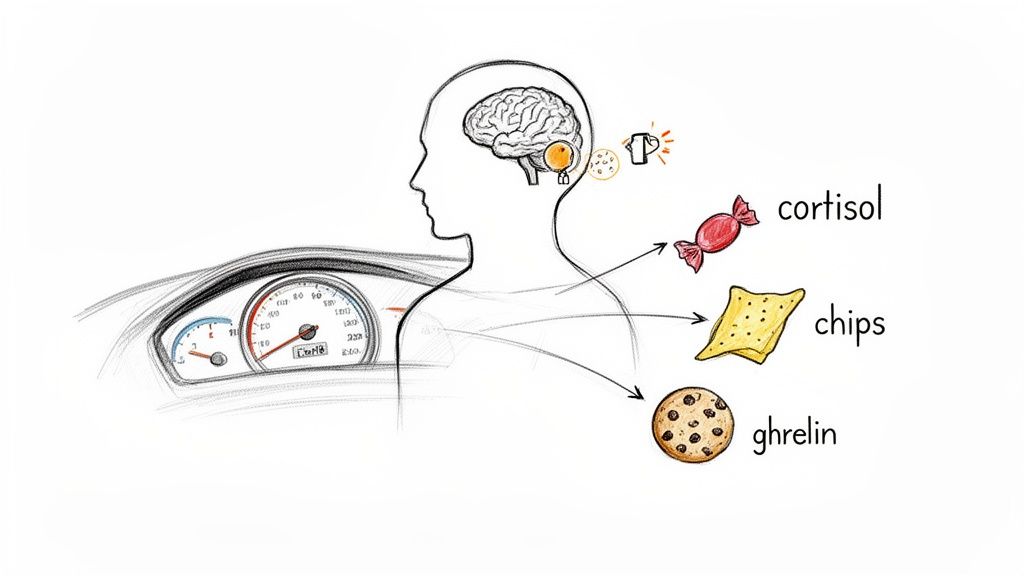
Ever feel like your hand is already in the chip bag before you’ve even consciously decided you’re stressed? That’s not a lack of willpower. It’s actually a sign of a highly efficient brain that has created a powerful mental shortcut called a habit loop.
Think of it as your brain going on autopilot. This process runs on a simple, three-step cycle: a trigger, an action, and a payoff. Every time you run through this cycle, you deepen the groove in your brain, making the behavior feel more automatic next time.
It’s a bit like carving a path through a dense forest. The first time you do it, it takes effort and concentration. But each time you walk that same path, it gets clearer, wider, and easier to follow until it becomes your go-to route—the one you take without a second thought.
The Three Parts of the Stress Eating Loop
To really get a handle on this, let's break down the habit loop piece by piece in the context of stress eating. Seeing these stages in your own life is the first real step toward forging a new path.
The Cue: This is the trigger that sets the whole process in motion. For stress eating, the cue is often the feeling of stress itself—that knot in your stomach before a big presentation, the frustration after a fight, or even just the nagging boredom of an empty afternoon.
The Routine: This is the actual behavior, the thing you do in response to the cue. Here, the routine is reaching for food. It’s not just any food, either; we’re usually talking about specific high-sugar, high-fat comfort foods that promise a quick fix.
The Reward: This is the payoff that makes your brain say, "Hey, let's do that again!" The reward isn't just about how the food tastes. It’s the rush of dopamine that temporarily numbs your anxiety, offering a fleeting moment of relief and distraction from whatever is causing the stress.
This cue-routine-reward cycle is precisely why gritting your teeth and telling yourself to "just stop" is so ineffective. Willpower is a limited resource, but habits are powerful, energy-saving shortcuts your brain will always prefer to take.
So, every time stress (the cue) makes you reach for a cookie (the routine), and you get that brief hit of comfort (the reward), you're reinforcing that neural pathway. Your brain quickly learns that eating is a fast and reliable way to feel better, even if only for a moment.
Over time, this makes the urge to eat when you're stressed feel completely overwhelming. The habit becomes so ingrained that the routine can kick in before you’ve even had a chance to think. But the good news is that by simply becoming aware of this loop, you give yourself a sliver of space—just enough to choose a different routine and start building a new, more helpful habit.
Pinpointing Your Personal Stress Eating Triggers
Knowing the science behind stress eating is a great start, but real, lasting change happens when you can see those patterns playing out in your own life. To really break the cycle, you need to become a bit of a detective, figuring out the specific situations—the triggers—that send you straight to the kitchen for comfort.
Think of it this way: stress isn't just some vague cloud hanging over your head. It’s a direct response to a specific cue. These triggers are like tripwires. Once you hit one, the old stress-eating habit kicks in on autopilot. But if you can spot the tripwire before you get to it, you can choose to step right over it. The goal here is to shift from reacting without thinking to responding with intention.
From Vague Feelings to Specific Cues
Your triggers can be surprisingly varied, and they usually fall into a few key categories. Naming them is the first step toward building a new, healthier response.
Situational Triggers: These are all about your environment or specific events. Maybe it’s a looming deadline at work, a tense phone call with a family member, or even just the simple act of walking into the kitchen after a brutal day.
Emotional Triggers: Sometimes, the cue isn't what’s happening around you, but what’s happening inside you. Feelings like loneliness, boredom, anxiety, or frustration can leave a void that food feels like a quick and easy way to fill.
Physiological Triggers: Let's not forget your body's own signals. Sheer exhaustion from a bad night's sleep or a dip in your blood sugar can spike cortisol levels, leaving you much more vulnerable to stress and cravings.
Identifying your triggers isn’t about judging yourself. It's simply about gathering data. Every time you feel that pull to stress eat, you get a chance to pause and ask, "What just happened?" This one simple question is your most powerful tool for building genuine self-awareness.
This awareness is more important than ever. Globally, the prevalence of eating disorders jumped from 3.5% to 7.8% between 2000 and 2018. Research also shows that women can be more susceptible to stress-induced eating. Brain studies have even found a specific neural pathway in females that can turn stress signals directly into binge urges. You can learn more about these gender-specific biological responses in recent scientific literature.
So, let's get practical and start mapping out what these triggers look like for you. The table below is designed to help you move from a general sense of why you stress eat to a concrete list of your personal tripwires.
Identifying Your Personal Stress Eating Triggers
Use this table to become more aware of the specific cues that lead to stress eating. Over the next week, try to jot down what was happening right before you felt the urge. You'll likely start to see patterns emerge.
Once you start tracking, you’re no longer a passenger on this ride. Recognizing your personal triggers is the first real, actionable step you can take. It allows you to anticipate when you’ll be most vulnerable and have a different plan ready to go. Instead of being blindsided by a craving, you can see it coming and consciously choose a new path. This is where the real work begins—and where lasting change is born.
Practical Ways to Cope With Stress Without Food
Knowing your triggers is a massive first step. But the real game-changer is having a solid plan for when those triggers show up—because they will show up. The goal isn't to muscle through with willpower. It's to build new, healthier pathways in your brain, giving your mind an alternative route to take when stress hits.
Think of it like building a toolkit of stress-relief strategies that have nothing to do with food. Each tool helps you manage the actual problem—the stress itself—instead of just slapping a temporary dopamine band-aid on it from a snack. Let's dig into some practical, science-backed methods you can use the moment an urge strikes.
Behavioral Shifts to Create Space
The secret to breaking any habit loop is to wedge a pause between the trigger and your automatic response. That little gap is where you get to take back control and make a conscious choice.
One of the most powerful ways to do this is with the five-minute pause. The next time a craving hits, don't just bolt for the kitchen. Set a timer for five minutes and do something else entirely.
For example, you could:
- Move your body: A few quick stretches, a walk around the room, or even some jumping jacks can help burn off the cortisol that’s fueling your stress.
- Change your environment: Step outside for some fresh air or just move to a different room. A change of scenery can be surprisingly effective at interrupting the autopilot script your brain is running.
- Engage your senses: Put on your favorite song, smell a calming essential oil, or wrap yourself in a soft blanket. Shifting your sensory focus can short-circuit a craving.
This simple act of waiting creates just enough distance for the initial intensity of the craving to subside. It gives the logical part of your brain a chance to catch up with the emotional part.
Cognitive and Mindfulness Techniques
Stressful thoughts are often the fuel for the urge to eat. If you can change how you relate to those thoughts, you can dial down their power over your actions. This is where cognitive reframing and mindfulness really shine.
When you feel an urge to eat when stressed, it’s a signal. Your body isn't just asking for food; it's asking for comfort, distraction, or relief. Learning to offer yourself these things in healthier ways is the core of breaking the cycle.
Mindfulness practices like deep breathing are incredibly effective. Taking just three slow, deep breaths can activate your body's "rest and digest" response, calming down the "fight or flight" system that drives stress eating. This simple action can lower your cortisol and ease anxiety right in the moment.
Journaling is another powerful tool. When a craving hits, grab a notebook and jot down what you're feeling. Simply naming the emotion—"I feel overwhelmed," "I feel bored," "I feel lonely"—can rob it of its power.
Proactive Environmental Strategies
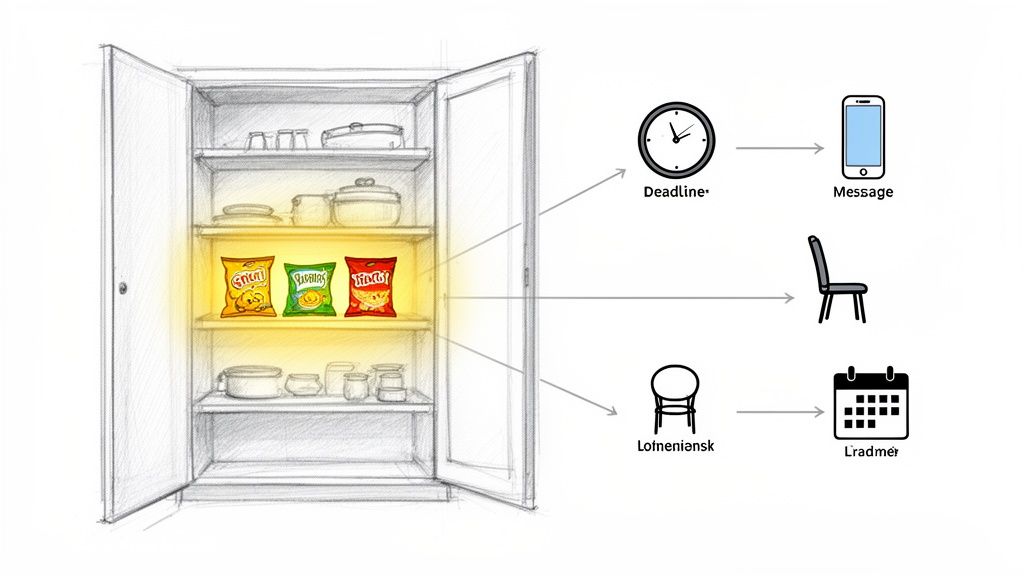
Finally, you can set yourself up for success by shaping your environment. Let's be honest, if your kitchen is a minefield of your go-to stress foods, you’re making things a whole lot harder on yourself.
- Create a "safe snack" station: Keep healthy, satisfying options like nuts, yogurt, or fruit out in the open and easy to grab for times when you are genuinely hungry.
- Make comfort foods less convenient: Move the tempting stuff to a high shelf or a cupboard in the back. Sometimes, that little bit of extra effort is all it takes to make you rethink the choice.
When stress is chronic, prioritizing self-care for burnout is absolutely essential to prevent it from showing up as stress eating. By proactively building these habits, you create a support system that makes the healthy choice the easy choice. You can find more strategies and actionable tips in this helpful resource on self-care for burnout.
Using Tech to Build Healthier Habits, Mindfully
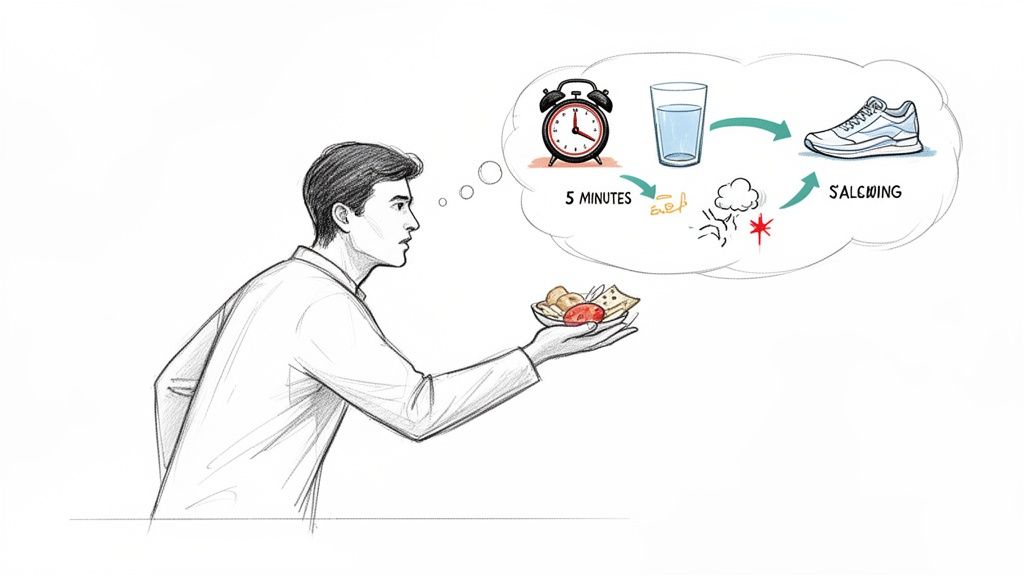
Let's be real: breaking the stress-eating cycle is tough. It’s a deeply ingrained habit, and it takes consistent practice to forge a new path. This is where the right tools can make all the difference.
It might seem strange to turn to your phone for a practice like mindfulness, but certain apps can act like a supportive coach in your pocket. They can help you build self-awareness without the rigid rules and judgment that often backfire.
The focus isn't on calorie counting, which, frankly, can just add another layer of stress. Instead, it’s about finally connecting the dots between how you feel and what you eat. Progress, not perfection, is the name of the game.
Turning Awareness Into Action
The very first step is to just notice what’s happening, without judging yourself for it. Think of yourself as a detective, gathering clues. Your only job is to observe. This is where a tool like the Superbloom app comes in handy.
A simple daily check-in lets you jot down your emotional state alongside what you ate. It sounds simple, but this little act can uncover connections you never saw before. You might realize you always crave sugar after that draining weekly team meeting, or that you reach for salty snacks when you're feeling a bit lonely.
Technology designed for self-awareness isn't about tracking failures. It's about recognizing your own patterns and celebrating the small wins, turning unconscious reactions into conscious choices. Every entry is just a piece of the puzzle, helping you understand yourself better.
This kind of data is gold. You finally start to understand why you eat when stressed, which moves you from feeling out of control to seeing clear patterns you can actually do something about.
From Insights to Intentional Choices
Once you see the patterns, you can start building new responses. Suddenly, you're empowered to be proactive. If you know that 3 PM meeting is a trigger, you can have a plan ready to go—maybe a five-minute walk outside or a cup of herbal tea.
This is where mindful tech helps cement those new habits. A tool like Superbloom might see you're logging stress around midday and gently suggest a quick breathing exercise. Or it might notice a pattern of low energy and recommend a high-protein snack to keep you steady.
Here’s how this approach creates real, lasting change:
- It builds genuine self-awareness: By logging your meals and moods, you can’t ignore the direct link between how you feel and what you reach for.
- It encourages you to pause: Instead of just reacting on autopilot, you're prompted to take a breath and reflect on what you truly need in that moment.
- It reinforces your positive steps: The app can show you the progress you're making, highlighting how those small, intentional choices are adding up. That's powerful motivation.
Ultimately, this isn’t about restriction at all. It’s about cultivating a healthier, more compassionate relationship with food and your own emotions. By using technology as a guide, you can learn to navigate your triggers with confidence and build sustainable habits that truly fit your life.
When to Seek Professional Support
Building new habits and learning to cope with stress are fantastic, powerful steps forward. But sometimes, it's just as important to recognize when stress eating points to a deeper issue that needs a little more support. Answering the question "why do I eat when stressed?" can occasionally lead us to a place where professional guidance is the best path forward.
Knowing when to ask for help is a true sign of strength, not failure. If your relationship with food just feels completely out of your hands, it might be time to talk to someone.
Signs It's Time to Get Help
If any of the following patterns sound familiar, it’s a good signal that professional support could make a real difference. These are clues that stress eating might be taking a significant toll on your well-being.
- A Persistent Loss of Control: You often find yourself eating much more than you planned and feel like you just can't stop, even past the point of being uncomfortably full.
- Intense Guilt or Shame: After eating, you're hit with overwhelming feelings of disgust, depression, or guilt that get in the way of your daily life.
- Negative Health Impacts: You're noticing that your eating habits are starting to affect your physical health, your mood, or even your most important relationships.
Reaching out for help is the ultimate act of self-care. It means you are prioritizing your long-term health and happiness over a short-term coping mechanism that is no longer serving you.
If these experiences resonate with you, there are several kinds of professionals who can help. A therapist can work with you to unpack the underlying stress and emotions, while a registered dietitian can help you rebuild a healthier, more peaceful relationship with food.
For more significant challenges, you might benefit from specialized programs, like those offering binge eating disorder support. Your well-being is what matters most.
A Few Common Questions About Stress Eating
As you start to unpack your relationship with food and stress, you're bound to have some questions pop up. Let's tackle a few of the most common ones to clear things up and help you feel more grounded as you move forward.
Is Stress Eating the Same as Binge Eating?
It’s a great question, and while they can look similar on the surface, they’re not the same. Think of stress eating as a coping mechanism—you feel stressed, so you reach for food to soothe yourself. It’s a reaction to a specific trigger.
Binge eating, however, is a clinical eating disorder. It involves regularly eating large amounts of food in a short period, often feeling a complete loss of control during the episode. If your eating habits feel compulsive and are causing you a lot of emotional pain, seeking professional help is a crucial next step.
Why Do I Always Crave Junk Food and Not, Say, a Salad?
This one is all about biology. When stress hits, your body floods with the hormone cortisol, which basically sounds an alarm in your brain to find the fastest energy source it can.
High-fat, high-sugar foods are the perfect fit. They deliver a quick energy jolt and a nice little hit of dopamine, the "feel-good" neurotransmitter. Your brain logs this as a successful mission, so the next time you're stressed, it knows exactly what to ask for.
Your body isn't trying to derail you; it's running on an old survival program. It thinks you need to fuel up to fight a predator, and frankly, a bag of chips provides a much quicker energy return than a bowl of kale.
Can Stress Eating Mess with My Digestion?
Oh, absolutely. Your gut and brain are in constant communication through what’s called the gut-brain axis. When your mind is in "fight or flight" mode, it tells your digestive system to slow way down to save energy for the perceived threat.
This slowdown can cause all sorts of discomfort like bloating, cramps, or indigestion, especially if you eat a big meal while you're feeling on edge. It’s a big reason why I eat when stressed often leads to feeling physically unwell later. Over time, chronic stress can even throw your gut bacteria out of whack, which can impact everything from how you absorb nutrients to your overall mood.
Is It Realistic to Think I’ll Ever Stop Stress Eating for Good?
The goal here isn't perfection. It’s not about vowing to never again eat a cookie because you had a rough day. It’s about building awareness and expanding your toolkit of coping strategies so that food isn’t your only option.
Think of it as carving out new pathways in your brain. Some days will be a breeze, and others will be tough. The victory is in the pause—the moment you recognize the urge, take a breath, and make a conscious choice. Progress, not a perfect track record, is what truly matters.
Ready to build a healthier relationship with food by understanding your personal patterns? Superbloom can help. Our AI-powered coach offers personalized guidance to help you recognize triggers and build sustainable habits without judgment or calorie counting. Start turning your awareness into action today by visiting https://superbloomapp.com.